

Improving Developer Productivity With End-to-End GenAI Enablement
Build an end-to-end developer enablement hub locally with GenAI, automating everything from requirements to deployment to boost productivity and streamline workflows.
Join the DZone community and get the full member experience.
Join For FreeThis is a very common scenario that every developer can relate to — I am focused on a feature, and suddenly my project buddy requests a PR review or asks for help when a test case is failing. Now, I need to context-switch to help my buddy, or the code review will be delayed.
Every engineering team faces the same bottlenecks — context switching, boilerplate work, delayed code reviews, and slow onboarding. The goal is to improve developer enablement and boost productivity through automation. Generative AI amplifies that goal. From writing user stories to generating test cases, GenAI can automate repetitive tasks and provide real-time guidance. But the challenge is to connect all those capabilities cohesively rather than treat them as isolated tools.
Let's build a centralized GenAI-Driven Developer Enablement Hub that connects developers, their codebases, and AI models to accelerate delivery. Think of it as a platform that plugs into your IDEs, CI/CD pipelines, and documentation systems locally.
Component Context Overview
This hub acts as an internal service that consumes your development context (requirements, code, design docs, tickets) and exposes GenAI capabilities through APIs. Developers interact through IDEs, local hooks, or CI/CD integrations.
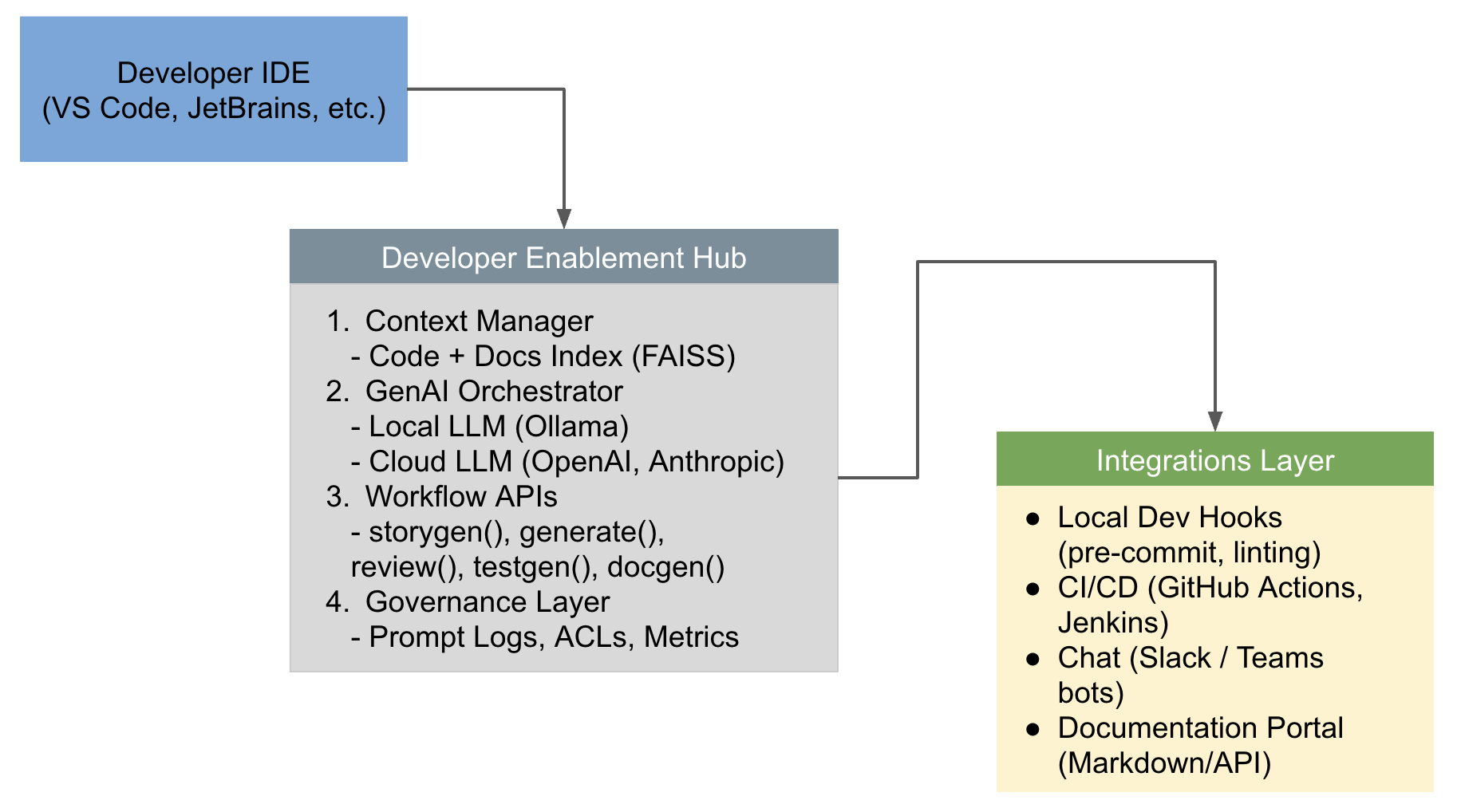
Context Manager: Indexing and Retrieval
Embeddings and retrieval are required to make GenAI aware of the internal codebase.
from sentence_transformers import SentenceTransformer
import faiss, os, json, numpy as np

model = SentenceTransformer('all-MiniLM-L6-v2')
index = faiss.IndexFlatL2(384)

def build_index(repo_path):
	docs, vectors = [], []
	for root, _, files in os.walk(repo_path):
		for f in files:
			if f.endswith('.py'):
				with open(os.path.join(root, f)) as code_file:
					content = code_file.read()
					docs.append(content)
					vectors.append(model.encode(content))
	index.add(np.array(vectors))
	with open('context_store.json', 'w') as f:
		json.dump(docs, f)

build_index('/my/code/repo')
This code snippet builds a searchable index of the internal code repo so GenAI can pull relevant snippets for context when answering developer prompts.
GenAI Orchestrator: Local and Cloud Model Integration
We will run a small LLM locally and switch to a cloud model when complexity and requirements exceed the local model limit. We will use FastAPI for API development.
from fastapi import FastAPI, Request
import requests, subprocess, os

# FastAPI based service
app = FastAPI()

@app.post("/generate")
async def generate(req: Request):
	body = await req.json()
	prompt = body["prompt"]
	local = subprocess.run(["ollama", "run", "mistral", prompt], capture_output=True, text=True)
	if len(local.stdout) < 200: # switch to cloud if response too short
		response = requests.post("https://api.openai.com/v1/chat/completions",
							headers={"Authorization": f"Bearer {os.getenv('OPENAI_KEY')}"},
							json={"model": "gpt-4o-mini", "messages": [{"role": "user", "content": prompt}]})
		return {"result": response.json()["choices"][0]["message"]["content"]}
	return {"result": local.stdout}
Workflow API: Story, Code, Test case, Documentation Generator
We will have multiple API endpoints to perform multiple tasks.
/storygen– It generates the developer friendly plan of actions basedon the story details which is sent as prompt./review– It reviews the code for bugs and best practices/testgen– It generates the test cases based on the code snippet as a prompt/docgen– It generates the documentation for the code
@app.post("/storygen")
async def storygen(req: Request):
	data = await req.json()
	story = data["story"]
	prompt = f"Convert this Jira story into a dev plan with modules, classes, and test strategy:\n{story}"
	return await generate(Request({"prompt": prompt}))


@app.post("/review")
async def review(req: Request):
  data = await req.json()
  code = data['code']
  prompt = f"Review this code for bugs and best practices:\n{code}"
  return await generate(Request({'prompt': prompt}))


@app.post("/testgen")
async def testgen(req: Request):
  data = await req.json()
  code = data['code']
  prompt = f"Generate pytest cases for the following code:\n{code}"
  return await generate(Request({'prompt': prompt}))


@app.post("/docgen")
async def docgen(req: Request):
  data = await req.json()
  code = data['code']
  prompt = f"Generate concise markdown documentation from the following code:\n{code}"
  return await generate(Request({'prompt': prompt}))
Governance Layer: Access Control, Security, Audit
To run this developer enablement hub locally, this section can be ignored. But to build a production-grade enablement hub, we need to think about the governance, security, access control, and audit.
- Prompt logging: Log each request (prompt + model response) for audit and improvement.
- Access control: Restrict model endpoints by role (developer, reviewer, admin).
- Local-first privacy: Use local inference (Ollama, LM Studio) for proprietary code.
- Secure secrets: Store API keys and embeddings in Vault/Secrets Manager.
- Feedback loop: Capture developer thumbs-up/down for continuous fine-tuning.
Integration With Developer Workflows
Now it's time to integrate the API endpoints in different workflows, for example, a pre-commit hook for test generation, CI/CD integration, and VS Code integration.
Local Pre-Commit Hooks for Test Generation
To align with shift-left testing practice, tests should be generated before the PR is raised. GenAI-generated tests will be treated as suggestions where developers need to validate the accuracy and coverage. This will be the high-level flow:
- Developers implement a feature.
- Pre-commit hook runs
/testgenand creates or refreshes tests. - Generated tests are written to a temporary folder (
tests/generated/). - Pytest runs automatically but does not block the commit unless critical failures occur, and it provides a coverage report.
- CI/CD revalidates tests on PR merge.
#.pre-commit-config.yaml

repos:
  - repo: local
    hooks:
      - id: genai-testgen
        name: Tests suggestion
        entry: bash -c 'python scripts/gen_tests.py || true'
        language: system
        pass_filenames: false
      - id: run-pytest
        name: Run existing unit tests and show coverage
        entry: bash -c 'pytest -q && coverage run -m pytest > /dev/null && coverage report | grep TOTAL | awk "{print \"Current coverage:\", $4}"'
        language: system
        pass_filenames: false
If coverage drops below the threshold (e.g., 80%), the developer needs to review the generated tests.
#scripts/gen_tests.py:

import os, requests, glob

code = "".join(open(f).read() for f in glob.glob("src/**/*.py", recursive=True))
r = requests.post("http://localhost:8000/testgen", json={"code": code})
with open("tests/generated/test_generated.py", "w") as f:
	f.write(r.json()["result"])
print("Suggested tests generated -> tests/generated/test_generated.py")
CI/CD Integration for Validation
The CI/CD pipeline will execute the tests again when a PR is raised.
name: CI Validation
on:
	push:
		branches: [ main, '**/*' ]
	pull_request:
		branches: [ main ]
jobs:
	test:
      runs-on: ubuntu-latest
      steps:
          - uses: actions/checkout@v4
          - uses: actions/setup-python@v5
            with:
              python-version: '3.11'
          - run: pip install -r requirements.txt
          - name: Run Unit Tests
            run: pytest -q
VS Code Integration With an Extension
This enables the developers to access the GenAI from their IDE.
import * as vscode from 'vscode';
import fetch from 'node-fetch';


export function activate(context: vscode.ExtensionContext) {
	let disposable = vscode.commands.registerCommand('genai.review', async () => {
		const editor = vscode.window.activeTextEditor;
		if (!editor) return;
		const code = editor.document.getText();
		const res = await fetch('http://localhost:8000/review', {
			method: 'POST', headers: { 'Content-Type': 'application/json' },
			body: JSON.stringify({ code }) });
		const data = await res.json();
		vscode.window.showInformationMessage(data.result);
	});
	context.subscriptions.push(disposable);
}
Local Deployment
ollama run mistral
uvicorn app:app --reload
Containerized deployment setup:
FROM python:3.10-slim
WORKDIR /app
COPY requirements.txt .
RUN pip install -r requirements.txt
COPY . .
CMD ["uvicorn", "app:app", "--host", "0.0.0.0", "--port", "8000"]
Conclusion: Empowering Developers With GenAI
These locally built Developer Enablement Hubs represent the next phase of productivity engineering. Rather than adding isolated GenAI features, this unified platform:
- Automates requirements, coding, testing, and documentation.
- Provides contextual assistance across tools.
- Preserves security and governance.
- Bridges local and cloud environments for flexibility.
As a result of this, developers' productivity will be reflected through the following metrics:
- Lower lead time
- Low code review lag
- Increased test coverage
- Improved onboarding time
- Increase in Gen AI adoption rate
Opinions expressed by DZone contributors are their own.
Comments