

From AI Chaos to Control: Building Enterprise-Grade LLM Gateways With MuleSoft Anypoint
This article explains how an AI Gateway centralizes LLM access, enabling secure routing, governance, cost control, and visibility for scalable AI adoption.
Join the DZone community and get the full member experience.
Join For FreeArtificial intelligence is no longer experimental. It has become an important part of how organizations are building AI agents and applications. From chatbots to autonomous systems, companies are rapidly integrating large language models (LLMs) into their workflows to improve efficiency, automate tasks, and enhance user experiences.
However, as adoption grows, so does the complexity around managing these systems.
Challenges in Scaling LLM Usage
When organizations start using multiple LLMs across different teams and applications, several challenges naturally emerge:
- Lack of visibility into how models are being used
- Multiple LLM providers used independently by different teams
- Governance and compliance challenges
- Difficulty in coordinating multiple AI agents
- Rising and unpredictable operational costs
- Security and data privacy risks
In many cases, different teams begin integrating their own preferred LLMs without a shared strategy. While this approach may work initially, it quickly becomes difficult to manage at scale.
This situation often leads to what can be described as AI sprawl, where systems become fragmented, inconsistent, and harder to govern centrally. Over time, this affects not only cost and security but also the overall reliability of AI-driven applications.
The Problem: AI at Scale Becomes Hard to Manage
When teams directly connect their applications to different LLM providers, a few common issues appear:
- Each team may choose a different LLM provider based on preference or convenience
- Costs become difficult to track across departments
- Sensitive or regulated data may be exposed if proper controls are missing
- There is no standard governance model across the organization
- Each team builds and maintains its own integration logic
This leads to duplicated effort, inconsistent implementations, and limited visibility for platform or IT teams responsible for oversight.
As a result, organizations struggle to maintain control over their AI ecosystem while still trying to innovate quickly.
Introducing a Centralized Approach: AI Gateway
To address these challenges, MuleSoft introduces the concept of an AI Gateway as part of the Anypoint Platform.
The AI Gateway acts as a centralized control layer for all LLM requests. Instead of applications connecting directly to different LLM providers, they communicate through a single entry point.
This gateway helps in:
- Routing requests to appropriate models
- Applying security and governance policies
- Tracking usage and cost across teams
- Maintaining consistency in AI interactions
In simpler terms, it works like a traffic controller for AI requests, ensuring that everything flows in a controlled, secure, and observable manner.
Key Capabilities of AI Gateway
1. Unified Access to Multiple LLMs
One of the main advantages of an AI Gateway is that it provides a single unified endpoint for accessing multiple LLM providers.
Instead of integrating each model separately, developers can connect once and access different models through the same interface. This also makes it easier to switch between providers if needed, without major changes to application logic.
2. Intelligent Routing of Requests
Not all AI requests are the same. Some are simple and can be handled by smaller, cost-effective models, while others require more advanced reasoning capabilities.
AI Gateway supports intelligent routing based on factors such as:
- Complexity of the request
- Cost considerations
- Performance requirements
There are generally two types of routing approaches:
Model-Based Routing (Static Routing)
In this approach, a specific model is assigned to handle a particular type of request. This is useful when the requirements are well-defined.
Semantic Routing (Dynamic Routing)
Here, the system analyzes the request and automatically decides which model is best suited. This may involve prompt classification or intent detection to improve accuracy and efficiency.
This flexibility helps organizations balance performance and cost more effectively.
3. Cost Control and Visibility
One of the major concerns with LLM usage is unpredictable cost. Since most models are billed based on token usage, expenses can grow quickly if not monitored properly.
AI Gateway provides visibility into:
- Token usage per application
- Usage across teams and departments
- Overall consumption trends
This helps organizations set budgets, monitor spending, and avoid unexpected cost spikes.
4. Built-in Governance and Security
Security is a critical aspect when dealing with AI systems, especially when sensitive or regulated data is involved.
AI Gateway helps enforce policies such as:
- Token limits to control usage
- Authentication and authorization mechanisms
- Data protection measures like PII masking
These controls ensure that data is handled safely and that only authorized requests are processed. It also helps reduce the risk of exposing sensitive information to external systems.
5. Monitoring and Observability
Another important capability is visibility into how AI systems are performing in real time.
Through the Anypoint Platform, organizations can access:
- Detailed logs for every request
- Usage analytics and trends
- Debugging information for troubleshooting
- Compliance and audit support
This level of observability is essential for maintaining reliability in production environments, especially when AI is used in business-critical workflows.
What Is an LLM Proxy?
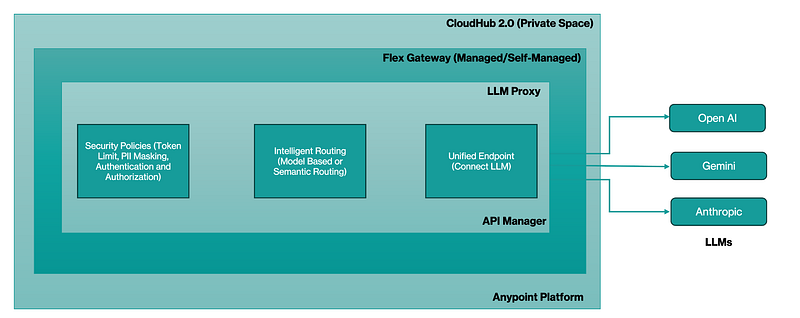
An LLM Proxy is a unified interface layer that sits between applications and LLM providers. Instead of integrating directly with multiple APIs, developers interact with a single endpoint, and the proxy handles routing, security, and policy enforcement behind the scenes.
This abstraction simplifies development and reduces the complexity of managing multiple integrations.
How an LLM Proxy Works
A typical flow looks like this:
- An application or AI agent sends a request to the LLM Proxy endpoint
- The proxy (running on a gateway such as Flex Gateway) receives the request
- Policies such as authentication, token limits, and data masking are applied
- The request is routed to the most appropriate LLM provider
- The response is returned back to the application
All of these steps are managed centrally through the platform, which reduces the need for custom logic in each application.
High-Level Concept
At a high level, the architecture can be thought of as a control layer sitting between users and multiple LLM providers. Instead of point-to-point integrations, all traffic flows through a single managed layer.
This simplifies both operational management and long-term scalability.
High-Level Architecture
Conclusion
AI adoption is growing rapidly, but managing it across large organizations introduces new challenges. Without proper structure, teams can end up with fragmented integrations, rising costs, and limited visibility into how AI is being used.
A centralized approach using an AI Gateway and LLM proxy helps address these issues by:
- Providing a unified access layer for AI models
- Enforcing governance and security policies consistently
- Improving visibility into usage and costs
- Supporting scalable and controlled AI adoption
This enables organizations to move from isolated AI experiments toward more structured, enterprise-ready AI systems.
Take control of your AI ecosystem with MuleSoft AI Gateway, simplifying, securing, and scaling every interaction through the Anypoint Platform.
Opinions expressed by DZone contributors are their own.
Comments