

Your Cloud Infrastructure Is Elastic, and So Should Be Your Cost Governance
Workload-aware governance uses historical patterns, metadata, and policies to control costs without disrupting critical workloads.
Cloud data warehouses solved one of the biggest problems we had with traditional enterprise data platforms - the capacity bottleneck!
For years, data engineering teams had to think carefully about infrastructure before onboarding any new workload. How much compute would we need? How much storage? What happens during month-end processing? What if data volume doubles next year?
Platforms such as Snowflake, BigQuery, Redshift, and Databricks changed that model significantly. Compute can now scale quickly, and storage can grow independently as well. Engineering teams are now able to provision additional capacity without waiting weeks for infrastructure.
This flexibility is one of the biggest reasons cloud data platforms became so successful.
But it also created a different problem that needs discussion and solutioning -
When compute becomes easy to consume, inefficient processes show up on your monthly bills.
A query that runs inefficiently is no longer viewed or captured as an operational incident, as the underlying platform simply allocates more resources and finishes the work.
The pipeline succeeds.
The dashboard refreshes.
The SLA is met.
And the inefficiency quietly appears on the cloud bill.
This is why I believe the next phase of cloud data engineering needs to focus not only on scalable architecture but on governed scalability.
Elasticity Changed the Cost Model
In traditional data warehouse environments, infrastructure capacity acted as the natural boundary.
There was only so much CPU, memory, storage, or concurrency available. When inefficient workloads competed for those resources, the impact became visible very quickly.
With Cloud platforms, this equation changed that relationship.
Let's try to understand this with an example. Suppose an ETL workload usually processes 500 GB of data using a medium-sized compute warehouse. As data volume increases, the engineering team may simply increase the warehouse size or allow additional clusters to handle the workload.
Operationally, this looks successful. But consider what happens over time...
A pipeline that originally required 20 minutes of compute may gradually require 35 minutes. And let's say some analysts add several analytical queries. Another reporting process begins running more frequently than before. As the team grows, development environments remain active longer than expected.
None of these changes individually look significant on paper. Together, however, they create a steady increase in compute consumption. The important question therefore changes from:
“Can the platform handle the workload?”
to:
“Should the workload be consuming this much compute?”
Successful Workloads Can Still Be Inefficient
One of the challenges with cloud data platforms is that traditional monitoring tends to focus heavily on failures.
- Did the pipeline complete?
- Did the query fail?
- Was the SLA breached?
- Did the orchestration workflow finish?
These are obviously important operational questions, but cost problems often occur when everything is technically working as expected, and no one is complaining.
Imagine a nightly data pipeline that normally consumes 30 compute units.
Over several months, its consumption gradually changes, as seen the image below:
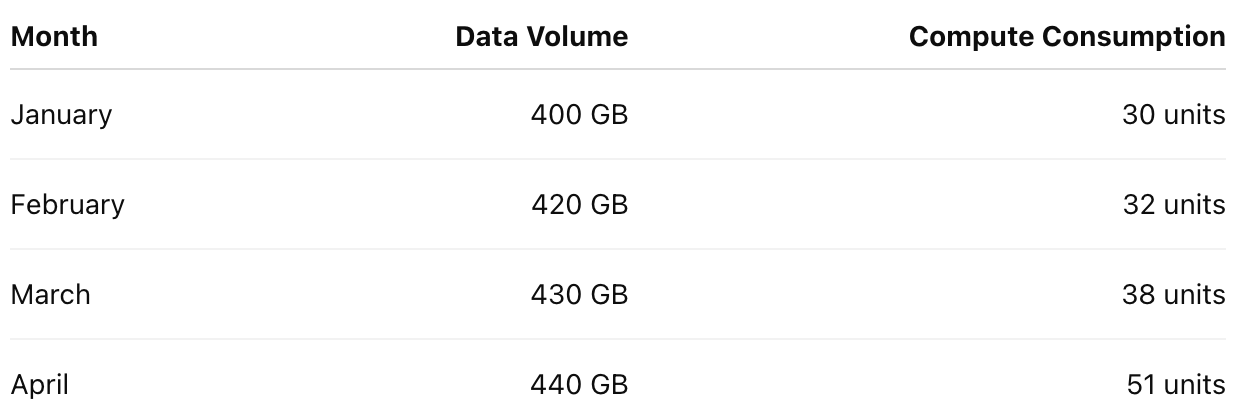
From an operational perspective, nothing necessarily failed here, but something changed between February and April.
- Perhaps a query plan changed.
- Or maybe partition pruning stopped working.
- An upstream data distribution might have changed.
- A new transformation rule introduced an expensive join.
This is exactly where the traditional monitoring and cost governance begin to diverge - The pipeline now turns out to be operationally healthy but economically unhealthy.
Cost Governance Should Be Workload-Aware
Most cloud cost controls usually operate at the infrastructure or account level. Having said that, the following cost control and/or monitoring mechanisms do not do justice.
- Budgets are useful.
- Usage alerts are useful.
- Resource monitors are useful.
- Monthly cost reports are useful.
But they usually tell us how much was consumed after the consumption occurred.
A more mature approach would be to understand what normal consumption looks like for individual workloads.
For example, a data platform could maintain historical baselines for:
- Compute consumption
- Execution duration
- Data volume processed
- Query volume
- Warehouse utilization
- Spill behavior
- Concurrency
- Cost per pipeline execution
Instead of asking whether today's workload exceeded a fixed budget, the platform could ask whether today's behavior significantly deviates from its historical pattern.
That creates a much more useful signal.
A workload processing 20% more data and consuming 20% more compute may be perfectly reasonable.
A workload processing 5% more data but consuming 70% more compute deserves investigation.
Static Thresholds are Not Enough
A common approach to cloud cost governance is to create fixed thresholds.
For example: Alert when warehouse consumption exceeds 100 credits
That is easy to implement, but it does not understand workload behavior and lacks he intelligence needed for a long-term solution for governance.
Consider the following two workloads:
Workload A normally consumes 10 credits and suddenly consumes 40.
Workload B normally consumes 500 credits and suddenly consumes 520.
A static threshold may consider Workload B more important because its absolute consumption is higher, but it misses an important distinction and context that workload A experienced a 300% increase.
This is potentially a much stronger indication that something changed and needs immediate intervention.
This is why cloud data governance should increasingly combine absolute thresholds with historical workload behavior.
A simple model might look something like this:
Expected Compute = f(Data Volume, Historical Runtime, Workload Type, Concurrency)
The goal does not need to be sophisticated machine learning. Even rolling averages, percentile bands, or historical comparisons can provide valuable signals.
The important part is establishing what "normal" means for each workload.
From Monitoring to Policy-Driven Governance
Once workload behavior becomes measurable, the next obvious question is, what should the platform do when abnormal consumption occurs?
To which the simplest and most natural response would be to set an alert.
Pipeline X consumed 65% more compute than its 30-day baseline while processing only 8% more data.
That alone gives engineers much more useful information than a monthly cloud bill.
Let's take this a step further and see how a mature platform can do better than simple alerts. These would typically rely on well-defined policies.
Policies could define different responses depending on workload importance and severity.
For example:
- A non-critical development workload can be automatically suspended after exceeding a defined consumption threshold.
- A production reporting workload might continue running but generate an alert.
- A regulatory workload might be allowed to exceed its normal limit because completing the workload is more important than controlling short-term cost.
This distinction matters as the governance policies should not blindly stop expensive workloads but instead should understand business context and take appropriate action.
Metadata Is the Secret Sauce
For a governance policy to implement workload-based actions, it is important to understand the underlying metadata.
In other words, for the compute to govern intelligently, the platform needs to understand more than query IDs and warehouse names. It needs business and technical context. Something like,
- Who owns this workload?
- Which application does it support?
- Is it production or development?
- What business process depends on it?
- How critical is it?
- What is its normal execution window?
- What is its expected data volume?
This is why metadata-driven architecture plays a vital role in FinOps.
Most organizations today already maintain this metadata for purposes like orchestration, lineage, data quality, ownership, governance, etc. This same metadata can help build the compute policies.
For example:
Workload: MONTH_END_FINANCE
Environment: PROD
Criticality: HIGH
Owner: FINANCE_DATA
Expected_Runtime: 35_MIN
Compute_Policy: ALLOW_AND_ALERT
Variance_Threshold: 40_PERCENT
Compare that with:
Workload: ANALYTICS_SANDBOX
Environment: DEV
Criticality: LOW
Owner: ANALYTICS
Compute_Policy: SUSPEND
Variance_Threshold: 100_PERCENT
Now the platform is not just monitoring the infrastructure based on static rules; it is making governance decisions based on workload context.
AI-Ready Data Platforms
This cost governance problem that we discussed becomes even more interesting as AI workloads move closer to enterprise data platforms.
Traditional analytics workloads are relatively predictable when compared to AI-enabled workloads.
Vector search, embedding generation, model inference, AI-powered analytics, autonomous agents, and natural-language querying introduce new consumption patterns on top of your operational consumption.
Interestingly, the users or processes generating this compute may not even realize how much infrastructure gets activated behind the scenes due to their AI-related activities.
That means the boundary between data FinOps and AI FinOps will increasingly disappear.
But the same fundamental question applies to both scenarios:
Is the amount of compute being consumed reasonable for the business value being produced?
For years, data engineering teams focused on operational questions like:
Did the data arrive successfully?
Can we trust the data?
As cloud platforms matured, another question became important:
How much did it cost to process the data?
Was that amount of compute reasonable for this workload?
Cloud infrastructure made it possible for data platforms to scale almost without limits. However, we will also need to make sure that governance scales as well.
Opinions expressed by DZone contributors are their own.