

Mastering Kubernetes to Maximize Your Cloud Potential
Understanding Kubernetes architecture through seven critical layers: storage, compute, networking, observability, security, dev tools, and CI/CD.
Join the DZone community and get the full member experience.
Join For FreeKubernetes is often introduced as a container orchestrator. That’s like calling a modern city “a collection of buildings.” Technically correct, but wildly incomplete.
In reality, Kubernetes is a layered ecosystem where storage, compute, networking, security, and developer workflows interlock like gears in a precision machine. If one gear slips, everything grinds. If all align, you unlock a platform that scales, heals, and evolves with your applications.
After working through complex deployments, production outages, and cost optimization journeys, one truth stands out:
Kubernetes mastery is not about knowing objects. It’s about understanding layers.
Let’s break down the seven critical layers of Kubernetes and the tools that make them powerful.
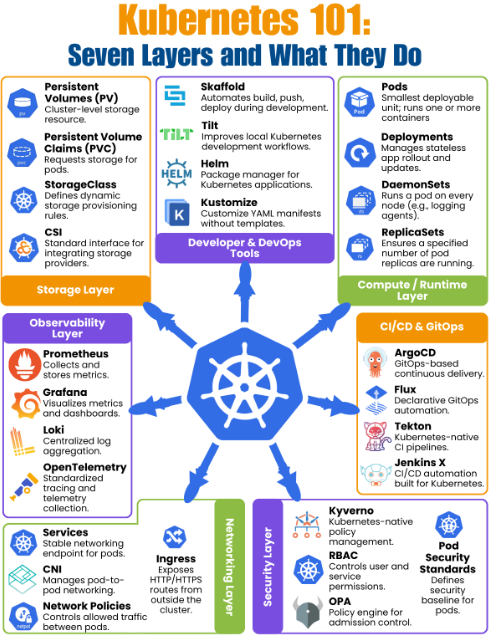
1. Storage Layer: Where State Meets Reality
Stateless is easy. Real-world systems aren’t.
The storage layer ensures your applications don’t forget who they are every time a pod restarts.
Key Components
- Persistent Volumes (PV) & Persistent Volume Claims (PVC): Abstract storage from workloads. Your app asks, Kubernetes provides.
- StorageClass & CSI (Container Storage Interface): Enable dynamic provisioning and seamless integration with cloud providers like AWS EBS, GCP PD, or Azure Disk.
Why It Matters
Without a well-designed storage strategy:
- Databases become fragile
- Stateful apps become unreliable
- Recovery becomes painful
This layer is the difference between ephemeral experiments and production-grade systems.
2. Compute / Runtime Layer: The Engine Room
This is the layer most engineers start with, but ironically, it’s not where mastery ends.
Core Primitives
- Pods: The smallest deployable unit
- Deployments: Declarative app management
- ReplicaSets: Ensure desired state
- DaemonSets: One pod per node (great for agents)
What It Solves
- Auto-healing (failed pods restart automatically)
- Horizontal scaling
- Declarative infrastructure
Hidden Complexity
Misconfigured probes, resource limits, or rollout strategies can silently degrade performance or cause cascading failures.
Compute is powerful, but blind compute is dangerous.
3. Observability Layer: Seeing the Invisible
If Kubernetes is a living organism, observability is its nervous system.
Without it, you’re operating blind.
Essential Stack
- Prometheus + Grafana
Metrics collection and visualization - Loki
Log aggregation without heavy indexing - OpenTelemetry
Standardized tracing across distributed systems
Why It Matters
- Detect anomalies before users do
- Debug distributed failures
- Understand system behavior under load
A cluster without observability is like flying a plane without instruments. You may stay airborne… until you don’t.
4. Networking Layer: The Silent Enabler
Kubernetes networking “just works”… until it doesn’t.
Core Components
- Services
Stable internal communication (ClusterIP, NodePort, LoadBalancer) - CNI (Container Network Interface)
Handles pod-to-pod communication - Ingress
Manages external access to services
Real Challenges
- Debugging network policies
- Handling cross-cluster communication
- Managing latency and service mesh complexity
Networking is often underestimated because it’s invisible when functioning and painfully obvious when broken.
5. Security Layer: Guardrails, Not Afterthoughts
Security in Kubernetes is not a feature. It’s a discipline.
Key Tools
- RBAC (Role-Based Access Control)
Define who can do what - OPA (Open Policy Agent)
Enforce admission policies - Kyverno
Kubernetes-native policy management - Pod Security Standards (PSS)
Baseline security enforcement
Why It Matters
Without strong policies:
- Privilege escalation becomes trivial
- Misconfigurations slip into production
- Compliance becomes reactive instead of proactive
Modern Kubernetes security is about policy-as-code, not manual reviews.
6. Developer & DevOps Tooling: Speed Without Chaos
Kubernetes can either accelerate developers… or slow them down dramatically.
The difference lies in tooling.
Key Tools
- Skaffold & Tilt
Rapid local development and feedback loops - Helm
Package management for Kubernetes - Kustomize
Environment-specific customization without templating
What This Layer Enables
- Faster iteration cycles
- Standardized deployments
- Reduced cognitive load for developers
Without this layer, Kubernetes becomes an operational burden rather than a developer platform.
7. CI/CD & GitOps: The Control Plane for Change
This is where Kubernetes evolves from infrastructure to platform.
Core Tools:
- ArgoCD & Flux
GitOps-driven continuous delivery - Tekton
Kubernetes-native CI pipelines - Jenkins X
Cloud-native CI/CD automation
Why GitOps Wins:
- Git becomes the single source of truth
- Changes are auditable and reversible
- Drift detection is automatic
Instead of pushing changes to the cluster, the cluster pulls desired state from Git.
That subtle shift changes everything.
The Bigger Picture: Kubernetes as a System of Systems
Each layer solves a specific problem:
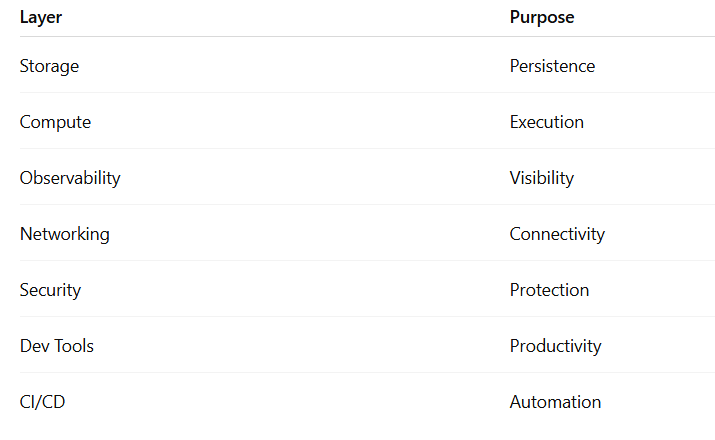
Individually, they’re powerful.
Together, they form a self-healing, scalable, policy-driven platform.
Final Thought
Most teams struggle with Kubernetes not because it’s complex, but because they approach it as a tool instead of a system.
You don’t “use Kubernetes.”
You operate an ecosystem.
And the moment you start thinking in layers instead of YAML files, everything begins to click.
Which Kubernetes layer challenges you the most today?
- Observability gaps?
- Security policy chaos?
- GitOps adoption struggles?
If you’re facing these, it might be time for a Kubernetes maturity or reliability audit. The bottleneck is rarely where you think it is.
Opinions expressed by DZone contributors are their own.
Comments