

Meta Prompting for Agile Practitioners
Learn how meta prompting turns AI into a partner for Retrospective prep—shaping context-rich dialogue while keeping facilitation a human skill.
 CORE
·
CORE
·
Join the DZone community and get the full member experience.
Join For FreeTL; DR: Meta Prompting
We’ve all been there: You’re preparing for the next Retrospective, and you turn to ChatGPT for help. “Give me some Retrospective ideas,” you type. What do you get back? Generic templates you’ve seen a hundred times before: Set the Stage, Gather Data, Generate Insights, Decide What to Do, and Close the Retrospective. (Kudos to Esther Derby and Diana Larsen for the format!)
The problem isn’t the AI.
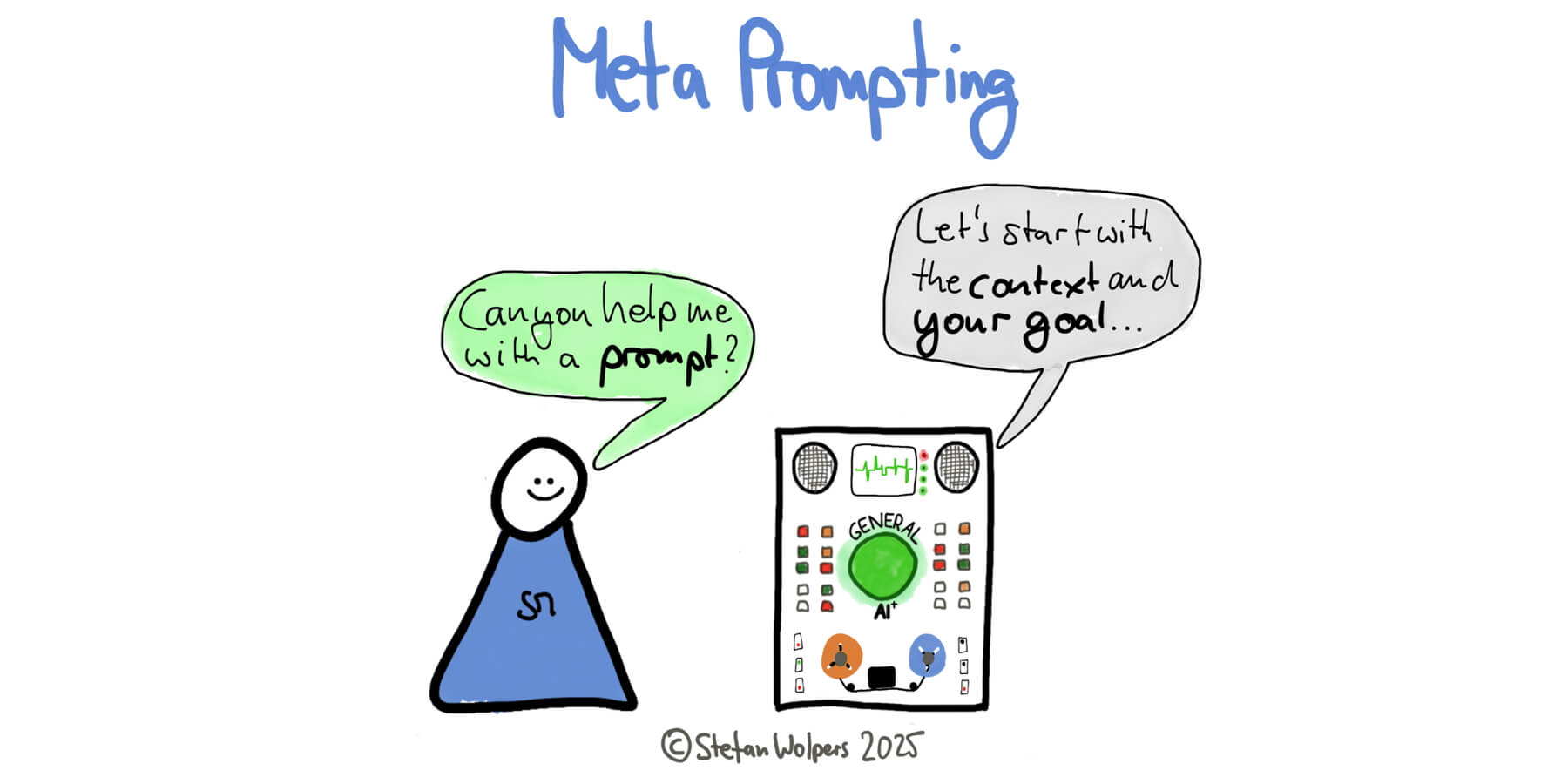
It’s how we’re asking: We are ignoring the benefits of meta prompting or having a conversation with the AI before jumping to task completion.
So, let’s start partnering with our AI.
From Commands to Conversations
Most of us treat AI like an advanced search engine. We ask a question, cross our fingers, and hope for something useful. (By the way, Perplexity.ai is a very helpful implementation of that mental model.) But what if instead of guessing what the AI needs to know, we could make it our partner in crafting the perfect request?
We call this meta prompting, but whether you call it that, conversational prompting, or simply “thinking out loud with your AI,” the principle is the same: having a conversation with the AI about what you’re trying to achieve before asking it to do the work.
Why Context-Rich Dialogue Matters
Think about your last challenging Retrospective. Maybe participation was dropping, or your team was using “Scrum issues” to avoid discussing real problems. These specific challenges need specific approaches, but most AI responses will be generic unless you guide the conversation deliberately.
Here’s the reality: AI won’t automatically ask clarifying questions. You need to prompt it to be inquisitive. Try starting with:
“Before you suggest any Retrospective formats, ask me three critical questions about my team’s current dynamics that would help you give a more targeted response.”
Then the conversation might unfold like this:
AI: “What specific behaviors are you seeing that suggest people are blaming Scrum rather than addressing real issues? How long has participation been declining? What’s your sense of the underlying team dynamics?”
You: “They say things like ‘this Sprint Planning is too rigid’ instead of discussing why they missed commitments. It’s been about 3 months, and I think they’re avoiding some conflict about workload distribution.”
AI: “Got it. So we’re dealing with deflection behavior and possibly unaddressed team tensions. Should I help you design a retrospective that safely surfaces these concerns, or would you prefer I help you create a prompt that guides you through designing that approach?”
This guided dialogue transforms generic advice into surgical recommendations.
Guiding the Conversation When AI Falls Short
When the AI gives you generic responses despite context, redirect explicitly:
- “That’s a good start, but you haven’t used the specific context I provided. Please refine your answer based on the team’s deflection behavior.”
- “You’re giving me standard advice. What would change if you factored in that this team avoids conflict?”
- “Stop and ask me what you need to know to make this recommendation more specific to my situation.”
Added bonus: You’re training the AI to be a better conversation partner within each session if you switch on “memory.”
Building in Meta Prompting Quality Checks: From Lightweight to Comprehensive
Once you’ve developed something together, don’t accept the first draft. Build in reflection moments appropriate to the complexity of your request.
For Quick Brainstorming (Lightweight)
“Please critique your last answer. Is it actionable? Does it directly address the root cause I described? Suggest one improvement.”
For Complex Challenges (Comprehensive Framework)
BEGIN_REFLECTIONYou are now in reflection mode. Keep each numbered section to ≤ 3 sentences.
A. Task Checklist
- List every sub-task you detected in the user’s request.
- For each, list those fully met or not fully met and justify your mark in ≤ 10 words.
B. Self-Rating (1–5)
- Accuracy • Completeness • Clarity • Concision • Evidence • Tone
- Explain any score < 4 in ≤ 2 sentences.
C. Gap Analysis
- Describe the two most critical weaknesses and why they matter.
- If any content violates open-source license or privacy norms, flag it.
D. Improvement Plan
- Propose three concrete edits or additions that would eliminate those weaknesses.
E. Agile Principles Check
- Psychological Safety: Does this approach help create a safe environment for honest feedback?
- Team Ownership: Does it empower the team to solve its own problems?
- Constructive Focus: Does it address systemic issues rather than individual blame?
Stop condition → If all scores are 5, respond with DONE immediately.
Finish with the single word: DONE
END_REFLECTION
Choose your approach based on stakes and complexity. A quick session exploring icebreaker ideas? Use the lightweight check. Designing an intervention for a struggling team? The comprehensive framework ensures you’ve covered critical angles.
See Meta Prompting in Action
The video in this lesson demonstrates this entire conversational approach using a real agile scenario. You’ll see how to guide AI toward better questions, how to redirect when it gives generic responses, and how reflection moments fit naturally into the preparation process.
Meta Prompting’s Critical Boundary: Preparation vs. Facilitation
Here’s what’s essential to understand: AI is your sparring partner during preparation. It cannot help you facilitate.
The AI can help you design the meeting, challenge your assumptions, and brainstorm activities. It cannot help you build trust, read the room, or adapt in real-time to human dynamics. Those skills, the heart of facilitation, require emotional intelligence, empathy, and the ability to respond to non-verbal cues that AI completely lacks.
Use AI to sharpen your plan and anticipate challenges, so you can focus entirely on the people when you’re in the room. Your role as the human facilitator becomes more critical, not less, when the AI competently supports you in preparing for events.
Conclusion
This conversational approach transforms AI from a search tool into a preparation partner. It requires you to guide the conversation deliberately, set appropriate quality checks, and maintain clear boundaries about where AI helps and where human judgment takes over.
For agile practitioners, this means moving from “What Retrospective format should I use?” to “Help me think through what’s happening with my team so I can design the right approach.”
Your next breakthrough Retrospective starts with that guided conversation — and succeeds because of your facilitation skills in the room.
What’s your experience been with using AI for meeting preparation versus live facilitation? Where have you found the boundaries most important? Could you share your thoughts in the comments below?
Published at DZone with permission of Stefan Wolpers. See the original article here.
Opinions expressed by DZone contributors are their own.
Comments