

Engineering Responsible AI for High-Stakes Financial Applications
How data engineering, explainability, monitoring, and governance can work together to make financial AI systems more accountable.
A lender changes its affordability policy. Nothing dramatic: a revised income-verification rule, a new minimum-evidence threshold for self-employed applicants. The credit model in production was trained before the change. Nobody retrains it because the model’s headline metrics still look fine. Over the following weeks, the applicant mix shifts, and the model starts declining a segment it used to approve. Approval rates for that segment fall, complaints rise, and an internal reviewer eventually asks a simple question: why was this person declined?
Nobody can answer quickly. The features that drove the decisions were computed by a pipeline that was quietly modified two sprints earlier. The model version in production has no recorded approval. The explanations the team can generate today don’t match the ones a customer might have been given last month.
I’m describing a composite here, not a real case, and I won’t put numbers on the cost because I’d be inventing them. [MY EXPERIENCE: a real incident or near-miss you’ve seen, with the cost described qualitatively.] But the shape of it is familiar to anyone who has run models in a regulated bank: the model itself was not the failure. The failure was everything around it. Nobody could reconstruct what happened, nobody noticed the drift early, and nobody owned the decision to keep the model live.
This article is about building that surrounding system. I’ll walk through the reasoning first, then a reference architecture, then four areas where I think teams most often get it wrong. I’ll finish with where this approach costs you real latency and effort, because it does.
Why Finance is Different
Plenty of ML systems can fail gracefully. A bad movie recommendation costs a few seconds of someone’s evening. A bad credit decision can deny someone a mortgage, and a bad fraud decision can freeze a salary account on the day rent is due.
Three things make the finance setting distinct:
Regulation attaches to the decision, not the model. Depending on jurisdiction, you may be dealing with model risk management guidance, consumer-credit rules, data-protection law with provisions on automated decision-making, and in the EU, the AI Act’s treatment of credit scoring as high-risk [VERIFY: exact article references and current obligations for your jurisdiction]. The common thread is that you must be able to show how a decision was made, who approved the system making it, and that you monitored it afterwards.
There is a duty to explain. An accuracy number does not help a declined applicant, a complaints handler, or a supervisor. You need reasons that are faithful to the model, stable enough to repeat, and understandable by a non-specialist. [VERIFY: whether adverse-action or “meaningful information about the logic” requirements apply to your product and region.]
Harm is asymmetric. A false "decline" and a false "approve" have very different costs, and those costs fall on different people. The loss function you optimize rarely captures that. This is why “improve AUC” is a poor governing objective in this domain.
Put together, these push you toward a particular stance: treat every model as a controlled, versioned, reviewable artifact, and treat every prediction as a record you may be asked to reproduce.
Reference Architecture
Here is the layout I’d start from. It is deliberately boring. Each box exists because some failure mode needed a control.
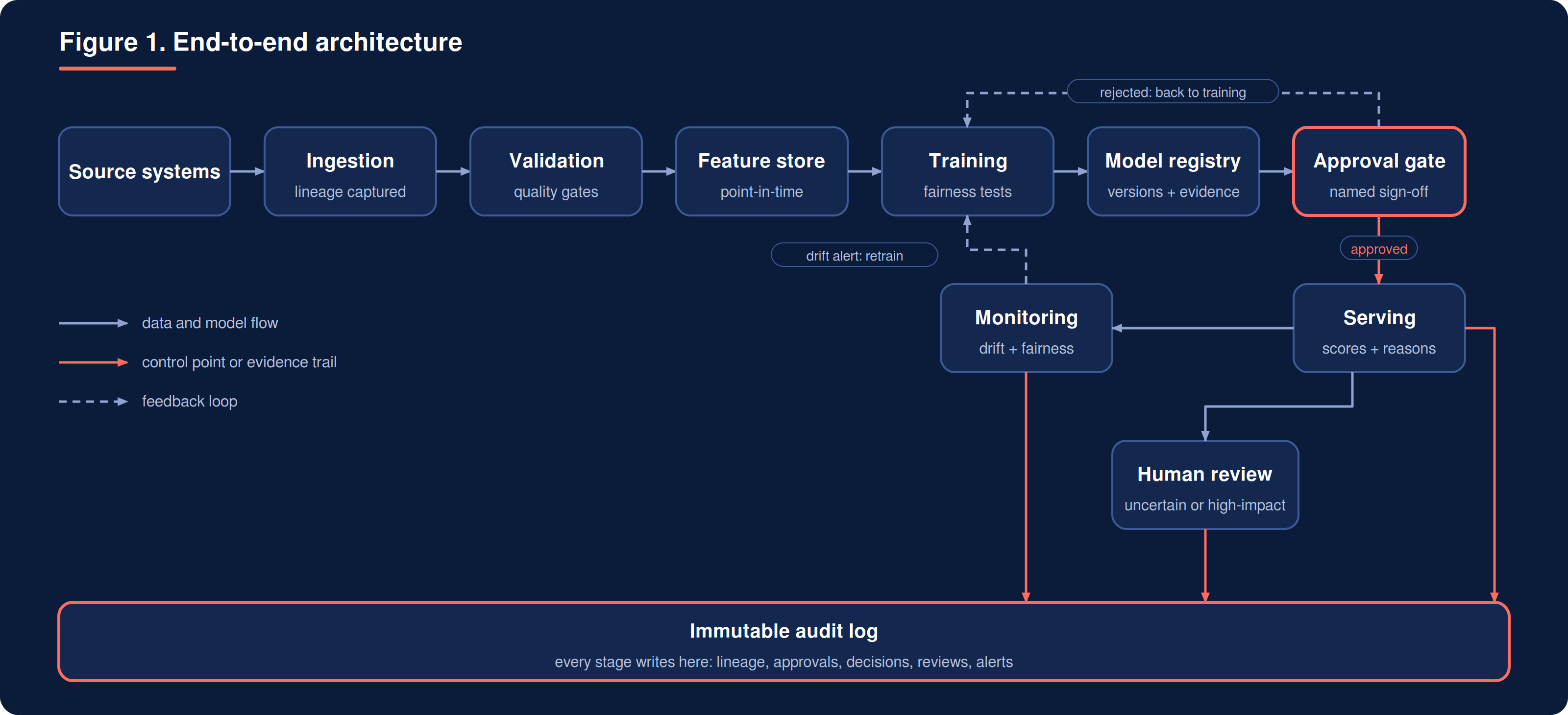
Figure 1. End-to-end architecture. Every stage emits events to the audit log, and monitoring can send a model back to retraining.
A few notes on the parts that surprise people:
Lineage and validation come first. If you can’t say which source tables and transformation versions produced a training set, no downstream control means much. Validation here means schema checks, null and range checks, and distribution checks against a reference. Failing a check should stop the pipeline, not log a warning.
The feature store earns its keep through point-in-time correctness. Training with features computed as of the decision date, not as of today, prevents a quiet form of leakage that makes models look better offline than they behave live. It also means serving and training use the same feature definitions, which removes a whole class of skew.
Training includes fairness and robustness tests as first-class steps. With results written to the registry alongside the model. More on this below.
The registry holds evidence, not just weights. Data snapshot ID, code commit, metrics, fairness results, explanation artifacts, and the approver’s identity all live with the model version.
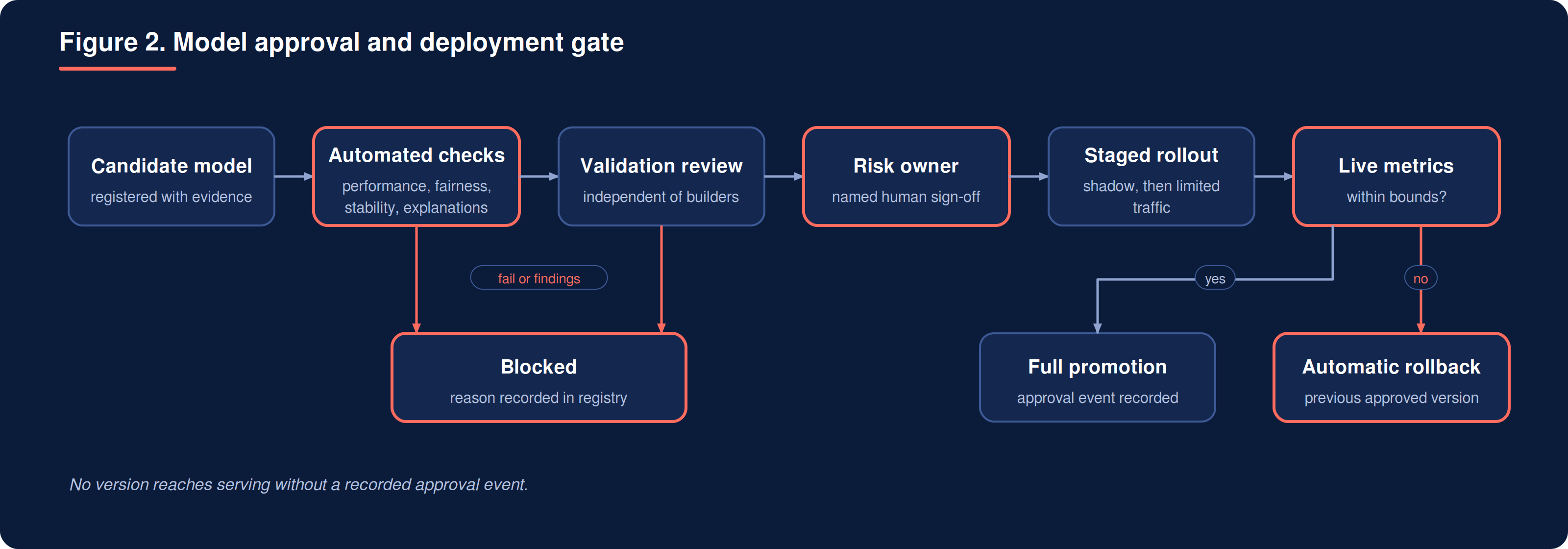
Figure 2. Model approval and deployment gate. Automated checks are necessary but never sufficient: a named human signs off.
The gate is where policy meets code. Make it impossible, technically, to deploy a model version that lacks a recorded approval. A process that depends on people remembering to check is not a control.
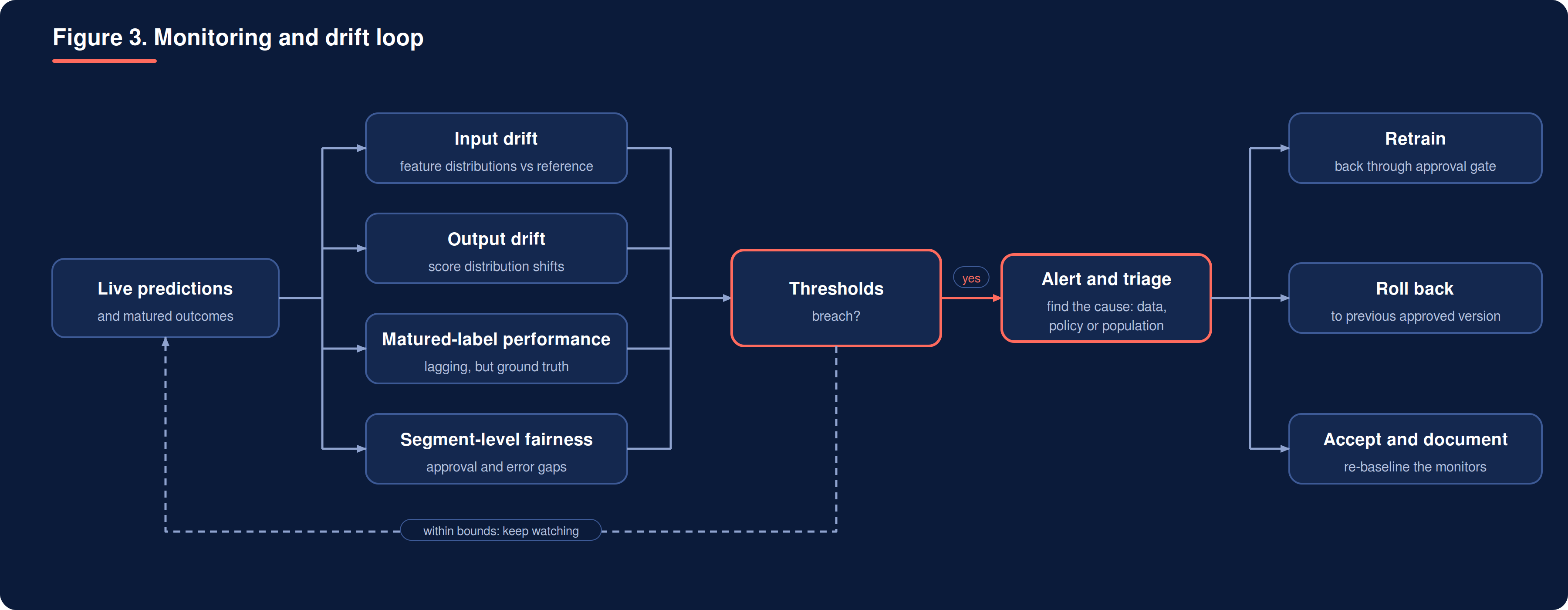
Figure 3. Monitoring and drift loop. Note the “accept” branch: sometimes the right response to drift is a documented decision, not a retrain.
Deep Dive 1: Explainability
The temptation is to bolt a post-hoc explainer onto whatever model scored best. I’ve seen it work, and I’ve seen it produce explanations that sounded plausible and disagreed with each other from one run to the next. [MY EXPERIENCE: a case where explanation instability or mismatch caused a real problem.]
My working rule: choose the simplest model class that meets the performance requirement, and only then ask what explanation method fits it. For tree ensembles, attribution methods like SHAP are common, but they explain the model’s output, not the real-world causal story, and customers will read them as the latter. Be careful with wording.
Practically, I’d store explanations at decision time, not regenerate them later. Regenerating with a newer library version or a different background dataset can yield different reasons for the same decision.
def score_with_reasons(model, explainer, features, top_k=4):
    score = model.predict_proba(features)[0, 1]
    attributions = explainer.shap_values(features)[0]
    ranked = sorted(zip(features.columns, attributions),
                    key=lambda p: abs(p[1]), reverse=True)[:top_k]
    return {
        "score": float(score),
        "model_version": model.version_id,
        "explainer_version": explainer.version_id,
        "reasons": [{"feature": f, "contribution": float(v)} for f, v in ranked],
    }
The version fields matter as much as the reasons. They let you say, months later, exactly what produced this output.
Deep Dive 2: Bias Testing
Fairness testing is awkward because the definitions conflict. Demographic parity, equalized odds, and calibration within groups cannot generally all hold at once when base rates differ. So you cannot pick “the” fairness metric and be done. You pick a small set, justify the choice with your compliance and legal colleagues, and record the trade-off. [VERIFY: the impossibility results, if you plan to cite them.]
Another snag: you often lack the protected attributes you’d need to test with, because collecting them may be restricted. Proxy methods exist, but they carry their own error, and I’d treat their outputs as screening signals rather than proof. [MY EXPERIENCE: how your team handled missing protected attributes.]
The part I feel strongest about is making the test a gate rather than a report. Here is a sketch of the config:
fairness_gate:
  segments: [age_band, region, employment_type]
  metrics:
    - name: approval_rate_ratio
      min: 0.80          # placeholder; set with compliance
    - name: false_decline_rate_gap
      max: 0.03          # placeholder; set with compliance
  min_segment_size: 500  # below this, flag "insufficient data" instead of passing
  on_fail: block_registration
The thresholds above are placeholders and not recommendations. The min_segment_size line is the one I’d keep: small segments produce noisy metrics that can pass by luck, and an honest “insufficient data” beats a false green tick.
Deep Dive 3: Human-In-the-Loop
“Human review” can mean a rubber stamp or a real control. The difference is design.
Route to a person when the model is uncertain, when the decision is high-impact, or when the input looks unlike the training population. Show the reviewer the reasons and the relevant features, but consider hiding the model’s score at first, because anchoring is real and a reviewer who sees “0.91 risk” may just agree. [VERIFY: research on automation bias in decision support, if you want to cite it.]
Measure the reviewers too. If they overturn the model almost never, either the model is excellent, or the review is theater, and you need data to tell which is which.
def route(decision, score, ood_score, amount, cfg):
    if ood_score > cfg.ood_threshold:
        return "human_review", "out_of_distribution"
    if cfg.band_low < score < cfg.band_high:
        return "human_review", "uncertain_band"
    if amount > cfg.high_value_limit:
        return "human_review", "high_value"
    return "auto", None
Always record the reason for routing. Those reason codes become a useful dataset later, for tuning the band and for spotting where the model is weak.
Deep Dive 4: Audit Trails
An audit log is only useful if it is complete, ordered, and tamper-evident. For each decision I’d capture: input feature values (or a reference to an immutable snapshot), model and explainer versions, score, reasons, routing outcome, any human action with identity and timestamp, and the final decision.
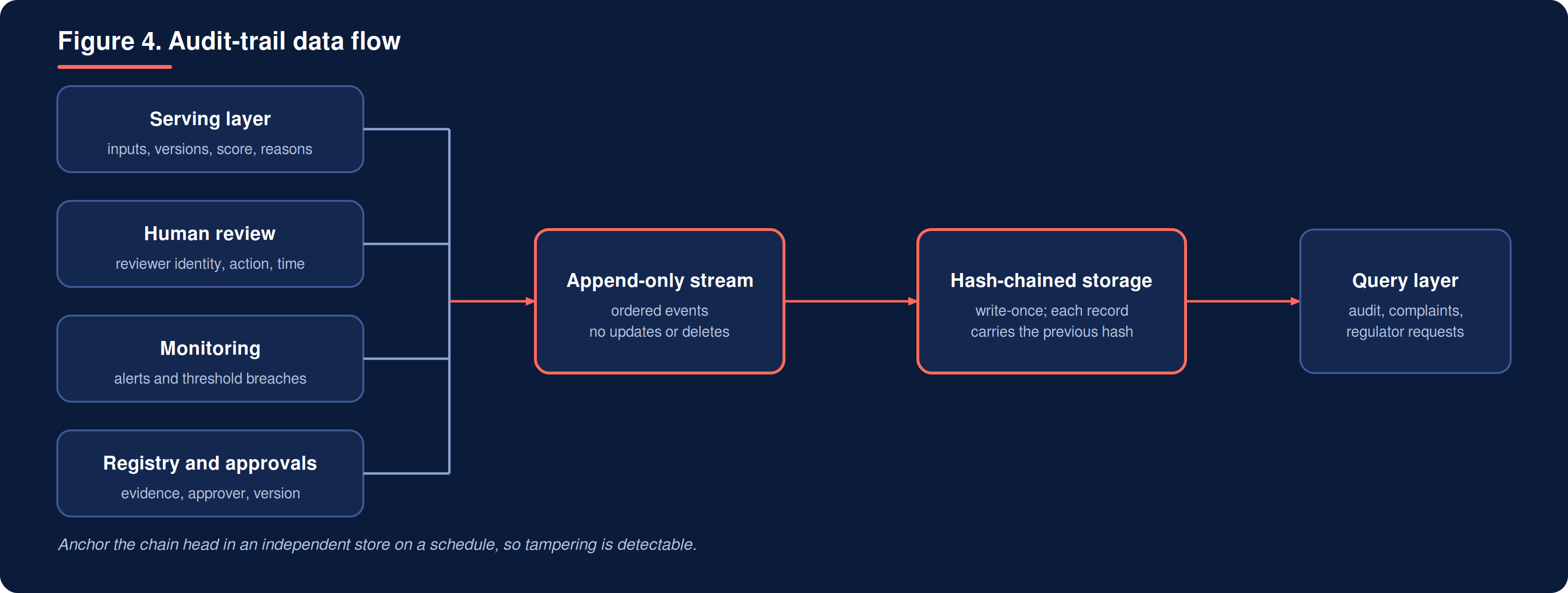
Figure 4. Audit-trail data flow. Decisions, human actions, alerts, and approvals all land in one ordered, append-only record.
A simple tamper-evidence trick is chaining each record to the hash of the previous one:
import hashlib, json

def append_record(log, payload):
    prev = log[-1]["hash"] if log else "0" * 64
    body = json.dumps(payload, sort_keys=True)
    h = hashlib.sha256((prev + body).encode()).hexdigest()
    log.append({"prev": prev, "payload": payload, "hash": h})
This is a teaching sketch. In production, you would use write-once storage with proper access controls and periodic anchoring of the chain head somewhere independent. Hash chains show tampering; they don’t prevent it.
Mind the privacy tension, too. An audit log that keeps personal data forever can collide with retention and erasure obligations [VERIFY: how your jurisdiction treats retention versus erasure for regulated records]. Storing references to snapshots, with access controls and defined retention, is usually easier to defend than copying raw data into the log.
Where This Breaks Down
I’d be misleading you if I made this sound free.
Latency. Computing explanations at decision time adds work, and for some model types it adds a lot. Hash-chained logging and synchronous writes add more. For real-time fraud scoring with a tight budget, you may need to compute explanations asynchronously and attach them afterwards, which weakens the “stored at decision time” guarantee slightly. I’d rather state that trade-off than hide it. [MY EXPERIENCE: latency budgets you’ve worked with and what you had to compromise on.]
Effort. The approval gate, fairness harness, and audit pipeline are a meaningful engineering investment, and they need ongoing ownership. Small teams will feel it. Sequencing helps: start with the audit log and the approval gate, since they’re what you’ll miss most in an incident, and add the rest iteratively.
Metrics can mislead. Drift statistics flag change, not harm. Fairness metrics depend on definitions you chose. Thresholds are judgment calls. None of this removes the need for people who understand the business and the law.
Delayed labels. Defaults take months to show up. Performance monitoring on matured labels will always lag, so you lean on proxies in the meantime, and proxies can be wrong.
Complexity can become its own risk. Every added control is another system that can fail or be misconfigured. Keep the architecture as small as your obligations allow.
Closing Checklist
If you take one thing from this, make it the idea that every decision should be reproducible and every model version should be accountable to a named person. Here’s a short checklist to test your own setup:
- Can you trace any production score back to a data snapshot, code commit, and model version?
- Do pipelines halt on validation failure rather than warn?
- Are training and serving features defined once, with point-in-time correctness?
- Do fairness and stability results live in the registry, and do they block promotion?
- Is it technically impossible to deploy a version with no recorded approval?
- Do you monitor input drift, output drift, matured-label performance, and segment-level metrics?
- Is there a defined action for each alert, including “accept and document”?
- Are human reviewers measured, and are routing reasons recorded?
- Are explanations stored at decision time with explainer versions?
- Is the audit log append-only, tamper-evident, and covered by a retention policy?
Go back to the opening scenario. With these pieces in place, the drift would have fired an alert, the policy change would have triggered a review, and the declined applicant’s question would have taken minutes to answer. That’s the point of the exercise: not a model that never goes wrong, but a system where going wrong is visible, bounded, and explainable.
Opinions expressed by DZone contributors are their own.