

Multilingual Conversational Payments Chatbot Architecture: Enterprise RAG With Safety Guardrails, Human Handoff, and Multi-Modal Support
A retrieval-augmented generation (RAG) pipeline that grounds LLM responses directly in your website/document content to prevent hallucinations.
Join the DZone community and get the full member experience.
Join For FreeA few months into any serious RAG deployment, most engineering teams tend to hit the same wall. Our AI-powered payment assistant demo worked beautifully. The pilot with twenty internal users worked beautifully. Then it goes live, someone asks a question about their medical benefits or a wire transfer that failed, the model confidently makes something up, and suddenly "chatbot" is a word nobody on the team wants to hear in a postmortem.
The fix isn't a smarter prompt. It's an architecture that assumes the model will occasionally be wrong, occasionally be asked something it shouldn't answer, and occasionally need to get out of the way entirely and hand the person off to a human. Here's how I'd structure that system if I were building it today.
The Shape of the System Architecture for a Chatbot
At a high level, you want to keep the stateless parts of your stack (the API gateway, the UI) separate from the stateful parts (retrieval, guardrails, escalation). That separation is what lets you scale, debug, and replace pieces independently later.
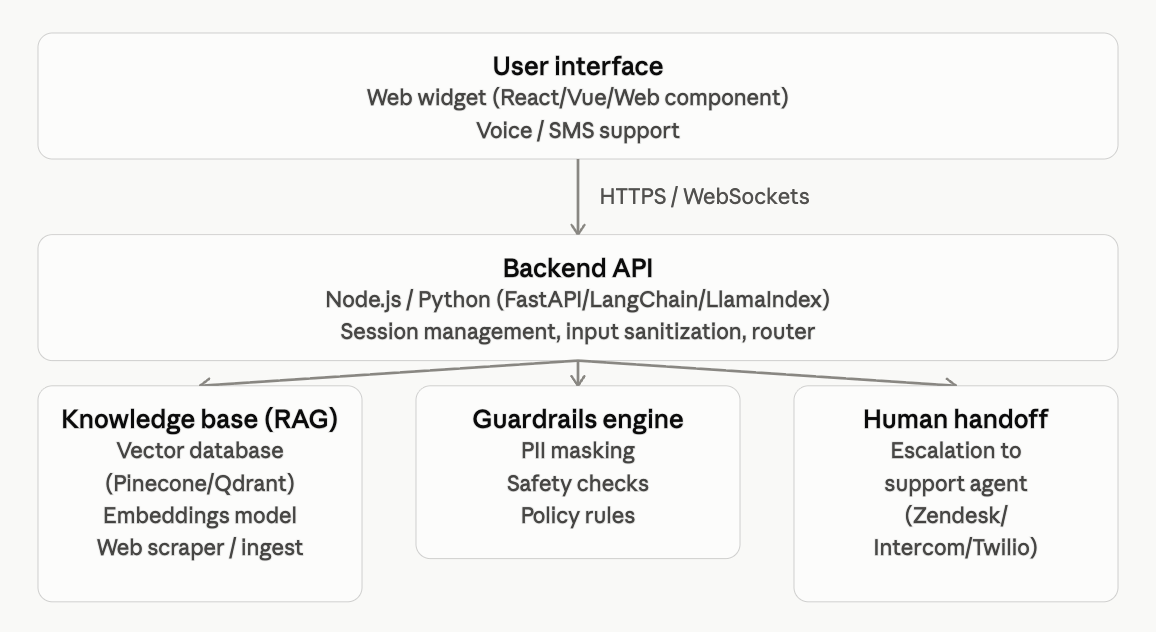
Four layers do the real work:
- Ingestion and the vector pipeline – turning your documentation into something searchable.
- Safety and policy guardrails – a layer that inspects both what goes into the model and what comes out, before either reaches the user.
- Orchestration and retrieval – the part that actually assembles a grounded, relevant prompt.
- Deterministic escalation – a rules-based off-ramp to a human that doesn't depend on the LLM deciding it's confused.
That last point matters more than it sounds like it should. If the only thing standing between a distressed user and a real person is a language model's judgment, you don't have a safety system — you have a hope.
System Architecture Overview
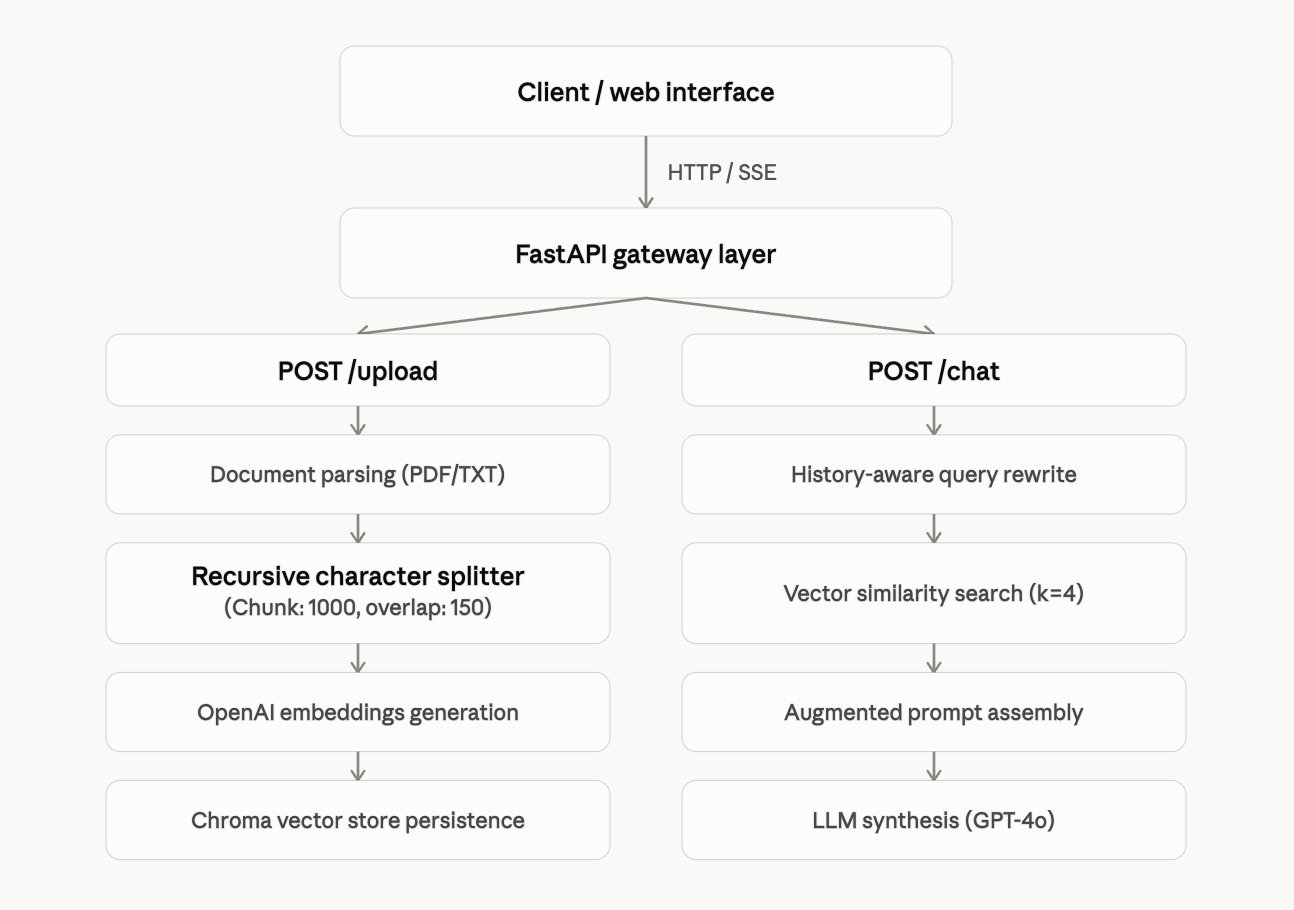
To maintain responsiveness and scalability, document ingestion pipelines are decoupled from the query-and-response execution flow.
Core System Design Decisions
- Asynchronous framework (FastAPI): Utilizing Python’s async/await primitives prevents blocking the event loop during network I/O operations to external embedding models and LLM providers.
- Persistent vector database (Chroma DB): Indexing embeddings directly to disk (./chroma_db) guarantees data durability across service deployments without requiring complete document re-ingestion.
- History-aware query reformulation: User follow-up prompts (e.g., "How much does it cost?") rely on implicit conversation state. A specialized sub-chain evaluates the chat history to rewrite ambiguous inputs into fully standalone semantic queries ("What is the cost of the Senior Care Essential plan?") prior to executing similarity retrieval.
Retrieval: Getting the Right Chunks in Front of the Model
Most RAG failures aren't generation failures. They're retrieval failures wearing a generation costume — the model looks like it hallucinated, but really it just never saw the right paragraph.
A few things that consistently move the needle:
- Incremental crawling over your actual documentation and service catalogs, rather than a one-time dump that goes stale within a month.
- Semantic chunking around roughly 1,000 characters with a 150-character overlap, so you're not slicing a procedure in half at a chunk boundary and losing the context that made it make sense.
- Metadata-aware vector storage (Pinecone, Qdrant, or pgvector if you want to stay inside Postgres) so you can filter by tenant, region, or document version instead of searching your entire corpus for every query.
- Hybrid search — sparse BM25 alongside dense cosine similarity — followed by a reranking pass (Cohere Rerank works well here). Pure vector search is good at "similar meaning" and bad at "exact term," which is a problem when someone types a SKU number or an error code.
None of this is exotic. It's just the difference between a retrieval layer that was tuned once and one that's actually maintained.
Guardrails: The Layer That Should Scare You a Little
This is where the architecture earns its keep, and where most home-grown chatbots quietly cut corners.
PII masking needs to happen on the way in, before anything — credit card numbers, SSNs, anything identifying — touches a vector lookup or gets shipped to a third-party model API.
Critical trigger overrides are the part people underestimate. If someone's message contains language suggesting a safety threat, active fraud, or physical harm, that should never be routed through the LLM's judgment first. A rule-based classifier catches it and serves a static, pre-approved protocol response immediately — no generation, no ambiguity, no chance of the model getting creative at the worst possible moment.
Regulated-domain disclaimers — medical, legal, financial — should be inserted automatically whenever intent classification detects the conversation drifting into that territory, and the system prompt should explicitly forbid the model from offering advice in those categories rather than relying on it to remember.
Tools like NeMo Guardrails or Llama Guard are built for exactly this: sitting between the user and the model, and between the model and the user again, checking both directions.
Ingestion Engine and Vector Search Pipeline
A key factor in retrieval quality is selecting proper document chunk boundaries. Overly large chunks dilute document embedding clarity, whereas tiny chunks fail to retain operational context. A balance of 1,000 characters per chunk with a 150-character sliding overlap ensures contextual continuity across document splits.
# rag_engine.py
import os
from dotenv import load_dotenv
from langchain_community.document_loaders import PyPDFLoader, TextLoader
from langchain_text_splitters import RecursiveCharacterTextSplitter
from langchain_openai import OpenAIEmbeddings, ChatOpenAI
from langchain_chroma import Chroma
from langchain.chains import create_history_aware_retriever, create_retrieval_chain
from langchain.chains.combine_documents import create_stuff_documents_chain
from langchain_core.prompts import ChatPromptTemplate, MessagesPlaceholder

load_dotenv()

class RAGEngine:
    def __init__(self, persist_dir: str = "./chroma_db"):
        self.embeddings = OpenAIEmbeddings(model="text-embedding-3-small")
        self.llm = ChatOpenAI(model="gpt-4o-mini", temperature=0.1)
        self.vector_store = Chroma(
            persist_directory=persist_dir,
            embedding_function=self.embeddings
        )
        self.rag_chain = self._compile_chain()

    def ingest_document(self, file_path: str) -> int:
        """Parses, splits, and embeds documents into the persistent Chroma store."""
        loader = PyPDFLoader(file_path) if file_path.endswith(".pdf") else TextLoader(file_path)
        docs = loader.load()

        splitter = RecursiveCharacterTextSplitter(chunk_size=1000, chunk_overlap=150)
        splits = splitter.split_documents(docs)

        self.vector_store.add_documents(documents=splits)
        self.rag_chain = self._compile_chain()  # Hot-reload retriever chain
        return len(splits)

    def _compile_chain(self):
        """Constructs a two-stage conversational retrieval pipeline."""
        retriever = self.vector_store.as_retriever(search_kwargs={"k": 4})

        # Stage 1: Contextualize Query
        context_prompt = ChatPromptTemplate.from_messages([
            ("system", "Given a chat history and the latest user query, reformulate it into a standalone query. Do NOT answer the question."),
            MessagesPlaceholder("chat_history"),
            ("human", "{input}"),
        ])
        history_retriever = create_history_aware_retriever(self.llm, retriever, context_prompt)

        # Stage 2: Grounded Generation
        qa_prompt = ChatPromptTemplate.from_messages([
            ("system", "Answer strictly using the retrieved context below. If the answer is not present, state that you do not know.\n\nContext:\n{context}"),
            MessagesPlaceholder("chat_history"),
            ("human", "{input}"),
        ])

        doc_chain = create_stuff_documents_chain(self.llm, qa_prompt)
        return create_retrieval_chain(history_retriever, doc_chain)

    def query(self, question: str, chat_history: list = None):
        """Executes retrieval-augmented generation across historical session state."""
        response = self.rag_chain.invoke({
            "input": question,
            "chat_history": chat_history or []
        })
        sources = list({doc.metadata.get("source", "Unknown") for doc in response.get("context", [])})
        return {"answer": response["answer"], "sources": sources}
REST API Service Layer
The application server manages HTTP request parsing, payload validation via Pydantic, temporary file execution, and state translation between native JSON payloads and LangChain Message primitives (HumanMessage, AIMessage).
# main.py
import shutil, os
from fastapi import FastAPI, UploadFile, File, HTTPException
from pydantic import BaseModel
from typing import List, Optional
from langchain_core.messages import HumanMessage, AIMessage
from rag_engine import RAGEngine

app = FastAPI(title="Production RAG Engine", version="1.0")
engine = RAGEngine()

class MessagePayload(BaseModel):
    role: str  # "user" or "assistant"
    content: str

class QueryPayload(BaseModel):
    question: str
    chat_history: Optional[List[MessagePayload]] = []

@app.post("/upload")
async def handle_upload(file: UploadFile = File(...)):
    """Ingests a document file (.pdf or .txt) into the vector space."""
    if not (file.filename.endswith(".pdf") or file.filename.endswith(".txt")):
        raise HTTPException(status_code=400, detail="Unsupported file format.")

    temp_path = f"./temp_{file.filename}"
    with open(temp_path, "wb") as buffer:
        shutil.copyfileobj(file.file, buffer)

    try:
        chunks = engine.ingest_document(temp_path)
        return {"status": "success", "filename": file.filename, "chunks_indexed": chunks}
    finally:
        if os.path.exists(temp_path):
            os.remove(temp_path)

@app.post("/chat")
async def handle_chat(payload: QueryPayload):
    """Processes conversational questions against the context store."""
    history = [
        HumanMessage(content=m.content) if m.role == "user" else AIMessage(content=m.content)
        for m in payload.chat_history
    ]
    return engine.query(question=payload.question, chat_history=history)
Managed Platform or Custom Build?
This is a real tradeoff, not a formality:
| Dimension | Managed (Voiceflow, CustomGPT) | Custom (FastAPI + LangChain + pgvector) |
|---|---|---|
| Time to launch | Days | Weeks |
| Data privacy / on-prem | Bounded by vendor's SOC2/HIPAA posture | Full control, self-hosted |
| Integration | Webhook-based | Native RPC/gRPC/DB drivers |
| Routing logic | Pre-built rule UI | Full graph state control (LangGraph, LlamaIndex) |
If you're regulated, handling sensitive data, or need routing logic more complex than "if sentiment negative, escalate," the custom path pays for itself. If you need something live for a trade show next week, it doesn't.
What to Actually Watch in Production Environment
Three metrics matter more than the rest combined:
- Faithfulness – is every claim in the output actually supported by a retrieved chunk? This is your hallucination canary.
- Context precision and recall – is the retriever pulling relevant chunks, or padding the prompt with noise that dilutes the model's attention?
- Time-to-first-token – stream responses over SSE and aim to get under 800ms. Users forgive a slightly slower complete answer far more readily than they forgive a UI that looks frozen.
The Real Point
AI is most useful and powerful when it adapts to people-not the other way around. None of these pieces — retrieval, guardrails, escalation — are individually hard to build. What's hard is remembering that a conversational chatbot handling real user problems needs all three working together, with the guardrails and escalation path treated as first-class citizens rather than an afterthought bolted on after the first bad headline. Build it that way from the start, and the postmortem you're avoiding is your own.
Opinions expressed by DZone contributors are their own.
Comments