

Does a Bigger Context Window Mean Better Memory: Understanding Context Windows, Model Memory, and RAG
Context is temporary, model memory is learned, and RAG retrieves external knowledge. A larger context window means more input, not perfect recall or permanent memory.
Join the DZone community and get the full member experience.
Join For FreeThe Confusion Starts With the Word Memory
Imagine giving an AI assistant a large software repository, several months of incident reports, and a complete set of operating procedures. All of it fits inside a million-token context window. It is tempting to say that the model now remembers the repository. That description hides three different mechanisms.
The model may already contain general knowledge in its weights. The current request may temporarily expose it to your documents. A retrieval system may also search an external corpus and supply only the most relevant passages. These mechanisms can work together, but they differ in where information lives, how long it lasts, how it is updated, and how reliably it can be traced.
A useful mental model is a knowledge worker at a desk. The context window is the desk surface. Model memory is the worker's learned expertise. RAG is a librarian who brings the most relevant pages to the desk. Application memory is the notebook or case file that the surrounding system saves between sessions.
1. Context Window: Temporary Working Space
A context window is the maximum amount of tokenized information a model can reference while producing a response. Depending on the model and API, that budget can include system instructions, the current question, recent conversation turns, uploaded documents, retrieved passages, tool results, and generated output. The training corpus is not part of this window; it influenced the weights earlier.
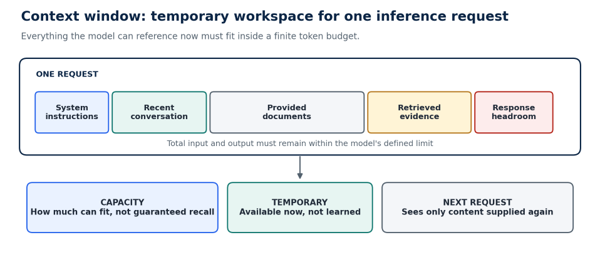
A large window increases capacity, but capacity is not the same as effective use. The model still has to locate relevant details, resolve contradictions, connect evidence across distant sections, and follow instructions while ignoring distractors. Research on long-context models has repeatedly separated advertised context length from usable task performance. The Lost in the Middle study found that answer quality could depend on where relevant evidence appeared in a long input. RULER expanded evaluation beyond simple retrieval and showed that performance can fall as sequence length and reasoning complexity increase.
These results do not mean long context is ineffective. They mean that every model and workload must be tested at the lengths, evidence positions, and reasoning patterns expected in production. A model that retrieves one literal sentence from a long prompt may still struggle to reconcile ten scattered facts.
Example: A team places 700,000 tokens of design documents, incident reports, and chat exports into one request. The correct timeout setting appears once in the middle of an old incident timeline, while a conflicting value appears near the end of a newer runbook. Both fit. The model must still identify which source is authoritative and current. A bigger window made the evidence available; it did not make the precedence decision automatic.
What a Context Window Does Not Provide
- Persistence: unless the application saves and re-sends information, a later request does not automatically contain it.
- Guaranteed recall: a detail can be present yet overlooked or combined incorrectly.
- Freshness: an old document remains old even when the model can read all of it.
- Authority: the model needs signals such as version, date, owner, and precedence to resolve conflicting sources.
Context caching is not memory: Caching can avoid recomputing an unchanged prefix and reduce cost or latency. It does not teach the model new facts or guarantee that the cached content will be used correctly.
2. Model Memory: Knowledge Encoded in Weights
During training, optimization adjusts billions of numerical parameters so that the model becomes better at predicting and generating language. The resulting weights can encode language patterns, concepts, procedures, and factual associations. Researchers often call this parametric knowledge or parametric memory.
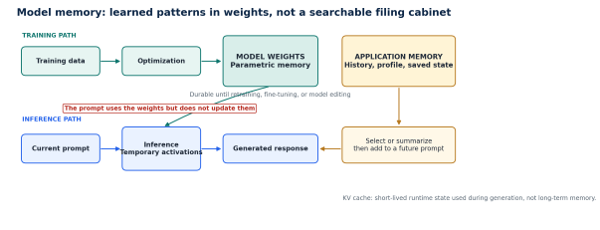
Parametric memory is durable because the same weights are reused across requests. It is also compressed and probabilistic. The model does not store a clean row for every fact, expose a reliable last-updated timestamp, or provide a source record for each answer. It may recall common knowledge well while producing an incomplete or outdated answer for a rare fact.
A normal inference request changes temporary activations, not the underlying weights. Telling a model that a service endpoint changed from /v1 to /v2 does not normally rewrite the model. The assistant can use that fact in the current context, but a fresh request will not know it unless the platform stores the fact, the caller sends it again, RAG retrieves it, or the model is updated.
Example: A model's weights may encode what HTTP 503 means, how circuit breakers work, and how to analyze a stack trace. They will not automatically contain your private runbook published yesterday or remember that a particular customer case was escalated this morning. General expertise belongs in the model; current operational state belongs outside it.
Application Memory Is a Separate Layer
Chat products often appear to remember users because the application stores conversation turns, summaries, preferences, or workflow state. Before the next model call, the application selects some of that data and places it back into the prompt. This creates a stateful user experience around a model that does not permanently modify itself after each turn. Google Cloud describes the same production pattern as externalizing conversational memory into a backing service.
The KV cache is another commonly confused term. It stores intermediate attention keys and values so token generation can proceed efficiently. It is runtime state for an active sequence, not durable semantic memory and not a replacement for a conversation or knowledge store.
3. RAG: Retrieve Before Generating
Retrieval-augmented generation connects a model to knowledge stored outside its weights. The original RAG work described generation that combines parametric memory in a pretrained model with explicit non-parametric memory in an external corpus. In a production architecture, retrieval typically has an ingestion path and a query-time path.
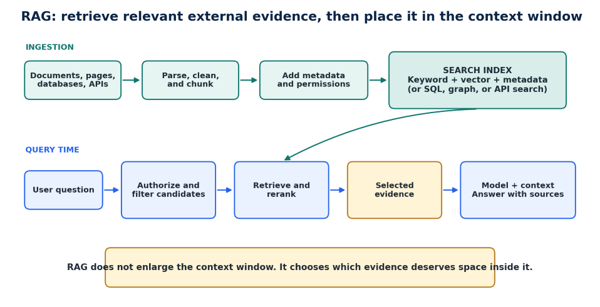
During ingestion, the system parses content, divides it into useful units, attaches metadata and permissions, and builds one or more search structures. At query time, it authorizes the request, searches for candidate evidence, reranks or filters the candidates, and adds the selected passages to the prompt. Google Cloud's RAG documentation describes the same sequence of ingestion, transformation, chunking, embeddings, and retrieval [6].
RAG is not synonymous with a vector database. Retrieval can use keyword search, vector similarity, hybrid search, metadata filters, SQL queries, a knowledge graph, or a live API. The defining idea is that external information is selected at request time and used to ground generation.
Example: An employee asks, 'How many days can I work from another country?' The model's training data cannot know the company's current policy. A RAG system can retrieve the latest approved policy, filter by the employee's region and role, place the relevant paragraphs in context, and return an answer with the policy version and source link. When the policy changes, the organization updates the source and index instead of retraining the model.
RAG Is a Pipeline, Not an Accuracy Switch
RAG improves grounding only when the pipeline returns good evidence, and the model uses it correctly. Failure can occur because a document was not indexed, chunk boundaries removed essential context, a query did not match the right terminology, permissions were applied too late, stale content outranked the current version, or too many weak passages diluted the answer. Retrieval quality and generation quality should therefore be evaluated separately.
Key distinction: RAG does not make the model remember a corpus, and it does not expand the model's maximum context. It chooses a small, relevant subset of external knowledge to occupy that context.
Context Window vs. Model Memory vs. RAG
|
Dimension |
Context window |
Model memory |
RAG |
|
Primary role |
Temporary workspace for the current generation |
Learned capabilities and parametric knowledge |
Fetch external evidence for the current question |
|
Where information lives |
Tokens supplied to the current request |
Parameters or weights |
Documents, indexes, databases, graphs, or APIs |
|
Lifetime |
Until the request or managed session is cleared |
Until weights are changed |
As long as the external source is retained and indexed |
|
How it is updated |
Send different tokens on the next request |
Retraining, fine-tuning, or model editing |
Update the source and refresh the index or query path |
|
Best for |
Current documents, instructions, and recent conversation |
Language, broad patterns, stable skills, and behavior |
Private, changing, large, or traceable knowledge |
|
Typical failure |
Relevant detail is truncated, diluted, or poorly used |
Knowledge is stale, approximate, or inconsistently recalled |
Retriever returns missing, stale, irrelevant, or unauthorized evidence |
|
Traceability |
Only if supplied content has clear provenance |
Usually weak: an answer cannot point to a specific training record |
Strong when passages, versions, and source links are preserved |
Table 1: The three mechanisms differ in location, lifetime, update path, and traceability.
How the Three Layers Work Together
The strongest production design is usually hybrid. Model weights supply language ability, general knowledge, and reasoning patterns. The context window holds the current task. RAG supplies fresh or private evidence. Application memory preserves the small amount of user or workflow state that should survive between turns.
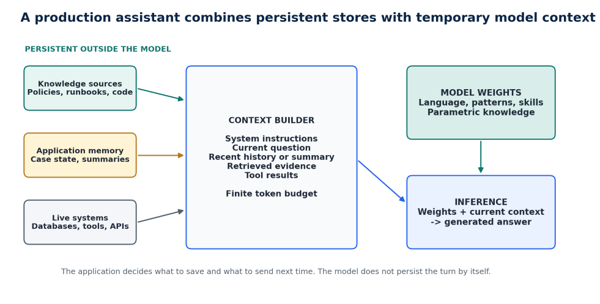
End-to-end example: A support assistant receives a question about repeated 503 errors. The model's weights provide general networking and troubleshooting knowledge. Recent conversation and the current error message occupy the context window. RAG retrieves the latest service runbook and an active incident notice. Application memory supplies the case ID, environment, and steps already attempted. The model combines those inputs into a response, while the application records the next approved action for the following turn.
Does a Million-Token Context Replace RAG?
Not generally. Long context and RAG solve different problems. Long context increases how much information can be considered in one request. RAG reduces a much larger or changing information space to the evidence most likely to matter.
Use Long Context When
- The complete input is known, bounded, and important to the current task.
- Relationships across distant sections matter and aggressive retrieval could omit a small but essential detail.
- You are analyzing a repository snapshot, contract set, transcript, or research packet as one coherent artifact.
- The model has been evaluated at the required length, and the latency and cost are acceptable.
Use RAG When
- The corpus is larger than the usable context or changes frequently.
- Answers must reflect private data, current policies, live systems, or user-specific permissions.
- You need source links, versions, provenance, or an auditable evidence trail.
- Most questions require only a small portion of the available knowledge.
Rely on Model Memory When
- The task depends on general language, broad domain patterns, coding ability, or stable learned skills.
- The information does not require exact provenance or frequent updates.
- You are choosing a model or fine-tuning behavior, style, classification boundaries, or output structure rather than maintaining a factual document store.
Practical Design Rules
- Name the layer precisely. Say context, parametric knowledge, application memory, retrieval index, or runtime cache instead of calling everything memory.
- Budget the context. Reserve room for instructions, the user request, selected evidence, tool results, and the expected output. A maximum is a ceiling, not a target.
- Retrieve less, but better. Prefer a small set of authoritative, diverse passages over a large block of loosely related text.
- Authorize before retrieval. The model should never receive content the user was not permitted to access, even if the final answer is later filtered.
- Preserve provenance. Carry source, version, timestamp, owner, and document status into the retrieved context and the generated citation.
- Evaluate retrieval and generation separately. Measure whether the correct evidence was found before judging how well the model used it.
- Write important state explicitly. Save approved facts, decisions, and workflow progress in application storage instead of hoping the model will infer them from a growing transcript.
- Test realistic long inputs. Move evidence between the beginning, middle, and end; introduce conflicting versions; vary the number of relevant passages; and include questions with no supported answer.
Conclusion
A large context window is valuable, but it is not a permanent or perfectly searchable memory. It is a larger desk. Model weights are learned expertise, not a factual database. RAG is a retrieval mechanism that brings selected evidence to the desk. Application memory is the system that decides what to record and supply again later.
The production question is therefore not, 'How much can the model remember?' It is, 'Which information belongs in weights, which belongs in the current context, which should be retrieved, and which state must the application persist?' Once those responsibilities are separated, accuracy, freshness, security, cost, and observability become much easier to engineer.
Opinions expressed by DZone contributors are their own.
Comments