

Orchestrating Multi-Agents: Unifying Fragmented Tools into Coordinated Workflows
Modern AI workflows rely on fragmented tools that don’t interoperate. Learn how an agent orchestrator can unify them into a coordinated, context-aware workflow.
Join the DZone community and get the full member experience.
Join For FreeFragmented Tools
Development teams are deploying specialized AI tools across different vendors, architectures, and environments. These tools exist in silos, creating operational complexity and limiting their collective potential.
As AI adoption accelerates and the number of deployed agents multiplies, a new challenge emerges: how do we coordinate these specialized tools to work together effectively?
Agent Orchestrator
The answer lies in agent orchestration, which coordinates multiple specialized AI agents within a unified system to efficiently achieve shared objectives. It also helps in enabling collaboration with third-party agents to solve complex problems and aid decision-making. Think of an agent orchestrator as a senior engineer routing work to team members with the right skills to get the job done.
Use Cases
Scenarios where agent orchestration delivers impact include:
Autonomous Incident Coordination
When a service degradation or SLO breach occurs, the orchestrator might coordinate between a monitoring agent to detect anomalies, an SRE agent to analyze logs, metrics and traces, and an automation agent to apply the fix, an SRE agent that analyzes logs/metrics/traces/SLOs, and an automation agent that implements the fix — without human intervention.
Multi-Cloud Disaster Recovery/Notification
When a primary cloud region experiences an outage, the orchestrator coordinates between a health monitoring agent that detects the failure, a backup verification agent that confirms data integrity, a DNS routing agent that redirects traffic, and a notification agent that alerts stakeholders, executing a complete failover strategy across multiple cloud providers seamlessly
Building the Orchestration Framework
Implementing effective agent orchestration relies on three foundational pillars:
- Contextual workflow orchestration: The orchestrator manages task dependencies and execution flow, ensuring each agent hands off contextually relevant output to the next. This coordination enables seamless, efficient progression through complex workflows.
- Intelligent data pipelines for agents: Seamless data flow is essential for orchestrated agents. The orchestrator allows agents to access shared data sources, exchange information, and maintain consistency across operations.
- Open-source orchestration technologies: Open-source orchestration frameworks provide scalable, interoperable building blocks for coordinating agents. These technologies offer standardized protocols for agent communication and monitoring capabilities for orchestrated workflows. An example framework for agent-to-agent communication is Google’s A2A protocol.
Main Components of the Orchestrator
Most orchestrators are built using the following key architectural components:
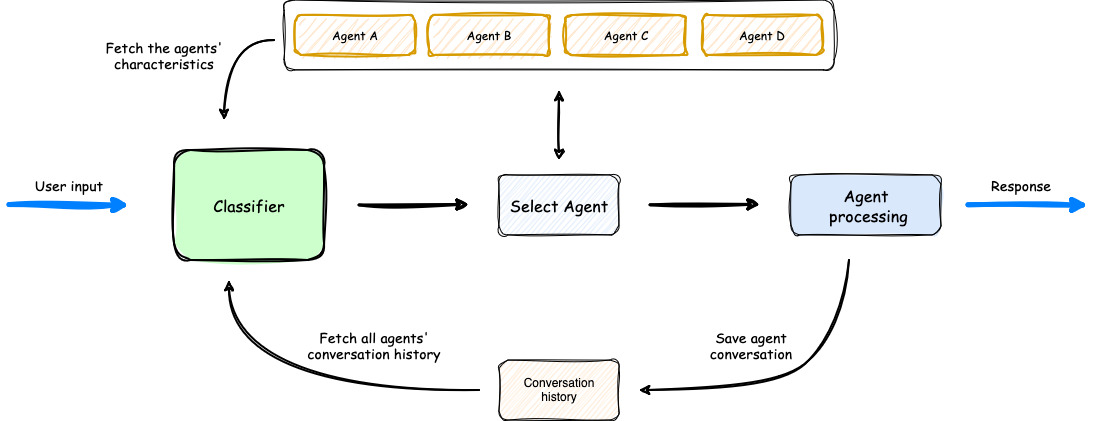
- Orchestrator: Central coordinator managing interactions between classifiers, agents, storage, and retrievers. It processes user input, directs agent workflows, and handles errors and fallbacks.
- Classifier: The classifier evaluates both the agents' characteristics and their conversation history to identify the most suitable agent for the task.
- Agents: Perform tasks based on classification. Includes prebuilt, customizable, and fully custom agents tailored to specific needs.
- Conversation storage: Stores conversation history at both the classifier and agent levels. The conversation will be repurposed for further user input queries.
- Retrievers: Fetch relevant external context to enhance agent performance. This can include API calls to external services or fetching data from a database.
Core Orchestration Process
The process generally follows these key steps:
- Assessment and planning
- Selection of specialized AI agents
- Orchestration framework implementation
- Dynamic agent assignment
- Workflow coordination and execution
- Intelligent data sharing and context management
- Adaptive optimization and continuous learning
Agent Orchestration Architecture
To illustrate how these components work together, let's trace through a typical deployment scenario. When a developer requests "Deploy new API version and monitor for anomalies," the orchestration system coordinates multiple specialized agents through a structured workflow: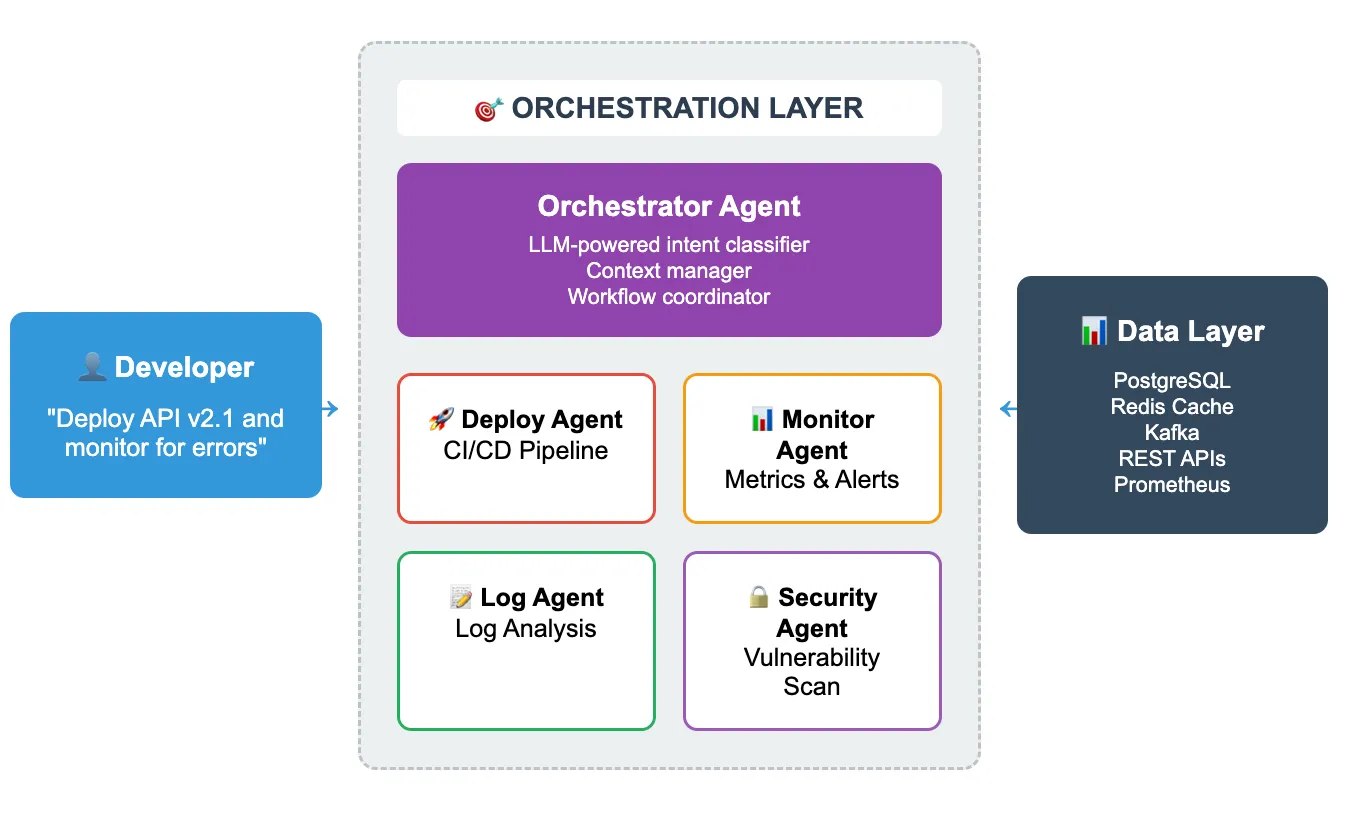
The orchestrator manages this through a sequential communication flow between agents: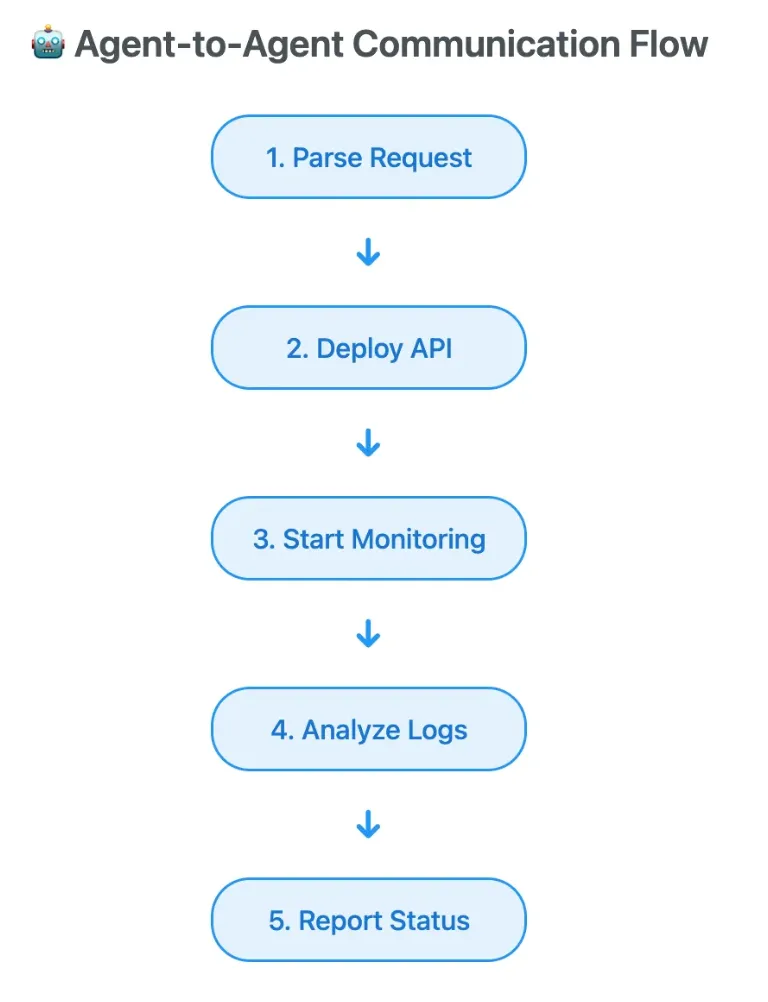
- Parse request – The orchestrator's classifier analyzes the developer's request
- Deploy API – Routes to the Deployment Agent for CI/CD pipeline execution
- Start monitoring – Automatically triggers the Monitor Agent for metrics
- Analyze logs – If anomalies detected, activates the Log Agent for analysis
- Report status – Provides consolidated status updates back to the developer
This A2A (Agent-to-Agent) communication ensures seamless handoffs between specialized agents while maintaining context throughout the entire workflow.
Below is a flow diagram on how AWS implements orchestration
High-Level Implementation
Below is a high-level implementation demonstrating how an orchestrator can coordinate tasks across multiple agents.
import json
from typing import List, Dict, Any

# Agent
class Agent:
    def __init__(self, name: str, description: str, tools: List, model: str):
        self.name = name
        self.description = description
        self.tools = tools
        self.model = model

    def execute_task(self, task_input: str) -> str:
        # Agent-specific task execution logic
        for tool in self.tools:
            if tool.can_handle(task_input):
                return tool.execute(task_input)
        return f"{self.name} processed: {task_input}"

# Agent Orchestrator
class DevOpsOrchestrator:
    def __init__(self, agents: List[Agent]):
        self.agents = {agent.name: agent for agent in agents}
        self.context_history = []

    def classify_intent(self, user_input: str) -> Dict[str, Any]:
        """Use LLM to determine which agent should handle the request"""
        context = "\n".join(self.context_history[-5:])

		available_tools = "\n".join([f"* {name}: {agent.description}" for name, agent in self.agents.items()])

        expected_structure = {"agent": "", "task": "", "follow_up": ""}

        prompt = f"""
        You are a specialized workflow coordinator for infrastructure operations.
        Leverage the conversation history to determine optimal task routing.

        Previous Conversations:
        {context}

        Registered tools with capabilities: {available_tools}

        Current Request: {user_input}

        ###Instructions###
        - Examine the request and identify the best-suited agent
        - Transform the request into clear instructions for the chosen agent
        - For complex workflows requiring multiple agents, specify the initial agent and indicate continuation needs
        - When no agent matches or task is complete, use "user_response" as the agent
        - Output must be valid JSON matching: {expected_structure}

        """

        # Mock LLM response (replace with actual LLM call)
        llm_response = self.query_llm(prompt)
        return json.loads(llm_response)

    def query_llm(self, prompt: str) -> str:
        """Mock LLM query - replace with actual implementation"""
        # This would call your actual LLM (OpenAI, Anthropic, etc.)
		return '{"agent": "deployment_agent", "task": "deploy new version", "follow_up": "monitoring_agent"}'

    def orchestrate(self, user_input: str) -> str:
        self.context_history.append(f"User: {user_input}")

        # Classify intent and route to appropriate agent
        routing_decision = self.classify_intent(user_input)
        agent_name = routing_decision["agent"]
        task = routing_decision["task"]

        if agent_name in self.agents:
            result = self.agents[agent_name].execute_task(task)
            self.context_history.append(f"{agent_name}: {result}")
            return result

        return "No suitable agent found for this request"

# Usage Example
deployment_agent = Agent(
    name="deployment_agent",
    description="Handles application deployments and releases",
    tools=[DeploymentTool()],
    model="gpt-4o-mini"
)

monitoring_agent = Agent(
    name="monitoring_agent",
    description="Monitors system health and processes alerts",
    tools=[MetricsTool(), AlertTool()],
    model="gpt-4"
)

# Create orchestrator
orchestrator = DevOpsOrchestrator([deployment_agent, monitoring_agent])

# Execute coordinated workflow
result = orchestrator.orchestrate("Deploy the new API version and monitor for errors")
Considerations and Challenges
While agent orchestration offers significant benefits, implementation teams should consider a few key challenges
- Complex coordination: Managing workflows across multiple agents increases complexity and risk of failure.
- High costs: More agents mean higher compute and integration overhead, often leading to unclear ROI.
- Context management: Maintaining a consistent state across agents is difficult due to token limits and fragmented memory.
- Security risks: Inter-agent communication and API exposure widen the attack surface and raise privacy concerns.
Summary
Agent orchestration isn’t just about automation — it’s about designing intelligent, adaptive systems where specialized agents work together seamlessly. By coordinating these agents in real time, teams can unlock the following benefits:
- Eliminate manual handoffs through automated, intent-driven task delegation
- Streamline complex workflows via a unified, orchestrated interface
- Scale with ease by integrating new agents as capabilities evolve
As agent-based architectures continue to mature, orchestration will be the key to unlocking their full potential.
References and Frameworks
Opinions expressed by DZone contributors are their own.
Comments