

Scaling Teams, Scaling Systems: Unlocking Developer Productivity With Platform Engineering
Platform engineering scales teams and systems, streamlines workflows, and reduces friction—driving faster delivery, collaboration, and sustainable growth.
 CORE
·
CORE
·
Join the DZone community and get the full member experience.
Join For FreeModern software delivery is complex. Developers are responsible not only for writing code that meets business requirements — both functional and non-functional — but also for navigating a long chain of supporting steps. From containerization, testing, configuration, security, deployment, and monitoring, each stage often relies on specialized tools and teams.
When these processes aren’t standardized, every project risks reinventing the wheel. The result is inconsistency, delays, and frustration. For example, requesting a new test environment might require submitting detailed tickets to a DevOps team, slowing timelines and draining energy. As organizations scale, so does the complexity — and the pain of delivery.
Platform engineering addresses these challenges by creating shared, reliable foundations. It provides self-service tools, standardized workflows i.e., golden paths, and built-in guardrails, enabling teams to focus on what matters most: writing code and shipping features.
This article explores what platform engineering is, why it matters, and how it helps organizations move faster while reducing developer burnout. It also examines common challenges and how to avoid turning platforms into yet another layer of complexity.

Platform Engineering
Definition
Platform engineering is a practice of building and maintaining an internal, self-service platform that makes it easy for development teams to build, deliver, and operate software.
Key principles of platform engineering are:
- Self-service (with guardrails) → developers should be able to build, deploy, and operate services independently — without filing tickets for routine tasks. Also ensuring automated guardrails for compliance and cost control.
- Golden paths, not golden cages → provide opinionated, well-supported paths that make the right thing easy — without preventing teams from choosing alternatives when needed.
- Product mindset → treat the platform as a product. Define users (developers), gather feedback, measure adoption, and iterate based on value delivered.
- Reduce cognitive load → abstract away infrastructure and operational complexity that does not directly contribute to the developer’s core task, i.e., building and shipping business logic.
It's imperative to note that Platform Engineering is not DevOps, but DevOps scaled through product thinking — treating developers as customers and the platform as the product.
Adoption Journey
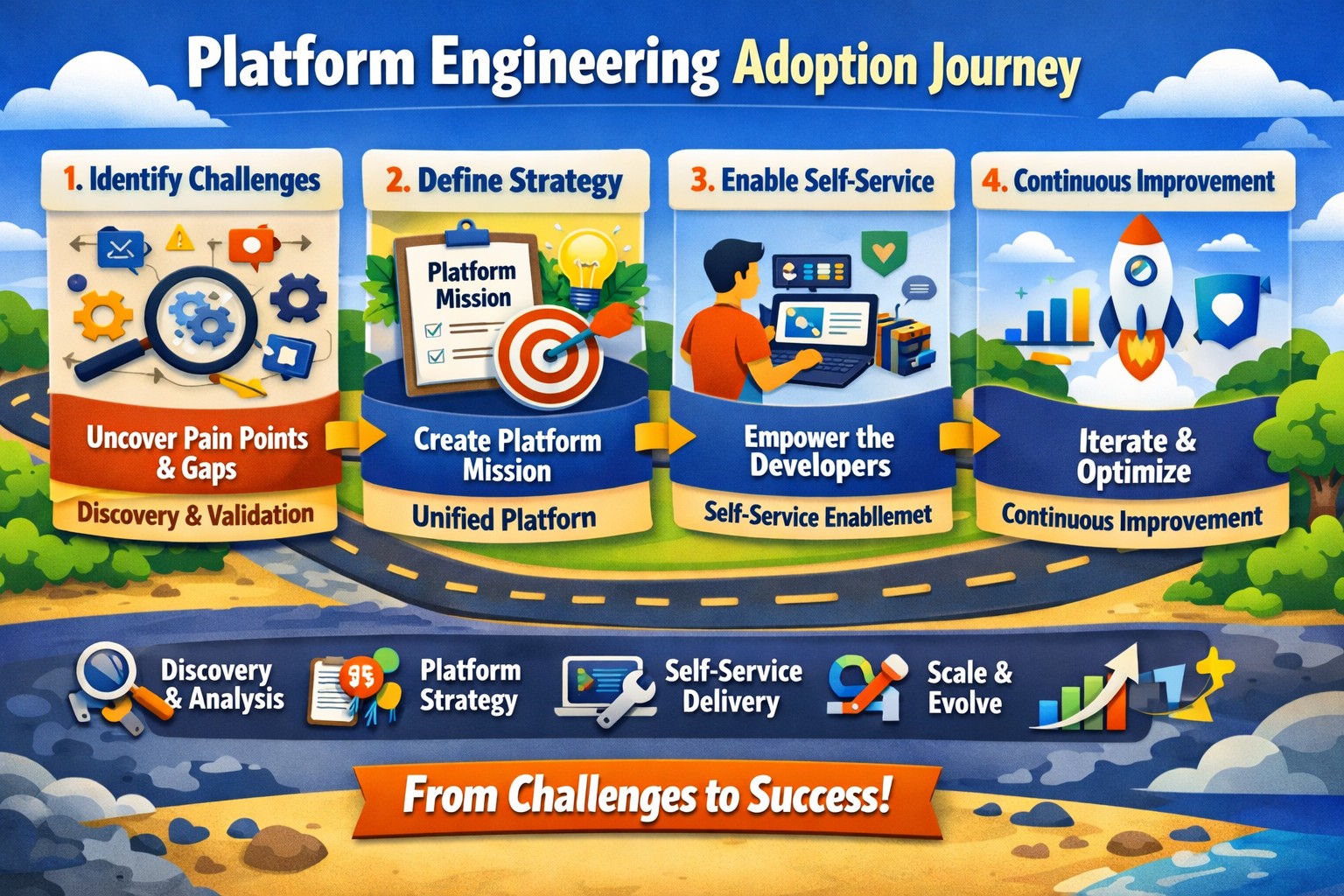
Large organizations often face delivery challenges that rarely make it into executive summaries. Issues like developer friction, inconsistent and/or duplicate tooling, and fragmented workflows are deeply embedded in day‑to‑day operations. Their impact — delayed releases, inefficiencies, and frustration — may be visible, but the root causes often remain hidden or disconnected from leadership narratives.
Thus, the first step is discovery and validation. Organizations must surface real pain points through design thinking workshops, targeted surveys, analysis of past initiatives, and continuous community/user feedback. These insights form the foundation for defining a clear and grounded Platform Mission Statement — one that aligns platform capabilities with genuine organizational needs.
Once the mission is clear, enterprises move toward unified platforms that standardize common tools and processes. This consolidation reduces duplication and improves reliability. Guiding Principles should be maintained via ADRs as a standardized platform for uniformity. Also, it's recommended to have decentralized decision-making to avoid bottlenecks and maintain long-term sustainability. To achieve this, use a community-driven approach via various guilds.
As maturity grows, self‑service enablement becomes the focus — developers can provision infrastructure, build & deploy applications, perform verification, and integrate monitoring with minimal friction. This can be achieved via Internal Developer Platforms (IDP) and Internal Developer Portals.
Finally, mature organizations embrace continuous improvement. The platform evolves like a product — guided by developer feedback and metrics. The feedback loops should act to adapt the platform and be evolutionary in nature. Being preventive or proactive, rather than reactive, goes a long way in achieving a successful platform implementation.
Internal Developer Platforms (IDP) vs. Internal Developer Portals
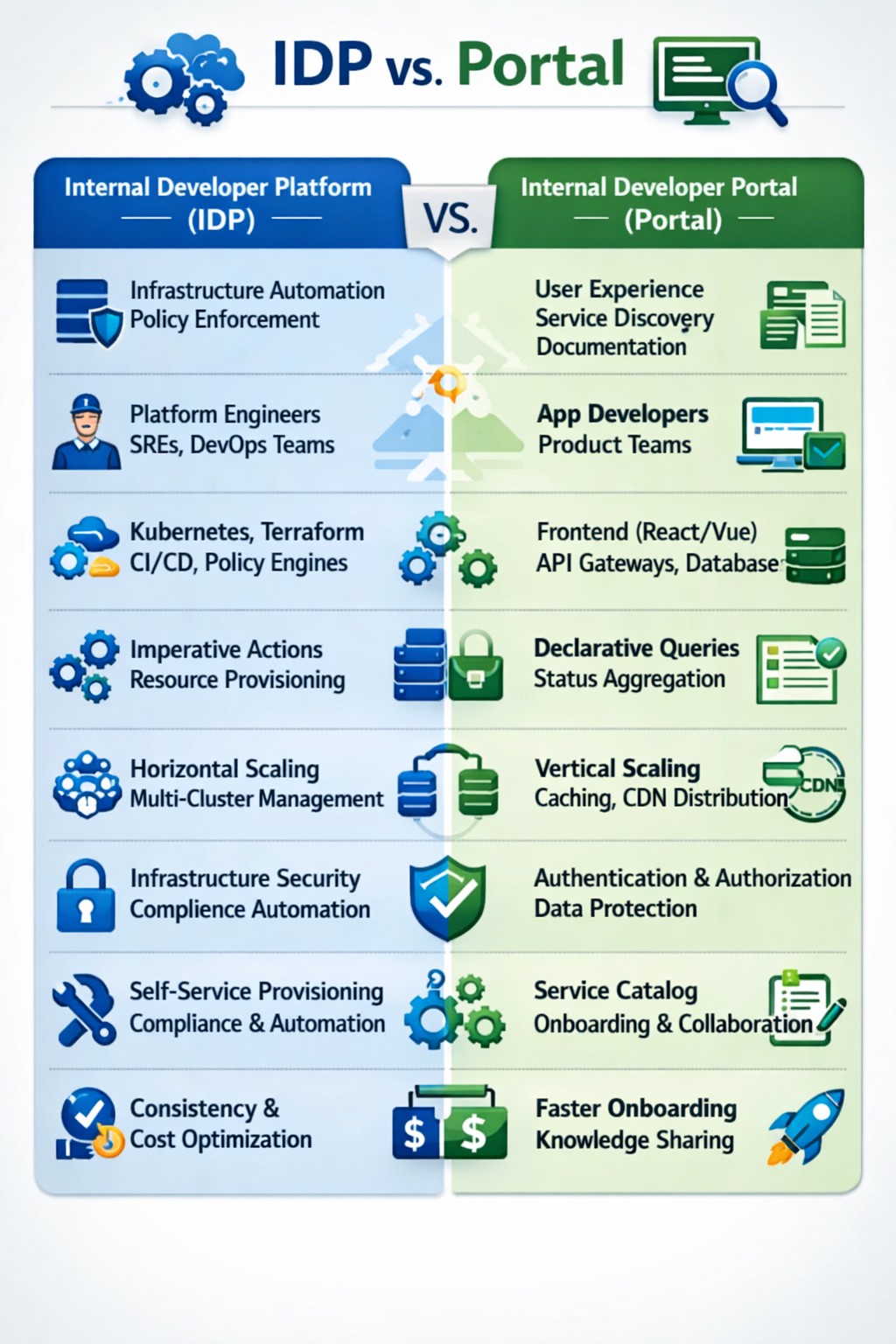
A common source of confusion in platform engineering is the distinction between an internal developer platform (IDP) and an internal developer portal. While these concepts are related and often work in tandem, they serve distinct purposes and have different architectural and user experience implications.
Internal Developer Platform (IDP)
An IDP is the “engine room” of platform engineering. It is a cohesive set of tools, frameworks, and automation scripts that standardize and automate the provisioning, deployment, and management of infrastructure and services.
Key components typically include:
- Self-service infrastructure provisioning → Developers can request and manage resources (VMs, databases, clusters) via APIs or CLI tools, eliminating ticket-based workflows.
- Unified deployment and orchestration → Standardized CI/CD pipelines, container orchestration (e.g., Kubernetes), and Infrastructure as Code ensure consistent, reliable releases.
- Centralized configuration and secrets management → Version-controlled settings, automated secret management, and policy enforcement across environments.
- Automated monitoring and observability → Integrated metrics, logs, and tracing provide real-time visibility into system health.
- Security and compliance automation → Policy-as-code frameworks (e.g., OPA) enforce security and compliance at every stage.
IDPs are typically built and maintained by platform engineering teams and are consumed by developers and operations teams to accelerate software delivery and reduce operational risk.
Internal Developer Portal
An internal developer portal is the “front door” to the platform. It provides a user-friendly interface (often a web dashboard) that aggregates documentation, service catalogs, APIs, and organizational guidelines.
Key features include:
- Service catalog → Centralized inventory of services, APIs, and infrastructure, supporting discoverability and ownership tracking.
- Integration ecosystem → Unified view of the development toolchain, integrating with version control, CI/CD, observability, and project management tools.
- Self-service workflows → Guided forms and wizards for routine operations (e.g., provisioning, deployments), with built-in approval workflows and RBAC.
- Onboarding and knowledge sharing → Centralized documentation, onboarding guides, and community Q&A features to accelerate ramp-up and collaboration.
- Metrics and scorecards → Dashboards tracking service health, maturity, and compliance, providing actionable insights for improvement.
Portals are typically used by application developers, product teams, and managers to discover services, access documentation, and initiate self-service workflows.
When to Use Each (or Both)
- Start with an IDP when the primary pain points are manual infrastructure provisioning, inconsistent environments, or the need for standardized automation.
- Start with a Portal when discoverability, onboarding, and knowledge sharing are the main challenges, or when existing tools are underutilized due to lack of visibility.
- Combine Both for maximum impact: the IDP provides the backend automation and guardrails, while the portal exposes these capabilities through an intuitive, developer-friendly interface
Team Topologies and Platform Engineering
The success of platform engineering is deeply influenced by organizational structure and team interactions. The “Team Topologies” framework provides a powerful lens for designing team structures that optimize for effective platform adoption
Four Fundamental Team Types
- Stream-Aligned Teams → Aligned to a flow of work from a business domain (e.g., a product or service). They own the end-to-end delivery and operation of features.
- Platform Teams → Build and maintain internal platforms that provide reusable services and capabilities to stream-aligned teams, reducing their cognitive load.
- Enabling Teams → Help stream-aligned teams overcome obstacles, adopt new technologies, or fill skill gaps.
- Complicated Subsystem Teams → Own subsystems that require deep specialist knowledge (e.g., advanced algorithms, core infrastructure).
Three Team Interaction Modes
- Collaboration → Teams work together for a defined period to discover new solutions.
- X-as-a-Service → One team provides a service that another team consumes with minimal interaction.
- Facilitation → One team helps another team acquire new skills or capabilities.
Relevance to Platform Engineering
- Platform Teams as Product Teams → Platform engineering teams should operate as product teams, treating stream-aligned teams as customers, gathering feedback, and iterating on platform features
- Reducing Cognitive Load → The primary goal of the platform team is to reduce the cognitive load on stream-aligned teams, enabling them to focus on delivering business value rather than infrastructure concerns
- Clear Interfaces and Boundaries → Well-defined APIs, documentation, and support channels ensure that platform capabilities are discoverable and consumable as a service, minimizing dependencies and handoffs
- Continuous Adaptation → Team boundaries and responsibilities should evolve as business needs and technologies change, with feedback loops guiding organizational adjustments
Conway’s Law and Its Applicability to Platform Engineering
Conway’s Law, articulated by Melvin Conway in 1967, states that “organizations which design systems are constrained to produce designs which are copies of the communication structures of these organizations”
In the context of platform engineering, this law has profound implications.
How Conway’s Law Shapes Platform Design
- Organizational Silos Lead to Siloed Platforms → If engineering teams are organized in silos (e.g., by business unit or product line), the platforms they build will reflect this fragmentation, resulting in duplicated tools, inconsistent practices, and integration challenges
- Cross-Functional Collaboration Enables Cohesive Platforms → Successful platform engineering requires cross-functional teams that span development, operations, security, and compliance, ensuring that the platform addresses the needs of all stakeholders and avoids becoming a new silo.
- Intentional Organizational Design → To achieve coherent, scalable platforms, organizations must deliberately design their communication structures and team interactions to support shared standards, rapid feedback, and continuous improvement.
Real-World Example - Monolith to Microservices → Organizations transitioning from monolithic architectures to microservices often reorganize teams around domains or services. If team boundaries are not aligned with desired system boundaries, the resulting architecture may become fragmented or inconsistent, reflecting the underlying communication patterns rather than optimal technical design
Platform Engineering as Both Solution and Symptom → Platform engineering often arises as a response to the silos and fragmentation created by previous organizational structures. However, if not implemented with a product mindset and cross-team alignment, platform engineering can inadvertently create new silos, perpetuating the very problems it seeks to solve
Metrics and KPIs to Measure Platform Success
Measuring the impact of platform engineering is essential for demonstrating value, securing buy-in, wider adoption, and guiding continuous improvement.
Common Metrics
- DORA Metrics → Deployment frequency, lead time for changes, change failure rate, mean time to recovery (MTTR).
- SPACE Framework → Satisfaction and well-being, performance, activity, communication and collaboration, efficiency and flow.
- Adoption Rates → Percentage of teams and services using the platform.
- Time to Onboard → Time required for new developers to become productive.
- Operational Metrics → Incident rates, uptime, resource utilization, and cost savings.
- Developer Satisfaction: Surveys, Net Promoter Score (NPS), and qualitative feedback.
Feedback Mechanisms
- Surveys and Office Hours → Regular check-ins with platform users to gather qualitative and quantitative feedback.
- Telemetry and Usage Analytics → Automated tracking of platform usage, feature adoption, and workflow bottlenecks.
Limitations and Common Challenges of Platform Engineering
Despite its benefits, platform engineering is not without challenges and limitations.
Organizational Challenges
- Resistance to Change → Teams may be reluctant to adopt new tools or workflows, especially if they perceive a loss of autonomy or increased complexity.
- Alignment and Buy-In → Achieving consensus on standards, priorities, and platform direction can be difficult in large or distributed organizations.
- Skill Gaps → Building and maintaining platforms requires expertise in infrastructure automation, CI/CD, security, and developer experience, which may be lacking in existing teams.
Technical Challenges
- Overengineering → Building overly complex or rigid platforms can lead to low adoption and maintenance burden.
- Integration Complexity → Aggregating data and workflows from diverse tools and systems requires careful planning and robust integrations.
- Legacy Systems and Technical Debt → Integrating with or migrating from legacy tools and architectures can be time-consuming and costly.
Cultural Challenges
- Product Mindset → Treating the platform as a product, with continuous feedback and iteration, is essential but often overlooked.
- Avoiding the “Golden Cage” → Mandating platform adoption without addressing real developer needs can lead to resentment and shadow.
Measurement and ROI
- Lack of Metrics → Many organizations fail to measure platform adoption, impact, or ROI, making it difficult to justify continued investment or guide improvements.
Products Over Projects
In platform engineering, the distinction between a project mindset and a product mindset is crucial.
Project Mindset
- Focus → Deliverables, deadlines, and completion.
- Approach → Work is structured around a defined scope with a start and end date.
- Outcome → Once the project is “done” the team moves on, often with limited ongoing ownership.
- Risk → Platforms built this way may stagnate, as continuous improvement and user feedback loops are not prioritized.
Product Mindset
- Focus → Long-term value, user experience, and continuous evolution.
- Approach → The platform is treated as a living product with ongoing investment, iteration, and support.
- Outcome → Teams own the platform end-to-end, ensuring it adapts to changing business and developer needs.
- Benefit → Encourages innovation and alignment with evolving enterprise strategy.
In short, with a project mindset, tasks are done as “Deliver and finish,” while with a product mindset, it's “Deliver, own, and evolve.”
Relationship Between Platform Engineering, DevOps, and SRE
While platform engineering, DevOps, and site reliability engineering (SRE) share common goals, they address different layers of the software delivery lifecycle.
DevOps
- Focus → Cultural and organizational transformation to break down silos between development and operations, emphasizing collaboration, automation, and continuous delivery.
- Practices → CI/CD, infrastructure as code, shared responsibility for quality and reliability.
SRE
- Focus → Applying software engineering principles to operations, with a strong emphasis on reliability, scalability, and incident response.
- Practices → Service-level objectives (SLOs), error budgets, automated monitoring, and incident management.
Platform Engineering
- Focus → Building and maintaining internal platforms that provide standardized, automated, and self-service capabilities for development teams.
- Practices → Product mindset, self-service, golden paths, policy-as-code, and platform-as-a-product.
How They Interact
- Platform engineering provides the foundation on which DevOps and SRE practices can scale, standardizing workflows, embedding automation and compliance, and enabling self-service for developers and operations teams.
- DevOps and SRE teams collaborate with platform engineers to ensure that the platform supports reliability, scalability, and continuous improvement.
Case Studies
Netflix used their platform to solve developers’ challenges to manage multiple services and software, knowing which tools exist, and switching contexts between tools.
Zalando leveraged their platform to unify the developer experience, promote compliance by default, and improve how the company operated over time.
Carlsberg’s Gaia platform automated infrastructure provisioning, embedded compliance, and provided self-service capabilities, reducing manual work and accelerating project delivery. The platform’s success was attributed to cross-functional collaboration, a product mindset, and continuous feedback from developers
eBay’s Velocity initiative (2020) boosted engineering productivity, cutting deployment times from 10 days to 1–2 and enabling same‑day mobile releases. Despite technical success, cultural resistance, outdated tech choices, and poor strategic execution prevented business growth.
Conclusion
Platform engineering represents a paradigm shift in how modern organizations build, deliver, and operate software at scale. By abstracting complexity, standardizing workflows, and empowering developers through self-service and automation, platform engineering accelerates delivery, improves reliability, and optimizes costs.
However, its success depends on more than just technology — it requires intentional organizational design, a product mindset, continuous feedback, and a careful balance between standardization and flexibility.
As the discipline matures, organizations that invest in platform engineering as a strategic capability will be best positioned to thrive in an increasingly complex and competitive digital landscape.
The golden rule of platform engineering → Treat your platform as a product, your developers as customers, and adoption as a metric — not a mandate.
Platform 2.0 — The AI‑Native Evolution
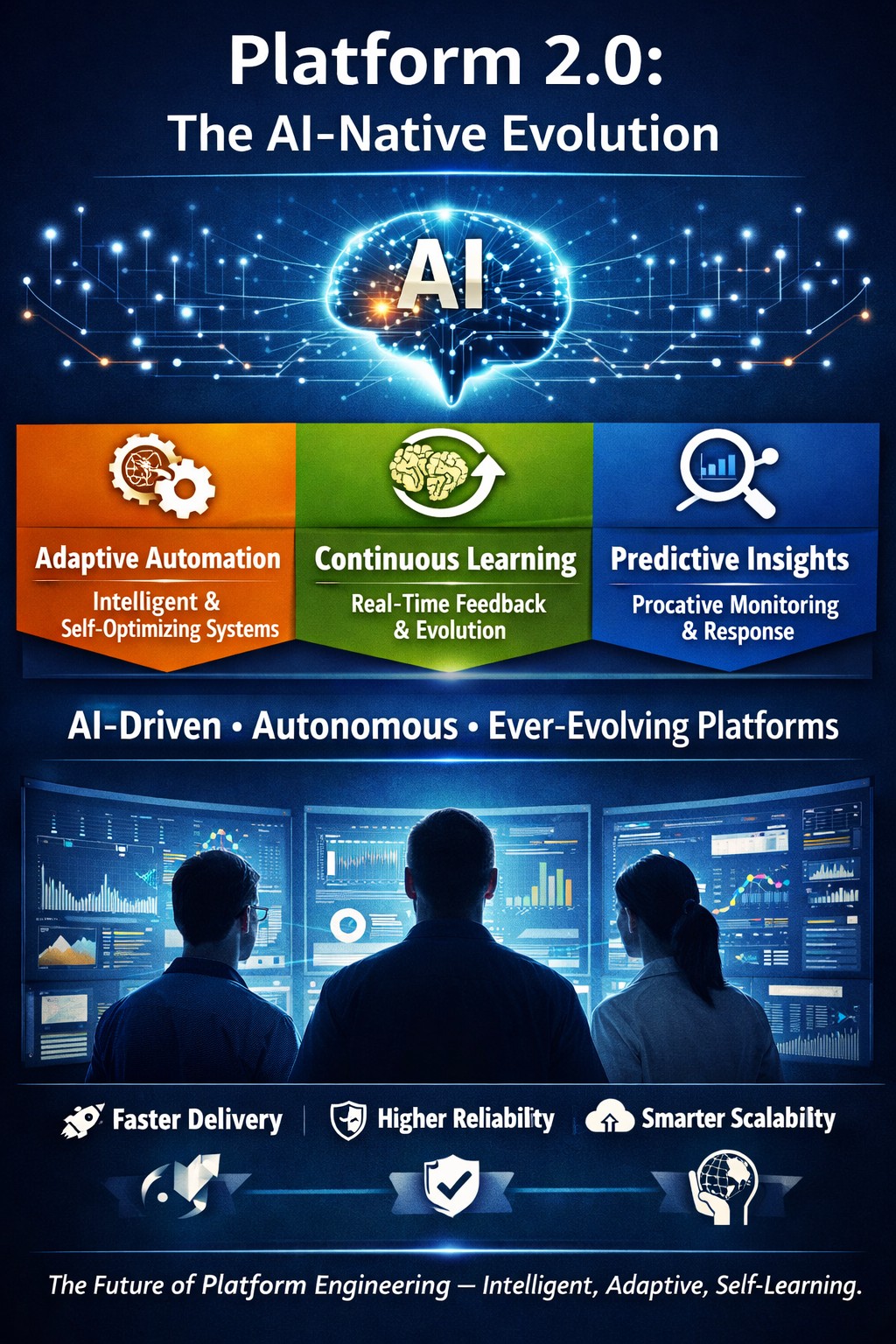
Platform 2.0 represents the next stage of platform engineering, where artificial intelligence becomes a built‑in capability rather than an add‑on. It transforms platforms from static automation frameworks into adaptive, learning ecosystems that continuously optimize themselves.
Core Principles
- Intelligence at every SDLC stage → AI augments design, development, testing, deployment, and operations with predictive and generative capabilities.
- Continuous learning → Feedback loops from telemetry and user behavior refine architecture and performance automatically.
- Autonomous optimization → Platforms self‑tune resources, detect anomalies, and evolve configurations without manual intervention.
- Human‑AI collaboration → Engineers focus on strategic design and governance while AI handles repetitive and analytical tasks.
Platform 2.0 enables faster delivery, higher reliability, and smarter scalability, redefining platform engineering as an AI‑native discipline — intelligent, adaptive, and perpetually evolving.
References and Further Reads
- Platform Engineering — Wikipedia
- What is Platform Engineering
- InfoQ trend report Platform Engineering as early adopters
- ThoughtWorks tech radar recommends adopting Platform Engineering as early as Apr/Oct 2021.
- Team Topologies
- DZone survey where nearly half of respondents indicate using platform engineering.
Published at DZone with permission of Ammar Husain. See the original article here.
Opinions expressed by DZone contributors are their own.
Comments