

Why Your RAG Pipeline, Not Your LLM, Is Causing Hallucinations
Most RAG "hallucinations" aren't the model's fault. They trace back to bad chunking, stale indexes, and loose retrieval thresholds. Fix the pipeline, not the model.
Every time a large language model produces a confidently wrong answer, the industry reaches for the same word: hallucination. It’s a tidy label. It frames the failure as a mysterious, almost biological quirk of the model itself, as if the AI briefly lost touch with reality and there’s not much anyone can do about it except wait for a better model.
That framing is convenient for model vendors. It is much less convenient for the truth. In production systems, especially retrieval-augmented generation (RAG) pipelines, which is how most enterprise AI actually gets deployed the majority of “hallucinations” I’ve seen traced back to something far less mysterious: bad data engineering. Stale indexes. Naive chunking. Missing metadata. Broken retrieval ranking. Silent ingestion failures. None of that is a model problem. All of it gets blamed on the model anyway. If you work in data engineering and you’ve been treating hallucination as someone else’s problem a model-layer issue for the ML team to solve it’s worth looking closer. There’s a good chance the fix lives in your pipeline, not their weights.
What “Hallucination” Actually Looks Like in Production
Textbook explanations describe hallucination as the model generating text that is fluent but factually unsupported by its training data or provided context. That’s accurate as far as it goes, but it skips the part that matters operationally: in a RAG system, the model is only as good as what it’s given to work with.
Consider the actual failure modes engineers report most often:
- The answer is correct, but the citation is wrong. The model pulls the right fact but attributes it to the wrong document, because the retrieval step returned a topically similar but incorrect source.
- The answer is stale. The model confidently reports a policy, price, or spec that used to be true, because the index it’s querying hasn’t been refreshed since the underlying document changed.
- The answer is fabricated from fragments. A document got chunked at an awkward boundary mid-sentence, mid-table, mid-clause and the model stitched together a plausible-sounding but invented conclusion from two unrelated fragments that ended up adjacent in the context window.
- The answer is simply missing information the system actually has. Poor embedding quality or a mismatched similarity threshold means the right document existed in the corpus but never made it into the retrieved context, so the model filled the gap with something it invented.
None of these are the model “hallucinating” in the sense of spontaneously inventing facts from nowhere. They’re the model doing exactly what it’s designed to do: generate a fluent, plausible continuation with broken or insufficient input. Garbage in, confident garbage out.
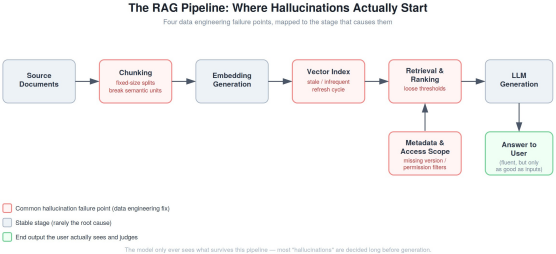
The model only ever sees what survives the pipeline above it. Most hallucinations are decided long before generation even starts in chunking, indexing, retrieval, and metadata handling.
Four Data Engineering Failure Points, and Where They Actually Live
1. Chunking strategy: Most RAG pipelines still chunk documents by a fixed token count, without regard to semantic boundaries. Splitting a table mid-row, a legal clause mid-condition, or a technical spec mid-parameter list doesn’t just lose information. It creates fragments that look complete but aren’t. The model has no way to know a chunk is truncated; it just answers with what it has. This is a classic ETL problem, not a model problem, and it’s fixable with better chunking logic (semantic or structure-aware splitting) long before it ever reaches inference.
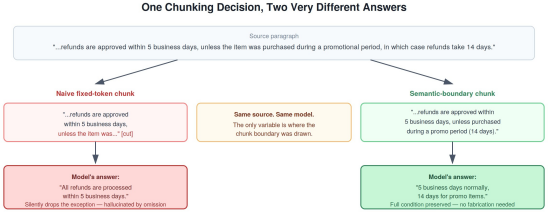
Same source document, same model, the only variable is where the chunk boundary was drawn. The naive split doesn’t just lose text. It produces an answer that sounds complete but silently omits a condition that changes the outcome.
2. Index freshness: Every RAG system has an implicit SLA on data freshness, whether or not anyone wrote it down. If your ingestion pipeline updates the vector index nightly but your source-of-truth documents change hourly, you have a guaranteed hallucination generator. The model will keep confidently answering with yesterday’s truth. This is squarely a pipeline scheduling and change data capture problem.
3. Retrieval ranking and thresholds: Embedding similarity is a proxy for relevance, not a guarantee of it. When similarity thresholds are tuned loosely, tangentially related documents get pulled into context, and the model treats them as authoritative. When thresholds are tuned too tightly, the correct document gets excluded, and the model has to guess. Getting this right is an ongoing data quality and evaluation exercise, not something you set once and forget.
4. Metadata and access-scoped retrieval: A shocking number of hallucinations in enterprise systems come from retrieval that ignores context like document version, region, or user permission, surfacing an outdated or wrong-jurisdiction document because the index wasn’t built with the metadata needed to filter it out. That’s a schema and indexing design failure, full stop.
Why This Reframing Matters
Calling this “hallucination” and routing it to the ML team means the fix gets sought in the wrong place: prompt tweaks, temperature adjustments, or maybe a bigger or newer model. Sometimes that helps marginally. It rarely addresses the actual defect, because the actual defect is upstream of the model entirely.
Reframing it as a data engineering failure changes the incentive structure in a useful way. It puts ownership where the leverage actually is: with the teams who control ingestion, chunking, indexing, freshness, and retrieval quality. It also changes what gets measured. Instead of a vague “hallucination rate” benchmarked against the model, teams start measuring retrieval precision, index staleness, and chunk integrity, metrics that are actually actionable by the people who can fix them.
This doesn’t mean models never confabulate on their own. They do, particularly in open-ended generation without any grounding context at all. But in the RAG-heavy, enterprise-context world most of us are actually building for, the model is rarely the first place to look.
What This Looks Like in Practice
If you want to test this thesis on your own system, a simple exercise: take a sample of hallucinated outputs your users have flagged, and for each one, manually trace whether the correct answer existed somewhere in your indexed corpus at the time of the query. In most systems I’ve audited this way, the correct source material was actually present; it just wasn’t retrieved, wasn’t current, or was fragmented in a way that made it useless. That’s not a model failure. That’s a pipeline failure wearing a model’s name tag.
Before reaching for a bigger model or a different provider, it’s worth auditing:
- Are your chunks semantically coherent or arbitrarily sliced by token count?
- How stale can your index get before anyone notices?
- What’s your actual retrieval precision, not vibes, measured precision, at the top-k results you’re feeding the model?
- Does your retrieval respect metadata like version, scope, and permissions, or does it treat every indexed document as equally valid?
The Bottom Line
“Hallucination” is a useful word for describing a symptom. It’s a misleading word for describing a cause. Most of what gets blamed on the model in production RAG systems is actually a data engineering problem, and it’s one that’s genuinely fixable, with tools and practices data engineers already know well: better ETL, disciplined schema design, freshness SLAs, and rigorous evaluation of retrieval quality. The model isn’t lying to you. Your pipeline is.
Opinions expressed by DZone contributors are their own.