

From Monolith to Microservices: Practical Lessons From Real System Modernization
Microservices add flexibility and scalability but increase complexity. Learn key challenges in observability, DevOps, and data management when moving from monoliths.
Join the DZone community and get the full member experience.
Join For FreeWhy Moving to Microservices Introduces Complexity Development Teams Underestimate
Over the past decade, microservices architecture has become a widely adopted approach for building scalable and flexible software systems. Many organizations modernizing legacy platforms are moving away from monolithic architectures toward smaller, independently deployable services.
The promise of microservices is appealing: independent deployments, improved scalability, and faster development cycles.
However, the transition from monolithic systems to distributed architectures often introduces challenges that are not immediately obvious.
In several enterprise modernization initiatives I’ve worked on, one observation consistently emerged: microservices do not reduce system complexity — they redistribute it across infrastructure, networking, and operational processes.
Understanding this shift is essential for software engineers and architects designing modern distributed platforms.
Understanding Monolithic Architecture
In a monolithic architecture, the entire application runs as a single deployable unit. Core components such as authentication, business logic, reporting, and data access typically share the same runtime environment and database.
This architecture provides several advantages, especially during the early stages of development:
- Simple deployment processes
- Easier debugging and testing
- Centralized data management
- Strong transactional consistency
For smaller teams or systems with moderate complexity, monolithic architectures can be highly effective.
However, as applications grow larger and teams expand, several limitations begin to appear:
- Slower release cycles
- Increased deployment risks
- Difficulty scaling specific parts of the system
- Tight coupling between modules
These limitations often motivate engineering teams to explore microservices architectures.
Monolith vs. Microservices Architecture
The following diagram illustrates the structural difference between monolithic systems and microservices-based architectures.
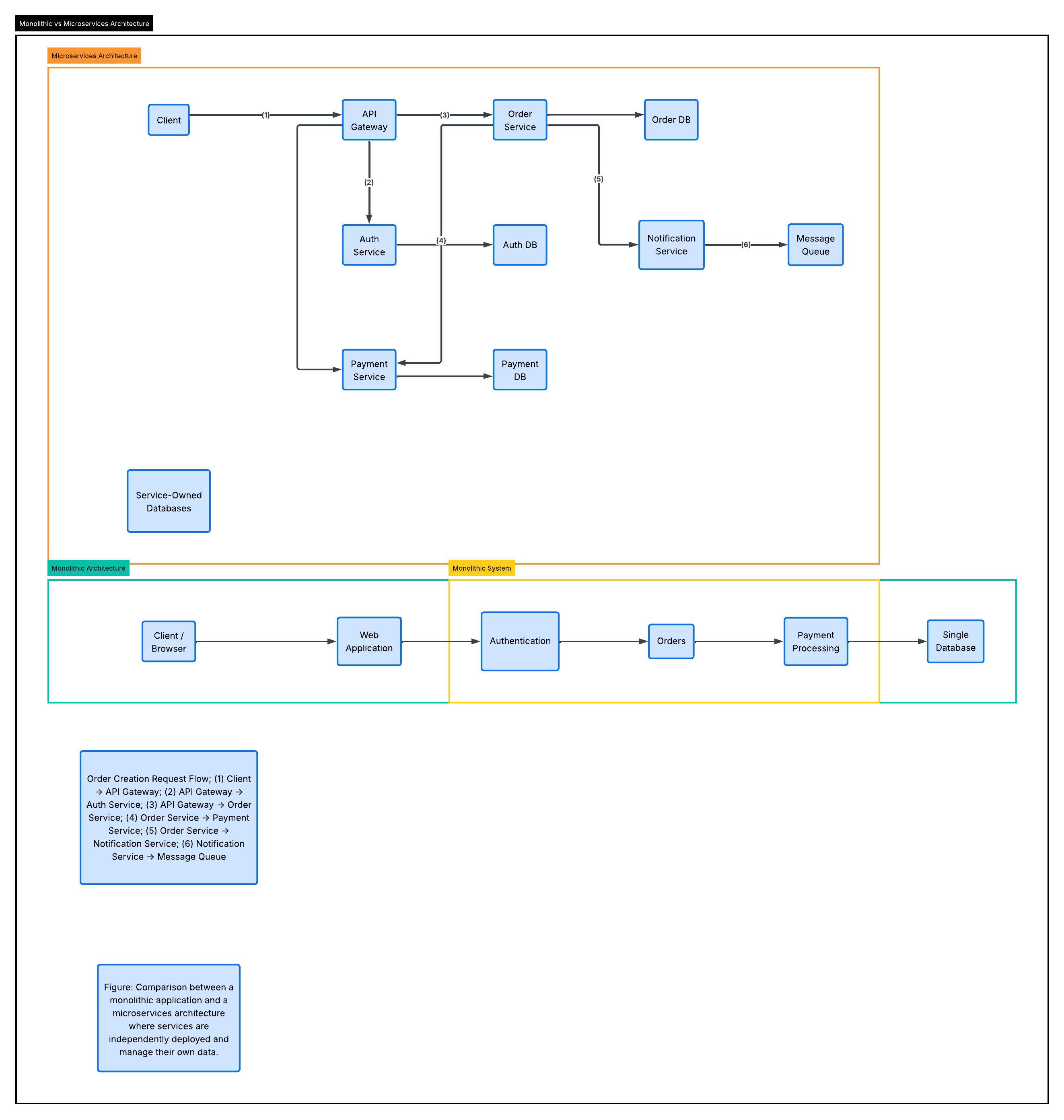
In a monolithic system, all functionality runs inside a single application and shares a common database.
In a microservices architecture, functionality is divided into smaller services that communicate through APIs or messaging systems. Each service typically manages its own data store and can be deployed independently.
While this design provides flexibility and scalability, it also introduces distributed system complexity.
Lesson 1: Distributed Systems Change the Failure Model
One of the biggest shifts when moving from monolithic systems to microservices is how failures occur.
In monolithic systems, most application components run within the same process. When issues occur, developers can usually trace them through application logs or debugging tools.
In microservices architectures, a single request may travel through multiple services before completing.
This introduces challenges such as:
- Network latency between services
- Service-to-service communication failures
- Increased debugging complexity
- Dependency chains between services
For example, placing an order may require interactions between authentication, inventory, payment, and notification services.
If any service in that chain fails, the entire operation may be affected. As a result, engineers must design systems that tolerate partial failures and recover gracefully.
Lesson 2: Observability Becomes Essential
Observability becomes significantly more important in distributed systems.
In monolithic applications, logs and stack traces are often enough to diagnose problems. In microservices environments, however, tracing requests across multiple services requires more sophisticated tooling.
Effective observability strategies often include:
- Distributed tracing systems
- Centralized logging platforms
- Metrics monitoring and alerting
- Service health dashboards
These tools allow engineers to understand how requests move across services and identify performance bottlenecks more effectively.
Without strong observability practices, diagnosing production issues in microservices architectures can be extremely difficult.
Lesson 3: DevOps Maturity Is Critical
Microservices architectures dramatically increase the number of deployable components in a system. Instead of managing one application, engineering teams may need to deploy and maintain dozens of services.
Automation becomes essential. Successful microservices environments typically rely on:
- Continuous integration pipelines
- Automated deployment workflows
- Container orchestration platforms
- Infrastructure-as-code practices
These practices allow teams to deploy services frequently while maintaining system stability.
Organizations attempting to adopt microservices without strong DevOps practices often struggle to manage the operational complexity.
Lesson 4: Defining Proper Service Boundaries
Another challenge when designing microservices is identifying appropriate service boundaries.
Early implementations often split services based on technical layers rather than business capabilities. This can lead to tightly coupled services that require frequent coordination between teams.
A more effective strategy is designing services around business domains, often guided by domain-driven design principles.
When services align with business capabilities, teams gain clearer ownership and can evolve services independently.
Lesson 5: Data Management Becomes More Complex
Data management also changes significantly in microservices architectures.
Monolithic systems often rely on a single relational database with strong transactional guarantees.
In contrast, microservices architectures typically encourage each service to manage its own database. This introduces new challenges, such as:
- Maintaining data consistency across services
- Managing distributed transactions
- Synchronizing data through events
- Handling eventual consistency
To address these challenges, many organizations adopt event-driven architectures where services communicate asynchronously through messaging systems.
Monolith vs. Microservices
| Factor | Monolith | Microservices |
|---|---|---|
| Deployment | Single application | Independent services |
| Scalability | Limited scaling | Scalable per service |
| Complexity | Lower initially | Higher operational complexity |
| DevOps Requirements | Moderate | High |
| Development Speed | Faster initially | Faster at scale |
Real-World Observation
In one modernization initiative I participated in, migrating a large monolithic platform into smaller services significantly improved deployment flexibility.
Teams were able to release features independently without coordinating large system deployments.
However, the transition also required significant investment in monitoring infrastructure, distributed logging platforms, and automated deployment pipelines.
This experience reinforced an important insight: Microservices are not only an architectural change — they require operational maturity as well.
Final Thoughts
Microservices have changed how modern software systems are designed and scaled. When implemented thoughtfully, they enable organizations to build flexible architectures that support large development teams and rapid innovation.
However, microservices also introduce new complexities in distributed communication, observability, and data management.
Engineering teams considering this transition should recognize that microservices are not a universal solution. Instead, they are a powerful architectural approach that must be applied carefully depending on system scale, team size, and operational readiness.
When supported by strong DevOps practices and thoughtful architecture design, microservices can deliver significant long-term value.
Further Reading
- Microservices – Martin Fowler: https://martinfowler.com/articles/microservices.html
- Building Microservices – Sam Newman
- Domain-Driven Design – Eric Evans
- Designing Data-Intensive Applications – Martin Kleppmann
Opinions expressed by DZone contributors are their own.
Comments