

The Code-Volume Delusion: Rethinking Engineering Velocity in the AI Era
AI is shifting the engineering bottleneck downstream, requiring leaders to prioritize PR cycle times, CI/CD stability, and architectural health.
 ·
·
Join the DZone community and get the full member experience.
Join For FreeLet's be honest about what happens when you give an entire engineering team AI coding assistants.
You look at the sprint board, and tickets are moving to "In Review" faster than ever. Your developers are happy. They are writing boilerplate in seconds and generating entire component structures before their morning coffee gets cold. If you measure productivity by the sheer volume of code generated, your team has successfully turned into a factory.
But then you look at your deployment frequency. It's flat. Depending on the week, it might actually be trending downward.
How can a team be writing code twice as fast, but shipping to production at the exact same speed?
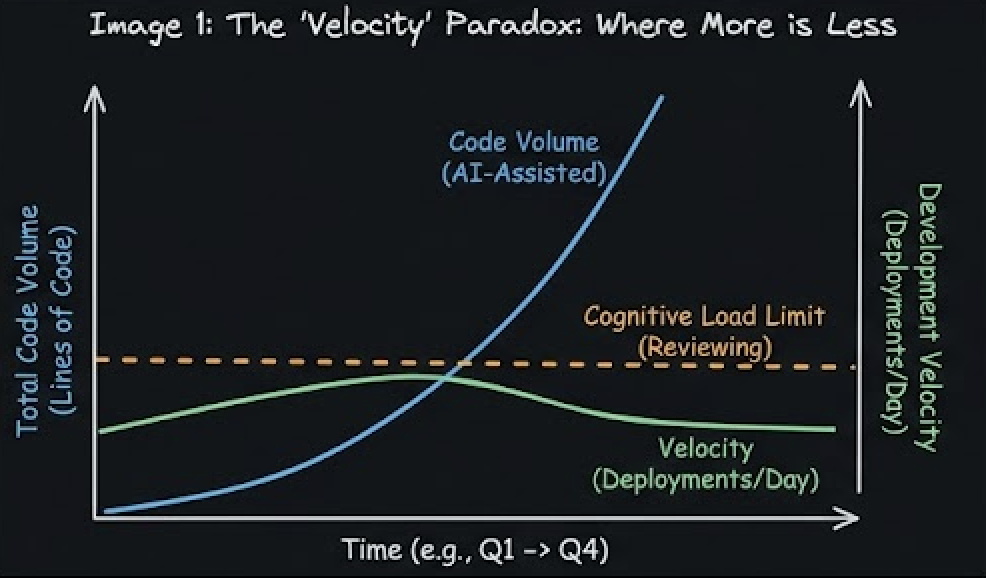
The problem is that output increases, but throughput/deployments remains static or drops. The challenge is how to address this.
The answer lies in basic systems engineering. If you optimize a step in a process that isn't the primary bottleneck, your overall throughput doesn't change. We just spent the last two years making typing faster. But typing was never the hardest part of software development.
As engineering leaders, we are flying blind if we rely on legacy productivity metrics in an AI-assisted world. The bottleneck hasn't disappeared; it has simply shifted downstream. To actually measure and manage engineering velocity today, you need to abandon "lines of code" and start tracking the new friction points.
Here are the three metrics you need to start watching immediately.
1. PR Cycle Time (and the "Rubber-Stamp" Ratio)
AI tools are incredible at generating massive blocks of code. They are decidedly not incredible at explaining the architectural reasoning behind why they generated it.
When a developer uses an LLM to build a feature, they often submit a massive Pull Request. For the author, it took ten minutes. For the senior engineer assigned to review it, it's a nightmare. Reviewing 500 lines of AI-generated code in a GitHub diff requires significantly more cognitive load than reviewing human-written code, because AI code often lacks a recognizable, human train of thought.
The immediate result? Your PRs sit in the queue for days.
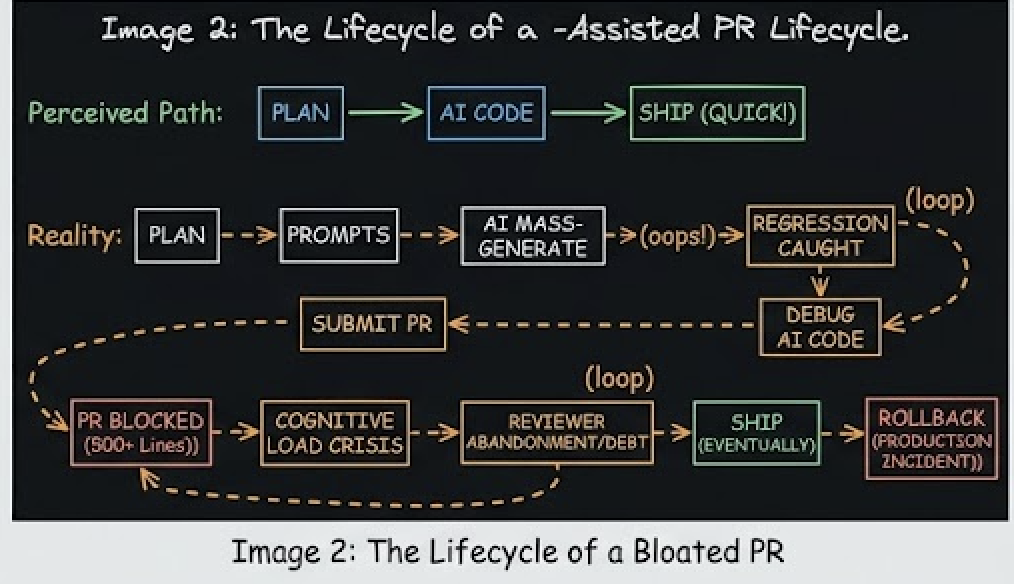
What to track:
-
Time to First Review / Time to Merge: If this metric is spiking while ticket completion is dropping, your bottleneck is purely code review. You need to enforce strict PR size limits. AI or not, a PR should rarely exceed 300-400 lines of logic.
-
The Rubber-Stamp Ratio: Look for massive PRs that are approved in under five minutes with a simple "LGTM." This means your senior engineers are overwhelmed and are just pushing AI code through without reading it. That is a ticking time bomb for production outages.
2. CI/CD Pipeline Stability and P95 Build Times
More code means more tests. AI is perfectly happy to generate fifty unit tests for a single utility function. On the surface, high test coverage looks great to upper management.
But if those tests are poorly constructed, overly coupled to implementation details, or reliant on flaky assertions (especially in UI testing), your CI/CD pipeline is going to grind to a halt. We’ve all seen it: a developer merges a feature, and the build fails three times in a row because of a flaky, auto-generated E2E test that didn't properly await a DOM element.
What to track:
-
Build Failure Rate (specifically on the main branch): If your developers are moving fast but your pipeline is constantly turning red, your velocity is zero.
-
P95 Build Duration: Is your pipeline taking 45 minutes to run because it's executing thousands of low-value, AI-generated tests? You might need to implement a "Build Gardener" rotation—assigning an engineer each sprint to aggressively prune useless tests, update assertions, and optimize pipeline caching.
3. The Code Churn Rate and Architectural Decay
Think of an AI coding assistant as a highly enthusiastic, incredibly fast junior developer. It solves the immediate problem right in front of it. It does not look at the holistic architecture of your application and decide to refactor a base class for long-term scalability.
If developers lean too heavily on AI for problem-solving, you end up with massive amounts of duplicated logic and hyper-localized fixes. The code works today, but the architecture rots tomorrow.
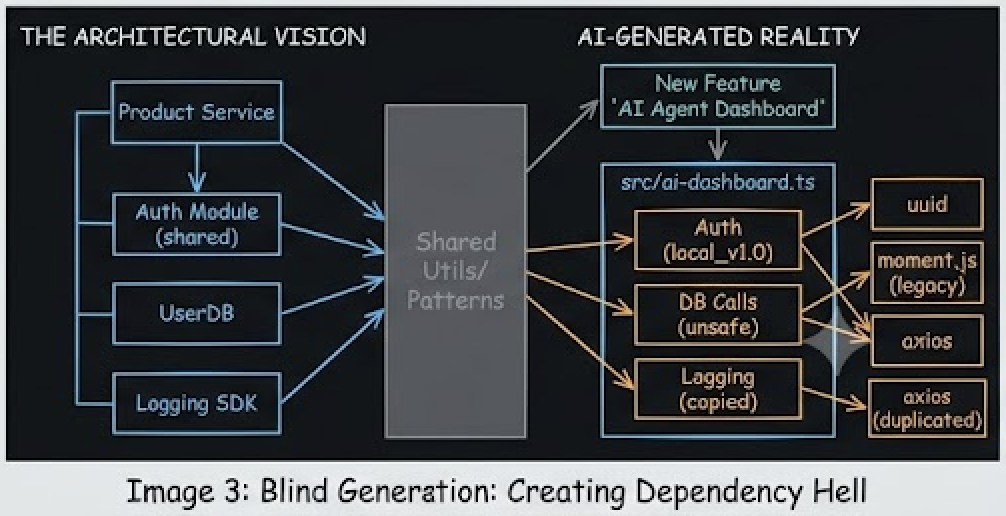
What to track:
-
Code Churn (Percentage of code rewritten within 3-4 weeks of being merged): High churn in an AI environment usually means developers are using trial-and-error via prompts rather than thinking through the system design. They merge a feature, realize it breaks an edge case, and have the AI write a messy patch the very next week.
-
Tech Debt Ratio vs. Feature Delivery: You have to force developers to slow down and do architectural planning before they open their IDE. If you don't track the time spent paying down debt, the sheer volume of AI-generated code will eventually bankrupt your architecture.
The Takeaway
AI coding assistants are a massive net positive for the industry. But they are a hyper-efficient engine, and an engine is dangerously useless if you don't upgrade your brakes and steering at the same time.
Stop looking at how fast your developers are closing tickets. Start looking at the health of your review culture, the speed of your pipelines, and the stability of your architecture. That is where the real engineering management happens today.
Opinions expressed by DZone contributors are their own.
Comments