

Architecting Scalable JSON Pipelines: The Power of a Single PySpark Schema
Build resilient, scalable data pipelines by flattening nested JSON with PySpark, schema-driven parsing, and Delta Lake for analytics-ready datasets.
Join the DZone community and get the full member experience.
Join For FreeIn modern data pipelines, dealing with JSON has become part of daily life. Almost every system we integrate with produces some form of semi-structured data, whether it’s application logs, third-party APIs, IoT device telemetry, or user interaction events. While JSON gives teams flexibility, it also introduces a quiet but persistent challenge: how do you reliably parse and flatten data when the structure is deeply nested, constantly evolving, and rarely consistent across sources?
Many teams fall into the trap of writing one-off parsers. Columns are hardcoded, nested fields are manually extracted, and every schema change turns into a fire drill. Over time, this approach becomes fragile, hard to maintain, and expensive to scale. What starts as a quick fix slowly turns into technical debt that slows down the entire data pipeline.
The real value of this approach is consistency. New data sources can be onboarded faster, schema changes are easier to manage, and data engineers spend less time debugging parsing logic and more time building meaningful data products. It also creates a clear contract between data producers and consumers, which is critical as organizations scale their data platforms.
In a world where data complexity keeps growing, having a generic, schema-driven way to handle JSON is no longer a nice-to-have. It’s a practical foundation for building resilient, scalable data pipelines that teams can trust and evolve with confidence.
Metadata-Driven Architecture
A metadata-driven architecture decouples processing logic from data structures. Instead of hard-coding ETL rules for every source, the system reads instructions such as schemas, mapping rules, and destinations from a central repository (JSON, SQL, or YAML). This allows a single, generic pipeline to handle diverse datasets dynamically, maximizing scalability and reusability.
By leveraging PySpark’s powerful pyspark.sql.types and from_json functions, you can build a generic parser that treats schemas as configuration rather than code. Instead of writing unique transformations for every new data source, this engine ingests a raw JSON string and a target schema definition, then dynamically maps the two.
Approach to Solve This Problem
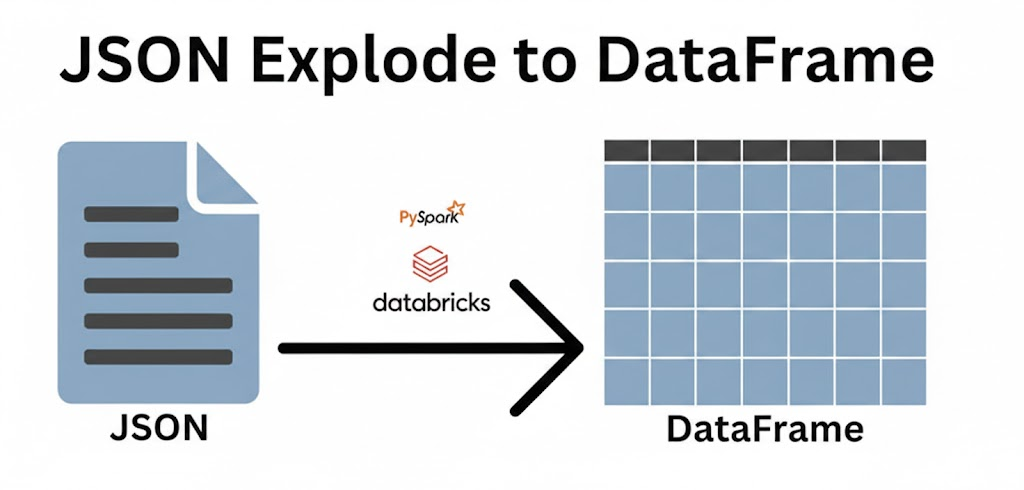
To address this, built a generic JSON parser using PySpark with a very simple goal in mind: make JSON ingestion predictable, reusable, and boring in the best possible way. Instead of relying on hardcoded logic, the parser takes a provided schema as its single source of truth. From there, it automatically flattens nested structures, handles arrays, and transforms the data into a clean, analytics-ready format without requiring manual intervention for each new dataset.
The Mechanics: How the Magic Happens
Forget the nightmare of writing endless .select() calls or chaining .withColumn() until your code looks like a skyscraper. The goal here is a "set it and forget it" engine. First, the parser ingests the raw JSON blob using spark.read.json. From there, the real heavy lifting begins: a recursive schema traversal.
The engine walks through the nested tree of the provided schema, identifying every struct and array. It dynamically resolves these deep paths into a clean, flattened DataFrame where every nested element gets its own column — without you lifting a finger. Finally, it’s ready to land, whether you’re pushing to a Delta Lake table, a Parquet file, or an external warehouse.
def flatten_dataframe(df, schema):
    """
    Flattens nested structs and arrays in a DataFrame schema.
    Arrays are exploded, and struct fields are promoted to top-level columns.
    """
    for field in schema.fields:
        column_name = field.name
        data_type = field.dataType

        # Explode arrays into individual rows
        if isinstance(data_type, ArrayType):
            df = df.withColumn(column_name, explode(col(column_name)))

        # Flatten struct fields into separate columns
        elif isinstance(data_type, StructType):
            for nested_field in data_type.fields:
                nested_column = f"{column_name}_{nested_field.name}"
                df = df.withColumn(
                    nested_column,
                    col(f"{column_name}.{nested_field.name}")
                )

            # Drop the original struct column after expansion
            df = df.drop(column_name)

    return df
Why This Is a Game Changer
Let’s be honest: most JSON data is a disaster. Hardcoding logic for every new API response is a fast track to burnout and technical debt. By centralizing your logic into a reusable, generic parser, you’re doing three things:
- Buying back your time: Engineering hours are spent on insights, not manual mapping.
- Killing schema drift: The parser handles what it's told, making it resilient to unexpected upstream changes.
- Future-proofing: Your ingestion layer becomes a robust, maintainable asset rather than a collection of "one-off" scripts.
Hard-Won Lessons From the Trenches
Through building this, a few "golden rules" emerged. First: Never trust the documentation. APIs lie; the actual schema coming through the wire is your only source of truth. Second, be careful with your Explodes. If you flatten arrays too early, you’ll end up with a massive row-multiplication problem that tanks performance. Lastly, if your sources change frequently, a schema registry is your best friend to keep versions straight.
What’s Next for the Parser?
While the current version is powerful, there's always room to level up. I’m looking into auto-schema inference with smart sampling to validate data on the fly. I’d also love to add dynamic column lineage so we can track exactly how a nested field became a flat column. Finally, the next frontier is full integration with streaming sources like Kafka, bringing this "One Schema" simplicity to real-time data.
Delta Format Support
raw_df = spark.read.json(input_path)

flattened_df = flatten_dataframe(raw_df, raw_df.schema)

write_to_delta(
    df=flattened_df,
    path="/delta/events",
    mode="overwrite",
    partition_cols=["event_date"]
)

delta_df = read_from_delta(spark, "/delta/events")
Recursive Flattening Engine
- Walks the schema recursively
- Explodes arrays safely
- Flattens deeply nested structs
- Preserves column lineage via naming
from pyspark.sql.functions import col, explode_outer
from pyspark.sql.types import StructType, ArrayType


def flatten_recursive(df, schema, prefix=""):
    """
    Recursively flattens a DataFrame schema.
    Struct fields are expanded and arrays are exploded.
    """
    for field in schema.fields:
        field_name = field.name
        qualified_name = f"{prefix}.{field_name}" if prefix else field_name
        flat_name = f"{prefix}_{field_name}" if prefix else field_name
        data_type = field.dataType

        # Handle arrays
        if isinstance(data_type, ArrayType):
            df = df.withColumn(flat_name, explode_outer(col(qualified_name)))

            # Recurse into array element if it's a struct
            if isinstance(data_type.elementType, StructType):
                df = flatten_recursive(
                    df,
                    data_type.elementType,
                    prefix=flat_name
                )

        # Handle structs
        elif isinstance(data_type, StructType):
            df = flatten_recursive(
                df,
                data_type,
                prefix=flat_name
            )

        # Handle primitive columns
        else:
            if qualified_name != flat_name:
                df = df.withColumn(flat_name, col(qualified_name))

    # Drop original nested column after expansion
    if prefix:
        df = df.drop(prefix)

    return df
Schema Injection at Read Time
Instead of relying on Spark’s inference, inject a known schema explicitly.
- No hardcoded column paths
- Safe handling of missing or null arrays
- Deterministic schemas across environments
- Easy to extend with schema registry or Delta
from pyspark.sql.types import StructType


def read_json_with_schema(spark, path, schema: StructType):
    """
    Reads JSON with an explicit schema to avoid inference issues.
    """
    return (
        spark.read
            .schema(schema)
            .option("mode", "PERMISSIVE")
            .json(path)
    )
from pyspark.sql.types import (
    StructType, StructField, StringType, IntegerType, ArrayType
)

event_schema = StructType([
    StructField("event_id", StringType()),
    StructField("user", StructType([
        StructField("id", StringType()),
        StructField("attributes", StructType([
            StructField("age", IntegerType()),
            StructField("country", StringType())
        ]))
    ])),
    StructField("items", ArrayType(
        StructType([
            StructField("sku", StringType()),
            StructField("price", IntegerType())
        ])
    ))
])
raw_df = read_json_with_schema(
    spark,
    path="/data/raw/events.json",
    schema=event_schema
)

flattened_df = flatten_recursive(raw_df, raw_df.schema)
Conclusion
This approach turns messy, evolving JSON into reliable, analytics-ready data by combining recursive parsing, schema injection, and Delta Lake, making ingestion pipelines resilient, scalable, and far easier to maintain.
Opinions expressed by DZone contributors are their own.
Comments