

Scaling Infrastructure as Code in Enterprise Automation
Tools like Ansible enable modernization but introduce a coding skills gap. This article outlines a pattern to democratize automation using intermediate tooling.
Join the DZone community and get the full member experience.
Join For FreeAs we approach the "2025 Cliff" — a predicted shortage of skilled IT personnel combined with the rapid aging of legacy systems — enterprises face a dilemma. We must modernize infrastructure to survive, but we lack the headcount to do it manually.
The industry answer is Infrastructure as Code (IaC). However, moving from manual operations to code-based automation is not just a technological shift; it is a cultural and skill-based chasm. Traditional Ops teams possess deep domain knowledge (network routing, OS kernel tuning) but often lack the software engineering skills required to maintain complex Ansible Playbooks or Python scripts.
Based on recent large-scale infrastructure modernization projects, this article outlines a strategy to bridge this gap. We explore how to build abstraction layers — specifically "Procedure-to-Code" and "Parameter-to-Config" generators — that allow legacy teams to adopt Ansible without becoming full-time developers.
The Limitation of "Rigid" Automation
Many enterprises start with "standardized build tools," proprietary scripts, or GUI-based wizards designed to build servers exactly one way. While effective for greenfield projects, these tools fail in modernization scenarios because:
- Limited scope: They cannot handle the "snowflake" configurations found in legacy systems.
- Black box: When the tool fails, operators cannot debug the underlying code.
- Vendor lock-in: They rarely integrate well with modern CI/CD pipelines.
To solve this, we turn to Ansible. It is agentless, uses readable YAML, and supports a massive ecosystem of modules. However, Ansible introduces a new bottleneck: The Playbook Creation Tax.
The Problem: The Automation Skill Gap
Migrating a 10-year-old system to code requires translating human intuition into YAML logic. This leads to two specific hurdles:
- The "Blank Page" syndrome: An engineer may know how to run
yum install httpdand edithttpd.conf, but not how to structure an Ansible Role, managegroup_vars, or handle idempotency checks. - Maintenance nightmare: Without software engineering discipline, Playbooks become spaghetti code: hardcoded IPs, massive monolithic files, and zero reusability.
The solution is not just teaching Ops to code; it's building tools that generate the code for them.
Pattern 1: BP2Y (Build Procedure to YAML)
The first architectural pattern is BP2Y. Instead of asking engineers to write YAML from scratch, we allow them to input a "Structured Procedure" essentially a list of commands they would run manually and generate a Playbook skeleton.
The Workflow
- Input: A standardized list of OS commands (e.g.,
mkdir,cp,systemctl). - Processing: A Python parser maps these commands to best-practice Ansible modules.
- Output: A valid, idempotent Ansible Playbook.
Code Example: The Concept
Imagine a Python script that takes a CSV of manual commands and converts them.
# Conceptual logic for BP2Y Generator
import yaml

def map_command_to_module(command):
    if command.startswith("yum install"):
        pkg = command.split(" ")[2]
        return {
            "name": f"Install {pkg}",
            "yum": {"name": pkg, "state": "present"}
        }
    elif command.startswith("service"):
        parts = command.split(" ")
        return {
            "name": f"Manage service {parts[1]}",
            "service": {"name": parts[1], "state": parts[2]}
        }
    # Fallback to shell module (discouraged but functional)
    return {"name": "Run raw command", "shell": command}

# Input: The Manual Runbook
manual_steps = [
    "yum install nginx",
    "service nginx start"
]

# Output: The Ansible Playbook
playbook = [{"hosts": "webservers", "tasks": [map_command_to_module(cmd) for cmd in manual_steps]}]
print(yaml.dump(playbook))
Benefit: This lowers the barrier to entry. The Ops engineer provides the logic, and the tool handles the syntax.
Pattern 2: PS2C (Parameter Sheet to Config)
The second pattern addresses the separation of Code (Logic) and Data (Configuration). In legacy environments, configuration is often trapped in Excel "Parameter Sheets."
We implement PS2C to parse these spreadsheets and generate the variable files (host_vars or group_vars) required by Ansible.
The Architecture
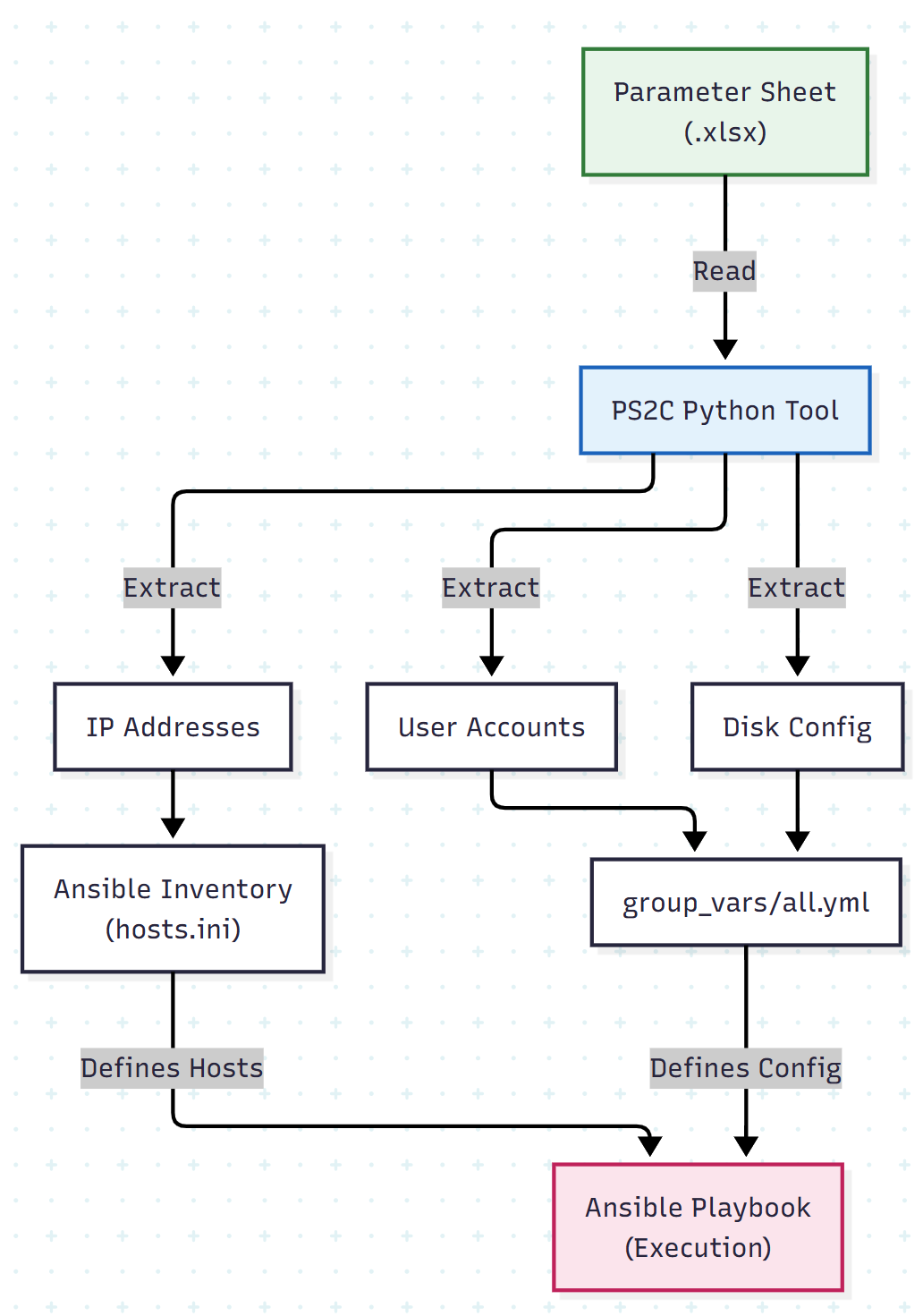
Why this matters
By decoupling the data, we ensure that the Ansible Playbook remains generic.
- Bad: Hardcoding
192.168.1.50in the YAML task. - Good: Using
{{ ansible_host }}and populating it via PS2C.
This allows the same automation logic to be reused across Dev, Staging, and Production environments simply by feeding it a different Excel sheet.
Operational Lifecycle: The "Update" Problem
Automation is software. It has bugs, and it rots. A major challenge identified in large-scale deployments is Version Drift.
- OS Updates: RHEL 7 commands might not work on RHEL 9.
- Tool Updates: Ansible modules deprecate parameters.
To handle this, we must implement a Maintenance Cycle for the automation tools themselves.
The CI/CD Approach for Ops
- Linting: Use ansible-lint to enforce coding standards automatically.
- Regression Testing: Before a major OS patch, run the Playbooks against a disposable VM to verify the automation still works.
- Version Pinning: Treat the "BP2Y" and "PS2C" generators as products. Version them (v1.0, v1.1) and require Ops teams to update their generators to support new OS features.
Conclusion
The transition to Automated Configuration is inevitable, but the "cliff" of missing skills is steep. By treating automation as a product rather than a task, we can build intermediate tools that bridge the gap.
- Don't force every SysAdmin to become a YAML expert on day one.
- Do build generators (BP2Y) that translate their domain expertise into code.
- Do build parsers (PS2C) that turn their documentation into configuration.
This approach creates a "Safe Harbor" for legacy teams, allowing them to participate in the modernization journey while maintaining the stability of the systems they support.
Opinions expressed by DZone contributors are their own.
Comments