

10 Strategies for Scaling Synthetic Data in LLM Training
Learn 10 proven strategies to scale synthetic data for LLM training, ensuring quality, diversity, governance, and long-term model performance.
Join the DZone community and get the full member experience.
Join For FreeWith businesses desperately searching for ways to reduce data bottlenecks associated with LLMs, synthetic data is now emerging as a leading solution. For those encountering difficulties in accessing, purchasing, and utilizing high-quality datasets due to scarcity, legalities, or costs, synthetic data provides a way out. You can also generate "long-tail" data that is difficult to find and use at scale.
Large language model (LLM) training teams are experiencing challenges in sourcing sufficient quality data for training purposes. Although data may exist, the data often has contractual restrictions or other limitations on its usage. Even if there are no contractual restrictions, cleaning, validating, and standardizing such data so that it produces consistent results during training is an extremely costly process. Due to this, synthetic data has emerged as a critical element in the training strategies of numerous LLM training teams.
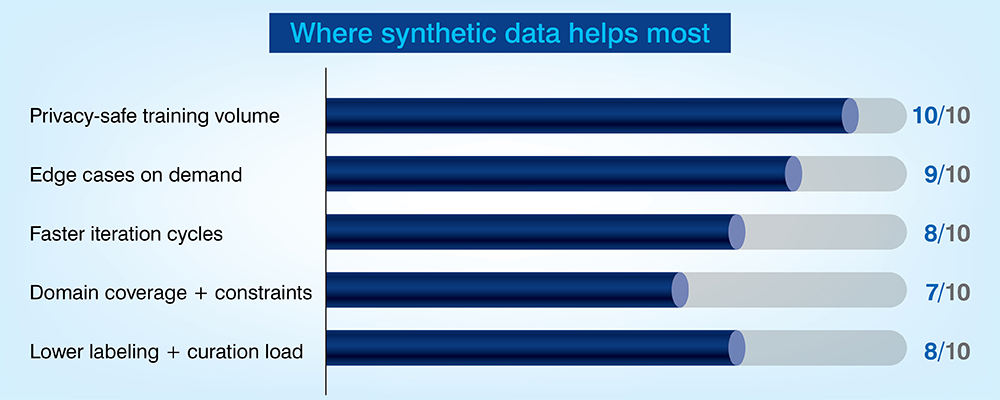
That’s why synthetic data has shifted from “nice extra” to a synthetic data infrastructure.
Imagine the extent of demand as the global synthetic data generation market size is projected to reach USD 1,788.1 million by 2030 at a staggering 35.3% CAGR from 2024 to 2030.
Gartner mentions that organizations lack AI-ready data unless the organization has access to ready-to-use AI data. Synthetic data pipelines can fulfill this need by generating large volumes of training data used to train LLMs through AI algorithms, which include controls, reviews, and traceability.
Top Strategies for Scaling Synthetic Data in LLM Training
You cannot simply decide to create synthetic data and expect to get meaningful results. Instead, begin with the end in mind: define the objectives that correspond to the downstream tasks you want to achieve.
Strategy 1: Define Task-Specific Synthetic Data Objectives
Retrieval-based training requires query and evidence alignment.
- Reasoning-based training requires calibrated levels of complexity so that the model will learn to determine whether it needs to process additional information or provide a direct answer.
- Domain-specific training requires the language, constraints, and tone of the specific domain.
- Finally, be sure to differentiate between pre-training data augmentation and fine-tuning data generation.
Although there is some overlap between the two, they serve different purposes. Pre-training can tolerate a wider range of variability. Fine-tuning requires strict schemas, rubrics, and output constraints.
Strategy 2: Control Data Distribution With Domain-Aware Prompt Engineering
One of the biggest issues with creating synthetic corpora is the tendency to create far too many examples of happy-path cases. These happy-path cases present no challenges to the model. In fact, models tend to perform very well in evaluation environments but struggle with the messiness of real-world prompts.
Controlling data distribution balances common intents, realistic variations, and difficult tail cases, which addresses the happy-path issue. Domain-aware prompt engineering provides a method for controlling data distributions in a purposeful manner, as opposed to allowing the distributions to develop accidentally, and taxonomies and controlled vocabularies help to minimize terminology drift. To further anchor synthetic text to domain reality, especially in high-compliance environments, teams can use structured generation patterns.
Strategy 3: Use Human-in-the-Loop Validation at Scale
Automated pipelines are prone to drift. Automated generators tend to repeat patterns. Automated checks fail to capture nuances. And plausible-looking samples can cause the model to train on the wrong behavior. This is why human-in-the-loop validation is required to prevent drift and ensure consistency throughout the pipeline.
However, human-in-the-loop validation can be used most effectively through strategic sampling. In particular, experts can validate the most risky areas of the pipeline and new templates. Spot checks can identify drift early, and feedback loops can correct recurring errors. To track quality signals, use practical signals related to semantic accuracy, schema fidelity, and task compliance.
This is how you can maintain quality and consistency of synthetic datasets as volume increases, as opposed to hoping for the best.
Strategy 4: Maximize Linguistic and Semantic Diversity
If you create synthetic data that sounds just like all other synthetic data, you may actually be reducing the potential for generalization of the model using that synthetic data.
When the model is trained using synthetic data generated in one single style, the model is learning the style of the generator and not the variability in the users. Create linguistic and semantic diversity through intentional methods such as:
- Sampling variation to ensure that the model sees a variety of ways to express the same thing.
- Multiple generator models to avoid developing a single dominant pattern.
- To increase coverage across various sentence structures, reasoning depths, and intent framing, without violating the constraints that you established for the task.
Diversity expands the range of the model; it doesn't introduce unnecessary noise.
Strategy 5: Generate Synthetic Edge Cases and Failure Scenarios
Edge cases and failure scenarios are rarely captured in real-world corpora, yet they are precisely where brittle behavior resides. Synthetic data can be designed to simulate edge cases and failure scenarios, providing a way to test the model's ability to handle those types of behaviors on demand. In particular, you can generate the following types of edge cases and failure scenarios:
- Conflicting constraints that test the model's ability to reason and understand the hierarchy of instructions
- Adversarial prompts that probe the policy boundaries of the model
- Low-resource scenarios, where the number of examples available is limited.
Synthetic data generation is particularly useful for strengthening the model's robustness in the long tail, where failures can result in lost trust, increased support costs, and even lost revenue.
Strategy 6: Combine Synthetic and Real Data Using Weighted Blending
The sixth strategy is to blend your synthetic data with real-world data by way of a weighted aggregation approach to cover missing areas of coverage, to identify the fundamental nature of natural language patterns as represented in synthetic data, and to create a method to determine the percentage of synthetic to real-world data at each level. Weighted aggregation allows you to control how much repetition occurs within the data during pretraining, which helps prevent overfitting of the data; however, it also requires that you apply additional filtering and schema checks during fine-tuning.
While both Preference Learning and Reinforcement Learning from Human Feedback (RLHF) utilize synthetic data pairs, Preference Learning remains dependent upon the judgments of humans. A curriculum-style blended dataset typically performs better than a randomly sampled dataset because a curriculum-style blended dataset controls the level of difficulty within a given task and prevents sudden and/or unforeseen shifts.
Strategy 7: Implement Strong Data Governance and Traceability
As volume grows, it is crucial to be able to explain what was modified, when, and why. Data governance establishes the means to do so. Create version datasets and slices. Document the generation parameters and templates. Identify the generator model name, revision history, and applied filters.
Establishing robust traceability will enable audits to survive, regressions to become debuggable, and ultimately will make your pipeline repeatable. Without establishing data governance, synthetic data scaling will simply consist of a series of single-use runs without accountability.
Strategy 8: Automate Quality Scoring and Filtering
Automated quality metrics for content are necessary to enable the scalable application of human review processes. The automated quality metrics should include rule-based evaluations for schema and formatting, and model-based evaluations for compliance with the instructions provided and semantic noise.
Duplicate and near-duplicate detection should be included to eliminate duplication. It should also continually filter. Filtering is important because the introduction of hallucinations and small discrepancies through synthetic data generation can lead to continuous degradation of the training process and its associated evaluation.
Therefore, ongoing filtering will help maintain a high signal-to-noise ratio and help prevent the degradation of the training process and associated evaluation reliability.
Strategy 9: Localize and Multilingualize Synthetic Data Pipelines
Although many pipelines are skewed toward English, localization is more important than translation and can limit the ability to expand products and degrade performance in multilingual environments. Synthetic data is useful in expanding low-resource languages; however, localization is significantly more important than translation.
Domain terminology must be correct, tone must align with local standards, and context must appear natural. Curation by experts is critical in these cases. Although fluent-but-wrong text can damage credibility and skew downstream evaluation in difficult-to-identify ways, expert curation will minimize the risk of these issues occurring.
Strategy 10: Design Synthetic Pipelines for Iterative Model Feedback
In terms of durability, closed-loop systems are the best form of synthetic data pipeline. Derive error from evaluation and production signals, generate targeted synthetic corrections, retrain, and retest.
By doing so, your dependence on the procurement of new real-world data will decrease, and your ability to develop models will increase as the models' behavior changes due to updates. In addition, the closed-loop system will be able to detect the onset of drift prior to it entering millions of synthetic samples.
Why Eterprise-Grade Synthetic Data Requires Specialized Partners
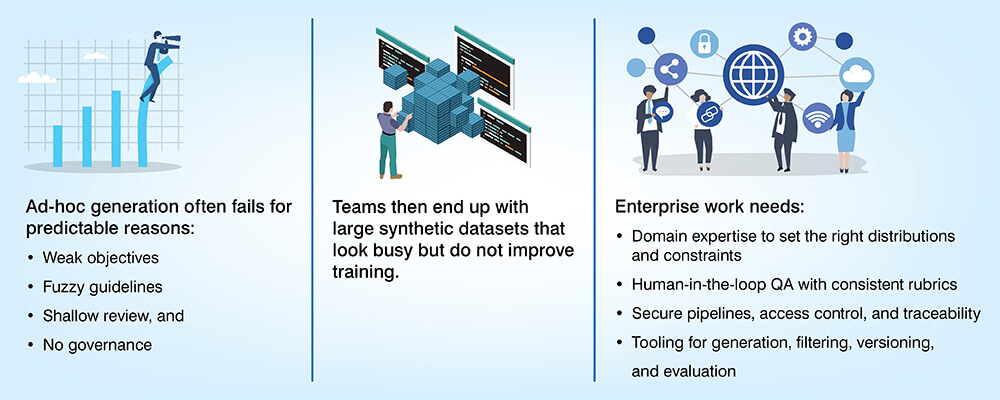
On “synthetic dataset tools,” most teams use a mix: prompt orchestration, dataset versioning, and evaluator frameworks, plus generation methods like prompt-based synthesis, distillation, and self-instruct patterns described in the reference.
Synthetic Data as a Long-Term LLM Scaling Strategy
Synthetic data is moving quickly from being a complementary technology to LLMs to becoming a core element in how teams develop, manage, and continually improve their models over time. Teams will get the most out of synthetic data if they create and sustain robustly engineered synthetic data pipelines based on well-defined objectives, controlled distributions, human-in-the-loop validation, and continuous, automatic filtering and traceability.
If you treat synthetic data as an infrastructure component, you will have achieved safer scale-up, rapid iteration, and dependable training data under realistic stressors.
Published at DZone with permission of Chirag Shivalker. See the original article here.
Opinions expressed by DZone contributors are their own.
Comments