

The Human-in-the-Loop AI: Reviving the Lost Art of Procedure Manuals
In the rush to automate everything, we forgot the most important API: the human operator. Here is an architectural pattern using Gen AI to fix broken documentation.
Join the DZone community and get the full member experience.
Join For FreeWe often treat “automation” and “documentation” as enemies. The prevailing DevOps wisdom is that if you have a runbook, you should automate it into a script. If you can’t automate it, you tolerate it as toil.
However, in complex cloud operations (CloudOps), there are persistent “Non-Automated Domain” tasks that require human judgment, complex troubleshooting, or legacy system interaction. When these tasks fail, it’s rarely because the engineer lacked skill; it’s because the documentation was ambiguous, outdated, or written by someone who left the company three years ago.
This article outlines a strategy to solve the “Documentation Debt” crisis. By combining Collaborative Refinement with a Generative AI Review Tool, we can transform static wikis into dynamic, error-checked knowledge bases.
The Problem: The “Implicit Knowledge” Gap
Documentation rot is a silent killer of Mean Time to Recovery (MTTR). The root cause is the gap between the Creator (Dev/Architect) and the User (Ops).
| Perspective | The Creator (Dev) | The User (Ops) |
| Goal | Specification accuracy | Execution speed |
| Context | Deep system internals | "What do I type now?" |
| Blind Spot | Assumes reader knows the jargon | Misses implicit prerequisites |
This gap leads to escalation. An operator reads step 3, finds it ambiguous (“Check system health”), and escalates the ticket to a senior engineer. The senior engineer fixes it in five minutes but burns an hour of context switching.
The Solution Architecture
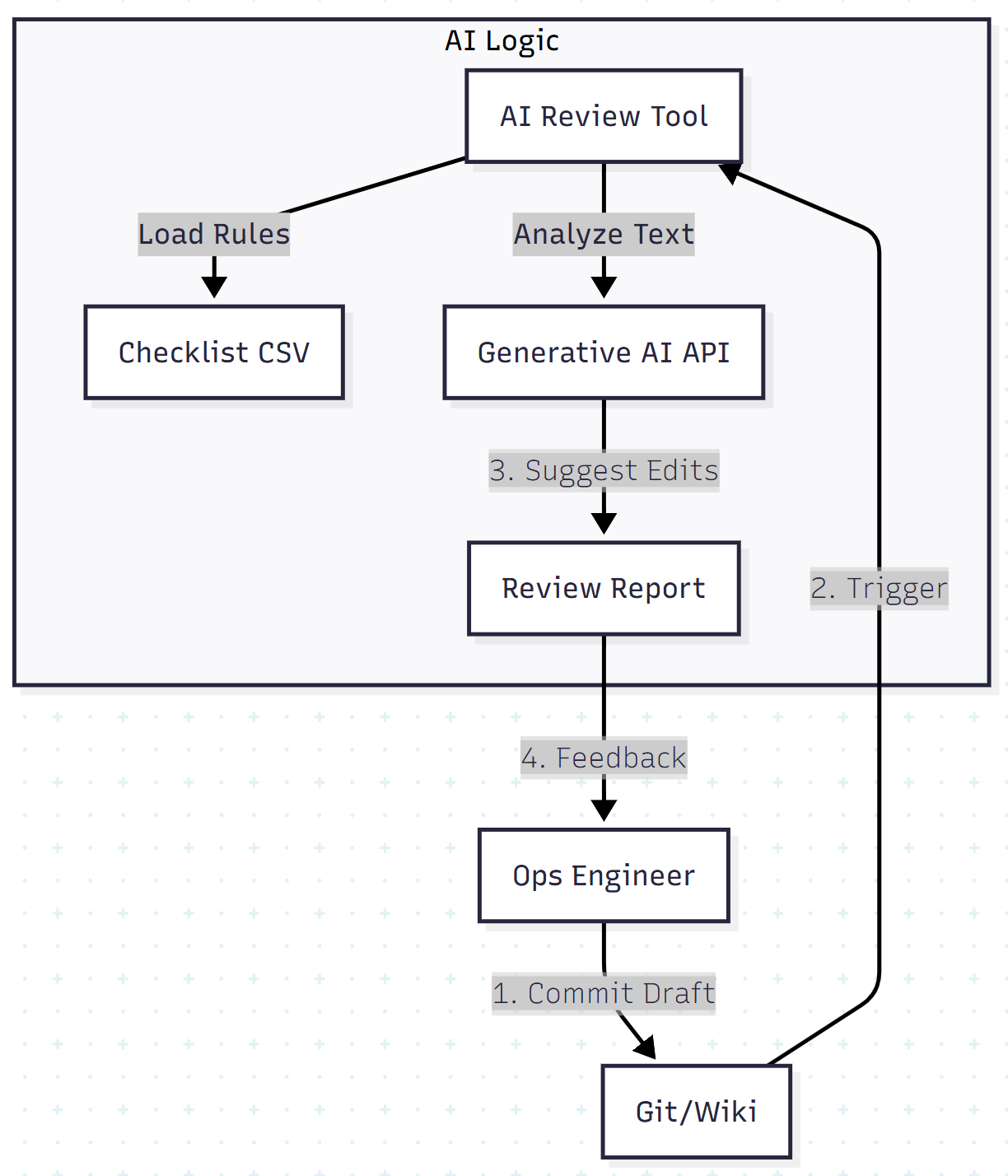
We cannot automate the execution of every task, but we can automate the validation of every procedure. The solution uses a Generative AI Reviewer to act as a rigorous editor.
1. The AI Reviewer Tool
Instead of relying on senior engineers to review every wiki edit (which they won’t do), we deploy a Python-based CLI tool powered by an LLM (Large Language Model).
The Workflow:
- Input: The tool ingests a procedure manual (Markdown/Text).
- Rules Engine: It loads a
checklist.csvcontaining specific heuristic rules (e.g., “Must define rollback steps,” “Must not use ambiguous terms like ‘appropriate’”). - Analysis: The LLM analyzes the text against these rules.
- Output: It generates a remediation report suggesting specific edits.
2. The Prompt Engineering Strategy
The magic lies in the prompt. We don’t just ask, “Is this good?” We force the AI to act as a Hostile Operator — someone who will follow instructions literally and fail if anything is vague.
System Prompt Concept:
“You are a junior operator with no prior knowledge of this system. Review the following procedure. If a step says ‘Check the logs’ but does not specify which log file path or what error string to look for, flag it as a Critical Error. If a command requires a variable (like
<server_ip>) but doesn’t explain where to find it, flag it.”
3. The Human Feedback Loop
AI finds the syntax errors; humans find the semantic voids. The organization implemented a “Slack-based Improvement Loop.” When an operator encounters a bad runbook during an incident:
- They flag it in a dedicated channel.
- The team collaboratively rewrites it immediately (not next quarter).
- The update is broadcast: “We changed the storage check procedure because Step 4 was misleading.”
Evaluation: The ROI of Clean Docs
Implementing this dual approach (AI Tool + Human Process) yielded measurable improvements in a high-stakes cloud environment:
- Review time: Reduced by 80% (from 18 minutes to 3.5 minutes per document).
- Escalation rate: Escalations due to “unclear instructions” dropped to zero in the pilot period.
- Engagement: Junior operators reported higher confidence and lower stress, knowing the “safety net” of accurate documentation was there.
Code Snippet: The Review Logic
Here is a simplified Python representation of the AI review logic using LangChain concepts.
import pandas as pd
from langchain.chat_models import ChatOpenAI
from langchain.schema import SystemMessage, HumanMessage

def review_procedure(procedure_text, checklist_path):
    # 1. Load Rules
    rules = pd.read_csv(checklist_path)['rule_description'].tolist()
    rules_text = "\n".join([f"- {r}" for r in rules])

    # 2. Construct Prompt
    system_prompt = f"""
    You are a Technical Editor. Review the procedure below against these strict rules:
    {rules_text}

    For each violation, output: [Rule ID] - [Issue] - [Suggested Fix].
    """

    # 3. Analyze
    llm = ChatOpenAI(temperature=0)
    response = llm.predict_messages([
        SystemMessage(content=system_prompt),
        HumanMessage(content=procedure_text)
    ])

    return response.content

# Example Usage
# review = review_procedure(my_runbook, 'standards.csv')
# print(review)
Conclusion
Automation is the ultimate goal, but until we reach the singularity, humans need to push buttons. By applying Generative AI not just to write code, but to verify human instructions, we close the gap between the architect’s intent and the operator’s reality.
Key Takeaway: If you can’t automate the task, automate the quality control of the manual.
Opinions expressed by DZone contributors are their own.
Comments