

The Self-Healing Directory: Architecting AI-Driven Security for Active Directory
Active Directory is the heartbeat of the enterprise, and a favorite target of attackers. Here is an architectural pattern for AI-driven anomaly detection and remediation.
Join the DZone community and get the full member experience.
Join For FreeFor over two decades, Active Directory (AD) has been the “central nervous system” of enterprise IT. It manages who gets in, what they can access, and when. Because of this centrality, it is the single most valuable target for an attacker. If you control AD, you control the organization.
The traditional security architecture for AD — SIEM logs, manual audits, and rule-based alerts — is broken. It generates too much noise (alert fatigue) and reacts too slowly (long dwell times). Modern attacks like Kerberoasting or “living off the land” use legitimate tools (such as PowerShell) to blend in, making signature-based detection ineffective.
Based on recent insights into modern AD defense strategies, this article outlines a Proactive AI Defense Architecture. This pattern shifts the focus from logging events to analyzing behavior, using User and Entity Behavior Analytics (UEBA) to detect and stop attacks before data exfiltration occurs.
The Problem: The Static Defense Trap
Traditional AD security relies on static rules.
Rule: “Alert if a user fails login 5 times in 1 minute.”
Attack: The attacker tries 4 times every hour (low-and-slow).
Result: Missed.
Rule: “Alert if a user accesses the Finance server.”
Attack: The attacker compromises the CFO’s credentials. The access looks legitimate.
Result: Missed.
The core issue is that attackers have moved beyond exploits; they are now logging in. To catch a thief who has the right key, you cannot look at the key — you have to look at the behavior.
The Architecture: AI-Driven Anomaly Detection
To secure AD against modern threats, we need an architecture that establishes a dynamic baseline of “normal” behavior and flags deviations in real time.
The architecture consists of three layers: Ingestion, Analysis (UEBA), and Response (SOAR).
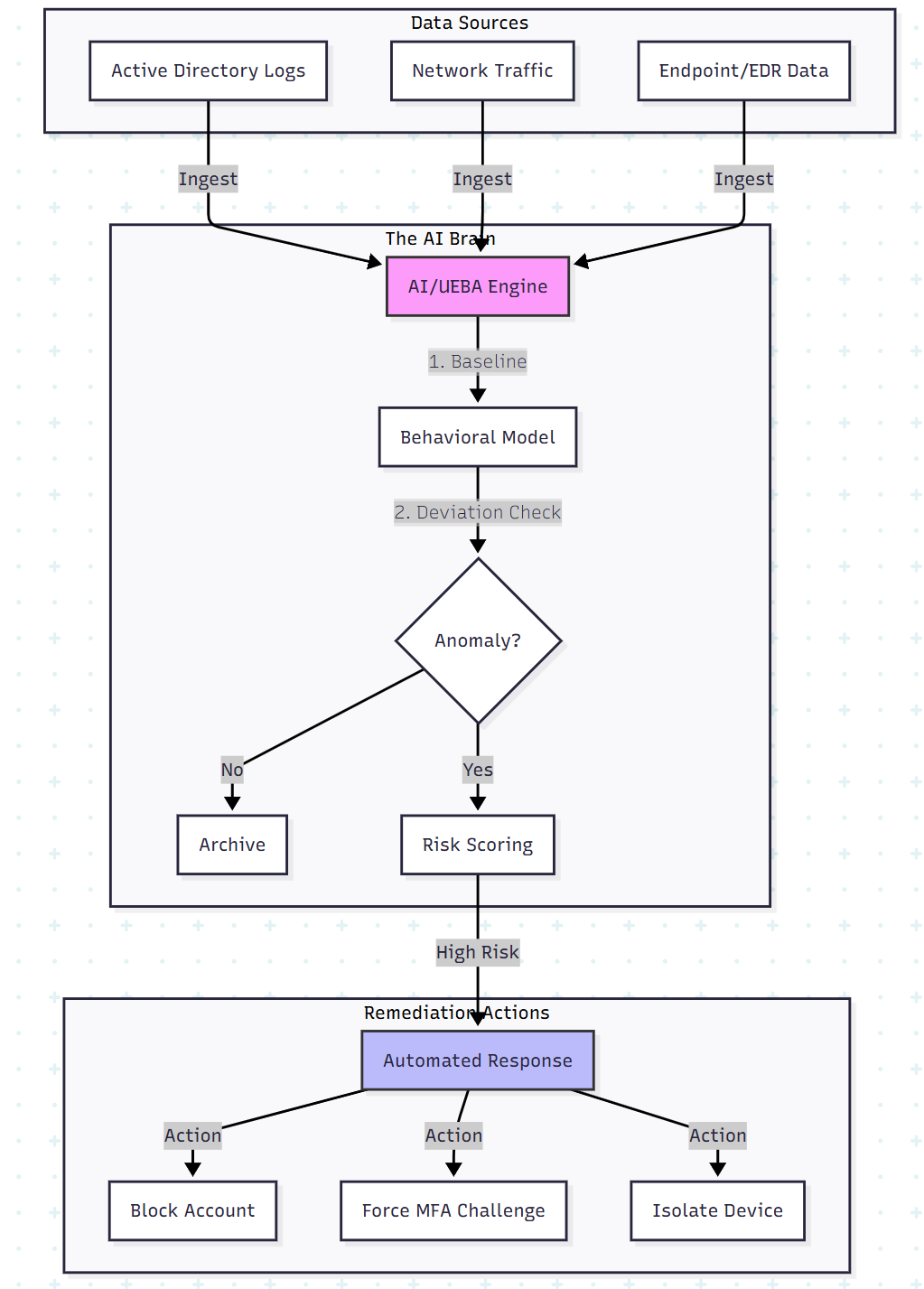
Layer 1: The Behavioral Baseline (UEBA)
Instead of hardcoded rules, the AI engine builds a unique profile for every user and service account:
- Time: When do they usually work?
- Geography: Where do they usually log in from?
- Volume: How much data do they typically query?
- Resources: Which servers do they normally access?
If an account that usually accesses email from London suddenly queries the entire LDAP directory from a server in New York at 3 a.m., the system flags it — not because of a “rule,” but because the probability of that behavior being legitimate is near zero.
Layer 2: Detecting “Living off the Land”
Attackers often use native tools (such as BloodHound or PowerShell scripts) to map the network. To the operating system, this looks like administration. To an AI model trained on process execution chains, it looks like reconnaissance.
Detection logic includes:
- Credential theft: Detecting pass-the-hash attacks by correlating login timestamps across machines in ways that are physically impossible for a single user.
- Lateral movement: Identifying administrative behavior originating from non-administrative endpoints.
- Privilege escalation: Spotting unauthorized changes to Group Policy Objects (GPOs) or ACLs that grant shadow permissions.
Layer 3: Automated Remediation
During a breach, speed is the only metric that matters. Human response time is measured in minutes or hours; AI response time is measured in milliseconds.
The detection engine is integrated with SOAR (Security Orchestration, Automation, and Response).
The Auto-Fix Pattern:
- Scenario: High-confidence ransomware behavior detected (rapid file encryption or renaming).
- Action: Immediately disable the AD user account and sever the network connection of the infected host.
- Result: The damage is contained to a single machine, preventing network-wide encryption.
Implementation: Integration Models
You do not need to rip and replace your existing AD setup. This architecture is typically deployed using one of two patterns:
- Agent-based (lightweight): Installing lightweight sensors on domain controllers to forward logs to the AI engine without impacting AD performance.
- Log forwarding: Configuring AD to ship logs to a centralized SIEM (such as Splunk or Microsoft Sentinel), where the AI models reside.
Key Configuration
Ensure your audit policy is granular enough. Standard logging often misses the detail required for effective AI analysis.
Enable:
- Audit Kerberos Service Ticket Operations
- Audit Sensitive Privilege Use
- Process Creation (with command-line arguments)
The ROI of Proactive Defense
Implementing this architecture transforms security from an operational cost into a savings generator:
- 90% reduction in alert noise: Correlating events into incidents eliminates most false positives.
- Breach cost avoidance: Preventing a single AD compromise can save millions in ransomware payouts and recovery costs.
- Operational uptime: Detecting performance degradation (such as slow authentication) before it causes outages preserves business continuity.
Conclusion
Active Directory is too complex for humans to monitor manually. The volume of telemetry and the subtlety of modern attacks require a non-linear approach.
By adopting an AI-driven anomaly detection architecture, organizations stop playing “whack-a-mole” with individual exploits and start defending against attacker intent. This approach transforms Active Directory from a static target into a self-healing system — one that adapts as quickly as the threats it faces.
Opinions expressed by DZone contributors are their own.
Comments