

Optimizing Cloud Costs With Serverless Architectures: A Technical Perspective
Exploring cloud cost optimization with serverless architectures, focusing on dynamic scaling, function design, and case studies.
 ·
·
Join the DZone community and get the full member experience.
Join For FreeAbstract
Serverless computing has fundamentally transformed cloud architecture, particularly for scale-out stateless applications. This paper explores the services provided by serverless architectures in general and Function-as-a-Service (FaaS) specifically in reducing cloud costs. Serverless computing eliminates the need for provisioning and managing static resources by leveraging a pay-per-use pricing model.
The deliverables include various cost optimization techniques, such as dynamic resource scaling, efficient function design, and optimized data management, all while maintaining a balance between performance and cost. Practical case studies illustrate real-world applications of serverless architectures in large-scale optimization problems and latency-sensitive services.
Although serverless frameworks offer numerous benefits, significant challenges, such as cold start latencies and vendor lock-in, remain unresolved and should be addressed in future research.
Keywords—Serverless computing, cloud cost optimization, Function-as-a-Service (FaaS), pay-per-use pricing, dynamic resource scaling, cold starts.
1. Introduction
Cloud computing has drastically changed the way businesses manage and scale their infrastructure. Traditional cloud architectures can work well but typically involve overprovisioning resources, leading to inefficiencies and higher costs. Serverless computing, particularly Function-as-a-Service (FaaS), offers potentially game-changing benefits such as auto-scaling and per-execution pricing, charging only for the exact amount of computing resources used during execution [1].
Serverless computing has also been introduced to reduce the burden of infrastructure management for developers, allowing them to focus solely on writing business logic. This architecture follows an event-driven model, where different events trigger functions automatically and auto-scale to accommodate varying loads. However, this shifts the responsibility of scaling, security, and fault tolerance to the underlying cloud provider, thereby reducing operational overhead [2]. One of the most notable characteristics of serverless computing is its cost model, in which customers are charged only for function invocations (i.e., information transits), making it an ideal choice for dynamic scaling under fluctuating workloads [3].
While serverless architectures offer many advantages, they also come with drawbacks. One of the most critical challenges is latency, particularly cold start delays, which can impact real-time or low-latency applications. The issue of vendor lock-in is further compounded by serverless services being tightly integrated with proprietary cloud resources such as storage [7].
This paper delves deeper into serverless architectures, how they enhance cloud cost efficiency, and the trade-offs associated with these improvements. We also explore pathways for organizations to leverage these architectures for cost-effective operations.
The remainder of this paper is organized as follows: Section II presents a brief overview of serverless architecture and its characteristics. Section III discusses the economics of pay-per-use pricing and how it leads to cost reductions. Section IV explores techniques for cost optimization in serverless environments. Section V examines the performance versus cost trade-offs. Section VI provides practical usage examples and case studies. Finally, Section VII concludes by discussing the limitations of serverless computing and its future directions.
2. Introduction to Serverless Architectures
Serverless computing is an emerging cloud-computing execution model in which a cloud provider executes a piece of code and automatically manages the function's sustainment. Function-as-a-Service (FaaS), typically through platforms such as AWS Lambda, is the most common means by which developers have naturally coalesced and converged toward serverless computing. The core idea of FaaS is that developers should be able to write short-lived functions that automatically scale with incoming events and are billed in proportion to the compute time consumed during execution [1].
2.1. Key Ideas of Serverless Architectures
Serverless computing can be summarized by a few key principles:
- Event-driven Execution: Serverless functions are designed to execute in response to specific events, such as an HTTP request, file upload, or database change.
- Automatic Scaling: The serverless platform automatically scales functions with incoming demand without manual involvement or capacity planning [4].
- Stateless Reference: Serverless functions are stateless— all data must be stored in persistent storage solutions such as databases or object storage (e.g., AWS S3, DynamoDB).
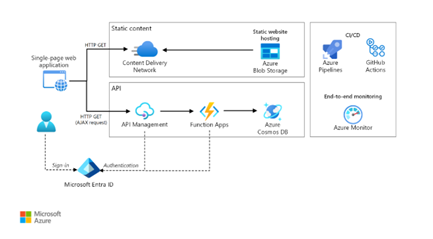
The diagram illustrates a serverless architecture utilizing Microsoft Azure. It depicts how a single-page application interacts with various Azure services, including API Management, Function Apps, and Cosmos DB. Identity and access management are handled through Microsoft Entra ID, while CI/CD processes are managed using Azure Pipelines and GitHub Actions. Static assets such as HTML files, images, media, and documents are stored in Azure CDN and Blob Storage. This internet-based architecture enables event-driven execution, scalability, and statelessness, ensuring cost-effective and efficient cloud application hosting.
2.2. Advantages of Serverless Computing Over Traditional Architectures
Serverless computing brings unique benefits compared to traditional cloud setups, such as:
- Improved DevOps Efficiency: Developers do not need to handle infrastructure provisioning, scaling, or maintenance, as these responsibilities are managed by the cloud provider [2].
- Cost Efficiency: Serverless platforms operate on a pay-per-use model, charging users only for the compute time when functions run. This eliminates the need and cost of maintaining idle resources, which is a common issue in traditional cloud-based systems with overprovisioning [3].
- Auto-Scaling: Serverless systems automatically scale based on demand, eliminating the need for complex auto-scaling mechanisms in traditional systems and ensuring optimal resource allocation [6].
2.3. Limitations of Serverless Architectures
Despite its advantages, serverless computing comes with challenges, including:
- Cold Starts: Cold starts occur when a function is executed for the first time or after a period of inactivity, requiring some time for resource provisioning before execution begins. This delay can impact the performance of latency-sensitive applications [2].
Mitigation: To minimize cold start delays, functions can be kept warm by scheduling regular invocations. Alternatively, some serverless platforms offer provisioned concurrency, which maintains a fixed number of pre-initialized function instances ready to respond immediately to requests.
- Stateless Design: Serverless functions are inherently stateless, requiring external storage to maintain state, which can introduce additional delays and costs [1].
Mitigation: Use efficient external storage systems like caching services (e.g., Redis) or databases optimized for serverless architectures (e.g., AWS DynamoDB). Also, consider using event-driven architectures that help minimize state dependencies.
- Vendor Lock-in: Serverless platforms are tightly integrated with specific cloud providers, making it difficult for organizations to migrate between providers without significant re-engineering efforts [7].
Mitigation: To reduce vendor lock-in, use standardized APIs and frameworks (e.g., the Serverless Framework or Cloud Native Computing Foundation's tools). Additionally, adopting containerized solutions such as AWS Lambda's container image support can provide greater flexibility in migration.
3. Cloud Economics and Pay-Per-Use Pricing
Serverless architectures are highly cost-efficient due to their pay-per-use pricing model. Unlike traditional cloud architectures, where resources are reserved and costs must be paid regardless of actual usage, serverless functions incur costs only when invoked and executed. As a result, serverless computing is well-suited for workloads with unpredictable or spiky (i.e., fluctuating) demand. It automatically provisions—and later deallocates—all necessary resources on demand during serverless function invocations [3].
![Figure 2: Cloud-Based Cost Efficiency and Pay-Per-Use Model (Retrieved from (Fragidakis et al., 2024)]](https://dz2cdn1.dzone.com/storage/temp/18474719-1750189182879.png)
The diagram illustrates the cloud cost structure based on a pay-per-use model, showcasing how cloud providers such as AWS, Microsoft Azure, and Google Cloud adopt serverless computing. It highlights the benefits of efficient cloud resource distribution for various organizational stakeholders, including engineering teams, leadership, and finance. Additionally, it depicts the flow of data from processing to analytics, ultimately supporting visualization and informed decision-making.
3.1. Subscription Model vs Pay-Per-Use-Breakdown
Costs are in the pay-per-use model, where we only pay for the serverless function resource used. The billing components are usually as follows:
- Amount of Invocations: The cost of how many times a function is invoked.
- Duration: The cost of execution length is usually measured as the time a function takes to complete, expressed in milliseconds [3].
- Memory Allocation: The cost increases as the function is provisioned with more memory, which makes perfect sense because this is usually dynamically configurable [2].
3.2. Scalability/Cost Efficiency
Functions in serverless architecture can automatically scale based on demand, which means costs scale with usage. Rather than a traditional cloud model of sprawl-type assets, resources remain underutilized during low periods of activity [4].
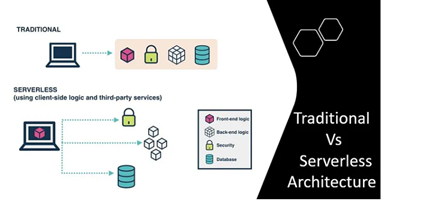
3.3. Cost Control for a Serverless Architecture
Serverless computing platforms also offer the possibility for developers to optimize costs through further resource tuning:
- Memory Configuration: The amount of memory you allocate to a serverless function directly affects its performance and overall cost. Over-allocation costs money, and under-allocation may result in slower function execution [3].
- Function Timeout: This enables developers to determine the longest runtime a serverless function should take before being automatically terminated [6].
In addition, built-in tools like AWS CloudWatch and AWS X-Ray can monitor function performance and resource utilization, enabling organizations to update their serverless applications at optimal cost [2].
3.4. Economic Benefits and Costs
Certainly, the pay-per-use model can result in significant savings on costs, but it also comes with trade-offs:
- Cold Starts / Latency: On infrequent invocations, serverless functions may experience a delay at startup due to cold starts. This, of course, would lead to more latency, which is especially problematic in delay-sensitive use cases such as IoT and real-time analytics [2].
- Predictable Pricing: Serverless computing removes the need to pay for idle resources, but it also means that costs now scale linearly with demand [4].
4. Tips for Cost Optimization in Serverless Architectures
Serverless computing is fundamentally about cost optimization. There are many ways to help your organization save money on the cloud while still keeping performance optimized. This includes techniques such as dynamic resource scaling, efficient function design, and intelligent use of storage and data management systems.
4.1. Dynamic Resource Scaling
Serverless architectures come with autoscaling capabilities, adjusting resources based on demand. This avoids an operational cost issue—overprovisioning—that is common in traditional cloud setups [1]. Because they scale on demand in real-time, one of the benefits serverless architectures provide is cost-to-usage matching, eliminating waste.
-
Horizontal Scaling: Horizontal scaling is a common and important type of dynamic scaling in serverless environments, which consists of automatically creating new instances (predetermined in number) of the function as a response to the number of requests coming in. One such example is AWS Lambda, which can automatically manage tens of thousands of instances running in parallel without explicit manual intervention [4]. Always being able to scale effectively without over-provisioning results in drastically lower operational costs.
4.2. Efficient Function Design
The quality and efficiency of serverless function design are decisive factors in cost optimization. Efficiently performing functions reduce memory usage and execution time, significantly contributing to cost savings [1][2]. Poorly designed functions, such as PUT BACK, must be written more efficiently. In defining a function, inefficient execution and possibly unnecessary resource utilization increase elapsed time and memory consumption.
Serverless function design best practices include:
- Lowering Execution Time: Small execution times are preferable, as the cost can be estimated by measuring how long functions take to execute.
- Make Functions Do One Thing – and Do It Well: Functions should do one thing and only one thing as quickly as they can [1].
- Optimal Memory Allocation: Serverless platforms, e.g., AWS Lambda, allow you to set up the allocated memory in a function. On one side of the pendulum, developers have to weigh executing more slowly due to insufficient memory [2] (or executing insignificantly faster because of caching responsiveness times), and, on the other side, increasing costs by adding additional and more expensive CPUs.
4.3. Optimizing Data Management
Let us take a closer look at how to manage data for serverless functions, as they are stateless and cannot store any of their intermediate results. Moreover, downstream tasks can be read from external storage. When using a serverless architecture, this data usually persists in the cloud (e.g., AWS DynamoDB) or object storage (e.g., AWS S3) [5]. Choosing the right data store is crucial for cost optimization based on workload and access patterns.
We optimize storage for performance and cost efficiency by using the right solution for each use case.
4.4. Function Invocation Optimization
The way serverless functions are triggered can also cause prices to vary.
-
Invocation Methods: For example, with AWS Lambda, you can trigger your functions using multiple invocation types—synchronous, asynchronous, and event-based triggers. Synchronous invocations may make you wait longer and therefore be more expensive, while asynchronous or event-based triggers will allow you to use resources more efficiently [2]. Moreover, choosing your invocation method wisely can reduce operational costs even further.
5. The Trade-off of Performance vs. Cost in Serverless Architectures
While the economic proposition looks good, serverless computing has several performance-cost trade-offs, especially regarding latency, cold starts, and concurrency limits. Learning about these trade-offs is essential to achieving the best balance between performance and cost when deploying into serverless environments.
5.1 Cold Starts and Latency Issues
The "cold start" problem is one of the main challenges in serverless architectures. The cold start issue occurs when a serverless function is triggered, and the associated cloud provider has to spin up a new runtime environment to execute the function because the function has not been run for some time. This is referred to as a cold start [2]. It introduces latency into the execution of a function and can be impactful for real-time applications that require quick responsiveness.
Strategies like provisioned concurrency ensure that function instances are warm and ready to receive requests, which helps solve the cold start problem. Nevertheless, provisioned concurrency will impose additional operational costs on your serverless application, as you need to pay for the resources that are always available, even when the demand is low [6].
5.2. Memory Allocation vs Execution Time Balancing
One of the most important trade-offs in serverless architectures is between memory allocation and execution time. Allocating more memory to a function helps achieve faster execution, and tasks get processed as quickly as possible. That being said, the more memory you allocate, the higher the cost becomes, as in serverless platforms, memory allocation means charging costs not only by execution time [3].
5.3. Concurrency Limits And Performance
Although serverless is supposed to scale infinitely, cloud providers tend to restrict high degrees of concurrency. AWS Lambda, for example, comes with a default limit of 1,000 concurrent invocations per account, which may need to be increased for an application under high traffic [4]. On the other hand, increasing concurrency limits will incur more costs as more function instances are required to handle the load.
The key problem is the scaling of concurrency, which must be managed so that application performance keeps up with demand as efficiently as possible. The performance and cost trade-off in serverless environments is crucial to ensure that scaling decisions do not lead to unnecessary resource
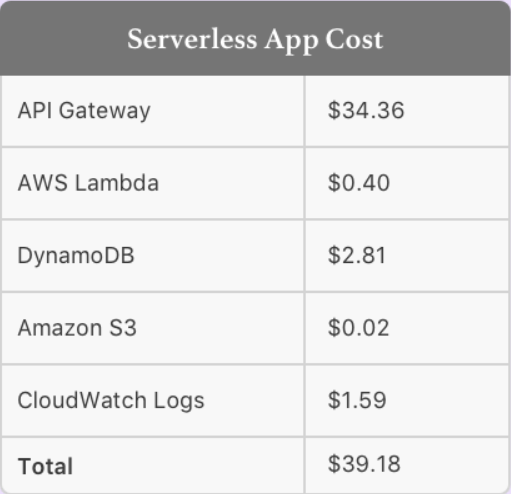
Table 1: Cost of serverless application
6. Use Cases and Case Studies
With serverless architectures, you can run everything from big data analysis to API, web serving, and mobile backends. It's important to note that these apps differ significantly in what they offer.. In this section, we will look at a few examples of how serverless systems have changed the game regarding performance and cost-effectiveness and discuss AWS Lambda pricing models.
6.1 Large-Scale Optimization Problems
Serverless architectures, such as AWS Lambda, are excellent for handling large-scale optimization problems where the workload is highly variable (spiky) over time. The automated scaling of functions to match demand means that serverless computing eliminates the need for over-provisioning, resulting in significant cost savings.
AWS Lambda (Data Processing)
In a large-scale data processing scenario, Lambda functions process terabytes of data in parallel. Utilizing AWS Lambda's dynamic scaling capabilities allowed us to operate at full speed during peak times while incurring minimal idle costs when not in use.
Below is a table that compares the costs of large-scale optimization tasks against the cost-effective ARM functions, with AWS Lambda pricing on both x86-based functions and the new price-performance optimized ARM architecture functions.
Table 2: AWS Lambda Pricing for Large-Scale Data Processing (US East Region)
|
Architecture |
GB-Seconds Used (Monthly) |
Price per GB-Second |
Total Monthly Cost ($) |
|
x86 (First 6 Billion GB-seconds) |
6 Billion GB-seconds |
$0.0000166667 |
$100,000 |
|
Arm (First 7.5 Billion GB-seconds) |
6 Billion GB-seconds |
$0.0000133334 |
$80,000 |
6.2 Latency-Sensitive apps
What Works Better for IoT, Real-Time Analytics, or Gaming: Serverless Computing?
Cold start latency remains a major pitfall for applications requiring instant reply times.
AWS Lambda for IoT Applications
A case study highlights an IoT-based application where sensor data from thousands of devices was managed using AWS Lambda. The platform did not require manual scaling, as it could automatically scale with incoming data streams. However, the cold start latency posed challenges for real-time performance. One of the solutions implemented was Provisioned Concurrency, which keeps the Lambda functions warm and always available to process requests without any cold start delay.
Costs for an IoT Application
The cost details of using AWS Lambda with Provisioned Concurrency for the case study are summarized in the simple table below:
Table 3: AWS Lambda Provisioned Concurrency Pricing (US East Region)
|
Architecture |
Provisioned Concurrency GB-Seconds |
Price per GB-Second |
Total Monthly Cost ($) |
|
x86 |
10 Billion GB-seconds |
$0.0000041667 |
$41,667 |
|
Arm |
10 Billion GB-seconds |
$0.0000033334 |
$33,334 |
6.3 Dynamic Workloads
They work best at processing dynamic workloads with unpredictable traffic spikes. When the demand for an application increases, AWS Lambda automatically scales out the function, considering the amount of resources you wish to allocate based on the input data. Later, it scales back in, allowing developers to pay only when their applications use resources.
Case Study: E-commerce Platform with Peak Traffic
An e-commerce platform utilized AWS Lambda during a high-traffic sales event (Black Friday). The platform experienced millions of checkout transactions, with Lambda functions automatically scaling up and down as the demand fluctuated. The company achieved significant cost reductions by only paying for the compute time consumed.
The following table illustrates the request-based pricing of AWS Lambda while handling millions of requests during such an event:
Table 4: AWS Lambda Pricing for High-Traffic Event (US East Region)
|
Requests |
Price per 1 Million Requests |
Total Requests (Millions) |
Total Monthly Cost ($) |
|
1 Million Requests |
$0.20 |
10 |
$2.00 |
|
100 Million Requests |
$0.20 |
100 |
$20.00 |
|
1 Billion Requests |
$0.20 |
1,000 |
$200.00 |
6.4 Integration of Serverless Computing With AI and ML
AI and ML applications are being incorporated into serverless architectures as a way of attaining elastic, optimized, and pay-as-you-go compute infrastructure for intensive computational workloads. The systematic integration of serverless architecture (SA) with AI/ML offers many benefits, such as scalability, auto-proportional scaling, and cost optimization through usage-based pricing strategies[8].
6.4.1 Benefits of Serverless AI/ML Integration
Auto-scaling for AI workloads means that the serverless function is capable of scaling up or down depending on the load and traffic related to AI/ML-specific tasks. This makes them ideal for real-time data processing, image analysis, and natural language processing (NLP).
Another advantage is cost reduction, since many AI models require high computing resources for both training and inference. The ability to run only when required makes it ideal for executing ML workloads without using resources when unnecessary.
Event-based processing allows serverless AI to start in response to activities like data uploads, specific user operations, and even timed operations, ensuring real-time operations.
AI model training and inference can be done concurrently across multiple serverless instances, increasing efficiency without the need for a dedicated cluster.
6.4.2 Use Cases of Serverless AI/ML
Accompanying real-time image and video recognition, serverless platforms can be used for AI models in facial recognition and object identification. Chatbots and virtual assistants use NLP models running on serverless platforms to manage interactions as required.
Thanks to serverless computing, analysis with machine learning algorithms can be carried out in real-time on multiple data streams as soon as they are generated, without interference with unrelated activities.
IoT and edge computing employ serverless AI to process the data gathered by IoT sensors in one cycle, including anomaly identification and condition-based maintenance. At the same time, it is important to mention several drawbacks of serverless AI/ML, including cold-start delays, limited execution time for functions, and vendor lock-in. Nevertheless, to address such challenges, many architects combine serverless functions with containerized services or GPU-based compute instances.
6.5 Serverless Security Challenges and Best Practices
With serverless computing, the provider handles most responsibilities, but new risks appear. It is crucial to stay aware of the specific risks associated with serverless infrastructures and take steps to minimize the chances of exploitation by attackers and hackers.
6.5.1 Key Security Challenges in Serverless Computing
This results in higher attack exposure as serverless apps rely on third-party services, exposing them to supply chain attacks and API misconfigurations. The quick lifecycle of function execution means that security mechanisms, like host-based intrusion detection, are ineffective in a serverless environment.
Cold-start security risks include vulnerabilities during cold start functions, where servers may be improperly configured or use an outdated runtime environment. Data leakage and compliance issues arise since serverless functions query storage, databases, and APIs, which can lead to breaches if security measures are not properly configured. There is still the risk of Denial-of-Service (DoS), where a serverless application can be flooded with function invocations, draining resources and increasing costs.
6.5.2 Best Practices for Securing Serverless Applications
The principle of least privilege (PoLP) should be followed, where serverless functions are given only the permissions necessary to complete their tasks, minimizing the impact of potential compromises. API abuse and unauthorized access can be prevented by using API gateways that include authentication and rate-limiting features. Configuration data should be securely stored in a vault or as environment variables to avoid accidental exposure.
Logging and monitoring at the function level are crucial, and specialized tools should be employed to track and identify malicious activities on function calls. Patch management involves continuously assessing and applying security patches provided by cloud providers to update serverless runtimes. DDoS protection should be enabled using native features like AWS Shield or Cloudflare Workers to prevent denial-of-service attacks.
Before deploying serverless functions, it is important to run security testing tools to perform both static and dynamic code analysis to identify vulnerabilities.
By implementing these measures, organizations can enhance the security of their serverless computing platform while maintaining business benefits such as cost optimization and scalability.
7. Conclusion
Serverless architectures, particularly with AWS Lambda, offer significant cost savings through a pay-per-use model, eliminating over-provisioning and reducing idle resource costs. Dynamic scaling adjusts resources based on demand, further optimizing costs. Efficient function design and optimal memory allocation enhance performance-to-cost efficiency. Provisioned concurrency ensures low-latency response for real-time applications, though it comes with additional costs. Arm-based architectures in AWS Lambda offer better price-performance, making them ideal for cost-sensitive organizations. Despite challenges like cold start latency and vendor lock-in, serverless architectures are effective for various use cases, such as IoT and dynamic workloads. Future work should focus on addressing these challenges, improving multi-cloud strategies, and exploring hybrid approaches to optimize cost efficiency.
References
[1]. Aytekin and M. Johansson, "Exploiting Serverless Runtimes for Large-Scale Optimization," in Proceedings of the IEEE International Conference on Cloud Computing (CLOUD), Jul. 2019, doi: https://doi.org/10.1109/cloud.2019.00090.
[2]. Pelle, J. Czentye, J. Doka, and B. Sonkoly, "Towards Latency Sensitive Cloud Native Applications: A Performance Study on AWS," in Proceedings of the IEEE International Conference on Cloud Computing (CLOUD), Jul. 2019, doi: https://doi.org/10.1109/cloud.2019.00054.
[3]. J. Weinman, "The Economics of Pay-per-Use Pricing," IEEE Cloud Computing, vol. 5, no. 5, pp. 101-c3, Sep. 2018, doi: https://doi.org/10.1109/mcc.2018.053711671.
[4]. W. Ling, L. Ma, C. Tian, and Z. Hu, "Pigeon: A Dynamic and Efficient Serverless and FaaS Framework for Private Cloud," in Proceedings of the IEEE International Conference on Computer Science and Information (CSCI), Oct. 2019, doi: https://doi.org/10.1109/csci49370.2019.00265.
[5]. M. Llorente, "The Limits to Cloud Price Reduction," IEEE Cloud Computing, vol. 4, no. 3, pp. 8–13, 2017, doi: https://doi.org/10.1109/mcc.2017.42.
[6]. J. R. Gunasekaran, P. Thinakaran, M. T. Kandemir, B. Urgaonkar, G. Kesidis, and C. Das, "Spock: Exploiting Serverless Functions for SLO and Cost Aware Resource Procurement in Public Cloud," in Proceedings of the IEEE International Conference on Cloud Computing (CLOUD), Jul. 2019, doi: https://doi.org/10.1109/cloud.2019.00043.
[7]. R. A. P. Rajan, "Serverless Architecture - A Revolution in Cloud Computing," in Proceedings of the 2018 Tenth International Conference on Advanced Computing (ICoAC), Dec. 2018, doi: https://doi.org/10.1109/icoac44903.2018.8939081.
[8]. A. Christidis, S. Moschoyiannis, C.-H. Hsu, and R. Davies, “Enabling Serverless Deployment of Large-Scale AI Workloads,” IEEE Access, vol. 8, pp. 70150–70161, 2020, doi: https://doi.org/10.1109/access.2020.2985282.
Opinions expressed by DZone contributors are their own.
Comments