

Solving the Global Data Residency Conflict: A Blueprint for the "Minimum Org" Salesforce Strategy
Solve the "Minimum Org" conflict: maintain one global Salesforce instance while meeting strict data laws in Russia and China using a 90-day residency overlay.
 ·
·
Join the DZone community and get the full member experience.
Join For FreeIn the world of enterprise SaaS, there is a constant, exhausting tension between operational efficiency and geopolitical reality. For global organizations, the “Minimum Org Strategy” — maintaining a single, unified Salesforce instance — is the primary driver of consistent reporting, streamlined Master Data Management (MDM), and reduced technical debt.
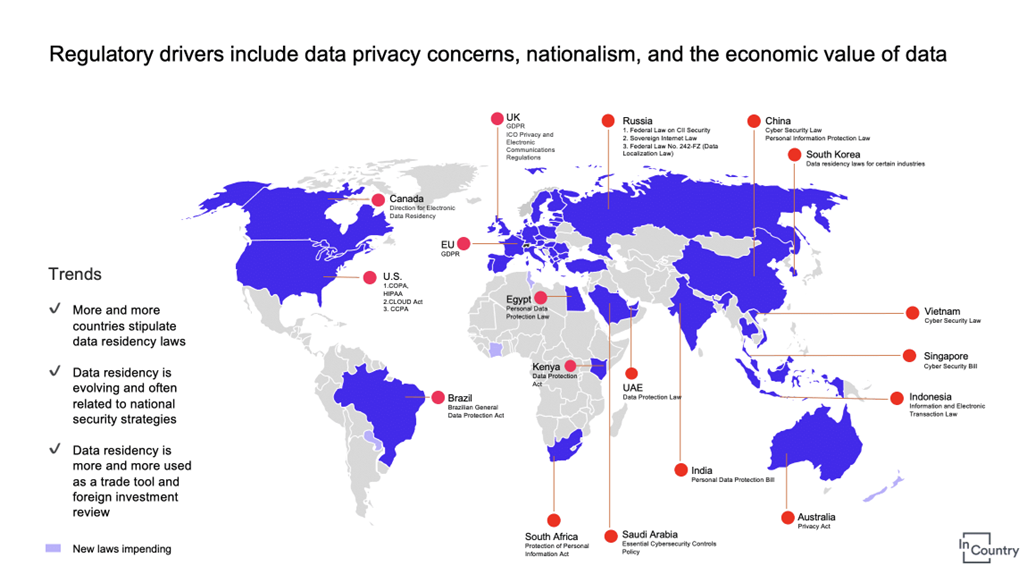
However, as data localization laws like China’s PIPL, Russia’s 242-FZ, and India’s DPDP Act tighten, architects are being forced into a defensive crouch. While Salesforce Hyperforce is often marketed as the solution for regional data residency, the technical reality is that it frequently forces a “multi-org” fragmentation. If you need your data to stay in Russia, Hyperforce effectively requires you to stand up a separate, “orphan” instance in that region.
For a highly regulated company, standing up a new, medical-grade validated org is a six- to eight-month odyssey involving rigorous quality audits. In 2023, as the geopolitical landscape shifted overnight, we did not have eight months. We needed a way to satisfy “red line” localization requirements without shattering our global architecture.
The Search for a Third Path: Data Residency as a Service (DRaaS)
Faced with the choice between non-compliance and organizational fragmentation, we began looking for a “Pattern B” approach: a residency overlay. The goal was to keep our business truly running on a single global application while localizing only the most sensitive data.
This search led us to the emerging category of Data Residency as a Service (DRaaS). A DRaaS model essentially acts as a privacy vault and geofencing layer that plugs directly into your existing SaaS stack. After evaluating several options, we leveraged InCountry, specifically its managed package for Salesforce. This allowed us to maintain global process integrity while isolating regulated PII, PHI, and PCI data within sovereign borders. It transformed a massive geopolitical risk into a modular engineering task.
The Technical Deep Dive: The Tokenization Handshake
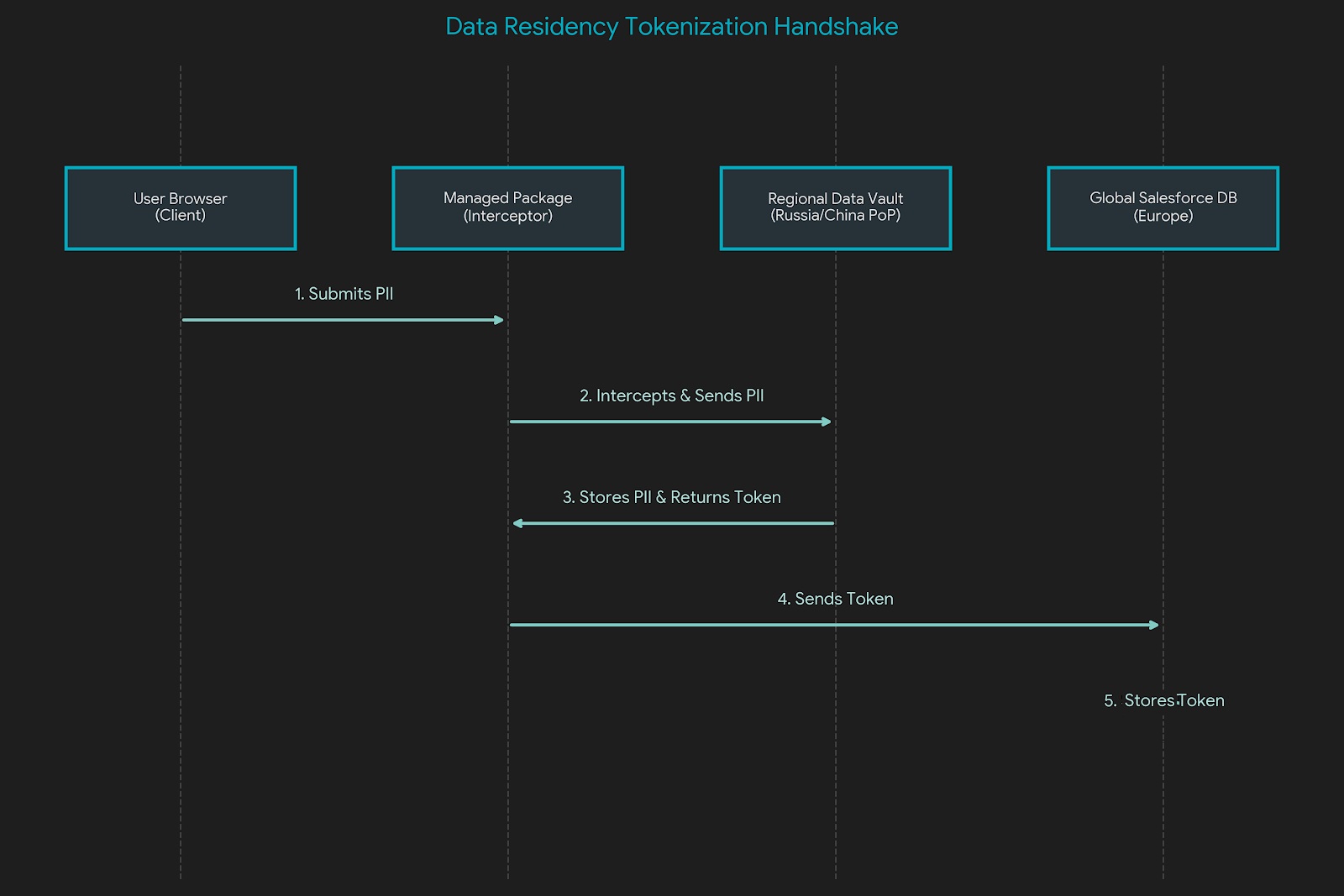
The core of this architecture is the Point of Presence (PoP). In our implementation, we established local PoPs in Russia (leveraging Yandex Cloud) and China. The data flow works through a transparent interception layer:
Ingestion: When a record is created (e.g., a Case for a Russian citizen), the system identifies the country of origin.
Redaction: Before the record leaves the region, sensitive fields (PII/PHI/PCI) are intercepted and routed to the local vault.
Tokenization: The local PoP returns a non-sensitive token or surrogate value. This token is what is stored in the global Salesforce database in Europe.
On-the-Fly Detokenization: When an authorized local user views the record, a client-side API call fetches the real values from the appropriate region on the fly, overlaying them in the browser’s RAM.
Breaking (and Fixing) Salesforce Search and Reporting
The “Minimum Org” strategy only works if the platform remains functional. When you replace “John Doe” with a token, global search and standard reports effectively “break” in the central database.
The Reporting Pivot
Standard Salesforce reports cannot aggregate tokens into meaningful names. We solved this by using Custom Report Types that act as a detokenization wrapper. When an authorized user runs these reports, the data is swapped client-side, enabling localized drill-downs without compromising global data storage rules.
The Search Latency
For users within the geofence, global search results are retrieved via a proxy to the local vault. While there is a slight performance tax or lag during this retrieval, we observed a stabilization curve in which usage-based performance reached an acceptable steady state for the business.
Geofencing: Identity-Driven Compliance
Geofencing is enforced through a strict policy engine. We mapped user.country attributes to specific PoP permissions. If a US-based admin attempts to search for a Russian record, they see only the metadata or the token. The “key” required to detokenize the record exists only for users physically and logically mapped to the Russian geofence, ensuring that we respect sovereign boundaries while operating globally.
The Regulated Reality: Why Single-Tenant Matters
In a highly regulated medical or pharmaceutical environment, the standard multi-tenant SaaS model can be a liability. Forced vendor updates can break a validated state. We found that moving to a single-tenant architecture was essential. By paying a slight premium for our own tenant, we created a “validation gate.” We could then coordinate with the vendor to determine which critical updates to accept and which to defer until our internal validation windows opened.
The Verdict: Agility in an Unstable World
With the residency overlay in place, the benefits were undeniable. We achieved full compliance in three months, slashing the six- to eight-month timeline required to stand up and validate a new org. For the modern enterprise architect, the goal is to build an application that is “global by default, local by law.” By anchoring on a global core and using residency overlays, you preserve your single source of truth while respecting the borders of a fractured world.
Monday Morning Takeaways
Classify at the field level: All good decisions start with identifying exactly what constitutes PII/PHI versus operational metadata.
Tokenize early: The sooner sensitive values become tokens, the fewer systems you must sanitize for global reporting.
Plan for price shocks: Usage-based residency APIs can spike in cost; model your high-water scenarios and throttle wisely.
Pick your anchor: Use a residency overlay (Pattern B) for your global core and carve out regional stacks (Pattern A) only when law or risk truly demands it.
Opinions expressed by DZone contributors are their own.
Comments