

How the Craft of Software Engineering is Evolving With AI Advancement
AI is transforming software engineering — enabling it to direct intelligent systems, balance efficiency gains with judgement, and conduct defensive programming at scale.
Join the DZone community and get the full member experience.
Join For FreeSummary
Artificial intelligence is transforming the nature of software engineering, shifting it from a primarily code-centric discipline toward one that emphasizes systems thinking, verification, and orchestration. Emerging paradigms such as “vibe coding” and defensive AI programming illustrate how the field now demands not just technical mastery but also a broader understanding of how intelligent systems interact and evolve. While AI offers unprecedented productivity gains to those who integrate it effectively, engineers must cultivate the discernment and methodological structure required to maintain reliability, quality, and correctness at scale.
Evolution from Builders to Curators
Software engineering has long been associated primarily with coding. Entry-level engineers focus on churning out code, and as they grow in their careers, they learn more about system design, architecture, etc. But with the rise of AI-assisted coding tools, that primary identity is shifting.
Today, engineers are becoming curators of intelligence rather than just implementers. Instead of writing every function by hand, they are helping shape AI output through constraints, validation, and iteration — guiding generative models toward reliable results.
Maintaining legacy code used to be a big nightmare for engineers. But, today AI assisted onboarding is making lives easier. AI is helping generate documentation, helping write unit tests for legacy code that explain system behavior, helping fix complex scaling bugs, and more.
AI is assisting reviewers in reviewing code, understanding system design, and connecting complex documentation across systems.
The craft of engineering is expanding from the mechanics of code to the art of directing AI to assist across the entire software engineering lifecycle .
The Rise of “Vibe Coding”
In this new era, many developers are embracing what’s been informally dubbed “vibe coding.” It’s the practice of using AI-assisted tools - copilots, code generators, or agents — to rapidly produce scaffolding, tests, or even entire feature sets based on intent.
Vibe coding comes with an enticing promise of speed and efficiency, effectively going from idea to prototype while offloading tedious boilerplate work.
However, in practice, vibe coding introduces a hidden overhead — a need for careful inspection, debugging, and reinforcement to ensure the AI’s output aligns with production standards.
The Judgment Gap
AI tools flatten certain technical barriers while deepening others.
AI Explorers can now generate working code faster than ever. But without proper system-level context and understanding, they may mistake plausibility for correctness. The AI’s confidence can mask critical flaws, such as missing edge cases, unsafe assumptions, or brittle architectures. This iterative process and surprises may even lead to dismissive thoughts on AI adoption.
AI Strategists, conversely, use AI as leverage. They employ it to explore architecture options, refactor legacy systems, or test design hypotheses. Their strength lies in deciding when to trust automation — and when to overrule it.
The result is a growing judgment divide: AI shifts effort away from manual coding and toward cognitive evaluation. The best engineers who are able to scale themselves with AI tools pragmatically are emerging as AI strategists.
AI Strategists
In the current state, there are limitations on what AI can do. Some developers report fatigue because they have to spend more time fixing AI-generated code before it is ready to ship to production, so that it works with the rest of the ecosystem. Some developers understand the limitations of current AI capabilities and delegate appropriate tasks, trying to build leverage rather than being frustrated by them. The AI strategists delegate the appropriate amount of work and act as orchestration and verification agents who deploy system thinking at scale
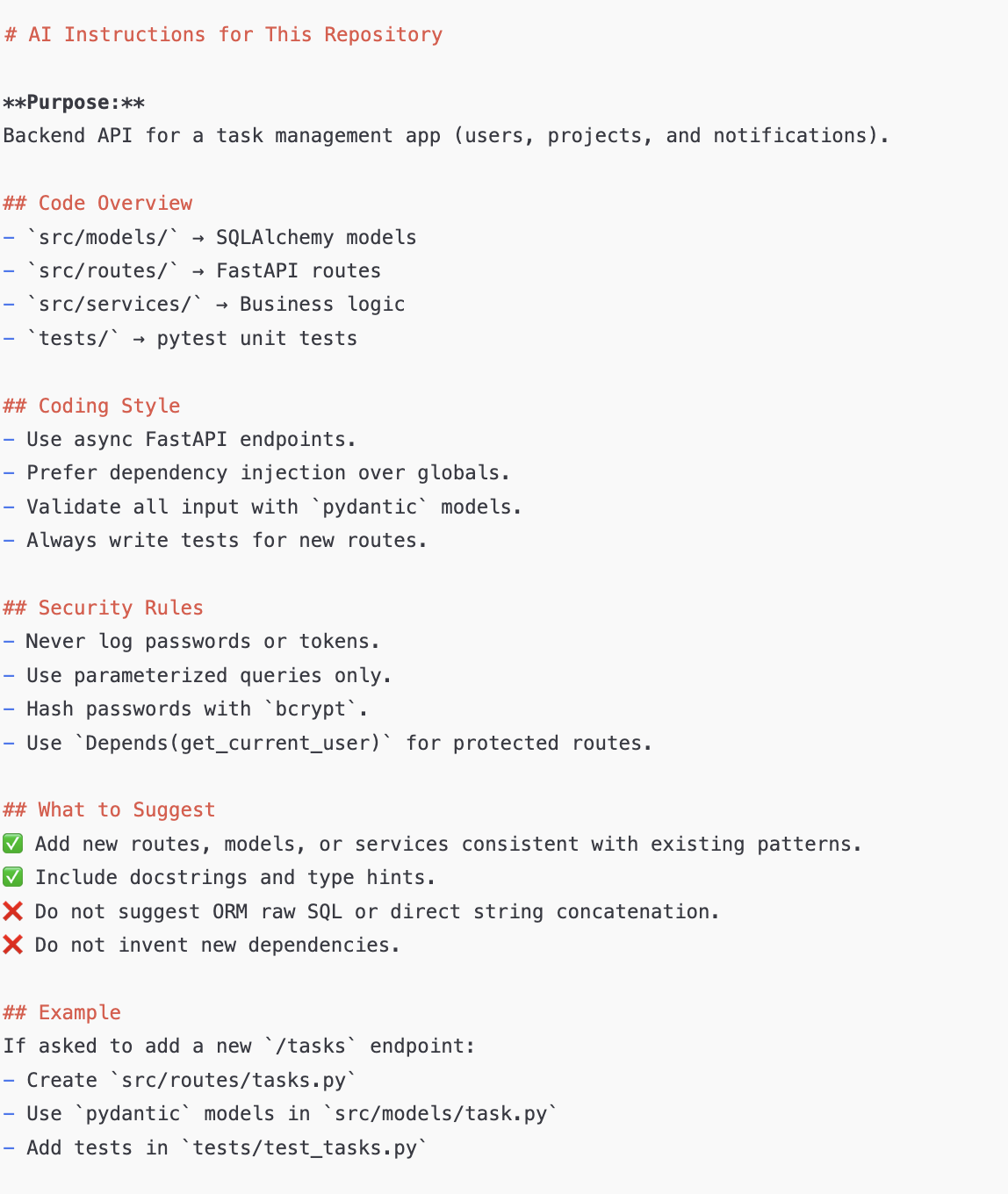
This example of a .github/copilot-instructions.md file provided to AI to narrow the problem space concretely to get better output:
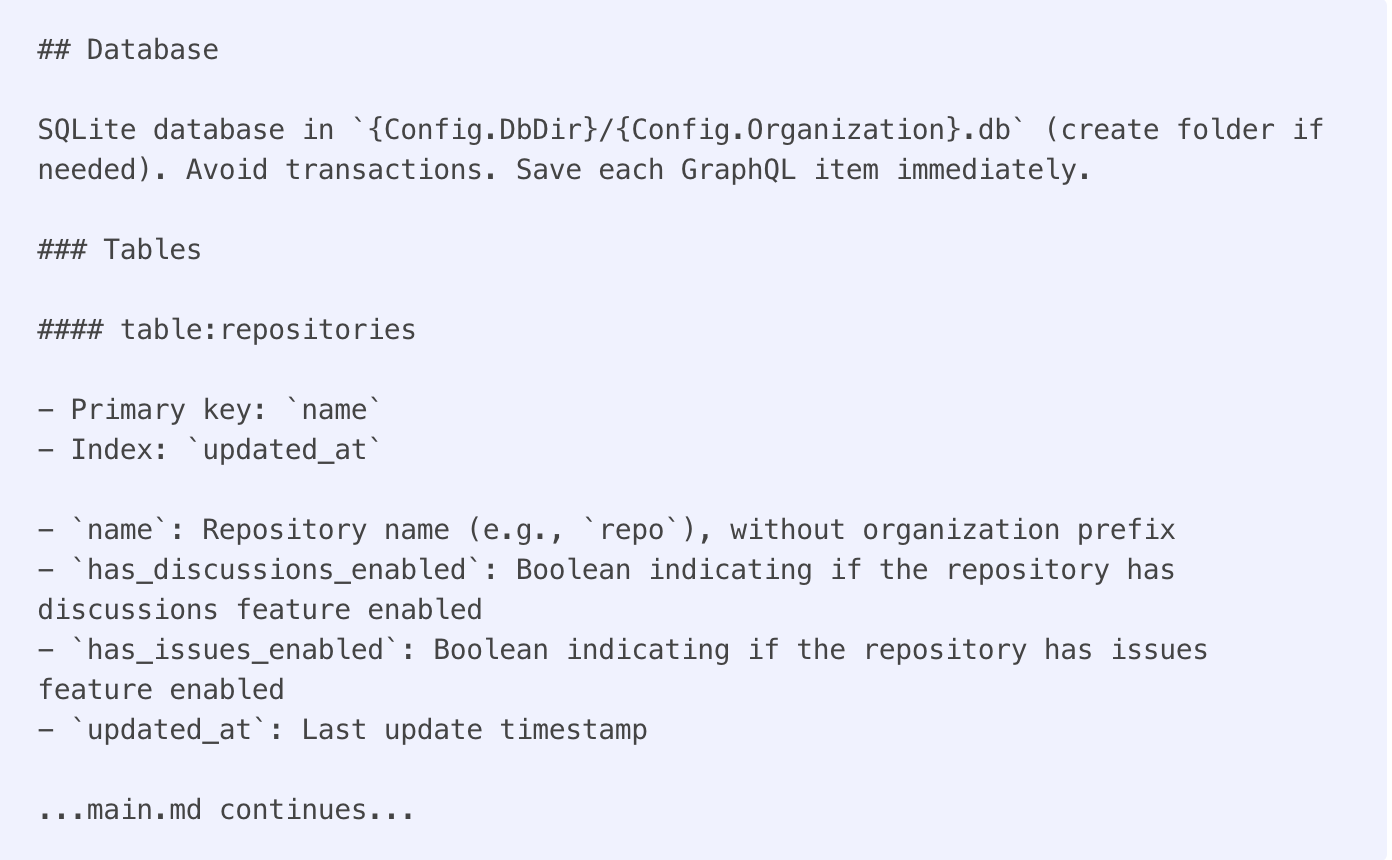
Spec-driven development: As a developer, you can provide the specs of the code in markdown and let AI generate the code for you. Example database schema in markdown:
Importance of Code Review
AI-generated code often optimizes for surface correctness — what looks right — rather than deep robustness. This may introduce new risks:
-
Security vulnerabilities through unsafe imports or outdated dependencies.
-
Unreliable logic that passes tests but breaks under scale or change.
-
Maintenance debt caused by duplicated or hallucinated code.
Teams quickly learn that AI productivity comes with an innovation tax — the cost of review, correction, and stabilization. It's extremely important for developers to realize that they are still accountable for the code they are shipping as authors and reviewing as reviewers.
Defensive AI Programming: Engineering for Trust
To make AI coding sustainable, organizations must develop a culture of Defensive AI Programming — a set of principles and practices that balance AI’s creative power with engineering rigor.
-
Trust but verify. Treat AI output as a draft, not a deliverable. Every generated line must be tested, reviewed, and validated against business logic, performance standards, and security policies.
-
Foster accountability and empower reviewers.
-
Rebalance team workflows to recognize the review burden. Senior developers should have time and tools for deep inspection, while juniors are trained to reason critically about AI outputs — not just accept them.
-
Encourage ownership. Every AI-assisted change should have an owner. Track code provenance: what was AI-generated, what was human-reviewed, and what was merged. Transparency builds trust.
-
Lead debugging complex issues: AI can sometimes be uncannily effective while debugging complex thread synchronization issues or scale challenges in intertwined systems. However, these scenarios often need the expert AI strategist who also has a great understanding of the context of the problem and can use AI effectively.
-
Codify guardrails: Integrate automated checks into CI/CD pipelines.
-
Set up dependency scanners for hallucinated or unsafe packages.
-
Conduct static analysis and linting tuned for AI-generated patterns.
-
Run unit and integration tests to expose “happy path” blind spots.
Defensive AI Programming ensures that human judgment remains at the core of automated productivity.
The Software Engineering Craft Evolves
The essence of software engineering has always been creativity under constraint. With AI, those constraints are shifting. Developers are evolving from builders to orchestrators. Their joy will come not from just writing every line, but from designing and orchestrating from a higher-level system understanding.
The craft endures, even as the tools transform.
Opinions expressed by DZone contributors are their own.
Comments