

The Strength of Scrum
Scrum has been around for almost 20 years. This post is a big retrospective on the successes and failures of the methodology in that time.

Join the DZone community and get the full member experience.
Join For FreeOn July 7th the Scrum community gathered in Amsterdam (The Netherlands) for the 5th edition of Scrum Day Europe. This year's theme was ‘the next iteration’. Therefore we looked back to see what Scrum brought us the last 20 years, but also looked forward into the future of Scrum. Naturally, the evaluation was done via a retrospective. The goal was to generate insights and define improvements for the Scrum framework from the Scrum community. Every participant contributed and provided input; thereby it proved to be a true community event!
The 5 Retrospective Questions
During the day we asked everyone to answer 5 questions:
- What has proven to be the strength of Scrum the past 20 years?
- What should be the focus of Scrum the upcoming 20 years?
- What of Scrum frustrated you the most so far?
- What connects you to Scrum?
- What is a small improvement that could be added to Scrum?
In a series of blog posts, I’ll share the answers we’ve received on these questions. This blog post will be about the strength of Scrum. I’ll share the filtered data and my personal takeaways. Of course, I’m also interested in your opinion!
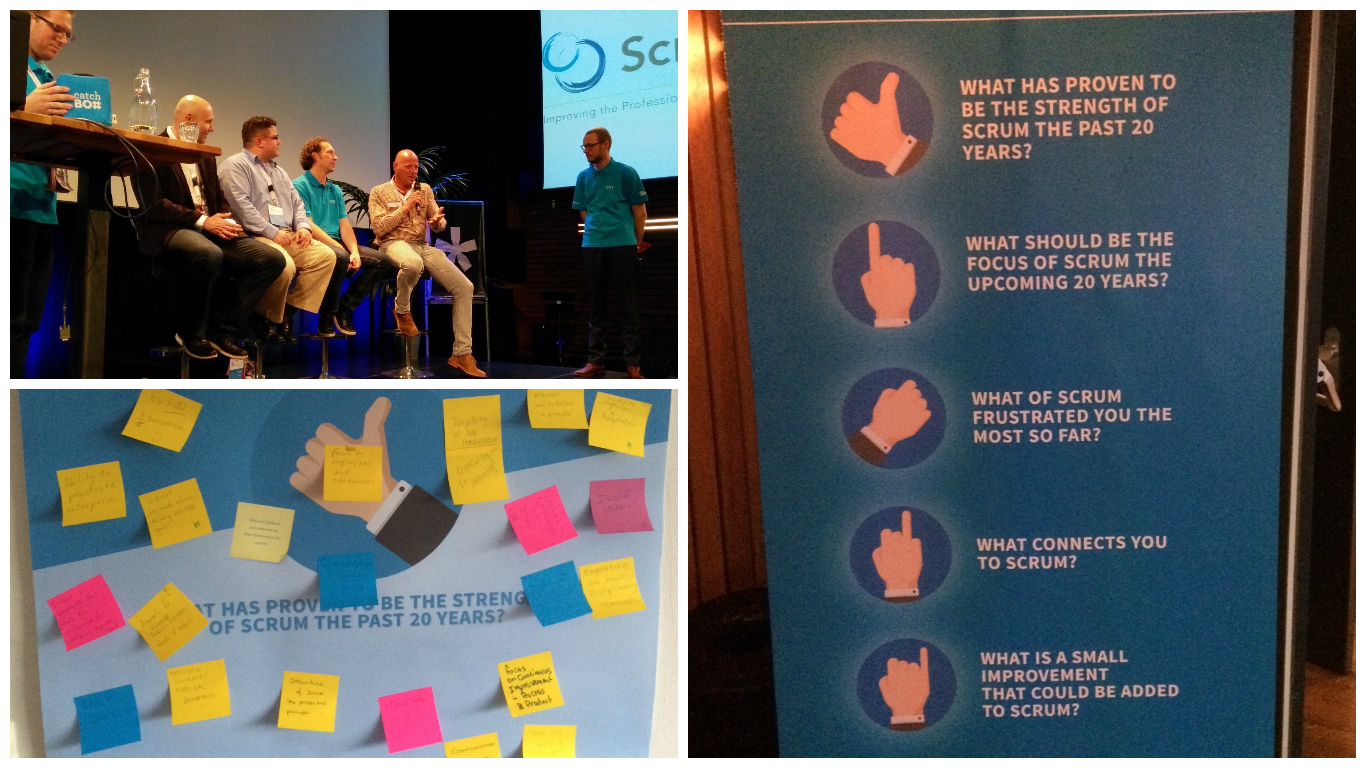
According to the participants was has proven to be the strength of Scrum is:
- It’s an easy & lightweight framework (6x)
- It’s a transparency enabler (5x)
- It delivers a framework that leads to sustainable and continuous improvement (4x)
- It appeals to universally basic human needs & values (3x)
- It provides short feedback loops, continuous planning (3x)
- It removes client-supplier boundaries (2x)
- It’s fun and successful (2x)
- It’s an enabler of personal growth
- The usage of time-boxes
- It improves communication on all layers
- It’s not a silver bullet
- It emphasizes multidisciplinary teamwork
What I Think is the Strength of Scrum
If I had to choose 3 reasons that explain the proven strength of Scrum, they would be:
1. The Simplicity of the Scrum Framework
Scrum is an easy-to-understand, straightforward, lightweight framework for developing and sustaining complex products. It offers you 3 roles, 3 artifacts, and 5 events and can be explained in 23 minutes and 36 seconds or in 5 minutes to your managers. It’s simplicity encouraged many organizations to give it a try. How difficult could it be? Well, nowadays we know better. Yes, it’s simple to explain and understand, but difficult to master. Scrum offers you a framework to deal with complexity. But it doesn’t prescribe ‘how’ to do it. This is where lot’s of organizations struggle. Nevertheless, it’s simplicity combined with the possible benefits does explain why Scrum has become so popular in the past 20 years.
2. The Mirror Scrum Offers
Scrum offers you a mirror. But it doesn’t guarantee a beautiful reflection in return. However, it’s the reality and the truth. This reality can be beautiful but also very painful. If it’s beautiful: enjoy and celebrate! If it’s painful: fix it, deal with it! This is exactly why some organizations love Scrum and why some dislike it. You can’t expect to achieve all the possible benefits – every Sprint a potentially releasable increment – without dealing with the bottlenecks. Compare it with losing weight. You’re not going to lose weight if you’re not willing to change your diet or frequently exercise. But let’s end positively. I think Scrum has become so popular because organizations love the mirror Scrum offers. The transparency it brings enables them to continuously improve themselves, deal with the rapid changing environments and become game changers themselves!
3. The Focus on Done Increments
The goal of Scrum is to create ‘done’, usable, and potentially releasable increments. A truly done increment that lives up to the standards the Scrum Team agreed upon offers transparency. A done increment offers you the ability to inspect the progress and validate assumptions and learning. Continuously delivering done increments gives the Product Owner the opportunity the release early and often. This will answer two important questions:
- Are we building the right product?
- Are we building the product right?
The focus on done increments and the associated benefits is one of the main strengths of Scrum. It enabled organizations to release their product in an early stage within the window of opportunity. However, releasing done increments early and often is a challenge to master. Check out this blog post by Stephanie Ockerman for some more details.
What’s Your Opinion?
What do you think that has proven to be the strength of Scrum the past 20 years? Would love to know your point of view!
Published at DZone with permission of Barry Overeem. See the original article here.
Opinions expressed by DZone contributors are their own.
Comments