

Understanding Custom Authorization Mechanisms in Amazon API Gateway and AWS AppSync
This article compares the use of custom Lambda authorizers in AWS API Gateway and AWS AppSync, focusing on their respective approaches to API authorization.
Join the DZone community and get the full member experience.
Join For FreeAWS provides Lambda-based authorization capabilities for both API Gateway and AppSync, each designed to secure different API paradigms, highlighting their complementary roles and the confidence they inspire in combined security potential.
Amazon API Gateway positions Lambda authorizers as a security checkpoint between incoming requests and backend integrations — whether Lambda functions or HTTP endpoints. The authorizer validates credentials, executes custom authentication workflows, and produces IAM policy documents that explicitly grant or deny access. These policies guide API Gateway’s decision to forward or reject requests to backend services.
In contrast, AppSync integrates Lambda authorizers directly into the GraphQL request lifecycle, intercepting operations before resolver execution. The authorizer examines request credentials (tokens, headers, or other authentication artifacts) and returns an identity context object upon successful validation. This context propagates through the resolver chain, enabling fine-grained, context-aware authorization decisions at the data access layer.
Common Characteristics
The shared attributes of Lambda authorizers in AppSync and API Gateway emphasize their core security capabilities:
- Security Enforcement: Both validate incoming requests and enforce access-control decisions, ensuring requesters possess sufficient privileges to access protected resources.
- Serverless Execution Model: Authorization logic runs within AWS Lambda functions in both cases, providing a consistent serverless compute foundation for custom authentication workflows.
- Flexible Authorization Logic: Developers can implement bespoke authentication and authorization rules within the Lambda function to meet diverse security requirements and business needs.
- AWS Service Integration: Both authorizer types integrate seamlessly with the broader AWS ecosystem. AppSync can leverage DynamoDB or Lambda as data sources, while API Gateway connects to Lambda functions and HTTP endpoints.
- IAM-Based Access Decisions: Both services use IAM policy frameworks to govern access permissions. The authorizer generates policy documents that explicitly define allowed or denied actions for authenticated principals.
Key Distinctions
These distinctions clarify the operational scope, timing, and architecture of Lambda authorizers in AppSync versus API Gateway:
- Functional Scope: AppSync authorizers operate at the GraphQL operation layer, making access decisions before resolver invocation. API Gateway authorizers function at the API route level, protecting endpoints before backend integration occurs.
- Execution Timing and Context Flow: AppSync authorizers produce an identity context object that propagates through the resolver chain. API Gateway triggers authorizers before backend integration, generating IAM policies that determine request disposition.
- Architectural Integration: AppSync authorizers integrate directly into the GraphQL resolver pipeline within GraphQL-specific contexts. API Gateway authorizers function as infrastructure components alongside endpoints, deployment stages, and API configurations.
- Data Format Expectations: AppSync authorizers process GraphQL requests, accessing operation types, field selections, and input arguments. API Gateway authorizers handle requests in formats dictated by integration types—JSON, form data, or others.
- Authorization Output Patterns: AppSync authorizers return identity context objects, enabling resolvers to make granular decisions. API Gateway authorizers generate explicit IAM policy documents defining precise access permissions for API resources.
These architectural differences influence implementation strategies and should guide service selection based on API paradigms, use cases, and authorization needs.
Amazon API Gateway Authorization Flow
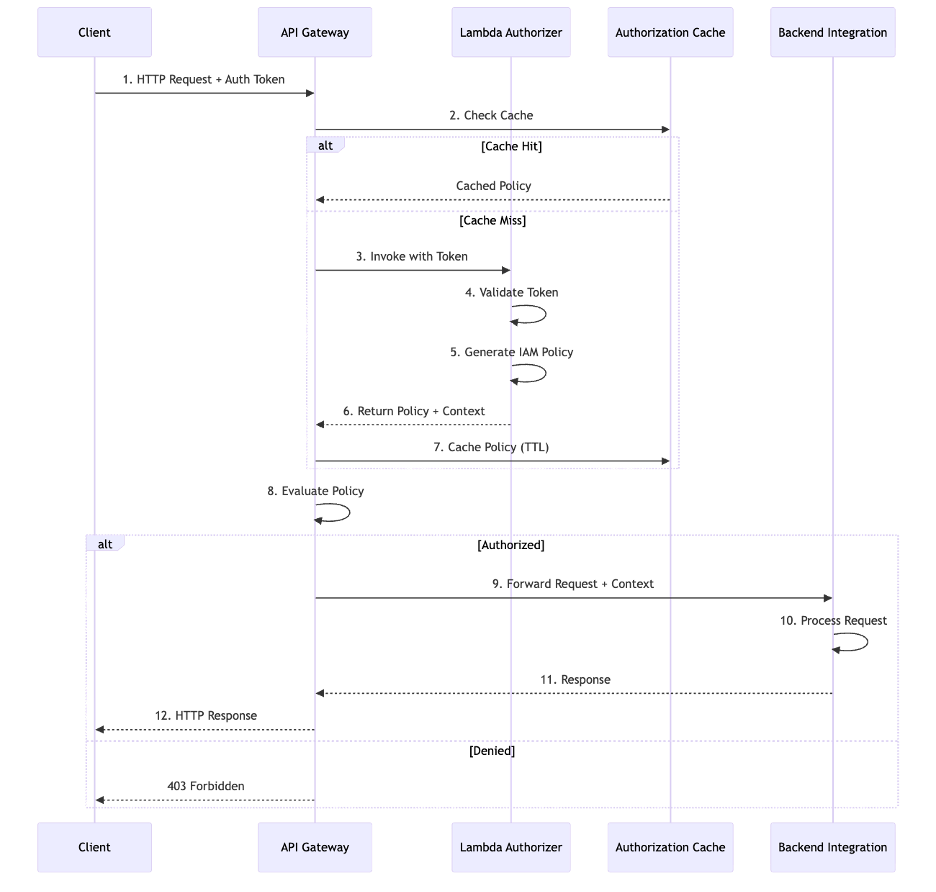
- Client initiates a request to the API Gateway endpoint.
- Lambda authorizer intercepts the request, executing authentication and authorization validation.
- Upon successful authorization, the authorizer returns the IAM policy document defining access scope.
- API Gateway evaluates the policy, allowing or denying the request.
- Approved requests forward to the backend integration (Lambda, HTTP endpoint, etc.).
- Backend processes the request and generates a response payload.
- API Gateway returns the backend response to the client.
Lambda Authorizer Contract for API Gateway:
Input Parameters:
event: Request metadata object containing HTTP headers, method, path parameters, and request context.context: Lambda execution context providing AWS account ID, request ID, and function metadata.
Output Parameters:
principalId: String identifier representing the authenticated principal for tracking and auditing.policyDocument: IAM policy document defining allowed or denied actions on API resources.context: Optional key-value object for passing additional metadata downstream.
AWS AppSync Authorization Flow
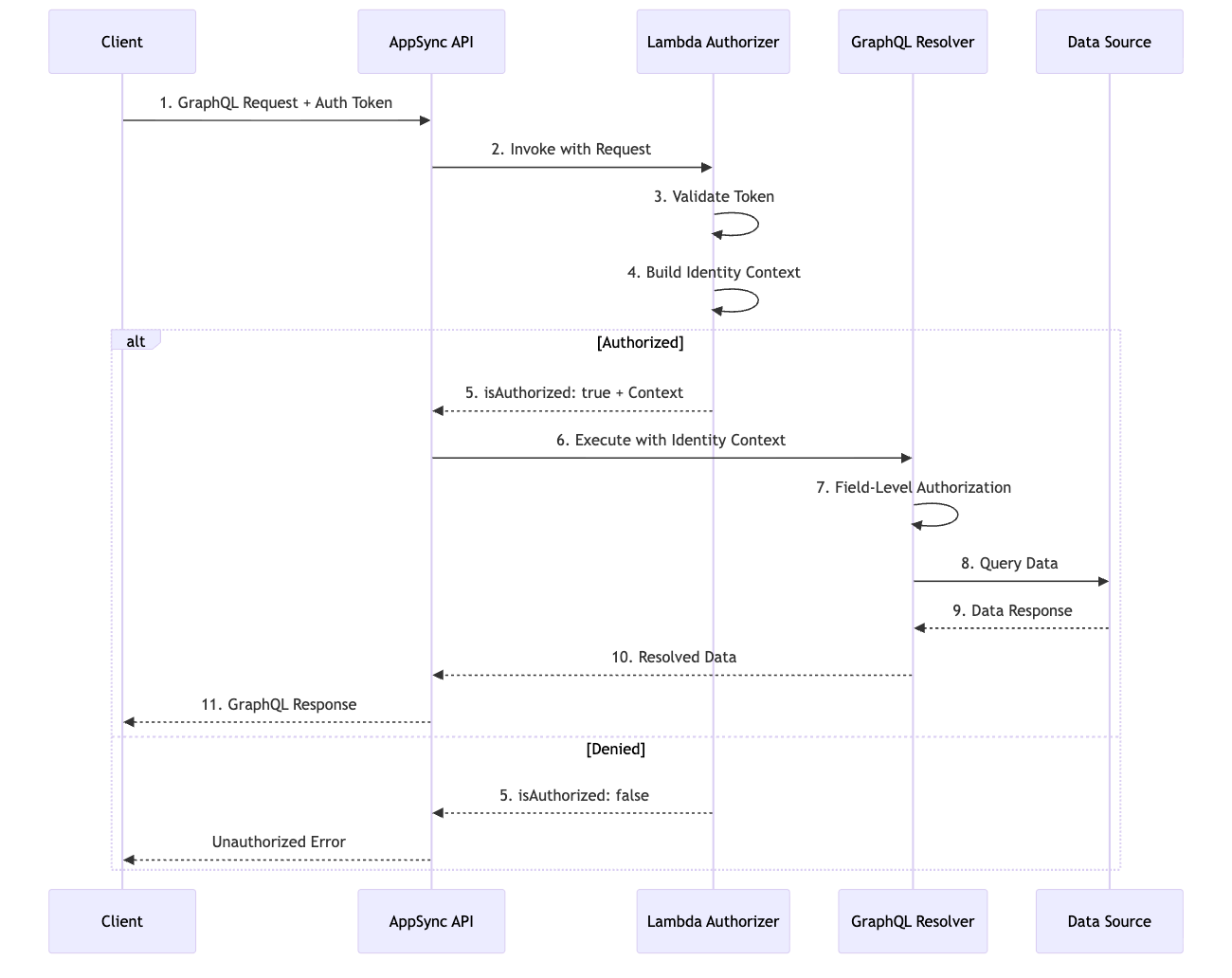
AWS AppSync Authorization Flow
- Client submits GraphQL request to AppSync API endpoint.
- Lambda authorizer intercepts the request, performing authentication and authorization validation.
- Successful authorization produces an identity context object.
- Request proceeds to the appropriate GraphQL resolver with the identity context.
- Resolver executes data source operations (DynamoDB queries, Lambda invocations, etc.).
- Resolver returns a GraphQL response to the client.
Lambda Authorizer Contract for AppSync:
Input Parameters:
event: GraphQL request object containing operation payload, HTTP headers, and request metadata.context: Lambda execution context providing request ID, function version, and runtime information.
Output Parameters:
isAuthorized: Boolean flag indicating authorization decision (true/false).context: Identity context object propagated to downstream resolvers.resolverConfig: Optional object for customizing resolver behavior, including caching strategies and field-level authorization rules.
Use Case Scenarios
Lambda authorizers address diverse authentication and authorization requirements across both services. The following scenarios illustrate practical applications for each implementation:
API Gateway Lambda Authorizer Applications:
- Token-Based RESTful API Security: When building RESTful APIs that require route-specific protection, Lambda authorizers validate authentication tokens and generate IAM policies that control resource access. This pattern suits applications needing granular endpoint-level authorization with explicit access control definitions.
- External Authentication Provider Integration: Organizations that leverage OAuth 2.0, OpenID Connect, or other third-party identity providers can implement Lambda authorizers to validate external tokens, perform claims-based authorization, and map external identities to AWS IAM policies for seamless integration.
- Complex Business Rule Authorization: Applications that require authorization beyond standard IAM capabilities benefit from Lambda authorizers that can invoke external services, evaluate business rules, query databases, and apply multidimensional access control policies before granting API access.
AppSync Lambda Authorizer Applications:
- Field-Level GraphQL Authorization: GraphQL APIs requiring fine-grained data access control leverage AppSync Lambda authorizers to enforce schema-specific authorization rules. The authorizer validates credentials and generates identity contexts that enable resolvers to make field-level and type-level access decisions based on user attributes.
- Multi-Factor Authentication Workflows: GraphQL applications implementing MFA can utilize Lambda authorizers to orchestrate multistep verification processes, integrating with external MFA providers, validating time-based tokens, or enforcing adaptive authentication policies based on request context and risk assessment.
- Federated Identity Resolution: Complex identity scenarios involving multiple authentication sources, user attribute aggregation, or cross-system identity federation benefit from AppSync Lambda authorizers that can resolve identities across disparate systems, enrich user contexts, and provide unified identity information to GraphQL resolvers.
API Gateway authorizers excel in RESTful API protection, third-party authentication integration, and policy-based access control. AppSync authorizers specialize in GraphQL-specific authorization patterns, context-aware data access control, and identity-enriched resolver workflows.
Quick Comparison
| Feature | API Gateway | AppSync |
|---|---|---|
| API Type | RESTful APIs | GraphQL APIs |
| Authorization Level | Route/endpoint level | Operation/field level |
| Output Format | IAM policy document | Identity context object |
| Caching | Built-in (TTL: 0-3600s) | Not built-in |
| Timeout | 30 seconds max | 10 seconds max |
| Use Case | Token validation, OAuth | Fine-grained data access |
| Integration Point | Before backend | Before resolver |
| Policy Generation | Explicit IAM policies | Context-based decisions |
Implementation Examples
API Gateway Lambda Authorizer (Python)
import json
import jwt
from typing import Dict, Any

def lambda_handler(event: Dict[str, Any], context: Any) -> Dict[str, Any]:
    """
    API Gateway Lambda Authorizer for JWT token validation
    """
    try:
        # Extract token from Authorization header
        token = event['authorizationToken'].replace('Bearer ', '')

        # Validate JWT token (simplified - use proper validation in production)
        decoded = jwt.decode(token, 'your-secret-key', algorithms=['HS256'])

        # Extract user information
        principal_id = decoded['sub']

        # Generate IAM policy
        policy = generate_policy(principal_id, 'Allow', event['methodArn'])

        # Add context data (available in backend)
        policy['context'] = {
            'userId': decoded['sub'],
            'email': decoded.get('email', ''),
            'role': decoded.get('role', 'user')
        }

        return policy

    except jwt.ExpiredSignatureError:
        raise Exception('Unauthorized: Token expired')
    except jwt.InvalidTokenError:
        raise Exception('Unauthorized: Invalid token')
    except Exception as e:
        raise Exception(f'Unauthorized: {str(e)}')

def generate_policy(principal_id: str, effect: str, resource: str) -> Dict[str, Any]:
    """
    Generate IAM policy document
    """
    return {
        'principalId': principal_id,
        'policyDocument': {
            'Version': '2012-10-17',
            'Statement': [
                {
                    'Action': 'execute-api:Invoke',
                    'Effect': effect,
                    'Resource': resource
                }
            ]
        }
    }
AppSync Lambda Authorizer (Node.js)
const jwt = require('jsonwebtoken');

exports.handler = async (event) => {
    try {
        // Extract token from request headers
        const token = event.authorizationToken.replace('Bearer ', '');

        // Validate JWT token
        const decoded = jwt.verify(token, process.env.JWT_SECRET);

        // Return authorization response with identity context
        return {
            isAuthorized: true,
            resolverContext: {
                userId: decoded.sub,
                email: decoded.email,
                roles: decoded.roles || [],
                permissions: decoded.permissions || []
            },
            deniedFields: [], // Optional: fields to deny access
            ttlOverride: 300  // Optional: cache TTL in seconds
        };

    } catch (error) {
        console.error('Authorization failed:', error.message);

        // Return unauthorized response
        return {
            isAuthorized: false,
            resolverContext: {},
            deniedFields: ['*'] // Deny all fields
        };
    }
};
Performance and Cost Considerations
Caching Strategies
- API Gateway: Built-in authorizer result caching (TTL: 0-3600 seconds) significantly reduces Lambda invocations and latency
- AppSync: No built-in caching; implement custom caching in authorizer using ElastiCache or DynamoDB
- Recommendation: Enable caching for high-traffic APIs to reduce costs and improve response times
Cold Start Impact
- Lambda cold starts add 100-500ms latency to authorization
- Mitigation: Use provisioned concurrency for critical APIs or implement connection pooling
- Consider keeping authorizer functions warm with scheduled invocations
Cost Optimization
- API Gateway caching reduces Lambda invocations by 90%+ for repeated requests
- Typical cost: $0.20 per million authorizer invocations
- A cache hit rate of 80% can minimize authorization costs by $0.16 per million requests
Security Best Practices
Token Validation
- Always validate token signatures using proper cryptographic libraries
- Verify token expiration (exp claim) and not-before (nbf claim)
- Check token issuer (iss) and audience (aud) claims
- Implement token revocation checking for critical operations
Secret Management
- Store JWT secrets and API keys in AWS Secrets Manager or Parameter Store
- Rotate secrets regularly using automated rotation policies
- Never hardcode secrets in Lambda function code
- Use IAM roles for Lambda to access secrets securely
Error Handling
- Return generic error messages to clients (avoid leaking security details)
- Log detailed error information to CloudWatch for debugging
- Implement rate limiting to prevent brute force attacks
- Use AWS WAF for additional protection against common attacks
Example: Secure Secret Retrieval
import boto3
import json
from functools import lru_cache

@lru_cache(maxsize=1)
def get_jwt_secret():
    """Retrieve and cache JWT secret from Secrets Manager"""
    client = boto3.client('secretsmanager')
    response = client.get_secret_value(SecretId='jwt-secret')
    return json.loads(response['SecretString'])['secret']
Error Handling and Responses
API Gateway Error Responses
When authorization fails, API Gateway returns:
- 401 Unauthorized: Invalid or missing token
- 403 Forbidden: Valid token but insufficient permissions
- 500 Internal Server Error: Authorizer function error
AppSync Error Responses
AppSync returns GraphQL errors:
{
  "errors": [
    {
      "message": "Unauthorized",
      "errorType": "Unauthorized",
      "locations": [
        {
          "line": 1,
          "column": 1
        }
      ]
    }
  ]
}
Custom Error Handling
def handle_authorization_error(error_type: str) -> Dict[str, Any]:
    """Return appropriate error response based on error type"""
    error_messages = {
        'expired': 'Token has expired',
        'invalid': 'Invalid token format',
        'missing': 'Authorization token required',
        'insufficient': 'Insufficient permissions'
    }

    # Log error for monitoring
    print(f"Authorization error: {error_type}")

    # Return generic error to client
    raise Exception('Unauthorized')
Limitations and Constraints
API Gateway Authorizer Limits
- Timeout: Maximum 30-second execution time
- Payload: Request/response limited to 10KB
- Cache TTL: 0-3600 seconds (1 hour maximum)
- Concurrent Executions: Subject to Lambda account limits
AppSync Authorizer Limits
- Timeout: Maximum 10 seconds execution time
- Payload: Request limited to 1MB
- No Built-in Caching: Must implement custom caching
- Resolver Context: Limited to 5KB
Best Practices for Limits
- Keep authorizer logic lightweight and fast
- Implement connection pooling for external service calls
- Use caching aggressively to avoid timeout issues
- Monitor CloudWatch metrics for timeout and error rates
Monitoring and Debugging
Key Metrics to Monitor
- Invocation Count: Track authorization request volume
- Error Rate: Monitor failed authorizations
- Duration: Track authorization latency (target: <100ms)
- Cache Hit Rate: For API Gateway authorizers
- Throttles: Identify capacity issues
CloudWatch Logs
import logging

logger = logging.getLogger()
logger.setLevel(logging.INFO)

def lambda_handler(event, context):
    logger.info(f"Authorization request: {event['methodArn']}")
    # Authorization logic
    logger.info(f"Authorization granted for user: {principal_id}")
Debugging Tips
- Enable detailed CloudWatch logging for authorizer functions
- Use AWS X-Ray for distributed tracing
- Test authorizers locally using SAM CLI
- Implement structured logging for easier analysis across disparate systems, enrich user contexts, and provide unified identity information to GraphQL resolvers.
API Gateway authorizers excel in RESTful API protection, third-party authentication integration, and policy-based access control. AppSync authorizers specialize in GraphQL-specific authorization patterns, context-aware data access control, and identity-enriched resolver workflows.
Summary
Lambda authorizers serve distinct yet complementary roles across AWS's API service portfolio. The selection between AppSync and API Gateway authorizers hinges on your API architecture, authorization complexity, and integration requirements.
API Gateway's Lambda authorizer implementation excels in RESTful API scenarios, providing robust route-level protection through IAM policy generation. The authorizer validates credentials before backend integration occurs, producing explicit policy documents that govern resource access. This approach proves remarkably effective for third-party authentication integration (e.g., OAuth, OpenID Connect) and for custom authorization workflows that extend beyond standard IAM capabilities. Built-in caching capabilities make it cost-effective for high-traffic applications.
AppSync's Lambda authorizer operates within the GraphQL paradigm, intercepting requests at the operation level before resolver execution. Rather than generating explicit IAM policies, it produces identity context objects that flow through the resolver pipeline, enabling granular, field-level authorization decisions. This model suits GraphQL APIs requiring fine-grained data access control and complex identity resolution workflows.
The architectural distinctions between these implementations are substantial. AppSync authorizers integrate directly into the GraphQL resolver chain, processing GraphQL-formatted requests and returning context objects for downstream authorization logic. API Gateway authorizers function as infrastructure-level components, handling various request formats (JSON, form data) and producing IAM policies that determine the disposition of requests.
Your implementation choice should align with your API paradigm: GraphQL applications benefit from AppSync's context-aware authorization model, while RESTful APIs leverage API Gateway's policy-based approach. Consider factors including authentication provider integration requirements, authorization granularity needs, caching requirements, timeout constraints, and the level of customization your security model demands. Both services provide serverless, scalable authorization mechanisms — the optimal choice depends on your specific architectural context and security requirements.
When implementing Lambda authorizers, prioritize security best practices, including proper token validation, secret management, error handling, and monitoring. Leverage caching strategies to optimize performance and costs and ensure your authorizer logic remains lightweight to avoid timeout issues. Regular monitoring of authorization metrics helps identify potential security issues and performance bottlenecks before they impact production systems.
References
AWS Official Documentation
- API Gateway Lambda Authorizers
- AWS AppSync Authorization
- AWS Lambda
- Security and Best Practices
- Monitoring and Debugging
Additional Resources
Opinions expressed by DZone contributors are their own.
Comments