

Golden Prompts: Turning AI Prompting into an Engineering Practice
Golden prompts turn ad hoc AI prompting into reusable, governed engineering assets for consistent, secure, high-quality outcomes.
 CORE
·
CORE
·
CORE
·
CORE
·
 ·
·
Join the DZone community and get the full member experience.
Join For FreeAI-assisted software engineering is becoming part of software development on a daily basis. AI tools are used now for code creation, writing tests, reviewing changes, troubleshooting, documentation creation, and architecture and design decisions.
But most teams still use AI largely in an ad hoc fashion. Every developer writes prompts differently, gives different levels of context, and expects different outputs. As a result, the quality of AI-generated results can be very different even for the same engineering task.
Consider a simple code-review request: Review this code.
One developer might expect security issues to be identified, another might focus on performance issues, while someone else may focus on maintainability and coding-standard violations.
When all engineers create prompts independently, teams will end up with inconsistent results, repeated experimentation, and missing important engineering requirements.
This is where golden prompts become useful.
What Is a Golden Prompt?
A golden prompt is a reusable and carefully designed prompt for a specific engineering task. It captures the right context, instructions, constraints, and expected output so that different engineers can achieve more consistent results.
For example, instead of simply asking: Review this Terraform code.
A golden prompt could ask the AI to review the code for security, IAM permissions, networking exposure, hard-coded secrets, maintainability, and potentially destructive changes, and return the findings in a predefined format.
Golden Prompts vs. Ad Hoc Prompts
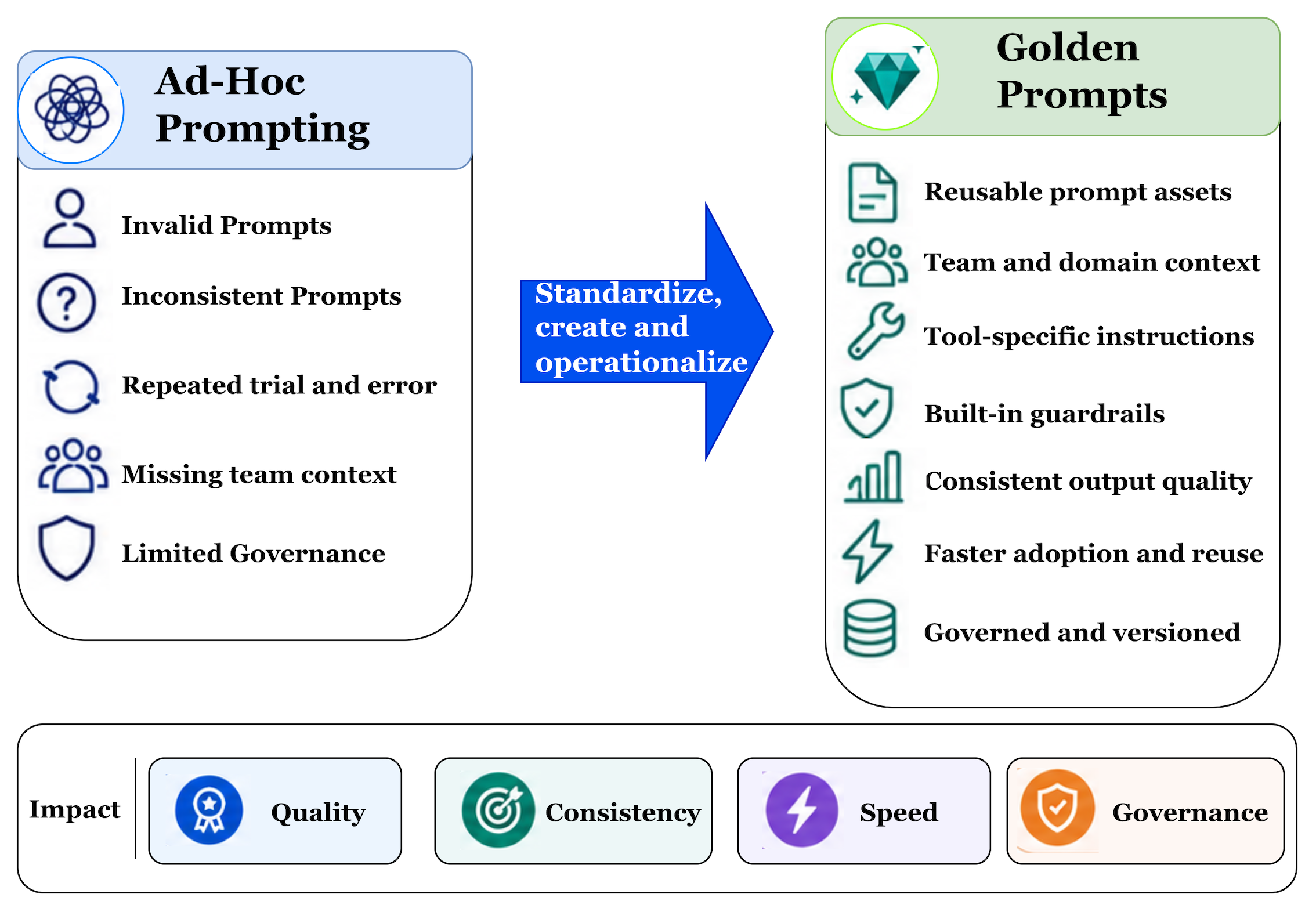
The key shift is simple:
Instead of treating prompts as disposable instructions, golden prompts treat them as reusable engineering assets.
That shift moves organizations from ad hoc AI use to a more structured prompt-engineering practice.
Why Do We Need Golden Prompts?
As AI tools become part of everyday engineering, prompt quality directly affects the quality and consistency of the output. Golden prompts move teams from individual experimentation to a common and repeatable approach to working with AI.
- Inconsistent AI output across engineers: Engineers can describe the same task in very different ways, and the results are different in terms of detail, accuracy, and quality. Golden prompts provide a common starting point and make results more consistent.
- Repeated prompt engineering effort: Without shared prompts, engineers spend time refining similar instructions for code reviews, test generation, troubleshooting, documentation, or architecture analysis. Golden prompts avoid this duplication by recording prompts that already work well.
- Missing organizational context: Generic prompts do not reflect architecture standards, coding guidelines, technology choices, or operational practices in an organization. Golden prompts should be written with this context in mind so that AI-generated responses are more closely aligned to how the organization builds software.
- Security and compliance risks: A general-purpose prompt can neglect security, privacy, compliance, and governance requirements. Golden prompts should include these expectations explicitly and make them part of the AI-driven workflow rather than the engineering team having to remember them.
- Variability across AI models and tools: Different AI models and coding assistants can interpret the same instruction differently. Golden prompts cannot eliminate model differences, but well-defined context, constraints, and expected outputs can reduce unnecessary variation across tools.
- Capturing engineering best practices: Golden prompts are a simple way of taking engineering knowledge and sharing it with the rest of the team. A well-designed prompt can include the practices of code quality, security, testing, reliability, and infrastructure for the wider team.
In short, golden prompts turn individual prompting knowledge into reusable team knowledge, improving consistency while reducing repeated effort.
Business Benefits of Golden Prompts
While golden prompts improve day-to-day engineering productivity, their value extends beyond individual users. Organizations can use golden prompts to improve consistency, accelerate AI adoption, and reduce operational risk.
- Reduced rework: Teams spend less time repeatedly refining prompts for common tasks.
- Faster onboarding: New engineers can leverage proven prompts instead of learning through trial and error.
- Improved consistency: Similar tasks are evaluated using common criteria and output formats.
- Better compliance and governance: Security, privacy, and organizational policies can be embedded into reusable prompts.
- Knowledge reuse: Engineering best practices become reusable assets that can be shared across teams.
- Higher AI ROI: Teams achieve more predictable and repeatable outcomes from AI-assisted workflows.
In essence, golden prompts help transform AI usage from an individual productivity technique into a scalable organizational capability.
The Impact of a Golden Prompt: A Before-and-After Example
The value of a golden prompt becomes clearer when we compare it with a generic prompt for the same engineering task.
Consider a simple code review scenario. Suppose the code being reviewed is:
def get_user(id):
	query = "SELECT * FROM users WHERE id = " + id
	result = database.execute(query)
	return result
Generic Prompt
Review this code.
A typical AI response can be —
The function retrieves a user from the database. Potential improvements:
- Add error handling.
- Validate user input.
- Consider using parameterized queries.
- Improve readability.
The response is technically correct, but it is broad and unstructured. There is no prioritization of issues, no severity assessment, and no clear guidance on what should be fixed first.
Golden Prompt
Act as a senior software engineer. Review the code for: Correctness, Security issues, Performance concerns and Maintainability. For each finding: Explain the issue, Assign a severity (High, Medium, Low), and Recommend a fix. If no issues are found, explain why the code is acceptable.
A typical AI response can be —
Code Review Findings
Finding 1: SQL Injection Vulnerability
Severity: High
Issue:
The query is built using direct string concatenation.
Risk:
An attacker could manipulate the input and execute unauthorized SQL commands.
Recommendation:
Use parameterized queries.
------------------------------------------------
Finding 2: Missing Input Validation
Severity: Medium
Issue:
The function assumes the input is valid.
Recommendation:
Validate the ID before executing the query.
------------------------------------------------
Finding 3: Missing Error Handling
Severity: Medium
Issue:
Database failures are not handled.
Recommendation:
Add exception handling and logging.
------------------------------------------------
Summary
The code contains one High-severity security issue and two Medium-severity reliability concerns. The SQL Injection vulnerability should be addressed before deployment.
The important difference is not that the golden prompt makes the AI smarter. It provides a clearer framework for evaluation by defining the review criteria, expected output structure, and severity classification. As a result, the response becomes more consistent, actionable, and reusable across different engineers and teams.
Anatomy of a Golden Prompt
A golden prompt is more than a detailed instruction. It is a structured prompt that gives the AI enough context, boundaries, and expectations to perform a task consistently.
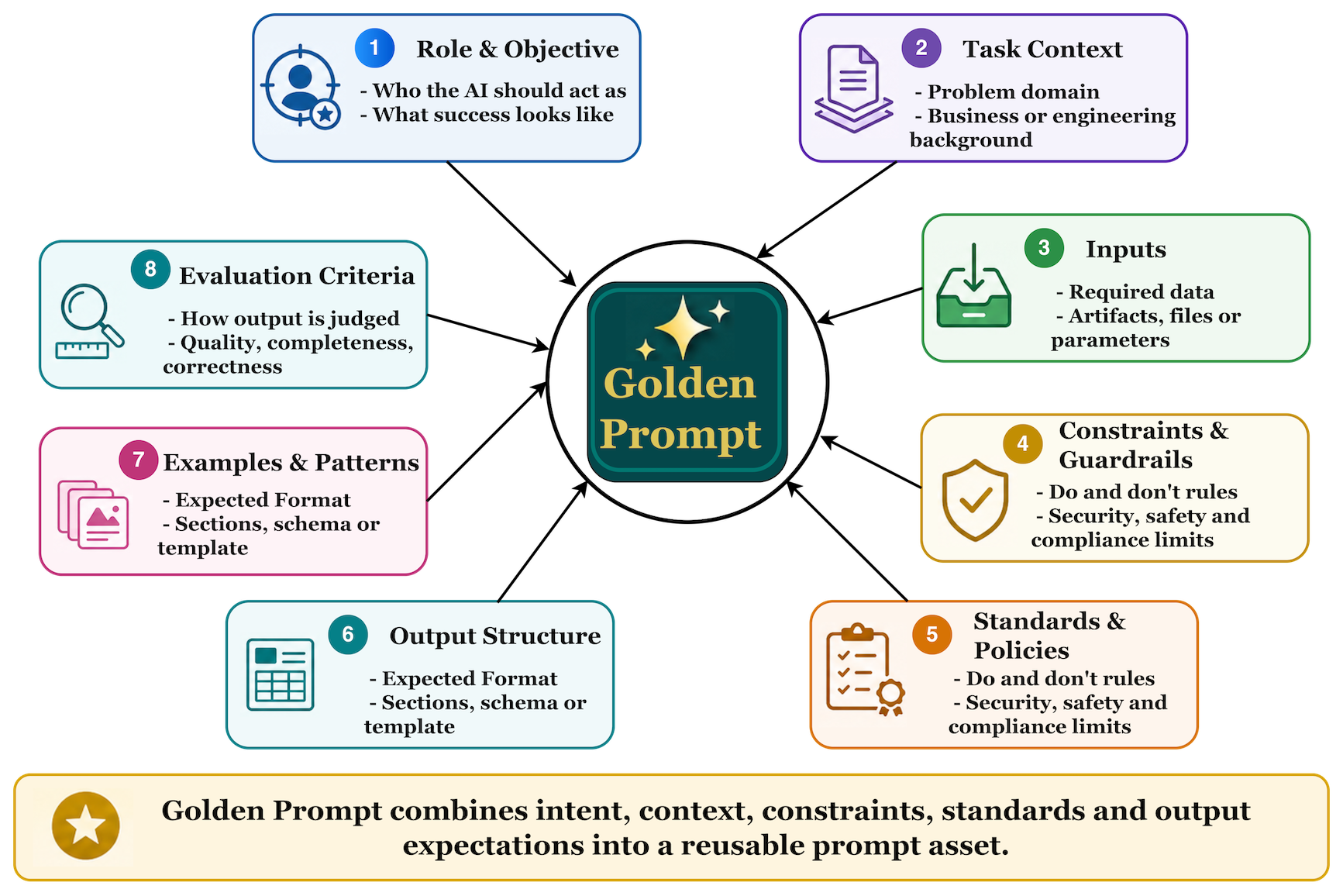
A simple way to visualize the anatomy of a golden prompt is:
Role + Context + Input + Constraints + Standards + Evaluation Criteria + Output + Validation
Not every golden prompt needs every element. The goal is to include enough structure to make the AI response reliable and repeatable without making the prompt unnecessarily complex.
Golden Prompt Use Cases Across Engineering and Service Teams
|
Engineering / Service Team |
Example Golden Prompt Use Cases |
|
Product Management |
Requirement refinement, user-story generation, acceptance criteria, feature prioritization, release-note drafting |
|
Development |
Code generation, refactoring, code explanation, unit-test generation |
|
Architecture |
Architecture review, technology evaluation, trade-off analysis, ADR generation |
|
DevOps & Platform Engineering |
CI/CD troubleshooting, Kubernetes diagnostics, IaC generation, runbook creation |
|
Security |
Threat modeling, secure code review, vulnerability analysis, security recommendations |
|
SRE & Operations |
Incident investigation, root-cause analysis, log and metric analysis, post-incident reviews |
|
Cloud Service Management |
Service health analysis, SLA/SLO review, capacity planning, change-impact assessment, operational readiness |
|
QA & Testing |
Test-case generation, negative testing, API testing, regression-test identification |
Designing Golden Prompts for Different AI Tools
The same golden prompt should not always be used unchanged across AI tools. Different tools have different strengths, context mechanisms, integrations, and interaction models. The core intent can remain the same, but the prompt should be adapted to the tool.
|
AI Tool / Tool Type |
Golden Prompt Considerations |
|
ChatGPT / General-Purpose LLMs |
Provide clear context, role, constraints, expected output, and relevant reference information. These tools work well for analysis, explanation, troubleshooting, and structured reasoning. |
|
GitHub Copilot / IDE Assistants |
Keep prompts closer to the code and development task. Include language, framework, coding conventions, testing expectations, and files or components that should be considered. |
|
Claude / Long-Context Assistants |
Take advantage of larger context by providing architecture documents, requirements, policies, or larger code sections when relevant. Clearly identify which information should drive the response. |
|
AI Code Review Tools |
Define the review criteria explicitly, such as correctness, security, performance, maintainability, error handling, and test coverage. Specify how findings should be prioritized. |
|
Security AI Tools |
Include the application context, threat model, security standards, trust boundaries, and expected severity classification. Avoid relying only on generic vulnerability identification. |
|
Cloud and Operations Assistants |
Provide environment details, logs, metrics, alerts, deployment information, and operational constraints. Ask the AI to base recommendations on evidence rather than assumptions. |
|
Infrastructure-as-Code Assistants |
Include the cloud platform, IaC framework, organizational standards, security requirements, naming conventions, and restrictions on destructive changes. |
|
Enterprise AI Platforms |
Include organizational policies, approved technologies, architecture standards, compliance requirements, and data-handling restrictions within the Golden Prompt or its supporting context. |
Golden Prompts Should Be Context-Aware
A golden prompt should not be very general. Its effectiveness depends on whether the golden prompt is representative of the environment in which the task is being performed. The same task may need to be handled differently depending on the team, application, technology stack, repository, security requirements, and so on.
- Team context: Include the responsibilities and working practices of the team using the prompt. A developer, SRE, security engineer, or product manager might evaluate the same problem differently.
- Application context: Provide relevant information about the application, its purpose, architecture, critical components, dependencies, and operational needs.
- Technology-stack context: Specify the languages, frameworks, cloud platforms, databases, Kubernetes distributions, CI/CD tools, or other technologies that should influence the response.
- Repository context: Where applicable, include repository-specific information such as project structure, existing coding patterns, dependencies, configuration conventions, and testing practices.
- Security context: Define relevant security expectations, such as authentication, authorization, secrets handling, network exposure, data protection, and vulnerability requirements.
- Organizational policies: Golden Prompts can also incorporate internal standards, architecture principles, compliance requirements, approved technologies, and operational policies.
This can be represented simply as:
Golden Prompt = Base Prompt + Team Context + Tool Context + Task Context + Guardrails
The base prompt defines the common task and expected outcome, while the additional context adapts it to a specific team, tool, environment, and situation.
For example, a common Kubernetes troubleshooting prompt may be reused across teams, but the surrounding context can specify the cloud platform, monitoring tools, production constraints, security requirements, and operational procedures.
The goal is not to create a completely different prompt for every situation. Instead, teams can maintain a stable base prompt and enrich it with the context required for the task at hand.
Building a Golden Prompt Library
As golden prompts grow across teams, they should be managed as shared engineering assets rather than scattered across personal notes or chat histories. A golden prompt library helps teams discover, use, and improve high-quality prompts consistently.
- Central prompt repository – Store all approved Golden Prompts in one centralized location that is easy to access and trust.
- Prompt categories – Organize prompts by domain, team, use case, or tool so users can quickly find the right prompt.
- Naming conventions – Use a clear and consistent naming pattern to make prompts easy to search, identify, and reference.
- Metadata and ownership – Capture details such as purpose, team, owner, use case, tags, and last updated date to ensure accountability.
- Version control – Track changes, maintain prompt versions, and support rollbacks to keep prompts accurate and reliable.
- Examples and usage guidance – Provide examples, expected inputs, sample outputs, and usage tips to help users apply prompts correctly.
- Reusable prompt templates – Provide templates for common scenarios that teams can customize to create new prompts quickly.
A well-managed Golden Prompt Library makes prompts easier to discover, reuse, improve, and govern across teams.
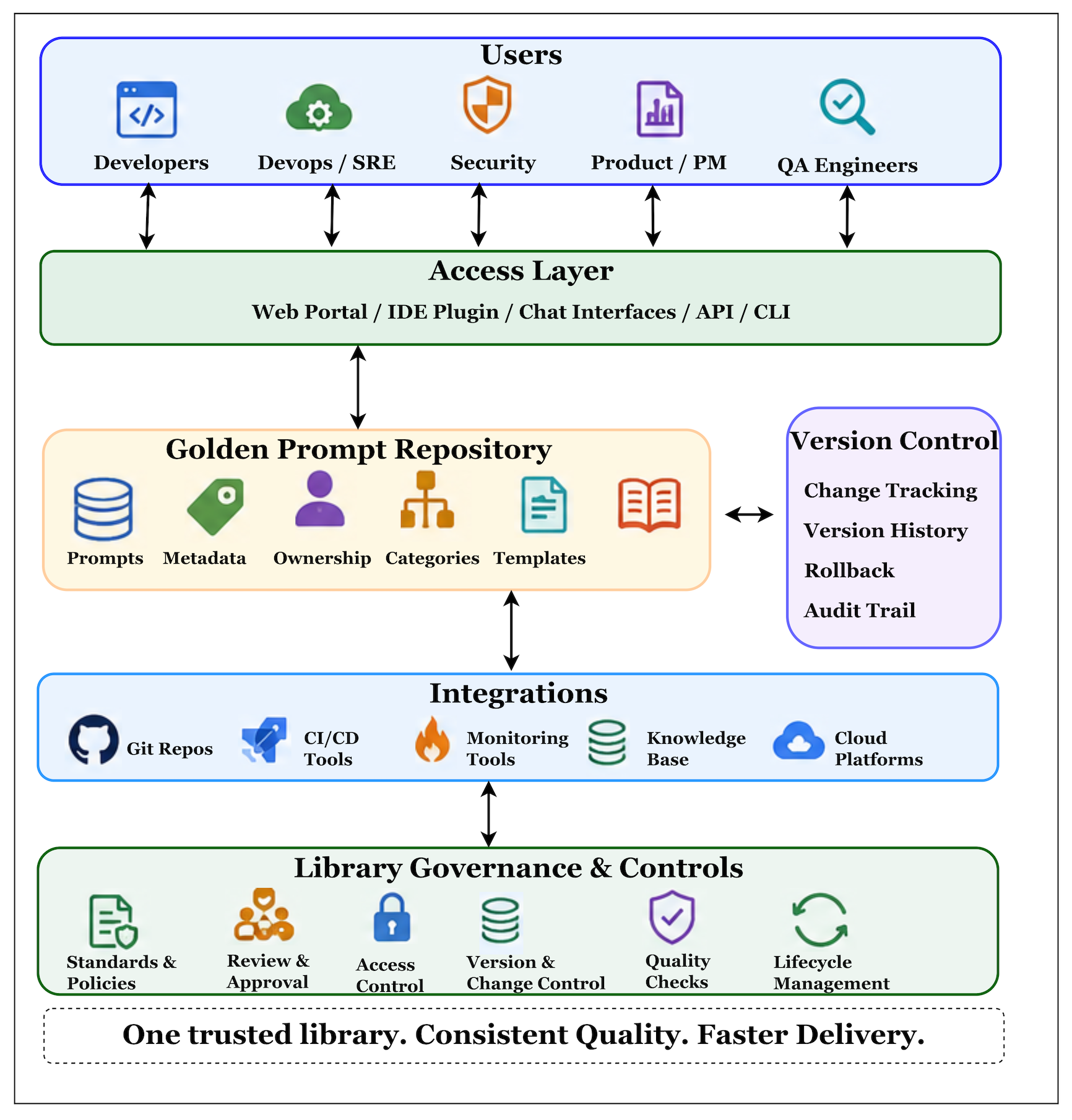
Golden Prompt Library Architecture
The library can sit at the center of the AI-assisted engineering workflow, connecting users, engineering tools, version control, and governance.
Users → Access Layer → Golden Prompt Repository → Tool Integrations
with version control and governance applied across the library.
The goal is simple: one trusted source for reusable prompts, with clear ownership, controlled evolution, and consistent usage across engineering teams.
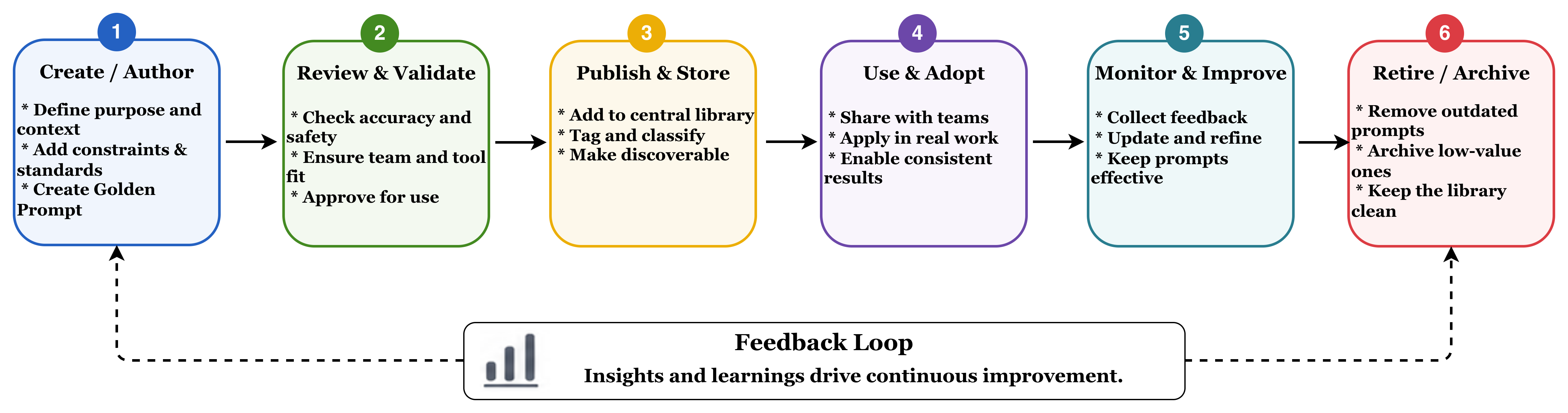
Golden Prompt Lifecycle
A golden prompt should evolve rather than remain static. A simple lifecycle helps teams create, validate, publish, monitor, and continuously improve prompts as engineering needs, tools, and standards change.
Golden Prompt Quality and Evaluation Criteria
A golden prompt should be evaluated before it is published to the shared library. The goal is to ensure that it is clear, reliable, reusable, and produces useful results across different users and scenarios.
|
Evaluation Criterion |
What to Check |
Weight |
|
Clarity |
Is the task and expected outcome clearly defined? |
10% |
|
Completeness |
Does the prompt include the required context, inputs, constraints, and output expectations? |
12% |
|
Accuracy |
Does the prompt guide the AI toward technically and factually correct responses? |
15% |
|
Relevance |
Does it stay focused on the intended task? |
5% |
|
Consistency |
Does it produce reasonably consistent results across repeated use? |
10% |
|
Context Awareness |
Does it include the required team, application, technology, and organizational context? |
10% |
|
Security & Safety |
Are appropriate security, privacy, and operational guardrails included? |
12% |
|
Standards Alignment |
Does it reflect applicable engineering standards and organizational policies? |
8% |
|
Actionability |
Does the output provide useful findings, recommendations, or next steps? |
7% |
|
Output Quality |
Is the expected response structured and usable? |
4% |
|
Tool / Model Compatibility |
Does it work effectively with the intended AI tool or model? |
2% |
|
Reusability |
Can it be reused across similar scenarios with minimal changes? |
3% |
|
Maintainability |
Can it be easily updated as requirements evolve? |
2% |
|
Total |
|
100% |
Note: The weights shown are illustrative and should be adjusted based on organizational priorities and risk appetite.
You could classify prompts as:
|
Final Score |
Quality Decision |
|
90–100 |
Golden / Approved |
|
80–89 |
Good – minor improvements |
|
70–79 |
Needs refinement |
|
Below 70 |
Not ready for Golden Prompt library |
Accuracy, completeness, security and safety, clarity, consistency, and context awareness the highest-priority factors. Security and safety and accuracy can be treated as mandatory gates, not just weighted criteria. For example, a prompt should not be approved even with an overall score above 90 if it fails a critical security or accuracy check.
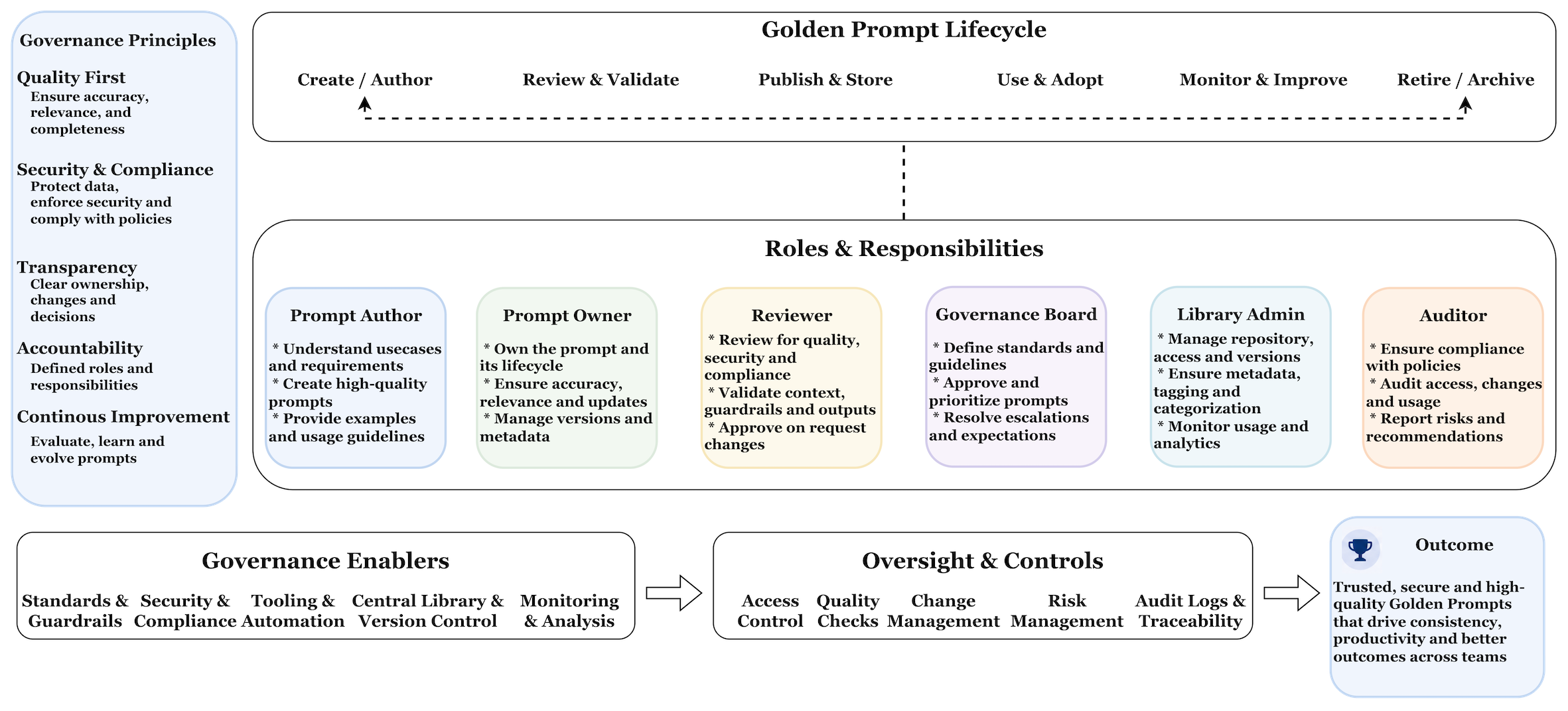
Golden Prompt Governance Model
A structured governance model ensures quality, security, consistency, and responsible use of golden prompts.
Golden Prompt Anti-Patterns and Risks
Golden prompts improve consistency, but poorly designed or poorly governed prompts can introduce their own risks. Recognizing common anti-patterns helps teams avoid prompts that are rigid, outdated, insecure, or unreliable.
|
Anti-Pattern / Risk |
What It Looks Like |
Why It Is a Problem |
|
Overly Generic Prompt |
Uses broad instructions with little context |
Produces shallow or inconsistent results |
|
Overloaded Prompt |
Tries to cover too many tasks, rules, and scenarios in one prompt |
Makes the prompt difficult to understand, maintain, and execute reliably |
|
Hard-Coded Context |
Embeds environment-, team-, or tool-specific details directly into the base prompt |
Reduces reuse and quickly makes the prompt outdated |
|
Missing Guardrails |
Does not define security, operational, or compliance boundaries |
Can lead to unsafe or inappropriate recommendations |
|
Ambiguous Instructions |
Uses unclear objectives or vague success criteria |
Different users or models may interpret the task differently |
|
Unvalidated Prompt |
Is published without testing against representative scenarios |
Errors and poor outputs become reusable at scale |
|
Model-Specific Dependency |
Relies heavily on behavior unique to one model or tool |
May perform poorly when the underlying AI model changes |
|
Prompt Duplication |
Multiple teams maintain slightly different versions of the same prompt |
Creates inconsistency and unnecessary maintenance |
|
No Ownership |
No team or individual is responsible for maintaining the prompt |
Outdated or incorrect prompts remain in use |
|
No Version Control |
Changes are made without tracking or review |
Makes rollback, comparison, and auditing difficult |
|
Stale Prompt |
Continues referencing old technologies, policies, or architectures |
Produces recommendations that no longer match the environment |
|
Excessive Trust in Output |
AI-generated results are accepted without validation |
Can propagate incorrect assumptions, insecure configurations, or poor decisions |
|
Sensitive Data Exposure |
Prompts encourage users to paste secrets, credentials, or confidential data |
Creates security, privacy, and compliance risks |
|
Too Rigid |
Forces the same workflow and output for every scenario |
Prevents adaptation when task context differs |
A useful principle is: Golden prompts should standardize good engineering practices without becoming static, overly restrictive, or blindly trusted.
From Golden Prompts to Golden AI Workflows
Golden prompts are a strong starting point, but enterprise AI usage does not stop at a single prompt. As AI adoption matures, prompts become part of broader workflows that combine context, tools, policies, and automation.
Evolve a single prompt into intelligent, policy-aware, tool-augmented AI workflows that deliver consistent and high-quality outcomes at scale.
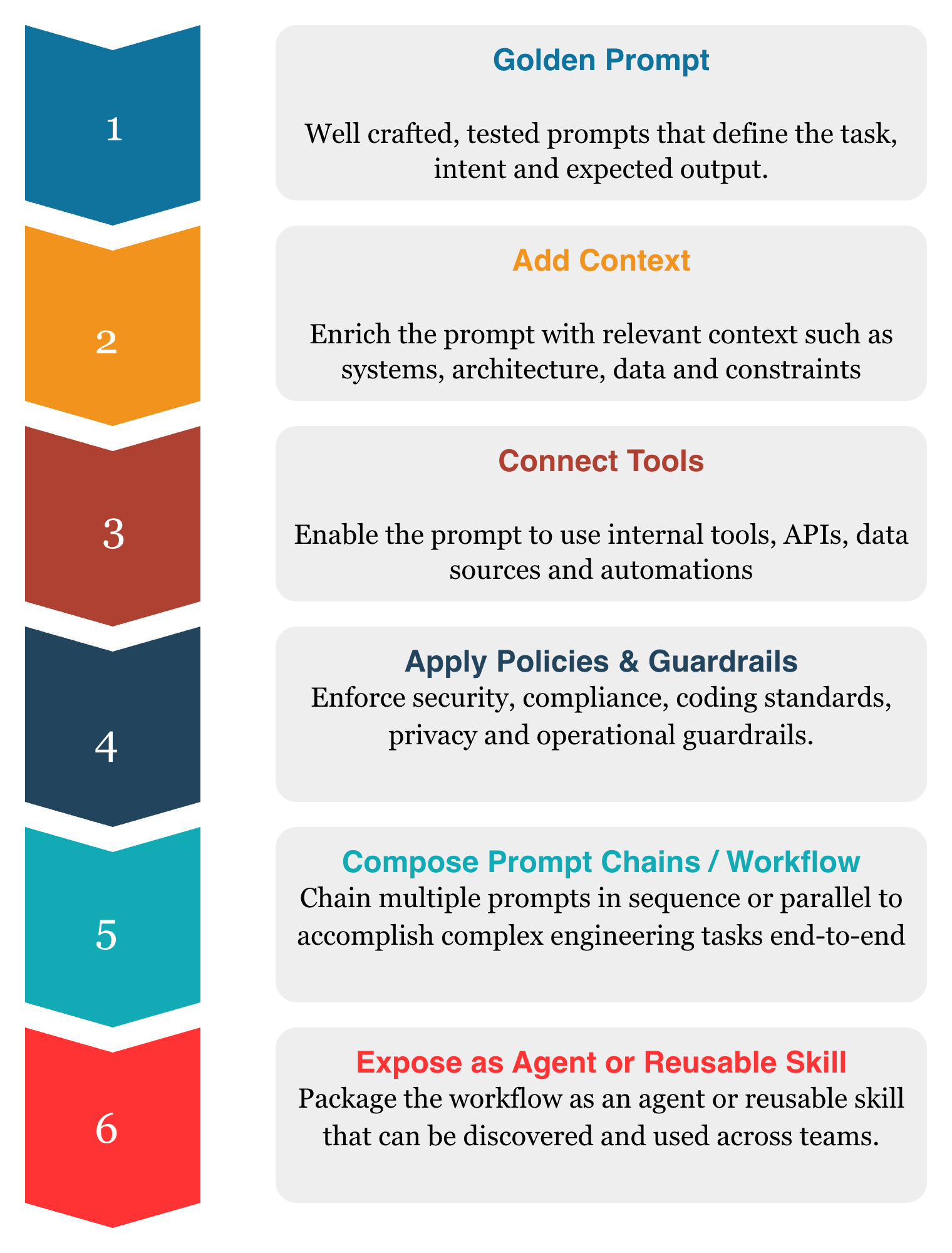
When combined with context, tools, and policies, golden prompts power intelligent workflows and agentic systems that drive productivity, consistency, and trust in enterprise AI engineering.
The broader idea is that golden prompts provide the standardized intent and guidance, while workflows, tools, and agents provide the execution around them.
Conclusion
As AI becomes increasingly embedded in software engineering, prompts should no longer be viewed as disposable instructions. Well-designed prompts capture engineering knowledge, standards, context, and guardrails, making them valuable reusable engineering assets.
Golden prompts bring standardization to AI-assisted engineering without removing developer flexibility. Teams can start from a trusted prompt and adapt the necessary context for a particular application, tool, or task while maintaining common quality and security expectations.
Ultimately, golden prompts provide a foundation for consistent, scalable, and governed AI-assisted software engineering. As organizations move toward AI workflows, reusable skills, and agentic systems, these prompts can become the building blocks that connect engineering intent with context, tools, policies, and automation.
Opinions expressed by DZone contributors are their own.
Comments