

Unified Checkout Experience Through Micro Frontend Architecture
Learn about the architecture and design for building a scalable end-to-end product that can integrate front-end apps to provide a cart and payment services.
 ·
·
Join the DZone community and get the full member experience.
Join For FreeLarge retail systems today, much like Walmart, operate multiple types of checkout registers across various services — pharmacy, auto care, fuel stations, photo centers, and more. These checkout points are not just limited to traditional frontend registers for scanning and payment, but encompass a broad array of service-specific interfaces.
As the breadth of services grows, retailers are often left managing fragmented checkout solutions. This fragmentation leads to inconsistent user experiences, higher training overhead for staff, and slower development cycles. The need for a unified checkout experience across microapps — one that abstracts underlying service complexity and presents a consistent interface to customers and associates — has never been more critical.
Architecture Overview
To address this challenge, we adopted a micro frontend-based architecture that emphasizes seamless integration and transitions between microapps. This approach is anchored by custom libraries and control transfer mechanisms that simplify complexity and enhance reusability.
Key components of the architecture include:
- Navigation APIs – For seamless control transfer between microapps
- View components – Modular UI elements that render data and manage user interactions
- Redux store – A centralized state management layer for storing session-critical data like customer information, cart items, and payment context
- Reusable JS library – A shared API client that interacts with Cloud-Powered Checkout services for cart management and payment processing
- Listeners and emitters – A real-time communication layer enabling efficient interaction between frontend apps and hardware peripherals (e.g., scanners, pinpads)
Architecture Diagram
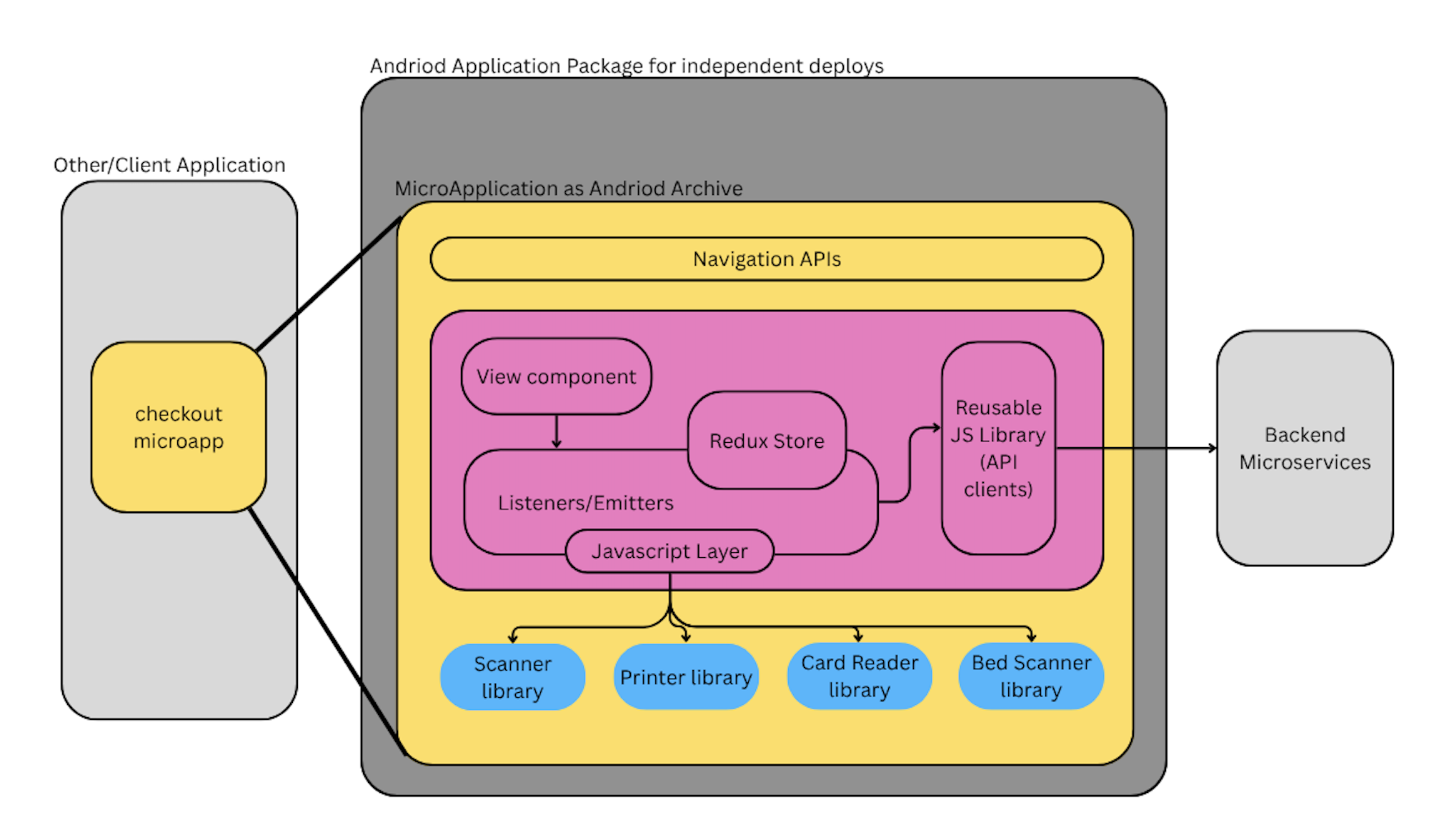
Architecture Details
1. Cross-App Control Transfer via Navigation APIs
One of the key integration challenges is the handoff between distinct microapps. For instance, a pharmacy app may handle prescriptions and age verification, while a checkout app is responsible for payment and receipt generation. Our architecture uses backend-based navigation APIs to retrieve the current cart state from one microapp and reinject that state into another, enabling a seamless transition without data loss or manual intervention.
2. Unified Look and Feel via Shared Components
Different microapps often lead to divergent UI implementations, requiring associates to relearn interfaces across services. We addressed this by creating a shared component library for views, styles, and animations — enabling a consistent and familiar experience across all microapps while improving development efficiency and design consistency.
3. Robust State Management
Moving between microapps requires persistence of context — such as user roles, cart contents, discounts, and operational permissions. The Redux store acts as a resilient state layer, ensuring relevant data persists during navigation and is cleaned up appropriately after checkout completion.
4. Centralized API Client Layer
Microapps frequently interact with server-side APIs for workflows, storage, and business logic. Historically, this led to redundant API clients across teams. Our solution is a reusable JavaScript library that encapsulates API logic (including retries and timeouts), enabling teams to share code and streamline backend interactions.
5. Event-Driven Peripheral Integration
In retail settings, hardware like barcode scanners and pinpads serve as primary input devices. These require low-latency, asynchronous communication to avoid UI lags or lost inputs. Our system employs listener-emitter patterns over WebSocket, with a durable event queue ensuring even rapid inputs (e.g., fast barcode scans) are processed in sequence. This improves performance, avoids data loss, and enables more natural, responsive interactions at checkout.
Compile-Time Integration for Seamless Microapp Control
A common approach to moving between applications is deep linking, where one app navigates to another via a URI or intent. While flexible, deep linking introduces runtime dependencies, requires loading and switching between full applications, and adds latency and failure risk — especially if the target app is unavailable or uninstalled.
To overcome these limitations, our architecture adopts a compile-time integration strategy. Each microapp is packaged as an Android archive (AAR), which can be consumed as a library dependency by other applications. This approach allows teams to:
- Avoid runtime dependencies or transitions
- Eliminate the need to install multiple apps
- Retain full control over integrated functionality
- Reduce integration fragility and runtime errors
Instead of depending on external applications at runtime, a host app can simply embed the compiled microapp library, invoking its components directly within its own process and UI flow. This provides strong guarantees about availability and compatibility.
Advantages of Compile-Time Integration
- No runtime overhead or latency: Unlike deep linking, there’s no app-switching or remote loading. Everything is precompiled and locally available, enabling fast, seamless transitions.
- Improved stability and resilience: Since the microapp is part of the host app's binary, failures due to missing installations or incompatible app versions are eliminated.
- Clear boundaries with full functional control: Host apps only access what the embedded library exposes, preserving encapsulation while enabling full control within defined interfaces.
- Simplified development and testing: Shared navigation APIs and interfaces are validated at build time, reducing integration bugs and enabling better tooling, static analysis, and test coverage.
This architecture allows for modular development across teams while ensuring tight integration and a cohesive user experience — without the fragility of runtime-linked systems.
Conclusion
This micro frontend architecture empowers organizations to build and maintain microapps independently — each owned by different teams — while delivering a cohesive and intuitive checkout experience across the entire retail ecosystem. With reusable libraries, shared state, and seamless peripheral communication, it simplifies development while elevating customer and associate satisfaction.
Opinions expressed by DZone contributors are their own.
Comments