

Using Java for Developing Agentic AI Applications: The Enterprise-Ready Stack in 2026
Learn how to build reliable, production-ready agentic AI in Java using LangChain4j, Quarkus, MCP, and OpenTelemetry for scalable enterprise apps.
Join the DZone community and get the full member experience.
Join For FreeAs agentic AI shifts from prototypes to enterprise production, Java emerges as a powerful alternative to Python-centric stacks. This article looks into building robust agentic applications using LangChain4j for orchestration, Quarks for high-performance deployment, Model Context Protocol (MCP) for standardized tool and data access, and OpenTelemetry for comprehensive observability. Through practical code examples — including tool definitions, agent creation with memory, RAG integration, and production patterns — the guide demonstrates Java's advantages in type safety, low-latency execution, deep system integration, and audit-ready tracing. This is ideal for developers seeking scalable, reliable agentic solutions in mission-critical environments.
Agentic AI — autonomous systems that reason, plan, use tools, remember context, and execute complex multi-step tasks — is moving from experimental prototypes to production workloads in enterprises. While Python ecosystems (LangChain, LlamaIndex, CrewAI) led the early wave, Java is emerging as a serious contender for mission-critical agentic applications.
Why? Java delivers type safety, battle-tested performance, seamless integration with existing microservices/monoliths, low-latency cold starts via GraalVM native images, and first-class observability through OpenTelemetry.
In 2026, the combination of LangChain4j, Quarkus, Model Context Protocol (MCP), and OpenTelemetry forms a coherent, JVM-native stack that enterprises increasingly prefer over Python for reliability and scale.
This article walks through the why, how, and production patterns for building agentic AI applications in Java — with concrete code examples, architecture decisions, and hard-won lessons from real deployments.
Why Java for Agentic AI in Enterprise Settings?
Agentic systems are non-deterministic, stateful, long-running, and often latency-sensitive. Java addresses pain points that Python stacks struggle with at scale:
- Strong typing + null safety dramatically reduces runtime surprises in complex tool-calling chains and multi-agent coordination.
- Quarkus + GraalVM – sub-100 ms cold starts and ~50-150 MB RSS memory footprints — critical for always-on agent fleets on Kubernetes.
- Existing ecosystem investment – most Fortune 500 companies run Java backends; agents can directly call internal services without HTTP/JSON overhead or separate runtimes.
- Observability by default – OpenTelemetry auto-instrumentation traces LLM calls, tool invocations, retries, and agent decisions end-to-end.
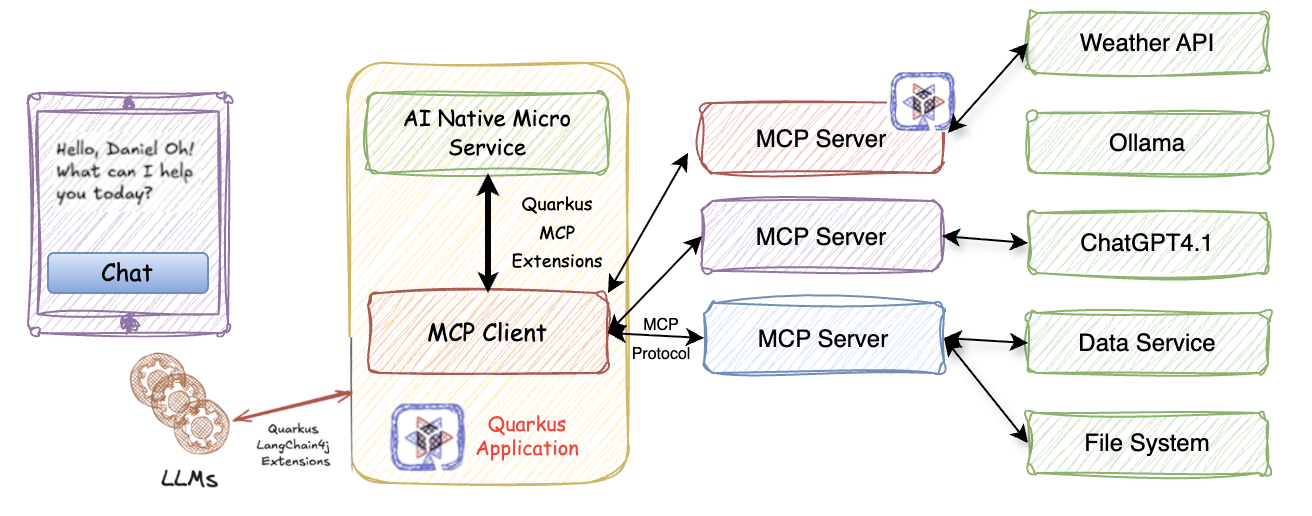
- MCP standardization – Model Context Protocol (introduced by Anthropic, widely adopted 2025–2026) provides a vendor-neutral way to expose tools, files, databases, and prompts. Java SDKs and Quarkus/Spring integrations make MCP first class.
Result: Organizations move agentic AI from "cool PoC" to "runs 24/7 serving thousands of users" faster with Java.
Getting Practical: The Java Stack for Agentic AI
- LangChain4j – idiomatic Java LLM orchestration (v0.3x+ series). Supports agents, tools, memory, RAG, streaming, and structured output.
- Quarkus LangChain4j extensions – auto-config, Dev UI, native compilation, Micrometer metrics → OTel bridge.
- Model Context Protocol (MCP) – standardized JSON-RPC protocol for tool/data access. Avoids per-vendor tool schemas.
- OpenTelemetry – traces, metrics, logs for agent reasoning, traces, latency histograms, error budgets.
- Ollama or a cloud-hosted model (like OpenAI or Mistral) for LLM execution.
Add PostgreSQL 17+ (pgvector), Redis (chat memory), or Kafka (agent event streaming) for persistence.
Step 1: Setting Up a Quarkus + LangChain4j Project
Start with the Quarkus CLI:
quarkus create app agentic-finance-demo \
  -x langchain4j-openai, langchain4j-weaviate, resteasy-reactive-jackson, opentelemetry, smallrye-health
Key pom.xml dependencies (2026 versions approximate):
<dependency>
    <groupId>io.quarkiverse.langchain4j</groupId>
    <artifactId>quarkus-langchain4j-openai</artifactId>
</dependency>
<dependency>
    <groupId>io.quarkiverse.langchain4j</groupId>
    <artifactId>quarkus-langchain4j-agentic</artifactId>
</dependency>
<dependency>
    <groupId>io.quarkiverse.langchain4j</groupId>
    <artifactId>quarkus-langchain4j-weaviate</artifactId>
</dependency>
Configure application. properties: properties
quarkus.langchain4j.openai.api-key=${OPENAI_API_KEY}
quarkus.langchain4j.openai.chat-model.model=gpt-4o-mini-2024-07-18
quarkus.langchain4j.weaviate.host=http://localhost:8080
quarkus.otel.exporter.otlp.endpoint=http://localhost:4317
Step 2: Defining Reusable Tools
Tools are the heart of agentic behavior. In Quarkus with LangChain4j, any public method annotated with @Tool can be used by an agent. Here's a basic example:
@ApplicationScoped
public class FinanceTools {

    @Tool("Fetch the latest stock price and 5-day change for a ticker")
    public String getStockPrice(@P("ticker symbol, e.g. AAPL") String ticker) {
        // In production → call internal market-data service or Polygon.io via REST client
        // Simulated for example
        return String.format("%s is trading at $%.2f (5-day change: +%.1f%%)",
                              ticker.toUpperCase(), 150.25 + Math.random()*10, Math.random()*5 - 2.5);
    }

    @Tool("Convert amount between two currencies using latest rates")
    public double convertCurrency(double amount, String from, String to) {
        // Production → use exchange-rate microservice or cached rates
        return amount * 1.08; // dummy EUR→USD
    }
}
Step 3: Building an Agent With Memory and Tools
Use AiServices for clean, type-safe agents. This turns your agent into a deployable microservice.
@Path("/finance-agent")
public class FinanceAgentResource {

    @Inject
    ChatLanguageModel model;

    @Inject
    FinanceTools financeTools;

    private final Agent agent;

    public FinanceAgentResource() {
        agent = AiServices.builder(FinanceAgent.class)
            .chatLanguageModel(model)
            .tools(financeTools)
            .chatMemory(MessageWindowChatMemory.withMaxMessages(15))
            .build();
    }

    @GET
    @Produces(MediaType.TEXT_PLAIN)
    public String ask(@QueryParam("q") String question) {
        return agent.chat(question);
    }
}

interface FinanceAgent {
    @SystemMessage("""
        You are a senior financial analyst assistant.
        Use tools when you need real data.
        Always explain reasoning step-by-step.
        Be conservative with assumptions.
         """)
    String chat(String userMessage);
}
Test it:
curl "http://localhost:8080/finance-agent?q=Compare AAPL and MSFT performance this week and suggest which to buy"The agent will call getStockPrice (possibly twice), reason, and respond.
Step 4: Adding RAG for Enterprise Knowledge
Combine agents with retrieval:
@Tool("Search internal company knowledge base for policies, reports, or product info")
public String searchKnowledgeBase(String query) {
    // In real app → Weaviate / pgvector retriever
    return ragChain.execute(query); // your RAG implementation
}
Quarkus Dev UI shows embeddings, retrieved chunks, and tool calls during development — huge productivity win.
Production Patterns and Gotchas
- Tracing agent reasoning – Use OTel semantic conventions for LLM spans (gen_ai.request.prompt, gen_ai.response.choices). Add custom attributes for tool names and arguments.
- Human-in-the-loop – For high-stakes decisions (e.g., trading), route to approval queue via tool or event.
- Rate limiting and cost control – Wrap model calls with resilience4j or SmallRye Fault Tolerance.
- Multi-agent supervision – Use supervisor pattern (one planner agent delegates to specialized workers).
- MCP integration – Expose internal services via MCP server → agents discover tools dynamically without hard-coded @Tool methods.
- Common pitfalls – prompt drift over long conversations, tool hallucination, and memory bloat. Mitigate with structured output (JSON mode) and periodic memory summarization.
Conclusion: Java’s Agentic Advantage in 2026
The Java ecosystem no longer trails Python for agentic AI. With LangChain4j’s maturity, Quarkus’s supersonic performance, MCP’s standardization, and OpenTelemetry’s observability, Java is often the better choice when agents must run reliably at enterprise scale, integrate deeply with legacy systems, and meet compliance and audit requirements.
Start small: Prototype one agent in Quarkus + LangChain4j this week. Once you experience the developer ergonomics and production readiness, you’ll understand why many teams are quietly shifting complex agentic workloads back to the JVM.
What agentic use case are you building next? Share in the comments — let's discuss patterns that survive production traffic.
Opinions expressed by DZone contributors are their own.
Comments