

UX Research in the Age of AI: From Validation to Anticipation
In the age of AI, UX Research must evolve from validation to proactive problem framing. Researchers who study trust, inclusion, and intent shape AI that works for people.
Join the DZone community and get the full member experience.
Join For FreeWith pressure to integrate AI into every corner of the digital experience, one phrase keeps showing up in product teams: “We just need to validate this AI feature.”
I hear this constantly, and it worries me. This seemingly harmless sentence reveals a deeper problem. It assumes the solution exists. That the need is known. That the user is understood. And that the job of UX research is to rubber-stamp usability rather than ask hard questions about whether the thing should exist in the first place.
As AI systems become more capable and more autonomous, UX research is no longer just about testing interface flows. We are entering a new era of responsibility: to study trust, to evaluate usefulness, to uncover unmet or misinterpreted needs, and to ensure the system respects user agency, privacy, and inclusivity.
UX research must evolve from being reactive and validation-focused to becoming proactive, strategic, and predictive.
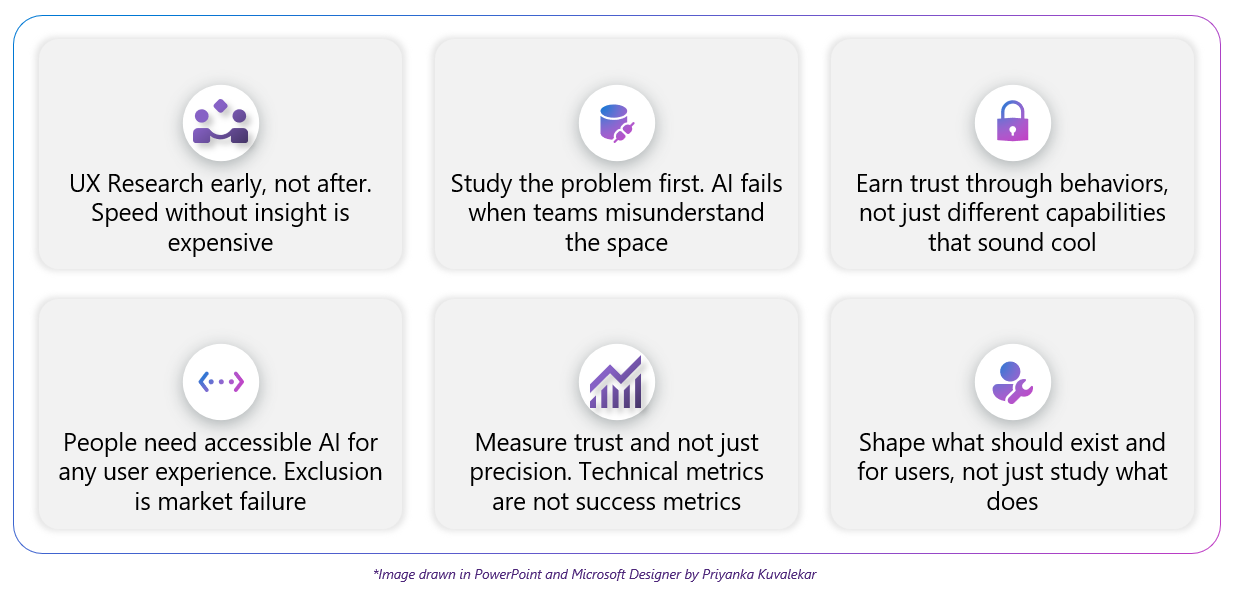
UX Research in the Age of AI
1. Speed Assumes the Why Is Already Known. It Usually Is Not
UX research has always played a critical role in defining the problem space: uncovering real user pain points, clarifying the context of use, and aligning solutions to actual needs. We ask the foundational questions early: Who is this for? What problem are we solving? What does success look like for the user, not just the business?
But in today’s AI-fueled product cycles, teams are moving faster than ever. Research gets deprioritized not because it is unimportant, but because it is seen as too slow.
That assumption is expensive. Organizations that invest in continuous UX research see revenue retention improvements of up to 10.8% over three years (Forrester, 2025). And when UX research informs rapid prototyping, engineering teams move faster with fewer costly pivots. Top-performing organizations saw 16 to 30 percent improvements in time to market when they embedded user-centric practices into their workflows (McKinsey, 2025).
So how do UX researchers stay strategic under pressure? I have found that sprint-aligned discovery works well: short, high-impact interviews or concept tests that fit within product sprints. Leveraging existing signals like support tickets, sales calls, and usage data helps frame hypotheses quickly. Micro-validations using roleplay or concept prompts can test intent without formal studies. And embedding broader questions during usability sessions often uncovers deeper context without adding time.
Good research does not always require six weeks. It requires the right questions at the right time.
2. Stop “Validating” and Start Studying the Problem First
In AI conversations, “validate” is overused and misapplied. Validation assumes a solution exists. But many AI features ship before the problem is well understood because teams want to “keep up” with competitors or chase the latest industry trend.
Teams say, “We don’t have time for discovery. Let’s build first, then test.” This mindset leads to expensive rework, frustrated users, and AI features that solve problems nobody actually has.
I saw this play out recently on a project involving an AI-native intelligent collaboration platform. The team had built an impressive AI assistant that could summarize meeting threads, suggest action items, and draft follow-up messages automatically. On paper, it looked like a productivity win. But when I ran contextual interviews with actual users, I discovered something the team had missed entirely: people did not want their messages drafted for them. They worried about tone. They felt the AI summaries stripped out nuance that mattered for relationship-building. One user told me, “I’d rather spend five minutes writing my own message than send something that sounds like a robot pretending to be me.”
The feature was technically sound. The model performed well. But the team had misunderstood the job. Users were not trying to save time on writing. They were trying to maintain trust and authenticity in their professional relationships. The AI was solving the wrong problem.
This is why JTBD matters. It is not a buzzword. It is a framework for surfacing real intent, understanding the why behind user actions, and revealing hidden frictions that AI might exacerbate. UXRs need to bring structured problem-framing workshops to the table, focus on outcome-driven insights rather than feature-driven feedback, and challenge assumptions before they calcify in roadmap decks.
We do not validate AI features. We help ensure we are solving the right problems for the right people in the right way.
3. Trust Is the New Usability for AI Products
AI changes how users make decisions, what they control, and what they understand. And that changes how they trust.
Trust is not binary. It is built over time, shaped by tone, behavior, consistency, and transparency. Fifty-three percent of consumers distrust AI-powered results, citing concerns about reliability and impartiality (Gartner, 2025). The same study revealed that 61% of consumers want the option to toggle AI summaries on or off.
These numbers should alarm any product team building AI features. If more than half of users approach your AI with skepticism, no amount of technical sophistication will drive adoption. The system has to earn trust through behavior, not just capability.
We need to ask harder questions: When do users over-trust and accept bad suggestions? When do they under-trust and dismiss useful ones? Does the AI explain its logic? How do tone and phrasing impact perceived authority? What happens when the AI fails silently? These questions cannot be answered by looking at model accuracy alone.
To study trust, I recommend longitudinal diary studies tracking confidence over time, think-aloud sessions during AI decision points, A/B testing voice and tone variations, and surveys with behavioral triangulation to see whether users actually override or accept AI suggestions.
Trust is not a checkbox. It is a relationship. And relationships must be studied, not assumed.
4. Inclusive AI Is Non-Negotiable
As AI becomes embedded in core workflows like voice commands, smart summaries, and auto-scheduling, it risks leaving entire populations behind. AI often fails to explain itself, especially to users who rely on assistive technologies.
According to the World Health Organization, 16% of the global population (approximately 1.3 billion people) experience significant disability (WHO, 2024). Yet only 7% of disabled respondents believe their communities are adequately represented in AI product development (TestDevLab, 2025). This gap between who AI is designed for and who needs to use it creates real barriers.
Common failures include AI that does not announce what it is doing, actions that occur without visual or auditory confirmation, consent prompts that are visual-only and exclude screen reader users, voice outputs that do not account for accent diversity, and error messages that assume visual context screen readers cannot convey.
If users cannot perceive what the AI is doing, they cannot consent to it. If users cannot interact with the system, they cannot benefit from it. And if AI products exclude 16% of the global population from the start, that is not just a moral failure. It is a market failure.
Research practices for inclusive AI should include testing flows with screen readers and keyboard navigation, including users with low vision, cognitive impairments, and limited mobility in studies, and evaluating whether AI announces its state and results across modalities.
Accessibility — especially for AI products — is not a “later” thing. It is a core UX success metric from day one.
5. Embed UX Research in AI Evaluation Loops
AI model evaluation usually focuses on precision, latency, or word error rate. But these metrics do not reflect whether the user experience is actually good. A model can score well on benchmarks and still frustrate users in practice.
Sometimes AI teams are measuring the wrong things. They obsess over model performance while ignoring whether users actually trust, understand, or want to use what they have built. Technical metrics matter, but they are not success metrics. User adoption, perceived helpfulness, and trust recovery after errors tell you far more about whether your AI will succeed in the real world.
When UX research feeds directly into AI evaluation, teams can prototype faster and refine models based on real user behavior rather than assumptions. This tight loop between research insights and engineering iteration is what separates high-performing AI teams from the rest. Engineers get clearer requirements. Designers get validated patterns. Product managers get confidence that what they are building will actually be used.
The connection between good research and rapid prototyping is direct. When researchers bring real user language, observed pain points, and documented edge cases into sprint planning, engineers spend less time guessing and more time building. Guardrails become obvious when you have already seen where conversations go sideways. Acceptance criteria write themselves when you have watched users struggle with a workflow.
Human-centered AI metrics should include trust decay rate (how quickly confidence erodes after errors), override success score (ease of user corrections), cognitive offloading balance (whether AI reduces or adds mental load), perceived helpfulness score, and consent clarity index (understanding of what data AI uses and why).
AI success must be measured not just by what the system can do, but by what it helps humans do safely, confidently, and equitably.
6. UX Research Must Lead, Not Follow
UXRs are not usability testers. We are not post-launch validators. We are strategic problem framers, translators of human behavior into product decisions, early-warning systems for risk, and advocates for equity, transparency, and clarity.
High-performing organizations are three times more likely to redesign workflows around AI rather than simply adding AI to existing processes (McKinsey, 2025). That redesign requires deep understanding of how people work, what they need, and where automation helps versus harms. It requires research.
The teams that get this right treat UX research as an accelerant, not a bottleneck. They bring researchers into the room early, give them access to users, and act on what they learn. They understand that building the right thing the first time is faster than building the wrong thing twice.
In AI products, our role is more vital than ever — not just to study what exists, but to shape what should.
Final Takeaway
“In the age of AI, your biggest risk is not building the wrong feature. It is building the right one for the wrong reason.”
UX research must evolve — not to keep up with AI’s pace, but to slow it down where it matters most. To interrogate assumptions. To center the human. And to make sure the systems we design today do not leave people behind tomorrow.
Opinions expressed by DZone contributors are their own.
Comments