DZone
Thanks for visiting DZone today,
Edit Profile
  • Manage Email Subscriptions
  • How to Post to DZone
  • Article Submission Guidelines
Sign Out View Profile
  • Post an Article
  • Manage My Drafts
Over 2 million developers have joined DZone.
Log In / Join
Refcards Trend Reports
Events Video Library
Refcards
Trend Reports

Events

View Events Video Library
  1. DZone
  2. Refcards
  3. Threat Modeling Core Practices
refcard cover
Refcard #388

Threat Modeling Core Practices

Threat modeling is a crucial component of the secure-by-design guiding principles. This Refcard provides the fundamentals of threat modeling, core practices for secure implementation, and key elements of conducting successful threat model reviews. Exploring the significance of modern tools for automating and streamlining threat modeling processes, we will review how to improve the accuracy of findings and facilitate integration and collaboration among software and security teams throughout the SDLC.

Free PDF for Easy Reference

Brought to You By

Semgrep, Inc
refcard cover

Written By

author avatar Apostolos Giannakidis
Product Security, Microsoft
Table of Contents
► Introduction ► What Is Threat Modeling? ► Core Practices for Threat Modeling ► Conclusion
Section 1

Introduction

The number of vulnerabilities identified in software products reached a record high of 48,000+ in 2025. Considering that enterprises worldwide require 164.7 days on average (as of Sep 2025) to patch security vulnerabilities, organizations have recognized the importance of taking a proactive approach to security. Designing secure software offers a wide range of benefits, from lowering the number of human hours spent fixing security vulnerabilities in production to limiting financial losses and regulatory penalties, thus gaining a competitive advantage and increasing customer loyalty.

Threat modeling is a crucial component of the secure-by-design guiding principles. This Refcard will provide the key fundamentals of threat modeling, core practices for secure implementation (including approaches and methodologies), and key elements of conducting successful threat model reviews. It will also explore the significance of modern tools for automating and streamlining threat modeling processes, improving the accuracy of findings, and facilitating integration and collaboration among software and security teams throughout the SDLC.

Section 2

What Is Threat Modeling?

Threat modeling is the engineering practice of reviewing the architecture and/or design of a system and its environment with the goal of identifying, prioritizing, and addressing potential security and privacy risks before they are exploited. Threat modeling, sometimes referred to as “whiteboard hacking,” is a collaborative process where participants put themselves in the mindset of an attacker and analyze the system’s design and architecture from an adversarial perspective, asking “what-I” questions with the goal of uncovering security risks and their potential impact.

Threat modeling involves creating system models, data flows, and sequence diagrams of the under-review system and documenting the attack surface, threat actors, and in-scope risks. If created manually, this process can create an additional workload for security and software teams, often delaying the release of software, creating friction between teams, and eventually becoming a tedious activity if it is not approached and managed properly. To address these challenges, the use of automation tools is becoming increasingly crucial, especially as the complexity of modern software systems grows due to numerous components, intricate interactions, and diverse trust boundaries.

Why Organizations Need Threat Modeling

Designing insecure software has always been a concern in software development; however, the complexity of modern software designs has amplified the problem. In 2021, OWASP recognized “insecure design” in its 2021 Top Ten list. Over the last few years, more standards and regulations have required organizations to systematically apply secure software design practices and threat modeling or security risk analysis processes. Standards such as the Application Security Verification Standard, IEC/ANSI 62443, and NIST 800-53/NIST 800-63/NIST 800-218 recommend threat modeling as a standard activity for every design change or sprint planning.

Threat modeling also enables organizations to determine the most appropriate and cost-effective security controls and countermeasures to mitigate identified threats as early as possible. Organizations often integrate threat modeling into their risk management process. This aligns security investments with potential security risks, optimizes resource allocation, and strengthens the overall cyber resilience strategy. It also provides a competitive advantage in the face of stricter regulations.

Threat modeling can also be a great way for teams to “shift left” and follow a secure-by-design approach. Organizations can incorporate suitable security controls into system designs, preventing the higher costs that would result if these security gaps were only discovered during or after implementation, testing, or worse yet, in production. This approach aligns with auditing and review requirements, as organizations can demonstrate the steps taken to ensure security from the outset of development.

Keys to a Successful and Secure SDLC

Threat modeling should be a core activity within the planning phase of the DevSecOps toolchain. Treating security requirements and specifications for threat modeling as design activities gives security the same priority as other business and technical requirements that need to be addressed in the design stage (e.g., business logic, scalability, resiliency). By considering security during the design stage, security controls can be integrated seamlessly into the software architecture and environment, reducing the likelihood of vulnerabilities being introduced later in the SDLC.

Effectively, threat modeling during the design stage encourages cross-functional collaboration between security and software engineers/architects and product managers. This cross-team collaboration and shared understanding fosters a culture of security awareness, ensuring that security considerations are embedded throughout the SDLC. To achieve effective cross-team collaboration and communication of the identified threats, automation tools are also highly encouraged.

Threat Modeling Tools

Performing a threat model review requires proper preparation and background work. Software and security teams need to collaborate closely to define the threat modeling process, identify system assets, gather threat intelligence information, create threat modeling artifacts/diagrams, and log identified threats. Additionally, cyber security regulations and standards require organizations to demonstrate evidence showing conformance with the use of audit trail reports and dashboards. Without tools to automate and streamline threat modeling activities and processes, teams can face challenges that could render their endeavor effectively impractical at a large scale.

Threat modeling is where you decide what can go wrong. Application security is how you make sure it doesn’t, in the code, before it ships. The most effective teams turn threat-model outputs (assets, trust boundaries, abuse cases) into developer-friendly checks in PRs/CI that catch real issues with low noise. That means fewer “security says no” moments and more fast, consistent guardrails that keep pace with delivery. The payoff is simple: Threats don’t live on a whiteboard; they show up as patterns in code, dependencies, and configuration. When mitigations become part of the workflow, you reduce rework, tighten feedback loops, and make security measurable without slowing down teams.

Benefits of Threat Modeling Automation

Threat modeling tools allow engineers to easily create and maintain data flow diagrams of their systems, regardless of their complexity and architecture. Without such tools, threat model reviewers would not be able to consistently capture all aspects of the ever-increasing attack surface of their software architectures. Effectively, the way modern threat modeling tools manage the process allows all stakeholders to quantify the security risks and have better visibility, reporting, and understanding of their system’s security posture.

Modern automation tools:

  • Simplify threat modeling and mitigation processes
  • Ensure thorough attack surface coverage 
  • Create consistency in the way security findings are recorded, mitigated, and managed
  • Allow the threat modeling process to be more measurable
  • Uplevel the overall quality of the process and security findings

Selecting a Threat Modeling Tool

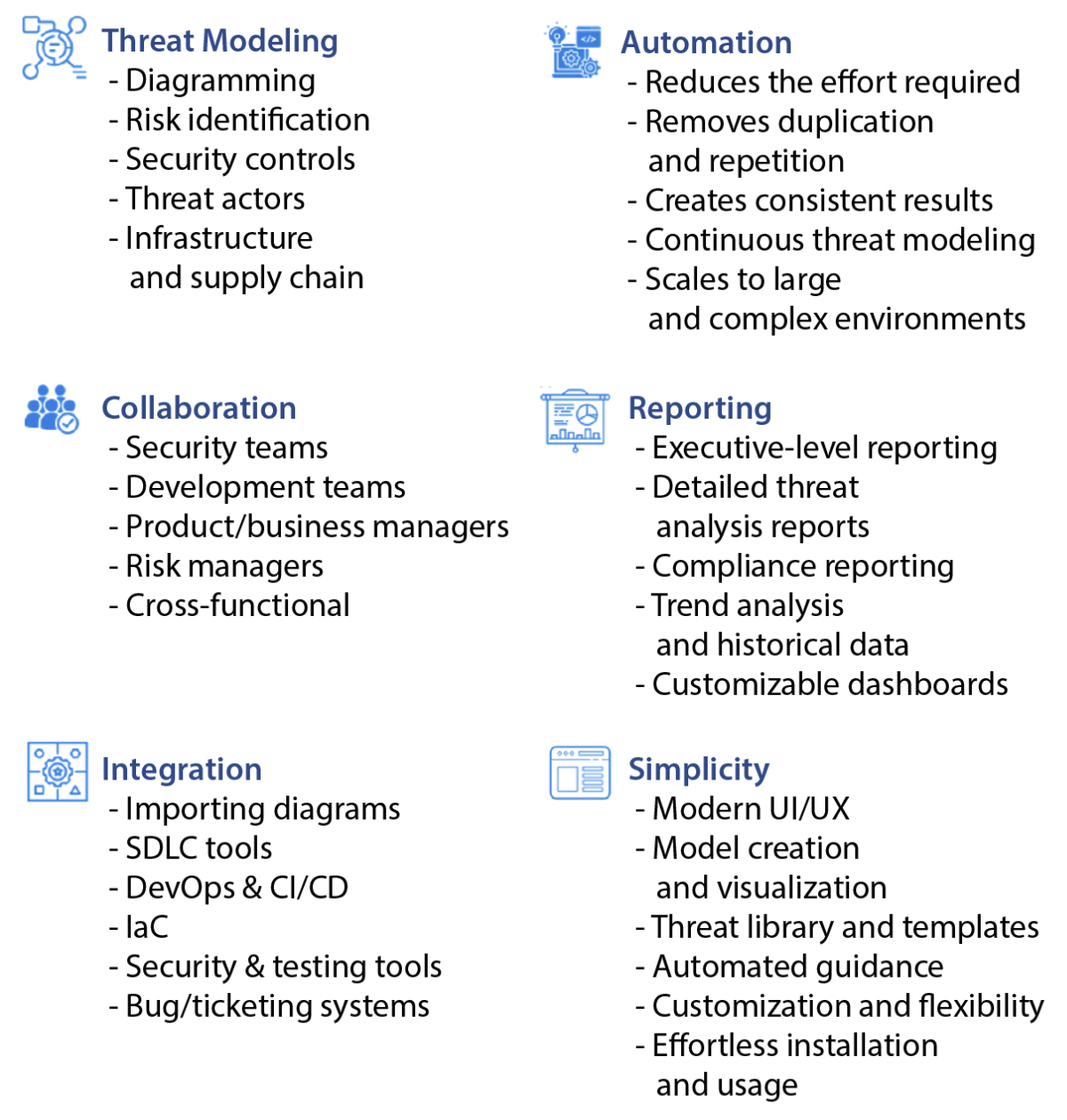
The most important factor to consider is the tool’s capabilities and ability to accurately identify security risks in a system with as few false positives as possible, taking into consideration its components, assets, trust boundaries, and attack surfaces. Because security is not static, the tool should regularly update its security risk registry with newly identified threats and zero-days, as well as be compatible and integrate with the organization’s existing architectural design tools to avoid duplication of designs and diagrams.

For cloud-based systems that define their cloud resources via Infrastructure as Code, consider selecting a tool that can consume JSON/YAML resource files to further accelerate threat modeling of the system’s cloud infrastructure. Additionally, integrating with DevOps tools and workflows for CI/CD facilitates automated threat model updates, saving additional valuable engineering time and accelerating threat modeling.

To facilitate the management of security findings within the SDLC, place emphasis on the tool’s integration capabilities with issue-tracking systems and collaboration platforms. This integration is critical for the overall user experience and promotes efficient teamwork. When scaling threat modeling, there will be challenges around handling, analyzing, alerting, and reporting security findings. Organizations should consider the tool’s capabilities on data analytics, reporting, custom dashboard creation, and compliance adherence against open standards such as the OWASP ASVS.

Figure 1: Key factors when selecting a threat modeling tool
Section 3

Core Practices for Threat Modeling

Using an established methodology and a structured, well-defined review process is fundamental to threat modeling, and understanding these core practices is critical to a successful threat modeling program.

Approaches and Methodologies

A one-size-fits-all approach is not suitable for addressing the varied security needs of organizations. Instead, organizations should carefully select a threat modeling methodology and approach that aligns with their unique characteristics and security requirements. A tailored approach is key to ensuring that threat modeling remains practical and impactful in different organizational contexts. There are four distinct approaches that provide different perspectives on analyzing and mitigating security risks:

Table 1: Overview of threat modeling approaches

Approach Description Techniques

Asset-centric

  • Identifies and prioritizes critical system assets
  • Safeguards asset integrity, confidentiality, and availability
  • Prioritizes security controls based on asset value and sensitivity
Asset inventory, data classification, DFDs, risk ranking, security control registers, IAM analysis, STRIDE
Attack-centric
  • Identifies potential attack vectors, entry points, and techniques that may be exploited
  • Builds proactive security controls by anticipating potential attacks
Threat actor profiles, threat hunting and intelligence, attack simulations and trees, attack surface and path analysis, attack vector identification
System-/software-centric
  • Analyzes security of system components and interfaces (e.g., services, infra, data stores)
  • Identifies vulnerabilities, misconfigurations, and component weaknesses
Design specs, DFD, sequence and component diagrams, vulnerability assessment, security requirements, secure design principles, security standards and frameworks
Risk-centric
  • Evaluates overall system risk
  • Incorporates risk analysis techniques and considers threat impact and likelihood
Risk matrix, quantitative risk assessment, business impact analysis, risk registers, threat libraries and intelligence, risk assessment workshops


Although there are several threat modeling methodologies, here we will examine STRIDE, PASTA, TRIKE, and VAST due to their popularity in the community:

Table 2: Prominent threat modeling methodologies

Methodology Description Techniques
STRIDE
  • Systematic threat analysis based on six categories
  • Especially beneficial during early development stages
  • Enables teams to proactively address security concerns
Spoofing, tampering, repudiation, information disclosure, denial of service, elevation of privilege
PASTA
  • Risk-centric, structured approach with seven steps
  • Simulates and tests viability of evidence-based threats
Business objective and technical scope definitions; analysis of attack surfaces, app decomposition, data flow, etc.; risk mitigation planning
TRIKE
  • Understands attacker goals and motivations
  • Analyzes attack techniques/methods and maps attack paths and potential impact
Attack surface analysis, threat enumeration, attack graphs
VAST
  • Visual and agile approach
  • Incorporates security across development, infra, and DevOps
  • App and operational threat modeling
Process and data flow diagrams, CVEs, OWASP Top 10

The Four Question Framework

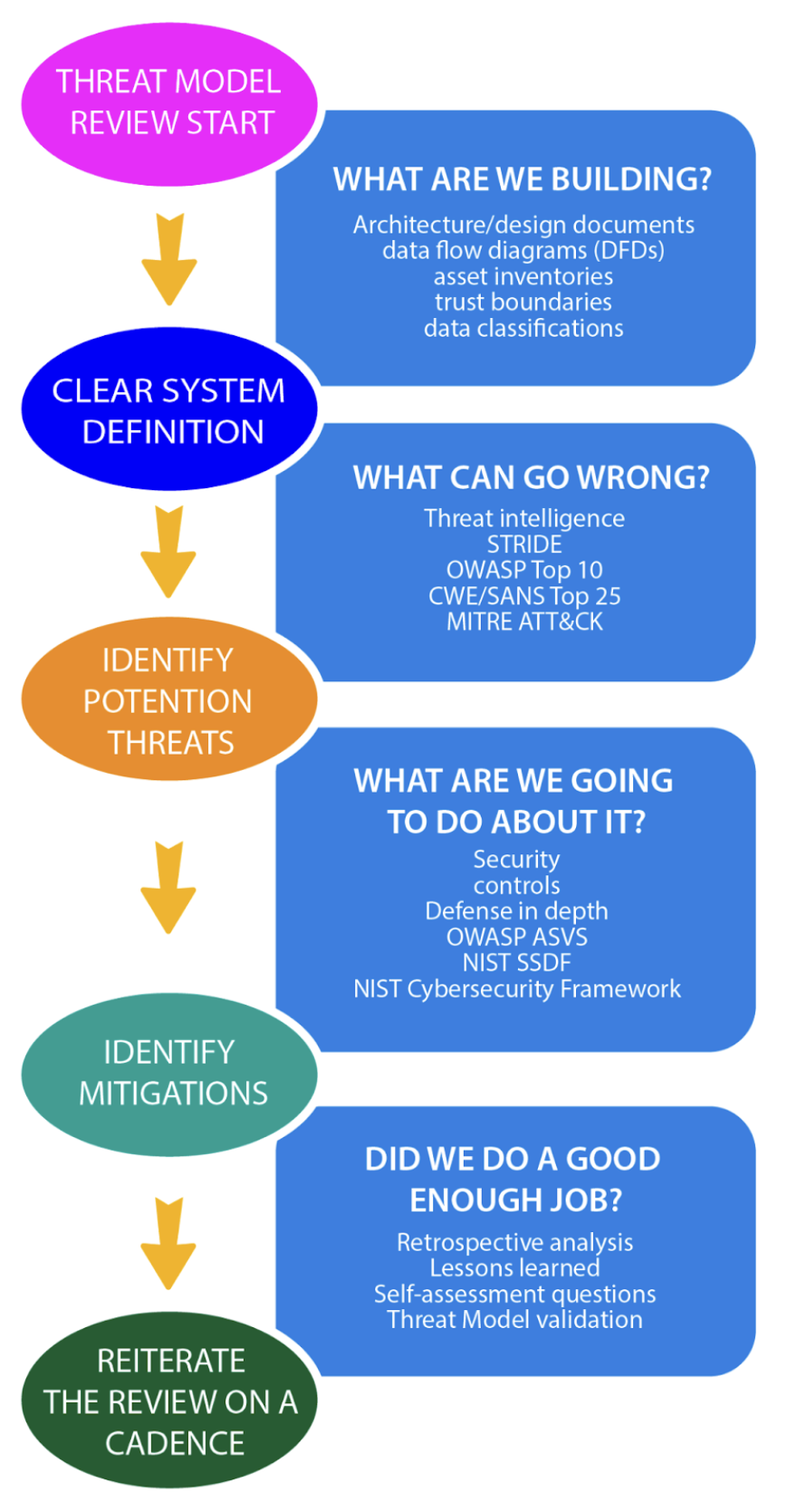
The “Four Question Framework for Threat Modeling” can help even the most inexperienced teams launch threat modeling and maintain consistency in their threat modeling reviews. It can be effectively utilized either independently or in combination with other threat modeling approaches and methodologies:

  1. What are we building? To answer this question, teams are typically expected to produce architecture or design documents, data flow diagrams, asset inventories, and data classifications.
  2. What can go wrong? Identify the main security and privacy threats that could compromise your system components or assets. Teams typically use a threat list such as STRIDE or OWASP Top 10 to answer this question.
  3. What are we going to do about it? Identify what needs to be done to mitigate the impact of these threats. Teams typically implement security controls or defense-in-depth mechanisms to answer this question. 
  4. Did we do a good enough job? It is imperative to conclude the process by conducting a retrospective analysis and identifying any lessons learned. The primary objective is to continuously improve the effectiveness of the implemented mitigations and enhance the overall threat modeling process.

Figure 2: The Four Question Framework process

Threat Model Reviews

A core activity in threat modeling is conducting a review meeting with stakeholders, with the goal of identifying, prioritizing, and addressing potential security and privacy risks.

Defining Processes and Expectations

To perform threat modeling successfully, key stakeholders should define end-to-end processes, expectations, and KPIs. This process must be well-accepted by both business leaders and security and software stakeholders. The process should ensure that the following are defined:

  • When reviews are conducted — e.g., after sprint planning, a specific cadence (define frequency)
  • Review meeting participants and responsibility; threat modeling is collaborative vs conducted by a single team
  • Proper communication channels for planning and threat recording, reporting, and alerting
  • Review scope, including system aspects to review, risks to assess, and the review’s breadth and depth
  • Risk categorization, prioritization, and acceptance
  • Organization’s top threats; threat intelligence is important at this stage
  • Security controls (remediations and mitigations) available
  • Preparation expected from all stakeholders 
  • SLAs for each identified threat
  • Artifacts expected to create before each review

Creating Threat Modeling Artifacts

Before conducting threat modeling reviews, the following artifacts must be created collaboratively and communicated to the review team in advance:

  • Inventorying assets, components, and trust boundaries provides a comprehensive identification of the various elements involved, including any sensitive data and other valuable resources that may be targeted by attackers.
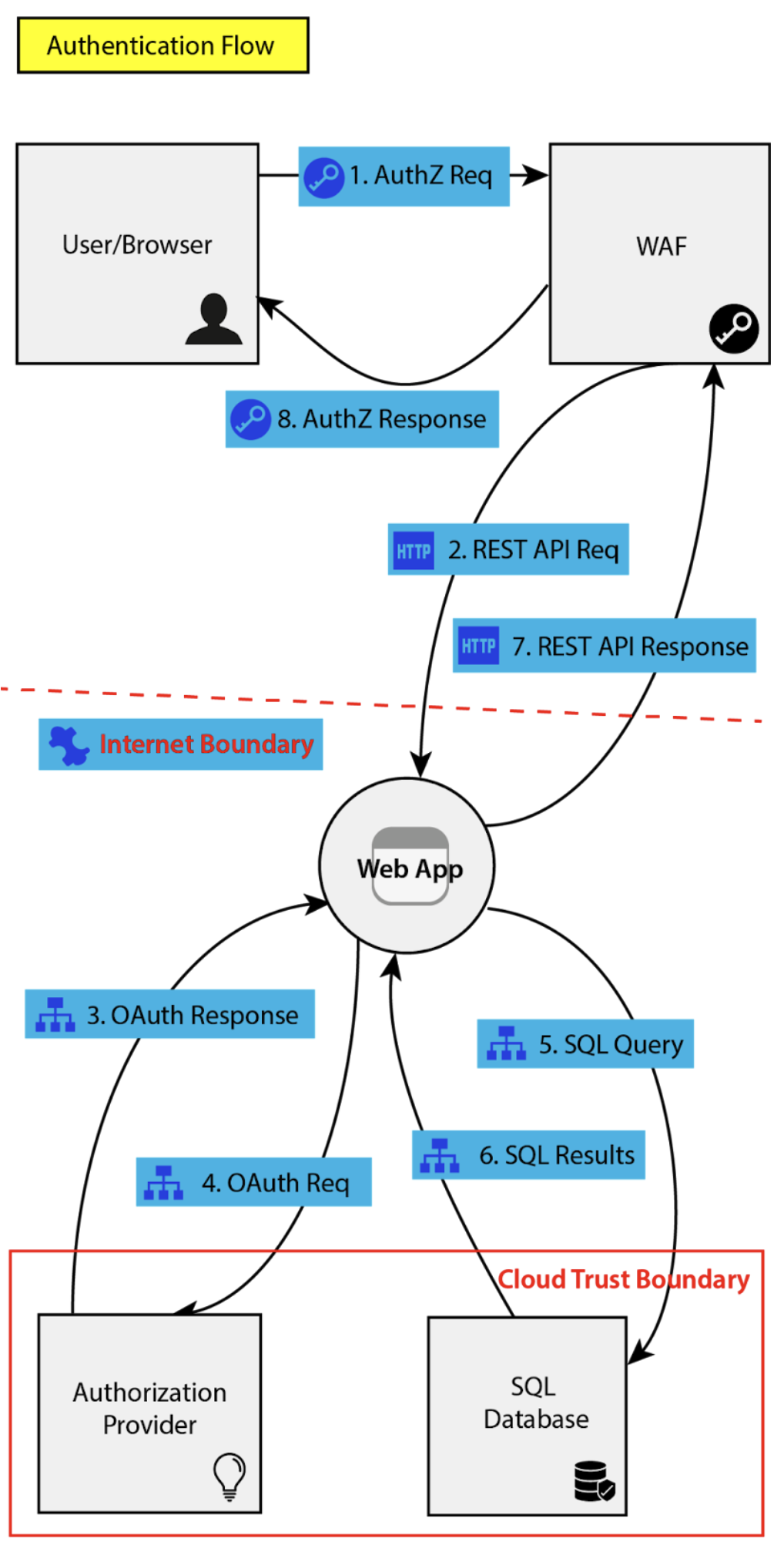
  • Data flow diagrams (DFDs) illustrate how data flow between components and through trust boundaries. They can be created using any diagramming tool. However, there are many advantages in using a threat modeling tool, which analyzes DFDs and helps identify potential vulnerabilities and attack vectors by highlighting system paths data takes.
  • Design diagrams, optional artifacts (e.g., UML sequence diagrams), can be useful when threat modeling complex sequences and interactions like authentication and authorization protocols.
  • Identifying and documenting security requirements, use cases, and abuse cases ensures that the focus remains on addressing specific security concerns and invariants of the system under review.

Threat modeling automation tools offer significant time-savings by importing system components from resource files (e.g., Terraform configs). This eliminates manual entry and enables quick generation of diagrams illustrating assets, components, and trust boundaries. The tools identify shared components, libraries, and patterns, reducing effort and identifying risks that affect multiple areas. They also establish trust boundaries by identifying interfaces and interactions, enhancing the accuracy and consistency of artifacts.

Figure 3: Sample DFD illustrating a simple AuthN/AuthZ process in a web app


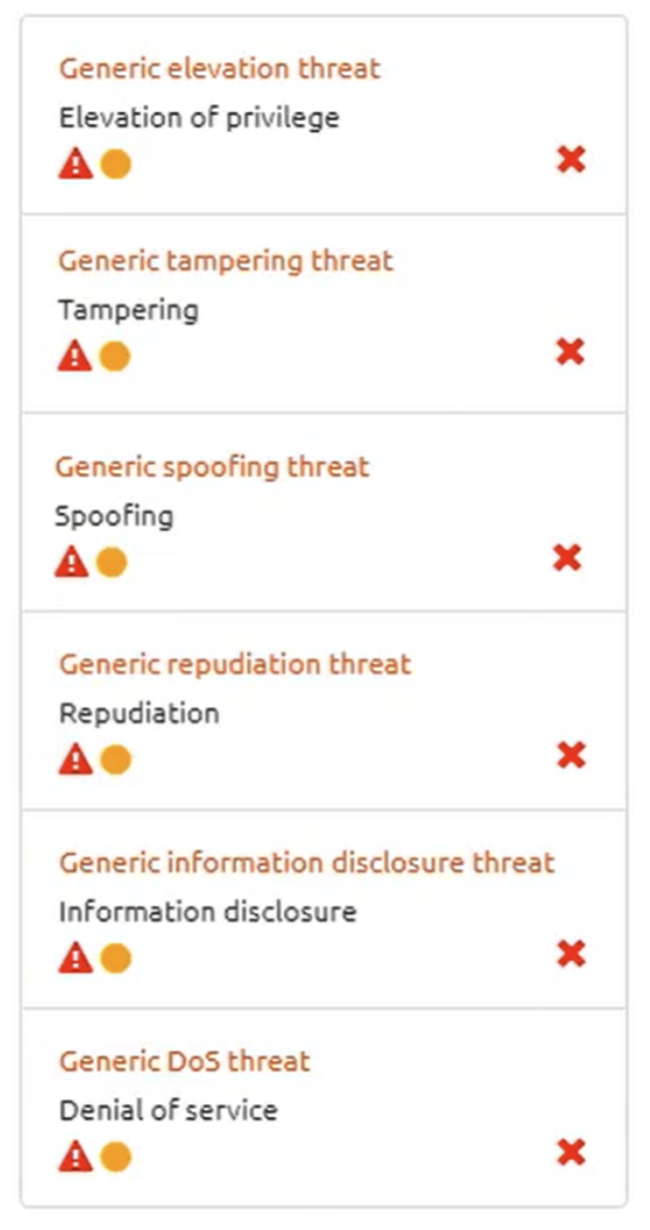
Figure 4: Sample threats identified by OWASP Threat Dragon

Assessing and Documenting Identified Threats

Once threats are identified, assess their severity by evaluating likelihood and impact, accounting for both internal and external factors that can influence each. Threat documentation should be unambiguous and actionable and include threat classification, attack vector, possible system impact, and existing vulnerabilities that may be exploited. Development teams should incorporate mitigation as part of their “definition of done,” and include information about recommended mitigations or security controls to address, such as feasibility, implementation considerations, and dependencies of each mitigation.

By automating the risk assessment process, organizations can obtain consistent and objective risk ranking and facilitate better decision-making. The tool’s integrations can automatically assess risks from many sources, such as vulnerability scanners and pen testing vulnerability reports. Risk acceptance can also be accelerated via integration with information risk and governance registers. Tools can automate consistent documentation of findings via templates and integration capabilities with bug-tracking systems.

Measuring Success

Threat modeling can become an expensive investment in money and time, so measuring its success and evaluating its effectiveness is critical to confirm that the program produces value and improves processes. Automation tools with reporting and regulatory compliance capabilities, along with live dashboards, play a significant role in this regard.

Key performance indicators (KPIs) provide metrics to assess the success of a threat modeling process. Examples include: 

  • Number of identified threats
  • Closure rate of high-risk threats (i.e., average human hours saved if vulnerabilities were fixed post-release)
  • Reduction of security incidents
  • Number of security controls implemented
  • Operating costs

Automation tools facilitate KPI collection and analysis, which enables comprehensive assessment of the threat modeling process. They provide reports and visualizations that highlight performance against KPIs, making it easier to track process metrics and identify trends in security risks. Additionally, automation tools can help evaluate the adequacy of mitigation strategies. Coverage and completeness metrics highlight the thoroughness of the threat modeling process, ensuring critical areas aren’t overlooked.

Automation tools also measure time and resource savings, quantifying the efficiency gains achieved. The automatically generated compliance reports demonstrate adherence to legal and regulatory obligations as well as ensure that best practices are adopted. Tools that offer live dashboards provide real-time insights into threat status, mitigation progress, and overall security posture. Monitoring these metrics over time enables improvement tracking and success in overall threat management.

Section 4

Conclusion

As systems grow more complex and exposed, organizations need a proactive security posture. Threat modeling automation improves speed, consistency, accuracy, and collaboration, but it still depends on choosing the right tool, using sound methods, and asking the right questions. When integrated into the DevSecOps toolchain and applied with a secure-by-design mindset, threat modeling helps manage risk across the SDLC. Remember that threat modeling is a continuous process, so maintaining an effective program requires evolving with new threats and keeping pace with relevant standards and regulations.

Additional resources:

  • Threat Modeling Manifesto
  • Threat Modeling Connect (community)
  • Threat Modeling: Designing for Security by Adam Shostack
  • Threat Modeling: A Practical Guide for Development Teams by Izar Tarandach and Matthew J. Coles 
  • OWASP Threat Modeling Cheat Sheet
  • OWASP Application Security Verification Standard

Like This Refcard? Read More From DZone

related article thumbnail

DZone Article

STRIDE Threat Model
related article thumbnail

DZone Article

Stop Loading Everything into Redshift: A Spectrum + Iceberg Pattern for Hybrid Analytics
related article thumbnail

DZone Article

AI Assessments Are Everywhere
related article thumbnail

DZone Article

Operationalizing Enterprise AI at Scale: Architecture, Governance, and Adoption
related refcard thumbnail

Free DZone Refcard

SBOM Essentials
related refcard thumbnail

Free DZone Refcard

Secrets Management Core Practices
related refcard thumbnail

Free DZone Refcard

Software Supply Chain Security
related refcard thumbnail

Free DZone Refcard

Identity and Access Management
  • RSS
  • X
  • Facebook

ABOUT US

  • About DZone
  • Support and feedback
  • Community research

ADVERTISE

  • Advertise with DZone

CONTRIBUTE ON DZONE

  • Article Submission Guidelines
  • Become a Contributor
  • Core Program
  • Visit the Writers' Zone

LEGAL

  • Terms of Service
  • Privacy Policy

CONTACT US

  • 3343 Perimeter Hill Drive
  • Suite 215
  • Nashville, TN 37211
  • [email protected]

Let's be friends:

  • RSS
  • X
  • Facebook