

Agentic AI in 2026: How Autonomous AI Agents Are Replacing Manual Dev Work
Autonomous AI agents are moving from demos to production in 2026. See how agentic AI, MCP, and multi-agent systems are changing dev workflows.
 ·
·
Join the DZone community and get the full member experience.
Join For FreeI watched a pull request get opened, reviewed, revised, and merged last week without anyone on the team writing a line of code by hand. A failing test triggered it. An agent read the stack trace, found the root cause in a config file three directories away, patched it, and tagged a human for sign-off. Nobody blinked. That's the part that surprised me — not the capability, but how unremarkable it's become.
This is the actual shift happening in software teams right now. Autonomous AI agents have moved past the demo stage and into daily engineering workflows, and the gap between “AI helps me code faster” and “AI runs the task end-to-end while I review the output” has mostly closed. Gartner now projects that roughly 40% of enterprise applications will embed task-specific agents by the end of 2026, up from under 5% just last year — one of the steepest adoption curves the analyst firm has tracked. If you're a developer, a founder, or a tech lead still treating autonomous AI agents as a novelty, this is the year that assumption stops holding up.
What Actually Changed
For a couple of years, “AI-assisted development” meant autocomplete with better taste. You typed, the model suggested, you accepted or rejected. Useful, but you were still the one driving every keystroke.
Agentic AI flips that relationship. Instead of suggesting the next line, autonomous AI agents take a goal — fix this bug, migrate this schema, write tests for this module — and work through the steps themselves: reading the codebase, running commands, checking the output, and correcting course when something breaks. That loop of plan, act, observe, and retry is the actual definition of agentic AI, and it's why the category feels so different from the copilots that came before it.
Claude Code was one of the tools that pushed this into the mainstream for individual developers, handling multi-file refactors and terminal commands with minimal hand-holding. Cursor built a similar experience directly into the editor. But the bigger story in 2026 is what happened at the platform level: GitHub's Agent HQ turned “which AI assistant should I use” into “which combination of agents should handle this ticket,” letting teams route work across Copilot's Agent Mode and third-party models from a single dashboard, with human approval gates before anything touches a protected branch.
Where the Orchestration Layer Comes From
None of this multi-agent coordination works without a shared way for agents to reach tools, files, and other services — which is exactly the gap Anthropic's Model Context Protocol (MCP) was built to close. MCP gives an agent a standard way to discover and call outside tools instead of every vendor inventing its own integration format, and it's become close to a default for agent orchestration since Anthropic donated its stewardship to the newly formed Agentic AI Foundation (AAIF), a Linux Foundation initiative that also now governs projects like Goose and AGENTS.md. That neutral home matters: it means an agent built by one team can plug into infrastructure built by another without a custom adapter for every pairing.
If your team is scoping actual implementation work — repository intelligence, agent orchestration across a codebase, or a production-ready rollout rather than a weekend experiment — this is usually the point where it's worth bringing in people who've built agentic workflows before rather than reverse-engineering the architecture from blog posts.
The 2026 Agent Landscape, Compared
Six tools keep coming up in conversations with other developers this year, and each one solves a slightly different problem:
|
Tool |
Best for |
Runs where |
|---|---|---|
|
Claude Code |
Deep, multi-file coding tasks and repo-wide reasoning |
Terminal / IDE |
|
GitHub Copilot (Agent Mode) |
In-editor task delegation tied to your existing workflow |
VS Code, GitHub |
|
Cursor |
Fast iterative coding with tight human-in-the-loop control |
Standalone editor |
|
GitHub Agent HQ |
Orchestrating multiple vendor agents under one governance layer |
GitHub platform |
|
OpenClaw |
Personal automation across messaging apps, not just code |
Self-hosted |
|
Hermes Agent |
Self-improving agents that build their own reusable skills over time |
Self-hosted |
Notice the split: some of these are coding-first (Claude Code, Copilot, Cursor), some are orchestration layers for running several agents together (Agent HQ), and a couple — OpenClaw and Hermes Agent — treat “developer tool” as just one use case inside a broader personal or team automation runtime. That's the direction agentic workflows are heading generally: fewer single-purpose bots, more general-purpose agents you point at whatever task needs doing, whether that's a codebase, a customer inbox, or AI-powered social media tools handling a content calendar.
Where Autonomous AI Agents Are Actually Winning
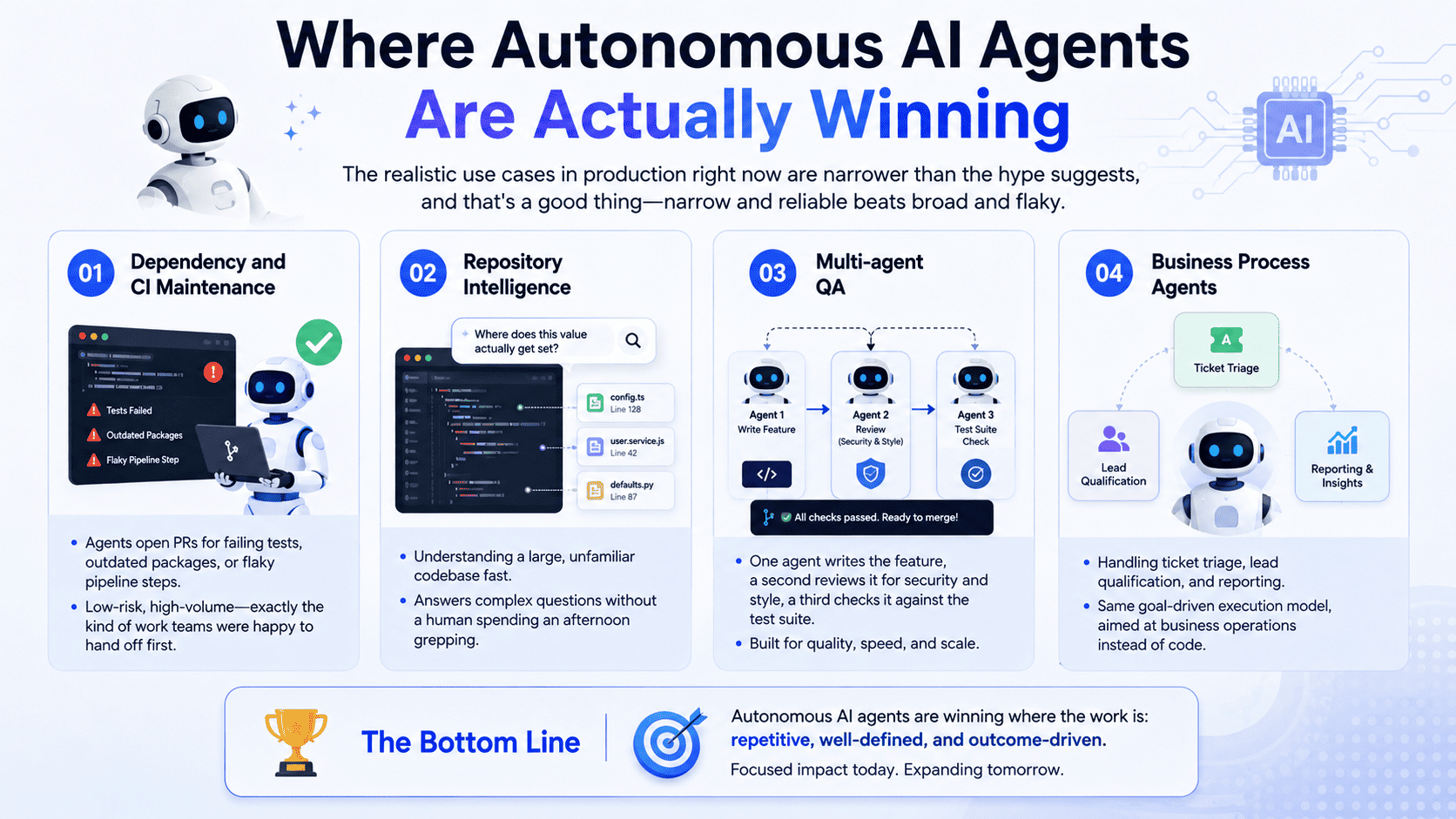
The realistic use cases in production right now are narrower than the hype suggests, and that's a good thing — narrow and reliable beats broad and flaky.
- Dependency and CI maintenance. Agents opening PRs for failing tests, outdated packages, or flaky pipeline steps — low-risk, high-volume, exactly the kind of work teams were happy to hand off first.
- Repository intelligence. Understanding a large, unfamiliar codebase fast enough to answer “where does this value actually get set” without a human spending an afternoon grepping.
- Multi-agent QA. One agent writes the feature, a second reviews it for security and style, a third checks it against the test suite — a pattern GitHub's Agent HQ and similar orchestration setups are explicitly designed around.
- Business process agents. Outside of pure dev work, enterprise AI agents are handling ticket triage, lead qualification, and reporting — the same goal-driven execution model, aimed at business operations instead of code.
The Limitations Nobody Skips Past
I'd be doing you a disservice if I didn't mention the failure mode Gartner keeps flagging alongside the adoption numbers: more than 40% of agentic AI projects are expected to be shelved by 2027, mostly because teams scoped them too broadly or skipped governance until after something went wrong. Fully autonomous agents making irreversible decisions without a review step are still a bad idea in most production environments. The teams getting real value are the ones treating agentic AI development as an engineering discipline — scoped tasks, audit trails, and a human who can pull the plug — not as a replacement for judgment.
Getting Started Without Betting the Roadmap
If you're evaluating this for your own team, start narrow. Pick one bounded, low-stakes workflow — dependency bumps, doc updates, a single well-tested service — and let an agent run it end-to-end for a few weeks before expanding scope. Set explicit guardrails (no direct merges to protected branches, mandatory human review on anything touching auth or billing), and measure actual time saved rather than assuming it. Most teams that get this right end up with a meaningful share of merged work coming from agents within a couple of months, with humans doing the scoping and reviewing rather than the typing.
FAQs
What are autonomous AI agents?
Autonomous AI agents are AI systems that can plan, execute, and adjust multi-step tasks toward a goal with minimal step-by-step human input, as opposed to tools that only respond to single prompts.
How is agentic AI different from a regular chatbot or copilot?
A chatbot answers one prompt at a time. Agentic AI runs a loop — plan, act, check the result, retry if needed — and can call tools, run code, and make decisions across many steps before reporting back.
Are autonomous AI agents actually production-ready in 2026?
For scoped tasks like dependency updates, test fixes, and repository analysis, yes. For fully unsupervised, high-stakes decisions, most teams still keep a human review step, and Gartner data backs up that caution.
What is the Model Context Protocol (MCP) and why does it matter?
MCP is an open standard that lets AI agents connect to external tools, files, and services in a consistent way, rather than needing custom integration code for every combination of agent and tool.
Do I need a multi-agent system, or is one agent enough?
Depends on the task. Single agents handle most day-to-day coding work fine. Multi-agent systems earn their complexity when you need separation of concerns — one agent building, another reviewing, another testing.
How do I get started with agentic AI development for my team?
Pick one narrow, low-risk workflow, set clear guardrails around what the agent can touch without approval, and expand scope only after you've measured real results — not assumed them.
Opinions expressed by DZone contributors are their own.
Comments