

How Agentic AI Is Turning Traditional Automation Into a Tool Layer?
Agentic AI doesn’t replace traditional automation. It uses existing workflows, APIs, and systems as tools while handling decisions, exceptions, and complex tasks.
Join the DZone community and get the full member experience.
Join For FreeMost of the automation I have built over the years follows the same recipe. A trigger fires, a chain of predefined steps runs, and everything works until reality produces an input nobody mapped. Then a ticket gets filed and a human patches the flow. For a long time, that was simply the cost of workflow automation.
Agentic AI workflows change the deal, but not in the way the hype suggests. They are not killing traditional automation. They are swallowing it. The cron jobs, API integrations, and RPA bots that quietly run most businesses are not going away. They are getting demoted from the system that decides to the system that gets called. That change in position is the real story, and it has concrete architectural consequences. This breakdown covers where the two models genuinely differ and where each one still wins.
What Traditional Automation Gets Right, and Where It Stops
Traditional automation is deterministic by design. It shows up in a few familiar forms: scheduled scripts and cron jobs, trigger-and-action platforms like Zapier and n8n, RPA bots that click through legacy interfaces, and integration pipelines that sync data between systems.
Determinism is the feature. The same input produces the same output, execution is cheap and fast, and you can audit every path. The ceiling is that every path must exist before runtime. Every edge case needs a branch, and every exception needs a rule. Every long-lived workflow I have maintained eventually turns into a museum of edge cases, and the maintenance cost quietly grows past the original build cost.
What Makes a Workflow Agentic AI
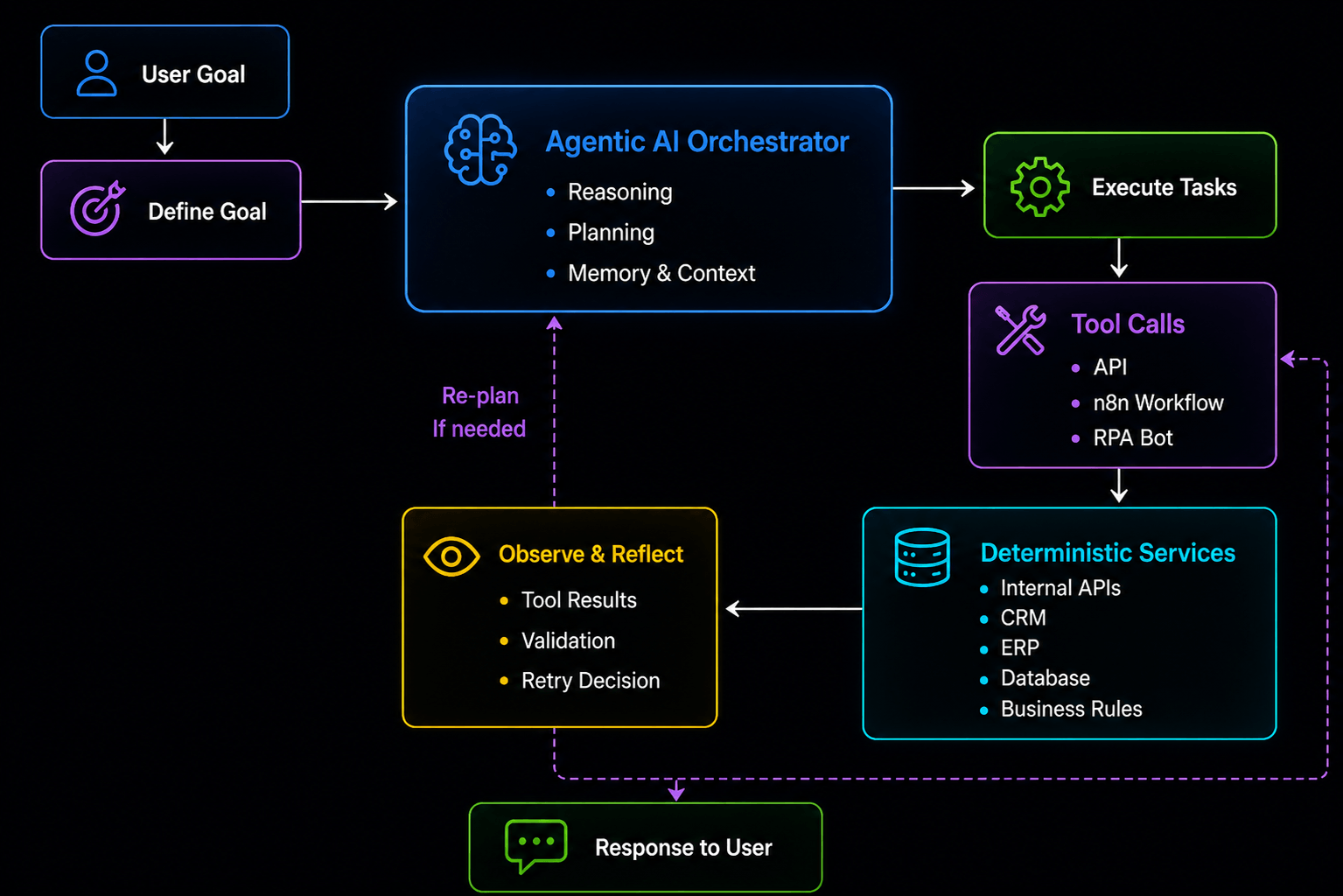
An agentic AI workflow puts a large language model inside the control loop. The system receives a goal instead of a script, plans its own steps, and adapts as conditions change. Three components define the pattern.
1. The Reasoning Loop
At the core sits a loop: read the current state, decide the next action, execute it, observe the result, and re-plan. Frameworks like LangGraph make this loop explicit as a state machine, but the defining trait is the same everywhere. The sequence of steps is generated at runtime, not hardcoded at build time.
2. Tool Calling
Agents act on the world through tool calling. Each tool is a function with a typed schema, and the model decides which one to invoke and with what arguments. Here is the part I find most underrated: a tool does not have to be new code. It can be an automation you already own, exposed behind an endpoint.
enrich_lead = {
    "name": "enrich_lead",
    "description": "Runs the existing n8n enrichment flow for a new lead "
                   "and writes the result to the CRM.",
    "input_schema": {
        "type": "object",
        "properties": {
            "email": {"type": "string"},
            "company_domain": {"type": "string"}
        },
        "required": ["email"]
    }
}
To the agent, that entire flow is one callable function. This is the exact interface where agentic systems and traditional automation meet.
3. Memory and Context
Deterministic pipelines keep state in databases and queues. Agents also carry working context: the conversation so far, intermediate results, retrieved documents. Managing that context window through summarization and pruning is an engineering discipline of its own, because an agent that forgets what it already did will happily do it twice.
The Real Shift: Your Automation Becomes the Tool Layer
Here is what most comparisons miss. Agents do not replace existing automation assets. They consume them. Standards like the Model Context Protocol exist precisely for this purpose, exposing existing systems as discoverable tools that any agent can pick up without custom glue code.
So the orchestration layer changes hands. In traditional automation, the DAG is the brain and the integrations are the limbs. In an agentic workflow, the model becomes the brain, and yesterday's automations become the limbs. That is why eating is the right word. When software ate industries, the industries did not vanish. They kept operating inside a larger organism. Well-built deterministic workflows become more valuable in this world, not less, because an agent is only as reliable as the tools it calls.
Take lead handling as an example. The deterministic version enriches a record and routes anything unusual to a human queue. The agentic version calls that same enrichment flow as a tool, then investigates the unusual part itself. It checks the company site, compares the lead against the target profile, drafts the outreach, and escalates only when confidence is low. The old automation still does the enrichment. The agent absorbs everything the old automation gave up on.
Where the Two Models Diverge in Production
The differences that matter show up after deployment, not in the demo.
1. Control Flow
A deterministic pipeline has explicit, enumerable paths you can unit test. An agent's path is emergent, and the same input can produce a different plan tomorrow. Testing shifts from asserting exact paths to running evals: scoring outcomes across many scenarios and watching for regression whenever a prompt, tool description, or model changes.
2. Error Handling
Traditional pipelines handle failure with retries, timeouts, and dead letter queues. Agents add something new. They can read an error message and correct course, retrying with fixed arguments or choosing a different tool entirely. That self-healing behavior is genuinely powerful and genuinely dangerous without bounds. An agent creatively retrying a payment call is not resilient. It is an incident in progress.
3. State and Replayability
Replaying a deterministic workflow is trivial. Replaying an agent run requires capturing every model response, tool result, and decision along the way. Tracing is not an optional extra in agentic systems. It is the only way to answer the question every stakeholder eventually asks: why did it do that?
4. Cost and Latency
A step in a rule-based workflow costs a fraction of a cent and completes in milliseconds. One agent loop can involve five to fifteen model calls, seconds of latency per step, and token costs that scale with context size. Multiply that across thousands of daily runs and the economics decide the architecture for you.
Failure Modes and the Guardrails That Contain Them
Agentic systems fail in ways traditional automation never did. The recurring ones: hallucinated tool arguments, planning loops that never converge, runaway token spend, and prompt injection arriving through tool outputs, where a scraped page or an inbound email quietly rewrites the agent's instructions mid-run.
The guardrails are becoming standard practice. Validate every tool call against a strict schema before execution. Design tools to be idempotent so a duplicate call cannot double-charge anyone. Cap the steps and budget per run. Put human-in-the-loop approval in front of irreversible actions like payments, deletions, and outbound messages. Trace every step, and run evals before any prompt or model change ships. Teams that skip these controls do not have an autonomous agent. They have an unsupervised one.
When Traditional Automation Still Wins
Deterministic automation remains the right choice more often than the hype admits. If you can draw the complete flowchart, the logic rarely changes, and the volume is high, a fixed pipeline beats an agent on cost, latency, and auditability every time. Payroll runs, scheduled reports, compliance-bound processes, and simple data syncs belong here and should stay here.
Agents earn their overhead where the flowchart keeps failing: messy inputs, paths you cannot enumerate in advance, and decisions that need judgment. Ticket triage, anomaly investigation, account research, and the exceptions that used to land in a human queue are the natural starting points. My working rule is simple: automate the predictable, delegate the ambiguous.
The Stack That Emerges
The architecture all of this points toward is layered. A deterministic core keeps handling high-volume, well-understood work exactly as it does today. An agentic edge sits at the boundary with the messy world, interpreting goals, absorbing exceptions, and orchestrating the tools underneath.
If you are planning a move in this direction, resist the urge to rebuild everything as agents. Audit the automation you already own, wrap the most reliable flows as callable tools, and point one agent at the single process where exceptions burn the most human hours. Measure the results, tighten the guardrails, then expand.
That is how agentic AI workflows are eating traditional automation in practice. Not by deleting it, but by digesting it into something that can finally handle the parts of the job no flowchart ever could.
Opinions expressed by DZone contributors are their own.
Comments