

Beyond State Consistency: Preventing Stale Decisions in AI Agent Systems
Learn how decision consistency helps long-running AI agents validate decisions against changing system states before executing consequential actions.
AI agents and agentic systems are being rapidly adopted in long-running systems and workflows. They are evolving to provide support beyond short request-response interactions to continuous processes that retrieve information, call tools, coordinate with other agents, wait for external events, and eventually perform actions in real systems.
This expansion introduces a new challenge: reliable decision-making from changing inputs. When agents make decisions based on system or component state, they can observe, reason, and produce insightful decisions. However, in rapidly changing environments, the triggers behind certain decisions can change before execution time. The result is a seemingly contradictory condition: the system can have fresh state while executing a stale decision.
State consistency and rapid decision execution alone may not be enough for long-running autonomous systems. We need to evaluate whether decisions taken based on certain states hold true at execution time. I will refer to this architectural property as decision consistency.
A Decision Can Become Stale Without Being Wrong
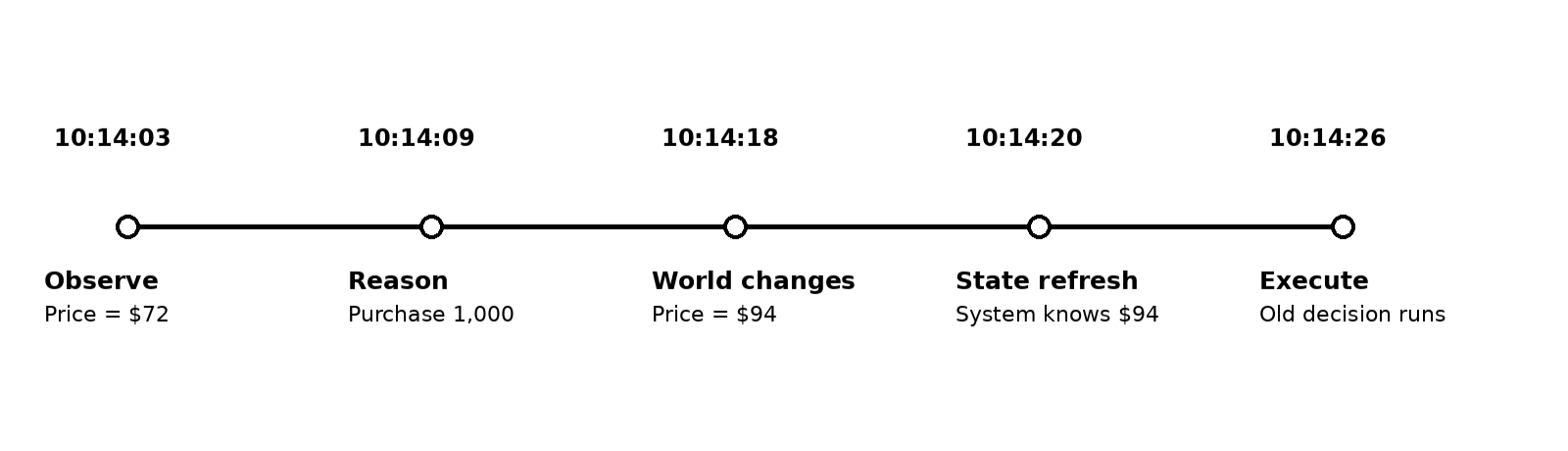
Figure 1. Timeline of a stale decision: the state is current at execution, but the decision was produced earlier.
Consider an AI agent responsible for purchasing inventory from approved vendors.
At 10:14:03, it observes:
Inventory = 100
Unit Price = $72
Budget = $100,000
At 10:14:09, the agent determines that purchasing 1,000 additional units is appropriate.
D1 = Purchase 1,000 units at $72Nine seconds later, the vendor changes the price to $94. At 10:14:20, the system receives the new value. At 10:14:26, an execution service processes D1. The purchase occurs at $94.
This sequence does not inherently carry a cause for failure. The database holds price information that the state update can propagate and prevent hallucination of the model.
Current State = S2
Pending Decision = D1(S1)
D1 was valid when produced, but the environment that led to that decision does not exist at the time of execution. With a stale read, the agent reasons from outdated information. With a stale decision, its validity changes over time.
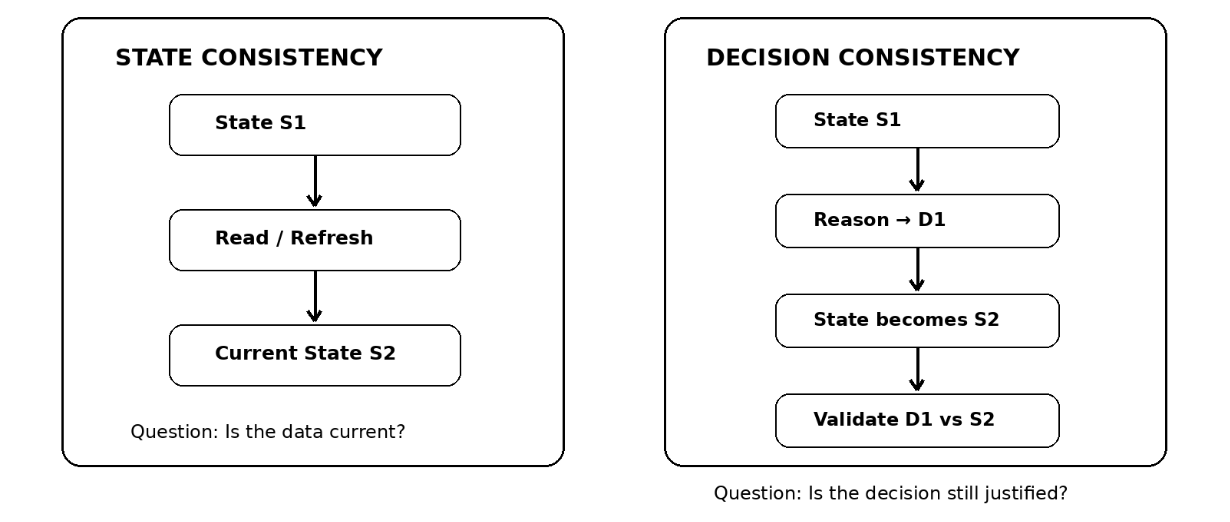
Figure 2. State consistency protects data freshness; decision consistency protects the validity of reasoning carried forward.
Distributed systems have matured greatly and use sophisticated state-management mechanisms, including locks, concurrency controls, and consensus protocols. These tools help address version control and identifying which state a system component is tied to. With agentic systems, a new layer of reasoning is added between the observation and action performed.
This distinction becomes increasingly important as agent workflows grow longer. LangGraph supports long-running stateful agents through durable execution and checkpoints [4], while Google ADK demonstrates workflows that can pause for days or weeks while waiting for approvals and other external events [5]. Durability solves the problem of resuming where an agent stopped, but successful resumption creates another question: should every decision made before the pause still be trusted after the pause?
Qualifying Stale Decisions
A straightforward solution to stale decisions is simply to re-run the agent immediately after each consequential action, which can largely mitigate the issue for simple workflows. However, for complex agent systems, this can incur high costs in terms of computation and time. This especially matters because agent computation behaves differently from ordinary application transactions. Traditional optimistic concurrency control can abort and retry a short transaction relatively cheaply. An agent may have spent minutes retrieving information, making model calls, and generating results.
This leads to an important design principle: the appropriate unit of invalidation in an agent workflow may be the decision, not the entire workflow.
From Version Checks to Semantic Validation
Dependency tracking introduces another complication. Suppose D1 was created when a price was $72.00 and, before execution, it becomes $72.01. The dependency changed, but the decision probably did not become invalid. If the price becomes $110, the same version check reports only that a change occurred and cannot determine whether the change matters.
This produces a more critical distinction that not all changes to the environment invalidate an execution run on stale data. The runtime can detect what changed, while deterministic rules or model reasoning determine whether the change matters.
| factor | lower validation need | higher validation need |
|---|---|---|
|
Dependency volatility |
Stable preferences/configuration |
Prices, capacity, permissions |
|
Decision lifetime |
Milliseconds/seconds |
Minutes, hours, days |
|
Action reversibility |
Drafting/recommendation |
Purchase, deletion, provisioning |
|
Recomputation cost |
Cheap single model call |
Multi-tool or multi-agent reasoning |
Table 1. Factors that should influence the strength of decision revalidation.
Reason → Bind → Validate → Act
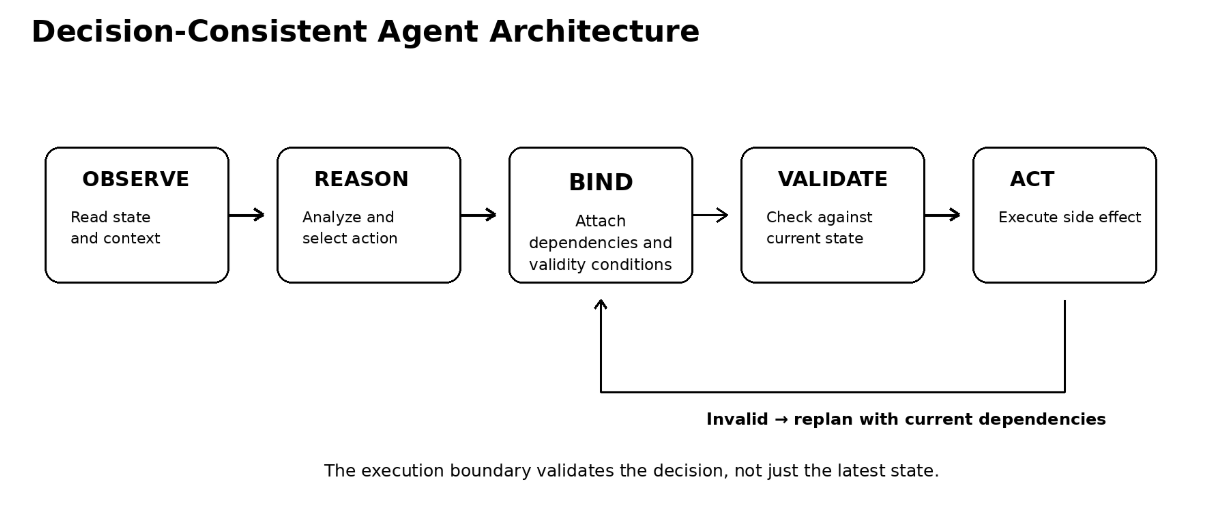
Figure 3. Observe → Reason → Bind → Validate → Act adds an explicit decision-validation boundary.
The simplified model for an AI agent is usually Observe → Reason → Act. For consequential actions, a stronger execution model can insert two additional stages:
Observe → Reason → Bind → Validate → ActThe Bind step is important to qualify which dependencies have changed since the last execution and which of them are detrimental to the outcome of the workflow. It filters tangential inputs; strong filtering here reduces transactional costs.
The purpose is not to make the LLM itself transactional. Instead, it creates a deterministic execution boundary around probabilistic reasoning. The model can decide what action appears appropriate; the runtime controls whether reasoning produced under an earlier state is still permitted to create a side effect.
Conclusion
Event-driven workflows are increasingly being backed by autonomous agent systems. To extract the most value, we must emphasize ways to avoid manual interventions and empower the agentic flow to make empirical decisions. However, not every agent needs the same guarantees. A writing assistant producing a paragraph can tolerate weak decision consistency because the action is low-risk and easily reversible. An agent purchasing inventory, modifying production infrastructure, or changing access policies has a very different risk profile.
The validation strategy should therefore depend on dependency volatility, decision lifetime, action impact/reversibility, and recomputation cost.
The central design principle remains simple: do not assume that a decision remains valid merely because it was correct when generated.
Short-lived interaction:
Observe → Reason → Act

Long-running consequential workflow:
Observe → Reason → Bind → Validate → Act
Distributed systems have spent decades developing mechanisms to determine whether the state being acted upon is still valid. As reasoning becomes part of the software execution path, agent architectures may need to preserve and validate something else as well: the decisions produced from that state.
References
- Chen, T., Wang, Y., & Brinton, C. G. (2026). Fresh Memory, Stale Plans: Dependency-Scoped Validation for Distributed LLM-Agent Memory. arXiv:2609.03340
- S-Bus (2026). Automatic Read-Set Reconstruction for Multi-Agent LLM State Coordination. arXiv:2605.17076
- CoAgent (2026). Concurrency Control for Multi-Agent Systems. arXiv:2606.15376
- LangChain. LangGraph Persistence Documentation
- Google Developers Blog. Build Long-running AI Agents That Pause, Resume, and Never Lose Context with ADK
Opinions expressed by DZone contributors are their own.