

Search Is Becoming the Control Plane for AI Agents
The future of AI agents is searchable tool discovery, not hardcoded APIs. MCP and semantic search are turning tools into capabilities agents can find and use at runtime.
 ·
·
Join the DZone community and get the full member experience.
Join For FreeYour agent won't be able to discover tools in 5 years using hardcoded API integrations. It will look for the capability that it requires, read the description of the tool, and call it at runtime.
That change alters the integration model altogether. Rather than developers having to wire in each and every OpenAPI spec to the codebase, agents will be able to discover, understand, and use capabilities from searchable tool catalogs on demand.
The Prediction
A search is no longer simply about people finding information. Instead, it is going to be a way for agents to locate capabilities. Agents’ tool indexes (the maps of what an agent can do) are now evolving into searchable, dynamic, and semantic tools. Teams that understand this shift early will build agents that are more flexible than systems locked into hardcoded integrations.
The API Problem Nobody Talks About
The amount of work involved in creating a new connection for an AI agent can be thought of as follows: The developer creates a method for their function. The developer explains how this method will be used in a system prompt. Authentication must be handled. The developers must then process the output. The developer(s) are responsible for testing the interface. When the API changes, the developers are also responsible for maintaining it.
This process is repeated every time a new interface is integrated with the AI agent. This means that every single interface is hand-created, maintained by a human, and hard-coded into the agent prior to deployment. Since a human told the agent exactly which interfaces exist in order for it to begin operation, the agent knows specifically which interfaces exist.
When using three interfaces, this approach works well. However, when using fifty, this model quickly falls apart. Additionally, when tools change, or new tools become available, or if an agent is to determine on its own which capabilities are needed to complete tasks it has never completed before, this model rapidly becomes untenable.
“REST APIs were designed for human developers, but the agent economy requires something else — APIs that self-explain, can be discovered at runtime, and communicate their purpose in a language that is already understood by the model.
This is the issue search is meant to solve. Not keyword search. Semantic search, which is not just text matching but understanding of meaning. If an agent can ask a tool registry for a tool with the question: “I need to send a message to a Slack channel”, and receives back the correct tool and description of how to use it, the whole integration model shifts.
How We Got Here — Faster Than Anyone Expected
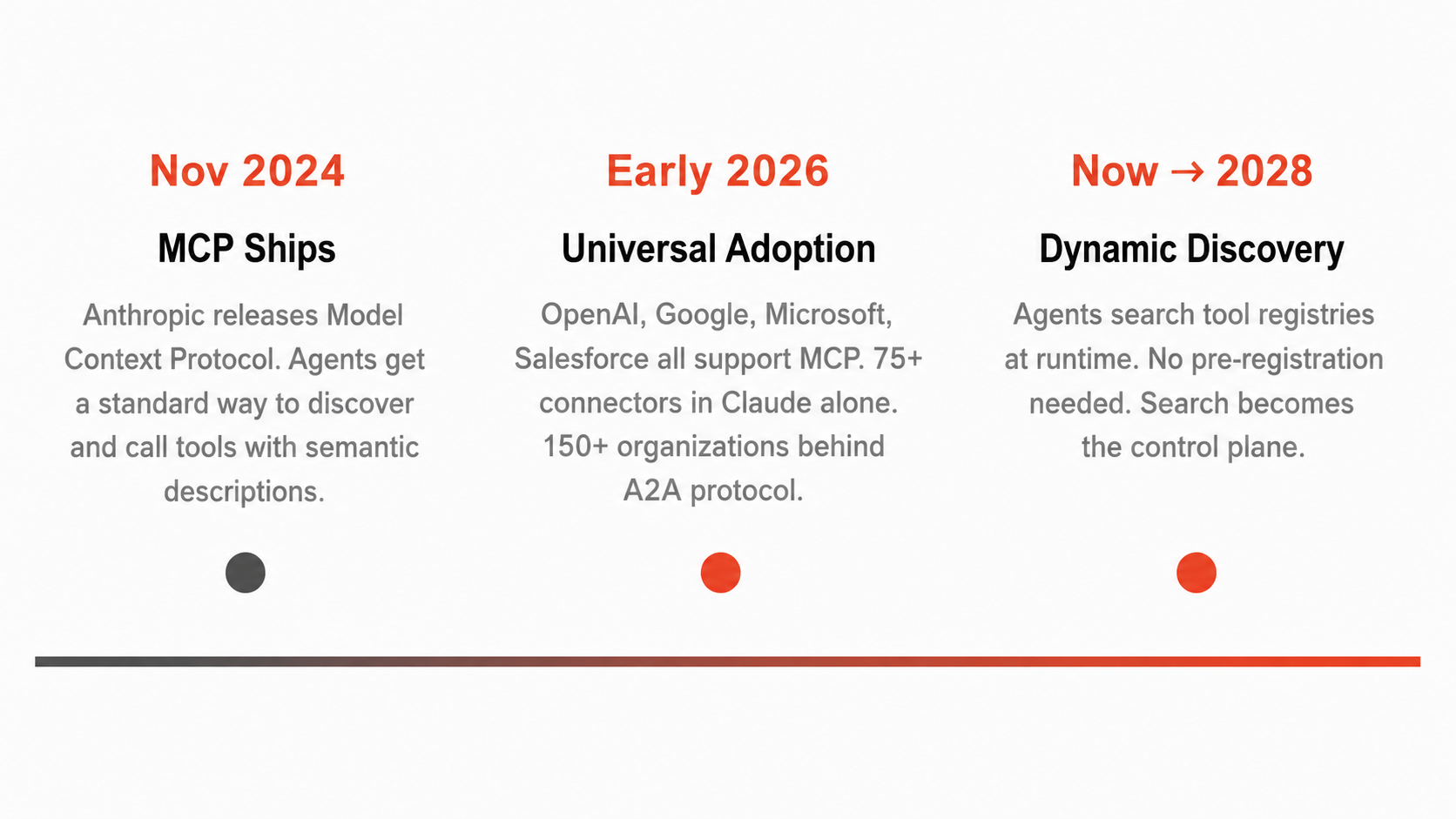 Anthropic introduced the Model Context Protocol (MCP) in November 2024. In retrospect, the basic idea was almost too easy to grasp. The issue of integrating the AI tool is similar to the peripheral device problem that USB has solved in computers. Prior to USB, each device would require a different type of cable, port, and driver. With this, USB developed a universal interface: one cable type, one port standard, and a common protocol that any device could implement. MCP does the same for agents and tools.
The take-up rate was quicker than most people anticipated. It started as an experimental protocol and is now the de facto integration layer for agentic AI, natively supported by Anthropic, OpenAI, Google and Microsoft, and deployed by millions of developer tool users every day by early 2026. It is now under the stewardship of the Linux Foundation. The Agent-to-Agent protocol (A2A), which was developed by Google, has now got 150+ organizations supporting it.
However, there's something that most engineers don't know about MCP. It's not only a more elegant API design. It's a searchable, semantic tool registry. An MCP server does not simply announce "here is a function. It offers a natural language description of the purpose of the tool, when to use it, what it expects, and what it returns. The agent doesn't have to be pre-programmed with the information about that tool. It can discover it.
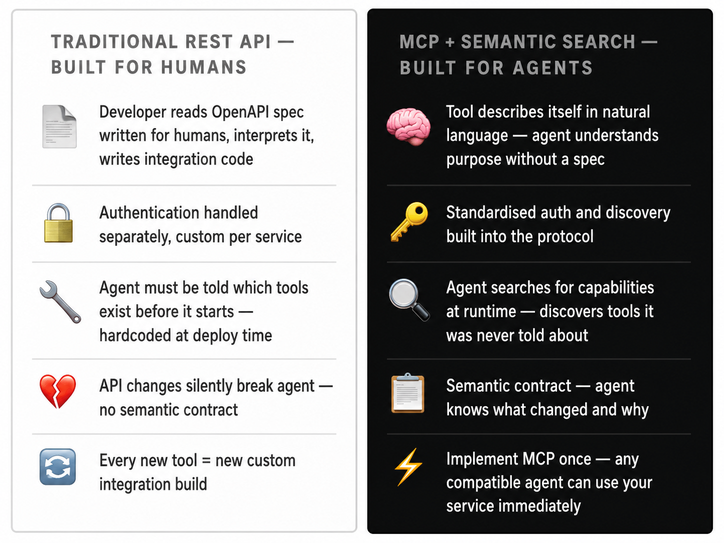
An AI agent that calls a REST API must be able to understand human-readable OpenAPI documents, make educated guesses about the shape of parameters, process raw JSON payloads into context, and deal with errors without any semantic context. The same agent invokes an MCP server and receives back tools that describe themselves and natural-language descriptions, pre-filtered relevance-ranked results, stateful sessions, and standardized auth and discovery.
The last part, self-describing tools with natural language descriptions, is where search comes into play. Once you have language describing your tools, you can index them. Once they can be indexed, they can be searched. Once you can search them, your agent doesn't have to know what tools are available.
The Search Layer That's Being Developed in the Background
Microsoft discontinued Bing Search APIs in August 2025. That's a retreat, doesn't it? It was really a signal. Microsoft's "Grounding" (search results formatted and structured just for agents, not humans) was a push toward Azure AI Agents. This difference is very significant.
A new breed of search infrastructure is coming into existence, one that isn't built for people typing queries into a box, but for agents that query registries to locate capabilities. AI-native search APIs such as Exa and Tavily leverage neural networks to interpret the meaning and context of the search query; they can deliver relevant information even if it doesn't contain your exact query, and they format the information in a way that is optimized for AI consumption. Firecrawl takes it one step further, keeping a freshness-checked search index of authoritative sources, integrating search with full content extraction, and allowing autonomous multi-step research through an agent endpoint.
These are not SEO tools. These are agent infrastructure. The companies developing them are assuming that search — semantic search, real-time search, agent-readable search — will be the means by which agents find everything: tools, data, other agents, capabilities they didn't know they needed when they began a task.
| Protocol | Origin | Main Problem It Solves | Maturity |
|---|---|---|---|
| MCP | Anthropic, 2024 | Standardizes how agents connect to tools, data, and services using self-describing interfaces | Most mature / widely adopted |
| A2A | Google → Linux Foundation | Helps agents discover, communicate, and collaborate with other agents | Strong ecosystem support |
| ACP | IBM, 2025 | Supports agent packaging, runtime discovery, and metadata-based capability description | Emerging |
| ANP | Open-source community | Enables decentralized peer-to-peer discovery of agents across the open internet | Early stage |
Pay attention to the similarities of all four protocols: discovery. All of them are looking for a way to discover what they need at runtime, without having to pre-register each and every connection. This is the search problem. It is simply referred to as "discovery" in the protocol world.
What Changes When Search Is the Control Plane
The implications of the practical are greater than they appear on the surface.
Agents transform from static to dynamic. The agents today come with a bunch of tools pre-installed at deployment time. A search-driven agent builds its own toolbox for each task based on what it finds in the search. Looking to make a payment? Look for a payment option. Need to send a notification? Look for notification devices. The agent who is processing your expense report in 2028 will have a different set of tools available to him than he did yesterday — because the registry has changed, new capabilities have emerged, and better options are now available.
The integration barrier is removed. At the moment, a new tool needs to be developed to create the integration for an agent. A search-driven model involves exposing an MCP server, describing what it can do in natural language, registering with the appropriate discovery layer, and any agent that supports the discovery layer can discover and use the server right away. You only have to implement MCP once on the server side, and any MCP-compatible AI can use your service right away. The agent capabilities marketplace opens up like the web.
The context window management turns into a search problem. Avoiding context bloat is one of the most difficult engineering problems in multi-agent systems: loading all the tools into the agent's context window at once, before the agent has even begun the task. The answer is progressive discovery: The agent has a small number of tools and asks for specific ones when they are needed, loading only that one when it is needed. This is a search operation. The agent asks the catalog, gets one tool, applies it, and continues with the next.
Today's Engineer's To-Do List
1. Expose Internal Tools as MCP Servers
If your team has internal APIs, databases, or services that your agents will ever need to access — wrap them in MCP now. Provide well-crafted descriptions of each tool in natural language. This is what most teams miss out on and then kick themselves later for. The key to finding the tool is the quality of its description.
2. Create a Tool Catalog, Not a Tool List
Don't explicitly include tool arrays in your agent configuration. Create an indexable catalog, even a basic vector index of your tools' descriptions. It is queried by your agent at the beginning of every task, and only loads what is needed. This alone will reduce the amount of context bloat and make your agent a much better agent at novel tasks for which it wasn't explicitly trained.
3. Avoid SERP APIs, Stick to AI Native Search APIs for External Data
In the event that your agent has to fetch external information, Exa, Tavily, and Firecrawl are designed for that purpose. They send back information that agents can read. Typical search engines provide HTML-ranked results for human readers. The impact that your agent can have with what it produces is huge.
4. Keep Discovery and Invocation Apart in the Design of Your System
They are two different operations that have distinct performance needs. Discovery (finding the correct tool) should be quick, stored in a cache, and be semantic. Invocation (literally the calling of) must be reliable and have error handling. If they are combined, their systems are slow at both. Do not mix them until day 1.
5. Pay Attention to the A2A and ANP Protocols
MCP resolves the tool discovery issue. A2A and ANP are a solution to the agent discovery problem, which involves finding the agent to which another agent can delegate. This is the next component of the same issue. Your orchestrator agent should be able to find its agent of choice, not be hard-coded with a list of agents that it knows about. That infrastructure is being developed today.
The Part That Should Make You Nervous
This is a security issue that the industry is not fully aware of.
If tools are dynamically discovered with search, then you open a new attack surface. In fact, security researchers have already surfaced a number of great security problems with MCP, such as prompt injection, tool permissions to combine multiple tools in order to exfiltrate data, or lookalike tools that can infiltrate trusted tools. Looking at that last one (lookalike tools), it's the search-era version of typosquatting. An MCP server is posted by a malicious party with a description similar to that of a legitimate MCP server. An agent looks for a payment processor and gets him. The result is always predictable.
This should not be an excuse not to use the architecture. It's a good indicator to consider trust hierarchies in your tool registry. What resources can your agent find? What is verified in advance of calling a tool? What is the oversight of the description? It is not yet possible to have good answers to these questions across the industry — and if the team that can answer them well has a significant security edge over teams focused purely on functional tool discovery.
Where This Ends Up
The transition away from static (hardcoded) API's toward a model of search-based, semantic agent tool discovery will happen. And it is happening fast. There are now working infrastructures in place with which to support this new paradigm.
MCP represents the "USB moment" for agent tools. The time when each development team can stop worrying about integrating an additional service into its existing stack and start using the MCP as the interface through which to do so.
Searchable catalogs of tools are what will enable this to be done at scale. Those groups developing these searchable tool catalogs today; those companies whose internal services have been wrapped in MCP; and those who are giving serious consideration to how they might develop a way to dynamically discover tools — they are preparing for a world where agents build their own capabilities, rather than waiting on developers to hook them up. That world is closer than you likely believe.
Opinions expressed by DZone contributors are their own.
Comments