

From APIs to Agents: How Back-End Engineering is Evolving in 2026
Back-end engineering is moving from static APIs to autonomous, AI-driven agents that can plan, decide, and act—not just respond to requests.
Join the DZone community and get the full member experience.
Join For FreeThe request-response model that defined back-end engineering for two decades is being stretched into something different. Back-ends still serve requests, but increasingly they also set goals, call tools on their own initiative, and run for a few minutes or hours before returning anything. That changes a lot of what back-end engineers have to think about: orchestration, async pipelines, tool governance, state management, and a different shape of failure.
Here’s what is actually shifting, and what stays the same.
The Short Version of How We Got Here
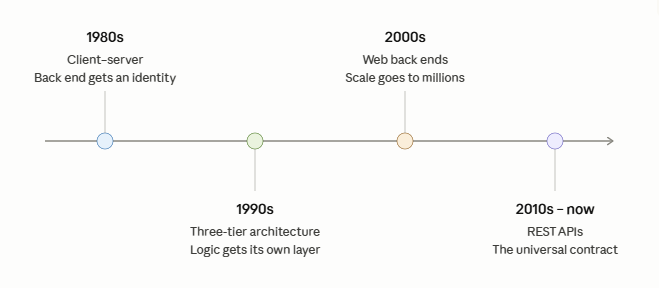
Back-end engineering's earlier chapters are well rehearsed: the client-server split in the 1980s, three-tier architecture in the 1990s, and REST APIs and stateless services as the web scaled through the 2000s and 2010s. The relevant point for what follows is that by the mid-2010s, back-end engineering had settled into a stable identity: designing clean APIs, keeping services stateless, and deferring persistence to the data layer.
Three things broke that stability roughly in parallel:
- Event-Driven Architectures and Microservices: Made services react rather than wait
- Cloud-Native Infrastructure: Decomposed the back-end into distributed, auto-scaling functions
- LLMs: Language models that back-end engineers started treating not as an external service to query but as a primitive inside the stack
The third shift is the one reshaping job descriptions in 2026.
How are Back-End Systems Evolving Today?
Back-ends today are managed and governed by autonomous AI Agents. Where a traditional back-end maps a request to a handler, an agentic back-end maps a goal to a planner-executor loop. The planner is usually an LLM. It reads the goal, picks a tool from a defined set, executes it, reads the result, and decides what to do next until either it produces an output or hits a stop condition.
This has five practical implications for the people building it.
1. An Orchestration Layer Becomes Load-Bearing
The first structural change is the introduction of an orchestration layer.
Agentic back-ends route goals to agents, and those agents call tools, query databases, invoke other agents, and this loop runs until the task is resolved. Frameworks like LangGraph, LlamaIndex, and CrewAI are used to develop and handle the function loop mechanics, but they don't make the design decisions for you. The back-end engineer is still on the hook for the topology: which agents exist, what tools each can call, when one agent hands off to another, and how failures cascade when a sub-agent times out or returns malformed output.
2. Tasks Become Async-First by Default
An API call assumes the response arrives in milliseconds. An agent doesn't.
A back-end agent tasked with "research this topic and draft a report" might run a web search, read several pages, synthesize findings, and write the output; all before returning anything useful. And that is not a 200ms operation. This is why agentic back-ends are async-first. Tasks are queued (using tools like Celery), messages are partitioned (Apache Kafka, RabbitMQ, etc.), agents run as background workers, and clients poll for status or receive results via a webhook or a WebSocket.
3. Tools Replace Services as the Unit of Dependency
In a traditional stack, you depend on a database, a cache, and a third-party API.
In an agentic back-end stack, you depend on tools; each one handles a function/capability that the agent can choose to invoke. The engineer's job shifts from developing to clearly defining the tool surface: what each tool does, what its arguments mean, what errors look like, and what the agent is allowed to do with it. A vague tool description is a silent correctness problem.
4. Observability Moves from Request Traces to Reasoning Traces
Debugging a traditional bug means following a request through the code path.
Debugging an agent means reconstructing why the model called lookup_invoice before verify_vendor, why it interpreted "this expense" as referring to a specific row, and where in the chain it diverged from what you wanted. Tools like LangSmith, Langfuse, and Arize Phoenix exist to make this tractable, but the discipline is new.
5. State Stops Being Incidental
Stateless APIs are easy to reason about because each request is independent. Agents are not stateless.
They need to remember what they've tried, what the user said three turns ago, and what previous tool calls returned. Short-term memory lives in the context window, cheap but bounded. Long-term memory means a vector store for semantic recall and a relational store for structured facts, plus a strategy for what gets written where and when.
6. Safety is Included at the System Level
Perhaps the most significant shift with AI Agents in back-end development is how they take real-world actions: sending emails, writing to databases, calling external APIs, and executing code. When a traditional API does something destructive, a human made that call explicitly. But when an agent does something destructive, it may have reasoned its way there through a chain of plausible-seeming steps.
This makes safety a big back-end architecture concern, not just a product concern. This is why many organizations hire AI Agent developers to build confirmation gates (points where the agent must pause and request human approval before proceeding), scope limits (defining the blast radius of what an agent can affect), and rollback mechanisms for actions that can be undone.
A Worked Example: An Invoice Approval Agent
Most of the above remains vague without real-world implementation, so here's one.
Say you're building an agent that handles incoming vendor invoices for a mid-sized finance team. The goal it receives looks like: "Process invoice #INV-4471."
Its tool surface might look like the following:
@tool1

def get_invoice(invoice_id: str) -> Invoice: ...

@tool2

def get_vendor_history(vendor_id: str) -> VendorHistory: ...

@tool3

def check_budget(department: str, amount: Decimal) -> BudgetStatus: ...

@tool4

def flag_for_review(invoice_id: str, reason: str) -> None: ...

@tool(requires_human_approval=True)

def approve_invoice(invoice_id: str, budget_check_id: str) -> None: ...
Four tools the agent can call freely. One approve_invoice gates on a human approver before it executes. That's a confirmation gate, and in an agentic system, it's an architectural decision, not a UI one. The framework needs to pause the run, surface the pending action to a human, store the partial state, and resume when (or if) approval comes back.
Where APIs Sit in All This
The framing of "APIs versus agents" misreads what's happening. Agents are heavy API consumers; every tool an agent invokes is, at its core, an API call. According to Postman's 2025 State of the API Report, 82% of organizations have adopted some level of API-first approach, and 1 in 4 describe themselves as fully API-first. That's gone up, not down, as agentic systems have spread.
What's changed is who the consumer is. The same report finds 89% of developers use generative AI in their daily work, while only 24% design APIs with AI agents in mind. APIs designed for human developers (chatty endpoints, ambiguous error messages, and REST conventions that assume a debugging human on the other side) work poorly when the consumer is an AI model that has to infer correctness from a description.
This is also where API gateways take on extra weight. In an agentic system, the gateway is the natural enforcement point for tool governance: which agents can call which tools, with what rate limits, against which data scopes. Versioning matters more, too. Postman's survey also found 51% of developers citing unauthorized or excessive agent calls as a top concern, which is really a statement about what happens when tool interfaces and agent assumptions drift apart.
What's Actually New
Strip out the framing, and the picture is fairly grounded. APIs still connect systems. Databases still hold state. SLOs still matter. The fundamentals of back-end engineering haven't been overturned; they've absorbed a new constraint that a part of the system now makes decisions instead of just executing them. Here is how it happens:
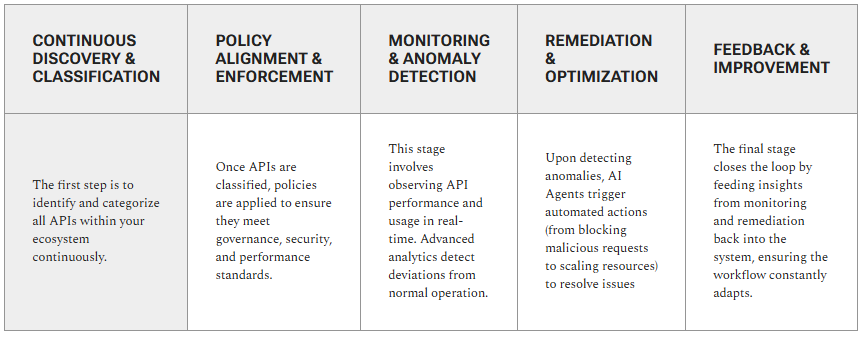
This changes how you design tool surfaces, handle long-running tasks, debug, and place confirmation gates. It doesn't change the rest. The interesting work, as usual, is in the boring parts: typed tool contracts, idempotency keys, schema versioning, retry semantics, and observability of multi-step plans. That's a meaningful shift, but also a journey that's been underway since the first minicomputer asked whether it really needed to do all the computing itself. The engineers who built the REST-era internet didn't know they were laying the ground for what comes next. And it is safe to say that the AI engineers involved in agentic back-end development today are doing the same thing.
Opinions expressed by DZone contributors are their own.
Comments