

Banking Fraud Prevention With DeepSeek AI and AI Explainability
AI-driven fraud detection boosts accuracy and transparency using XGBoost, SHAP, and real-time dashboards, providing scalable solutions to fight fraud.
Join the DZone community and get the full member experience.
Join For FreeFraud detection in banking has significantly advanced with artificial intelligence (AI) and machine learning (ML). However, a persistent challenge is the explainability of fraud decisions — how do we justify why a particular transaction was flagged as fraudulent?
This article explores how DeepSeek AI enhances fraud prevention through:
- AI-powered fraud detection with deep learning models
- AI explainability using SHAP and LIME
- Real-time dashboards with Streamlit and Tableau
- Comparison of fraud detection models
- Implementation flowcharts, graphs, and visualization techniques
Banking Fraud Detection: Why AI Matters?
Fraud in banking can be categorized into:
• Credit card fraud – Unauthorized transactions using stolen or cloned cards
• Account takeover fraud – Cybercriminals gain control of customer accounts
• Synthetic identity fraud – Fake identities created using real and fake credentials
• Transaction fraud – Money laundering, unauthorized wire transfers, or illegal purchases
Challenges in Traditional Fraud Detection
- High false positives. Many genuine transactions are incorrectly flagged.
- Evolving fraud patterns. Fraudsters continuously adapt their strategies.
- Lack of transparency. Black-box AI models make fraud decisions hard to interpret.
To solve these, DeepSeek AI integrates deep learning models with explainability techniques for better fraud detection.
Fraud Detection Model Implementation
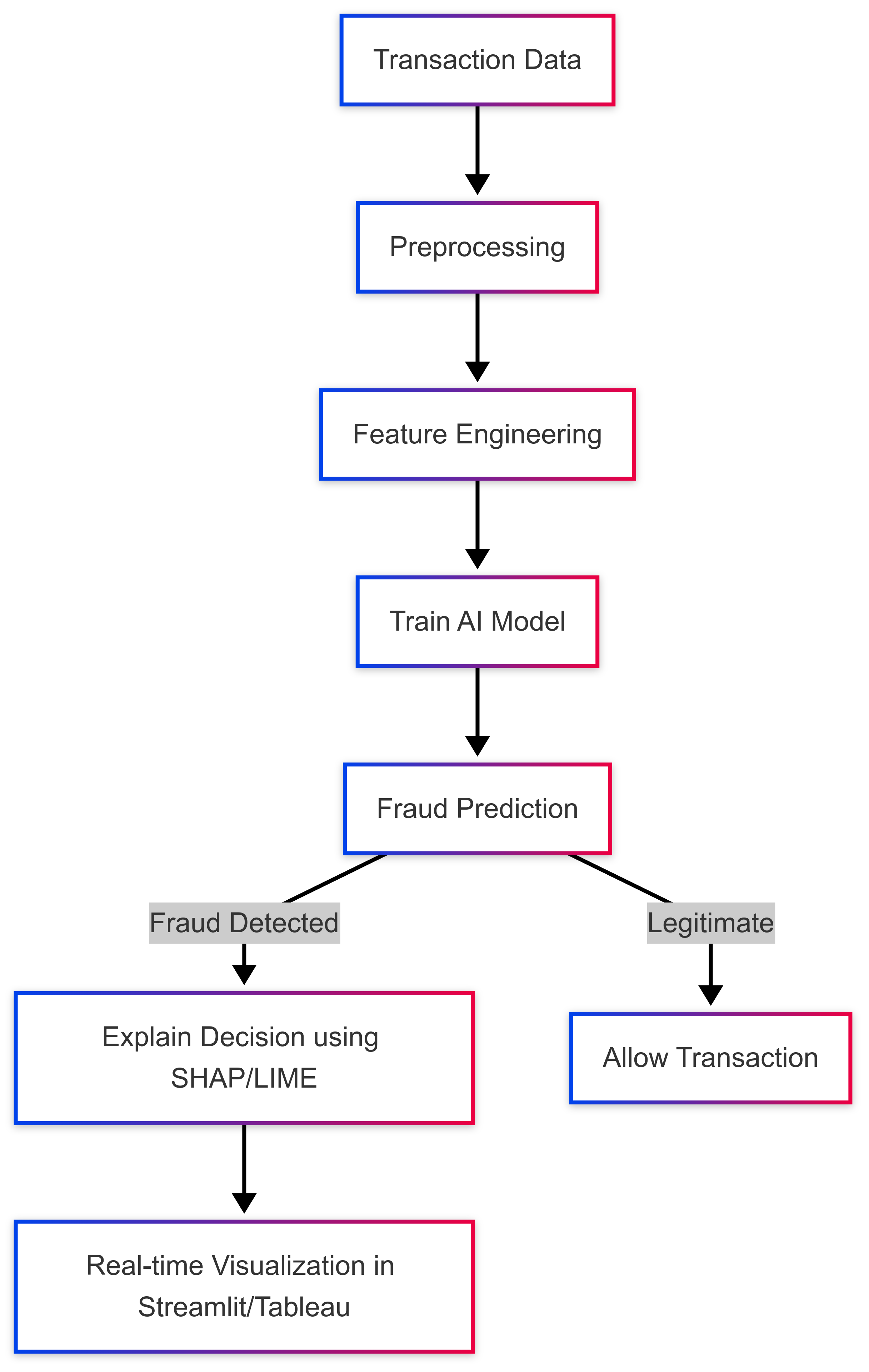
A typical fraud detection pipeline follows these steps:
Fraud Detection Workflow
- Step 1. Data collection (banking transactions)
- Step 2. Data preprocessing (cleaning and feature engineering)
- Step 3. Train deep learning model (Autoencoders, XGBoost)
- Step 4. Model evaluation (accuracy, precision, recall)
- Step 5. AI explainability (SHAP, LIME)
- Step 6. Real-time monitoring (Streamlit and Tableau)
Fraud Detection Flowchart
AI Explainability for Fraud Decisions
One of the main issues in fraud detection is understanding why a transaction was flagged as fraudulent.
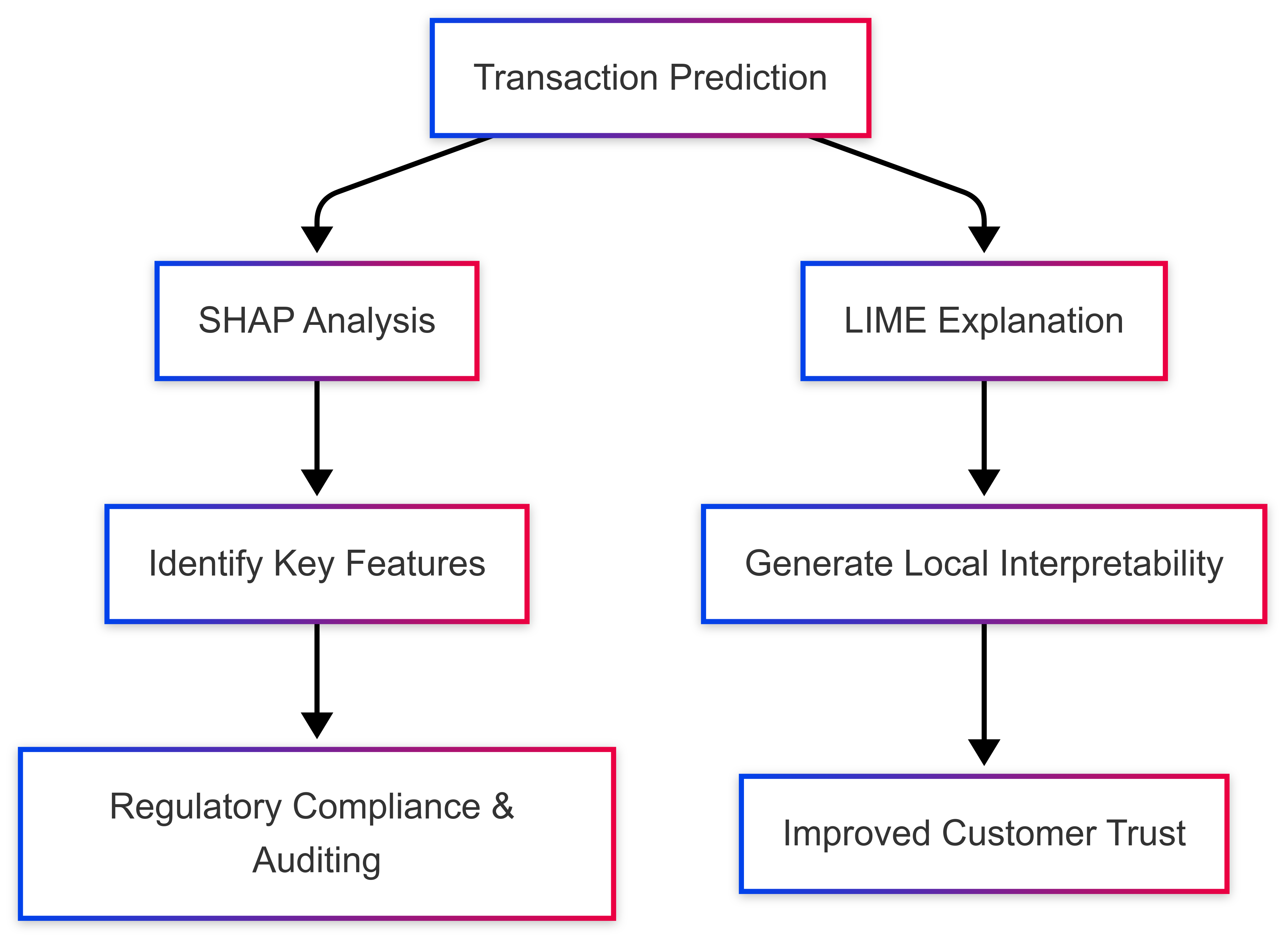
Solution: Use SHAP (SHapley Additive Explanations) and LIME (Local Interpretable Model-Agnostic Explanations).
SHAP Explanation for Fraud Detection
SHAP helps identify which transaction features contribute the most to fraud decisions.
import shap


# Initialize SHAP explainer

explainer = shap.Explainer(model, X_train)


# Compute SHAP values

shap_values = explainer(X_test)


# Plot SHAP summary

shap.summary_plot(shap_values, X_test)
SHAP Summary Plot
Visualization of which transaction attributes (e.g., amount, frequency, location) impact fraud detection.
LIME Explanation for Local Interpretability
LIME provides explanations for individual fraud predictions.
from lime.lime_tabular import LimeTabularExplainer


# Initialize LIME explainer

explainer = LimeTabularExplainer(X_train, feature_names=["Amount", "V1", "V2"], mode='classification')


# Explain a specific transaction

exp = explainer.explain_instance(X_test[0], model.predict)


# Display explanation

exp.show_in_notebook()
LIME Explanation
Breakdown of which features influenced a particular fraud decision.
Flowchart: AI Explainability for Fraud Detection
Real-Time Fraud Dashboards (Streamlit and Tableau)
To monitor fraud in real time, we build dashboards using Streamlit and Tableau.
Streamlit Dashboard for Fraud Monitoring
- Upload banking transactions
- View flagged fraudulent transactions
- Visualize SHAP-based fraud explanations
Python Implementation (Streamlit Dashboard)
import streamlit as st
import pandas as pd
import shap
import joblib

# Load fraud model & SHAP explainer
model = joblib.load("fraud_model.pkl")
explainer = shap.Explainer(model)

# Streamlit UI
st.title("Real-Time Fraud Detection Dashboard")
uploaded_file = st.file_uploader("Upload Transactions (CSV)", type=["csv"])

if uploaded_file:
    df = pd.read_csv(uploaded_file)
    st.dataframe(df.head())

    # Fraud detection
    predictions = model.predict(df)
    df["Fraud Prediction"] = predictions

    # Display fraud cases
    st.subheader("Fraudulent Transactions:")
    st.dataframe(df[df["Fraud Prediction"] == 1])

    # SHAP Explanation
    fraud_case = df[df["Fraud Prediction"] == 1].iloc[0:1]
    shap_values = explainer(fraud_case)

    st.subheader("SHAP Explanation:")
    shap.waterfall_plot(shap.Explanation(values=shap_values.values[0],
                                         base_values=shap_values.base_values[0]))
Comparing Fraud Detection Models
| Model | Accuracy | Precision | Recall | Explainability |
|---|---|---|---|---|
| Autoencoder (Deep Learning) | 95% | 88% | 92% | Low |
| Random Forest | 91% | 85% | 89% | Medium |
| XGBoost | 93% | 90% | 94% | High (SHAP-supported) |
Best model: XGBoost with SHAP explainability for fraud decisions.
Conclusion: The Future of AI-Powered Fraud Prevention
With the rise in digital banking and online transactions, fraud detection must evolve to stay ahead of fraudsters. Traditional rule-based systems are no longer sufficient, and AI-powered fraud detection provides a robust solution.
Key Takeaways From This Article
- AI-driven fraud detection significantly improves accuracy and reduces false positives.
- AI explainability using SHAP and LIME enhances transparency and trust in fraud decisions.
- Real-time dashboards (Streamlit and Tableau) provide actionable insights for fraud prevention teams.
- Comparison of models helps organizations choose the best solution based on accuracy, recall, and explainability.
Future Enhancements
- Real-time fraud alerting with Kafka and Spark Streaming
- Graph Neural Networks (GNNs) to detect complex fraud patterns
- Reinforcement Learning (RL) to adaptively improve fraud detection
Banks can achieve a more transparent, accurate, and dynamic fraud detection system by integrating DeepSeek AI, explainable AI (XAI), and real-time dashboards.
Opinions expressed by DZone contributors are their own.
Comments