

Building Centralized Master Data Hub: Architecture, APIs, and Governance
This article provides an overview of centralized master data hub for enterprises applications from fragmented master data managing in different systems.

 CORE
·
CORE
·
 ·
·
Join the DZone community and get the full member experience.
Join For FreeMany enterprises operating with a large legacy application landscape struggle with fragmented master data. Core entities such as country, location, product, broker, or security are often duplicated across multiple application databases. Over time, this results in data inconsistencies, redundant implementations, and high maintenance costs.
This article outlines Master Data Hub (MDH) architecture, inspired by real-world enterprise transformation programs, and explains how to centralize master data using canonical schemas, API-first access, and strong governance.
Fragmented Master Data
In a typical legacy environment, the applications manage the master data differently:
- Each application owns and maintains its own master tables
- Master definitions diverge over time
- Functional logic is reimplemented repeatedly
- Changes require coordination across multiple systems
The absence of a single source of truth increases operational risk and slows down innovation.
Centralized Master Data Hub
The proposed solution is to establish a centralized master data hub that acts as the single source of truth for enterprise-level master data.
Below are the key principles for a centralized master data hub:
- Central ownership of master data
- Canonical, version-controlled schemas
- API-only access to master data
- Strong governance and auditability
Below are the benefits of a centralized master data hub:
- Single, authoritative source of master data
- Reduced duplication and inconsistencies
- Lower maintenance and implementation costs
- Improved data quality and governance
- Medium-risk migration strategy
Below are the risks and challenges identified while building a centralized master data hub. These risks can be mitigated through caching, high availability design, and phased adoption.
- Synchronization between local and centralized masters
- Increased dependency on hub availability
- Careful change management required
- Performance considerations for high-volume consumers
Commonly, creating a scheme from fragmented data would be a challenge (migration from a multi-schema to a single-schema model).
To address schema standardization challenges, the MDH is implemented as a centralized database platform with two logical tracks.
Track 1: Canonical Schema Creation
This track hosts enterprise-wide common masters, such as country, state, currency, branch, location, etc., with the characteristics of:
- Canonical, normalized schema
- Exposed via entity-level APIs
- Lightweight master data UI
- Bulk upload support
These masters are designed for reuse across the enterprise.
Track 2: As-Is Configurable Schemas
This track supports application-specific masters that cannot be immediately standardized with the characteristics of:
- Per-application schemas
- Minimal or no schema changes initially
- Existing stored procedures can continue
- Gradual migration to API-based access
This dual‑track approach minimizes migration risk while supporting long‑term standardization. Master data migration plays a critical role in transitioning from fragmented data sources to a centralized master data hub. A well‑defined, structured migration process enables enterprise teams to establish the hub effectively and ensures seamless adoption by consuming applications. The migration flow outlines the high‑level activities involved in consolidating and standardizing master data.
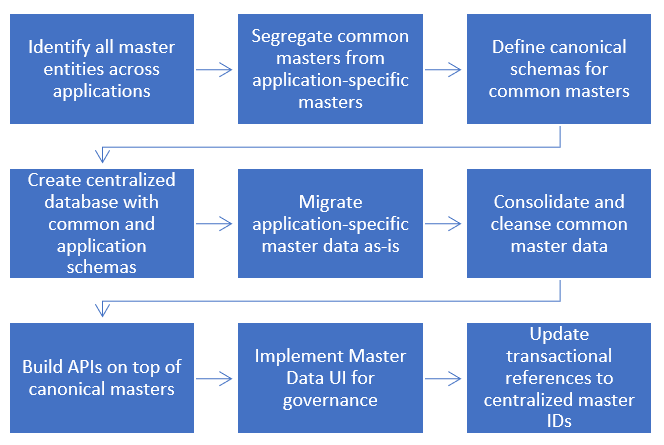
Once the MDH is established, enterprise‑wide access to master data becomes essential. APIs built on top of canonical master entities are consumed by applications across the organization. All consumers access master data exclusively through APIs, eliminating direct database access. This model decouples applications from underlying data structures and enables controlled, scalable evolution of master data.
For any enterprise transformation initiative, strong governance is essential to manage master data effectively. The following governance use cases and processes help ensure consistency, control, and long‑term success of the MDH.
Change in Data: Adding a new country/location in master data
The process steps help the teams to adopt:
- Raise a service request or ticket
- Review and approval by the MDH team
- Update via master data UI
- Automatic synchronization to consuming applications
Changes in Schema: Adding a new attribute to an existing master
The process steps below help the teams to adopt:
- Change request initiation
- Impact analysis by MDH administrators
- Stakeholder review and approval
- Schema, API, and UI enhancements
- Testing (MDH and impacted systems)
- Deployment and closure
Change in API: Modifying an existing master API, process mirrors schema changes, with additional focus on backward compatibility and consumer impact.
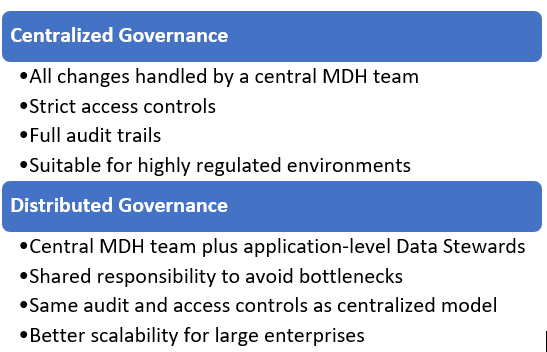
Governance is managed by the two approaches:
Conclusion
Implementing a centralized master data hub based on canonical schemas, API‑driven access, and strong governance provides a scalable and maintainable approach to enterprise master data consistency. When paired with a pragmatic migration strategy, this model enables modernization without disrupting existing application ecosystems.
The approach effectively balances standardization and flexibility, making it suitable for complex enterprise environments with multiple consuming applications
Opinions expressed by DZone contributors are their own.
Comments