

Compliance Automated Standard Solution (COMPASS), Part 11: Compliance as Code, the OSCAL MCP Server Way
How AI-native tooling is finally closing the loop between compliance personas and OSCAL artifacts with an MCP-standardized, AI-agent-ready interface.
Join the DZone community and get the full member experience.
Join For Free(Note: A list of links for all articles in this series can be found at the conclusion of this article.)
In the previous installments of this series, we traced the arc from raw compliance intent — regulations such as NIST 800-53, FedRAMP, PCI DSS, EU AI Act — all the way to machine-readable OSCAL artifacts managed via GitOps pipelines and Trestle-powered automation. The central thesis has been that treating compliance artifacts as code, subject to the same versioning, testing, and review disciplines as software, is the only sustainable path to continuous assurance at scale.
Part 3 of this series explored the collaboration topology: Regulators publishing OSCAL catalogs, Control Providers authoring component definitions, System Owners assembling SSPs, and Assessors generating SAPs and SARs — all mediated by Trestle's markdown-to-OSCAL round-trip. The friction was always the same: every persona still needed CLI fluency or IDE comfort to engage productively with OSCAL JSON.
That friction is now removable. The Model Context Protocol (MCP) brings a standardized, AI-agent-ready interface to compliance tooling — and compliance-trestle-mcp, the first OSCAL-native MCP server from the OSCAL Compass community, makes every Trestle operation invocable by any MCP-compliant AI client: Claude, Roo Code, GitHub Copilot Workspace, or a custom agentic pipeline.
Compliance-as-Code Game Changer With MCP
The Model Context Protocol, incubated under the Linux Foundation and now an industry-wide open standard, provides a JSON-RPC layer by which AI models discover and invoke "tools" — discrete, typed operations exposed by servers. Think of it as the USB-C port for AI agents: standardized, self-describing, composable. Once an MCP server is registered, any compliant client can call its tools without custom integration work.
For compliance workflows, this changes the architecture of engagement fundamentally. Today, driving Trestle to resolve a NIST 800-53 profile, generate SSP markdown, and assemble the resulting OSCAL JSON requires CLI invocations with precise arguments — work that falls to the Trestle-literate members of a compliance team. With compliance-trestle-mcp, those same operations become natural-language-addressable: an AI assistant executes the correct Trestle command sequence, validates the output, and surfaces results in whatever interface the persona is already working in.
Compliance-trestle-mcp: Architecture and Capabilities
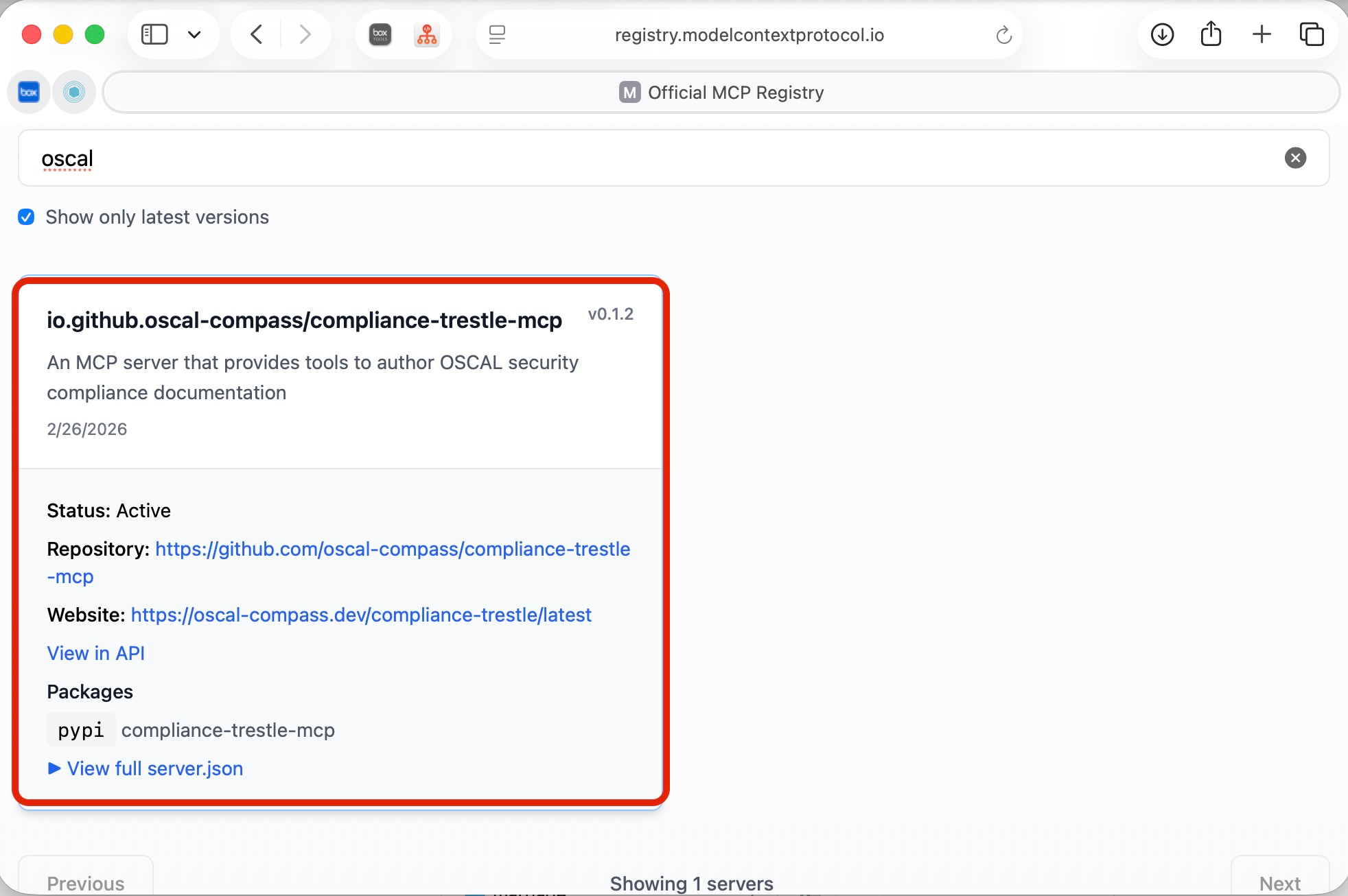
The server is published on PyPI as compliance-trestle-mcp (v0.1.2, February 2026) and registered on the Official MCP Registry at registry.modelcontextprotocol.io under the identifier io.github.oscal-compass/compliance-trestle-mcp. Status is Active. Source: https://github.com/oscal-compass/compliance-trestle-mcp.
Tool Surface
Six tools are currently exposed by the server, each wrapping a core Trestle operation:
| tool | what it does |
|---|---|
|
trestle_init |
Initialize a Trestle workspace, creating the OSCAL folder hierarchy (catalogs, profiles, component-definitions, system-security-plans, etc.) |
|
trestle_import |
Import an existing OSCAL model (catalog, profile, SSP, component definition) from a local file or remote URL into the active workspace |
|
trestle_author_catalog_generate |
Generate per-control Markdown files from a catalog JSON, enabling human-readable editing without touching raw OSCAL |
|
trestle_author_profile_generate |
Generate Markdown documentation for the controls selected by a profile, preserving parameter overrides and guidance additions |
|
trestle_author_profile_resolve |
Resolve a layered OSCAL profile to a flat resolved-profile catalog, collapsing all imports and modifications |
|
trestle_author_profile_assemble |
Assemble edited Markdown controls back into a valid OSCAL Profile JSON, completing the round-trip |
Installation (One Liner)
Add the following stanza to your agent's MCP configuration file (e.g., .roo/mcp.json for Roo Code or the Claude Desktop config):
{
  "mcpServers": {
    "trestle": {
      "command": "uvx",
      "args": [
        "--from",
        "compliance-trestle-mcp",
        "trestle-mcp"
      ]
    }
  }
}
Personas Revisited: Now With an AI Co-Pilot
Part 3 of this series established the canonical compliance-as-code collaboration model: five personas, each with distinct artifacts, editing interfaces, and OSCAL expertise levels. The MCP layer transforms each persona's relationship with those artifacts.
Regulator
Regulators publish security regulations and standards (NIST 800-53, GDPR, HIPAA) typically as PDFs. With compliance-trestle-mcp, a Regulator's technical team can instruct an AI agent to call trestle_import against a raw OSCAL catalog URL (e.g., the NIST GitHub releases), then trestle_author_catalog_generate to produce reviewable Markdown. Editorial cycles that previously required Trestle CLI expertise are now conversational. The AI handles the workspace plumbing; the domain expert focuses on control prose accuracy.
Compliance Officer/CISO
Compliance Officers author organizational overlays — parameter tailoring, guidance additions, control selections — expressed as OSCAL profiles layered on a regulatory catalog. With the MCP server, the AI can be prompted to "resolve the FedRAMP Moderate profile against the NIST 800-53 Rev5 catalog and generate the delta markdown for my SSP authoring queue." The agent chains trestle_author_profile_resolve→ trestle_author_profile_generate autonomously, surfacing the output for human review. This eliminates manual multi-step CLI orchestration and radically compresses profile maintenance cycles.
Control Provider (Component Author)
Control Providers — the engineers maintaining component definitions that map control implementations to policy-as-code rules — have traditionally needed both OSCAL fluency and DevSecOps context simultaneously. Now, an AI agent can assist by importing existing component definitions, generating Markdown stubs for unmapped controls, and prompting the engineer for implementation prose inline in the chat. The component definition round-trip (JSON → Markdown → edit → trestle_author_profile_assemble → JSON) is fully MCP-orchestrated.
System Owner/SSO
The System Owner assembles SSPs from profiles and component definitions — historically the most labor-intensive and error-prone step. With compliance-trestle-mcp, an AI agent can be directed to initialize the workspace, import all upstream artifacts, resolve the applicable profile, and generate the SSP Markdown scaffolding in a single conversational exchange. What once required mastery of four distinct Trestle sub-commands and careful argument threading is reduced to a natural-language instruction sequence.
Assessor
Assessors generating Security Assessment Plans (SAPs) and Reports (SARs) need to trace every selected control back through the SSP to the component definition and the originating catalog. With the MCP server, an AI agent can navigate that traceability chain on demand, resolving profiles and surfacing control implementation status, evidence links, and outstanding POA&M items — all without the assessor ever touching Trestle directly.
The Emerging OSCAL MCP Ecosystem
compliance-trestle-mcp is the first OSCAL-native MCP server from an established open-source compliance project, but it is not alone. A brief survey of the emerging ecosystem:
| server | origin | focus |
|---|---|---|
|
compliance-trestle-mcp |
OSCAL Compass / CNCF Sandbox |
Full Trestle workflow: init, import, catalog/profile generate-assemble-resolve. First CNCF OSCAL MCP server. Registered at registry.modelcontextprotocol.io. |
|
mcp-server-for-oscal |
AWS Labs (awslabs) |
OSCAL schema introspection, model listing, and reference resource retrieval. Optimized for AI agents needing authoritative OSCAL structural guidance rather than authoring workflows. |
|
OSCAL MCP UI Apps |
Atelier Logos / Community |
Visual MCP UI layer for FedRAMP and HIPAA OSCAL workflows; interactive SSP visualization and compliance gap analysis via agentic app runtime. |
The AWS Labs server (github.com/awslabs/mcp-server-for-oscal) serves a complementary purpose: where compliance-trestle-mcp is workflow-centric (authoring and assembly), the AWS server is schema-centric (introspection and reference), providing AI agents with authoritative answers about OSCAL model structure, valid element sets, and use-case patterns. Together, they cover both the "what is OSCAL" and "do OSCAL" dimensions of agent-assisted compliance.
NIST's Vision and the CSWP 53 Horizon
The timing is not coincidental. NIST CSWP 53 ("Charting the Course for NIST OSCAL," December 2025 initial public draft) explicitly names agentic AI and digital twins as the next integration frontier for OSCAL — autonomous risk reasoning and continuous assurance driven by AI agents operating on machine-readable compliance artifacts. The compliance-trestle-mcp server is a concrete early instantiation of exactly that vision, with the CNCF Sandbox project providing governance and sustainability guarantees that standalone tools lack.
What Comes Next for compliance-trestle-mcp
The v0.1.2 release covers the catalog and profile authoring surface. The roadmap naturally extends toward the full OSCAL lifecycle for AI-assisted System Security Plan and MCP resource exposure — surfacing OSCAL documents as MCP resources (not just tool outputs) so AI clients can reason over live workspace state.
Conclusion
Compliance as Code has always promised to make compliance automation as natural as software development. The MCP layer removes the final adoption barrier: the requirement for personas to learn Trestle directly. With compliance-trestle-mcp, every compliance stakeholder — from the Regulator drafting a new catalog overlay to the Assessor closing out a FedRAMP SAR — can now engage with OSCAL artifacts through natural language, mediated by an AI agent that understands both the domain and the toolchain.
The server is live, registered, and installable in seconds. The OSCAL ecosystem is building out MCP coverage rapidly, with NIST's own roadmap pointing in the same direction. The gap between compliance intent and continuous machine-readable assurance has never been smaller.
References and Learn More
[1] OSCAL Compass / compliance-trestle-mcp GitHub. https://github.com/oscal-compass/compliance-trestle-mcp
[2] Official MCP Registry — io.github.oscal-compass/compliance-trestle-mcp. https://registry.modelcontextprotocol.io
[3] AWS Labs mcp-server-for-oscal. https://github.com/awslabs/mcp-server-for-oscal
[4] COMPASS Part 3: Artifacts and Personas (DZone). https://dzone.com/articles/compliance-automated-standard-solution-compass-part-3-artifacts-and-personas
[5] NIST CSWP 53: Charting the Course for NIST OSCAL (Dec 2025 IPD). https://csrc.nist.gov/pubs/cswp/53/charting-the-course-for-nist-oscal/ipd
[6] Building Visual MCP UI Apps for FedRAMP & HIPAA with OSCAL (Atelier Logos, Jan 2026). https://www.atelierlogos.studio/blog/2026-01-08-using-the-aws-mcp-server-for-oscal
[7] OSCAL Hub — Open-Source OSCAL Platform (RegScale / OSCAL Foundation). https://regscale.com/blog/introducing-oscal-hub/
[8] Model Context Protocol Roadmap (Linux Foundation, updated Mar 2026). https://modelcontextprotocol.io/development/roadmap
Below are the links to other articles in this series:
- Compliance Automated Standard Solution (COMPASS), Part 1: Personas and Roles
- Compliance Automated Standard Solution (COMPASS), Part 2: Trestle SDK
- Compliance Automated Standard Solution (COMPASS), Part 3: Artifacts and Personas
- Compliance Automated Standard Solution (COMPASS), Part 4: Topologies of Compliance Policy Administration Centers
- Compliance Automated Standard Solution (COMPASS), Part 5: A Lack of Network Boundaries Invites a Lack of Compliance
- Compliance Automated Standard Solution (COMPASS), Part 6: Compliance to Policy for Multiple Kubernetes Clusters
- Compliance Automated Standard Solution (COMPASS), Part 7: Compliance-to-Policy for IT Operation Policies Using Auditree
- Compliance Automated Standard Solution (COMPASS), Part 8: Agentic AI Policy as Code for Compliance Automation With Prompt Declaration Language
- Compliance Automated Standard Solution (COMPASS), Part 9: Taking OSCAL-Compass to Industry Complexity Level
- Compliance Automated Standard Solution (COMPASS), Part 10: How OSCAL Mapping Paves the Way for Continuous Compliance Scalability
Opinions expressed by DZone contributors are their own.
Comments