

Compliance Automated Standard Solution (COMPASS), Part 10: How OSCAL Mapping Paves the Way for Continuous Compliance Scalability
Mapping Model is the missing architectural layer that transforms multi-framework compliance from exponential complexity to a linear scale.
 ·
·
 ·
·
Join the DZone community and get the full member experience.
Join For Free(Note: A list of links for all articles in this series can be found at the conclusion of this article.)
The Scalability Wall
In previous posts of this COMPASS series, we demonstrated how OSCAL enables compliance-as-code from Catalogs through Component Definitions, to System Security Plans (Part 3), how Compliance Policy Administration Centers bridge compliance to policy enforcement (Parts 4–7), and how these patterns scale to complex environments (Part 9). Yet organizations still hit a fundamental bottleneck: the relentless proliferation of regulatory frameworks.
Consider a financial services firm operating globally. They must simultaneously satisfy DORA in the EU, PCI DSS for payment processing, SOC 2 for SaaS customers, ISO 27001 for international contracts, NIST 800-53 for federal clients, and state-specific privacy regulations. Each framework brings hundreds of controls requiring documentation, implementation, testing, and evidence collection. The traditional approach treats each as an independent program with separate teams, spreadsheets, and evidence repositories. When a new regulation emerges — NIST AI RMF or ISO 42001 — the organization stands up yet another parallel program. This doesn’t scale. Operational overhead grows quadratically while security posture improves marginally.
The OSCAL v1.2.1 Mapping Model, introduced in March 2026, provides the architectural solution. By enabling systematic, machine-readable mappings between control frameworks, OSCAL transforms multi-framework compliance from an O(N²) problem to O(N). The result: evidence reuse, automated gap analysis, and genuinely scalable continuous compliance.
Why Spreadsheet Mappings Failed
The compliance industry has always understood that frameworks overlap. Multi-factor authentication appears in NIST 800-53 as IA-2, PCI DSS as Requirement 8.3, ISO 27001 as A.9.4.2, and SOC 2 as CC6.1. Implementing MFA once should count toward all four frameworks. The challenge has been formalizing these relationships for compliance teams, auditors, and automation tooling.
The predominant approach — manual crosswalk spreadsheets from consulting firms — suffers from fundamental flaws. They lack semantic precision. Does “maps to” mean controls are equivalent, or that one subsumes the other, or merely that they’re related? They exist as static documents disconnected from actual OSCAL artifacts. When frameworks update — PCI DSS v3.2.1 to v4.0, NIST 800-53 Rev 4 to Rev 5 — spreadsheets become instantly stale. Most critically, they’re human artifacts, not machine-readable structures that automation can reason over.
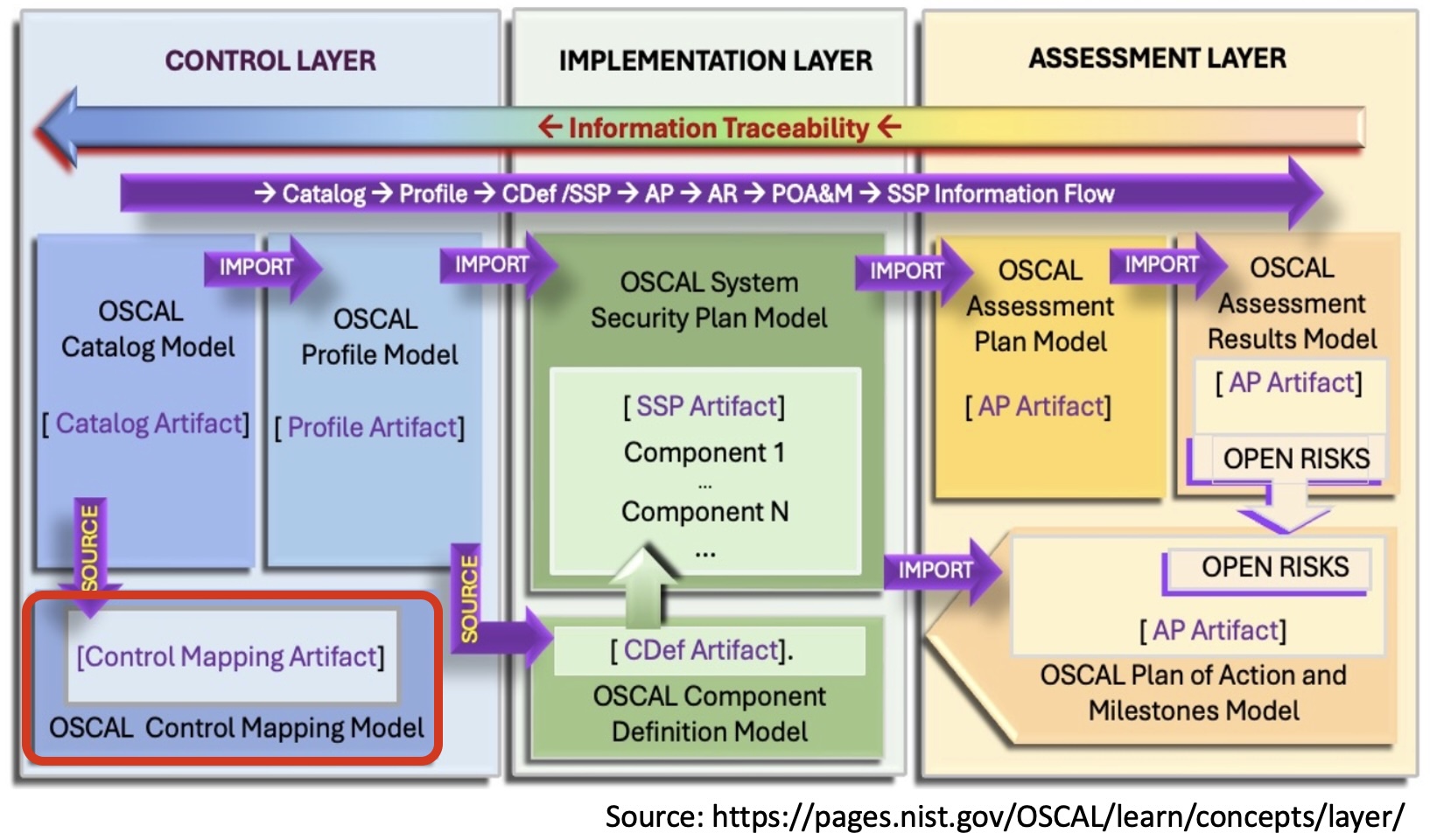
OSCAL Mapping (see Figure 1) addresses each limitation. Mappings use formal set theory relationships: equal (identical requirements), subset (A’s requirements fully contained in B), superset (A broader than B), intersects (partial overlap requiring delta analysis), and not-applicable (no relationship, important for gap identification). Mappings are OSCAL documents following the same schema and validation rules as other artifacts. They version control alongside catalogs and SSPs, compose through standard reference mechanisms, and integrate into GitOps workflows. Mappings are bidirectional and composable, supporting Framework A to B, B to A, and transitive chains like EU AI Act to ISO 42001 to NIST 800-53.
When mappings are machine-readable, tooling automatically identifies which controls in a new framework are satisfied by existing implementations, which require deltas, and which are entirely new obligations. When mapping version control alongside frameworks, updates trigger automated validation rather than silent staleness.
4 Architectural Patterns
OSCAL community experience across government agencies, enterprise IT, and emerging regulatory domains has converged on four patterns.
Pattern 1: Version-to-Version Mapping
Version-to-version mapping addresses regulation evolution within the same framework. When PCI DSS transitions from v3.2.1 to v4.0 or NIST 800-53 updates from Revision 4 to Revision 5, organizations face expensive manual analysis determining which existing implementations remain compliant and which need updates.
Version mappings create explicit relationships between control versions using the same semantic types. For requirements with equal relationships — where fundamental obligations remain unchanged despite text clarifications — existing implementations automatically satisfy the new version with no work. For subset relationships — where the new version narrows the scope — implementations may now exceed requirements. For superset relationships — where a new version adds requirements — the mapping identifies exactly which delta implementations are needed.
For intersects relationships — where a control splits or merges between versions — the mapping documents the partial overlap and flags affected implementations for review. NIST published official mappings from 800-53 Rev 4 to Rev 5, enabling organizations to query the OSCAL Mapping document and determine precisely which controls need reassessment. This automated impact analysis, traditionally requiring weeks of manual document comparison, now completes in hours and produces actionable gap reports showing new, modified, and unchanged requirements.
Pattern 2: Direct Framework Mapping
Direct mapping applies when an organization has established compliance with one framework and must demonstrate compliance with a second. A company with mature NIST 800-53 compliance that needs PCI DSS certification creates an OSCAL mapping artifact documenting relationships between NIST and PCI controls using semantic relationship types. For controls with equal or superset relationships — where NIST fully satisfies PCI — the mapping provides machine-readable evidence that existing implementations already meet new requirements. For intersects relationships — where NIST partially addresses PCI — the mapping identifies exactly which delta requirements need attention. For PCI requirements with no NIST mapping, analysis immediately surfaces genuinely new obligations.
This pattern typically yields 40-60% coverage through equal or superset relationships. The remaining 40-60% splits between partial coverage requiring delta implementations and no coverage requiring new implementations. Implementation time drops from 12-18 months for greenfield programs to 4-6 months for delta implementation.
Pattern 3: Enterprise Baseline Mapping
Enterprise baseline mapping addresses organizations maintaining proprietary internal control frameworks that must map multiple external regulations to that baseline. IBM’s IT Security Standard (ITSS), Google’s Control Framework, and similar enterprise-specific sets represent distillations of institutional practices refined over decades. External regulations map to the baseline, not to technical implementations. Technical implementations documented as Component Definitions map to baseline controls. Assessment results aggregate to the baseline. When auditors request framework-specific evidence, the organization computes it through the two-hop relationship: external framework to baseline to implementation evidence.
Adding a new framework requires mapping it to the baseline — an O(N) operation. Critically, it doesn’t require touching Component Definitions describing technical implementations or evidence collection infrastructure. The organization escapes O(N²) complexity, where each new framework forces a review of all existing mappings. The baseline provides stability and abstraction that direct external-framework-to-implementation mappings cannot offer.
Pattern 4: Harmonized Framework Construction
Harmonized framework approach addresses organizations subject to multiple regulations simultaneously, where maintaining separate programs creates unacceptable overhead. The organization constructs a single unified catalog representing the superset of all applicable requirements. All Component Definitions implement controls from this harmonized catalog. Framework-specific compliance reports are computed by mapping the harmonized catalog back to each source regulation.
Construction begins with a foundational framework providing broad coverage, typically NIST 800-53. The organization maps the second framework to NIST, identifying requirements already covered, those requiring catalog extensions for deltas, and those representing entirely new obligations. The process repeats for each additional framework, mapping to the growing harmonized catalog. Component Definitions implement harmonized controls once, automatically satisfying multiple frameworks simultaneously through mapping relationships. A single implementation for multi-factor authentication satisfies the harmonized control, which, through mappings, simultaneously satisfies NIST IA-2, PCI 8.3, ISO A.9.4.2, and any other mapped requirement.
Real-World Impact
IBM’s internal IT compliance manages compliance across more than 40 frameworks globally. The shift to OSCAL-based compliance with formal mappings uses ITSS as the enterprise baseline (Pattern 3). When the EU’s Digital Operational Resilience Act introduced new requirements, automated gap analysis through DORA-to-ITSS mapping identified that 65% of DORA requirements have equal or superset relationships to existing ITSS controls, existing implementations fully satisfy these with no new work. Another 25% have intersects relationships requiring delta implementations. The remaining 10% represent genuinely new obligations. This gap analysis, requiring months of manual review pre-OSCAL, now completes in hours. IBM reduced average time-to-compliance from 12-18 months to 4-6 months, achieved 70% reduction in duplicate documentation, and cut ongoing assessment effort by 3x through evidence reuse.
Integration With Continuous Compliance
OSCAL mappings integrate seamlessly into the compliance-to-policy workflows detailed in earlier parts of this series. Without mappings, separate Component Definitions would document pod security policies against NIST controls and again against PCI controls, duplicating validation logic. With mappings, a harmonized catalog contains a control for pod security policies with documented mappings to both NIST 800-53 SC-7 and PCI DSS Requirement 2.2. A single Component Definition implements this harmonized control by referencing OPA policies validating pod security. When OPA validation runs and collects evidence, that evidence is recorded against the harmonized control. Assessment result computation applies the mappings: evidence satisfying the harmonized control automatically counts toward both NIST SC-7 and PCI 2.2.
Validation logic is written once, maintained once, executed once, and produces evidence once — but that single evidence artifact satisfies multiple regulatory obligations simultaneously through the mapping layer. The mapping layer enables unified compliance posture dashboards showing which technical implementations satisfy which framework requirements through which mapping relationships.
The Path Forward
A critical challenge is mapping quality and consensus. The relationship between controls can be interpreted differently by different domain experts. The OSCAL Foundation addresses this through collaborative mapping development in public repositories. Mappings are authored in Git using Trestle-based workflows. Pull requests propose mappings or modifications. Domain experts from multiple organizations review and discuss each mapping, documenting disagreements and consensus rationale. Approved mappings merge into canonical repositories with clear provenance and confidence scores.
NIST has published official mappings between NIST 800-53 Revision 5 and NIST Cybersecurity Framework 2.0. FedRAMP is developing mappings from FedRAMP baselines to broader NIST 800-53 controls. The OSCAL Foundation community is creating mappings between major frameworks like ISO 27001, PCI DSS, SOC 2, and NIST 800-53. These mappings version control with clear change tracking, update when frameworks evolve, and accumulate community feedback, improving accuracy.
The next frontier involves extending mappings to emerging regulatory domains. The AI safety landscape — NIST AI RMF, EU AI Act, ISO 42001 — represents a new compliance frontier where mapping infrastructure can prevent fragmentation. By establishing OSCAL mappings between AI regulations from the outset, the community can enable organizations to implement AI safety controls once and automatically satisfy multiple frameworks through mapping relationships.
The next article in this series will demonstrate how these layers combine to address AI safety and governance, showing how Component Definitions for AI technical stack components (KServe, LangChain, MLflow) map to AI-specific regulations (NIST AI RMF, EU AI Act, ISO 42001) through OSCAL mapping mechanisms, enabling continuous compliance at scale for AI systems.
References
OSCAL Mapping Resources:
- OSCAL v1.2.1 Mapping
- OSCAL Mapping Best Practices White Paper: Community review at LF AI & Data Security & Compliance WG
- OSCAL Foundation
Community Presentations:
- NIST OSCAL Workshop (July 2025): “Collaboratively Maturing the OSCAL Control Mapping Model”
- SunStone OSCAL PlugFest (May 2025): “OSCAL Mapping Scenarios and Process”
Tools:
The authors welcome collaboration through the OSCAL Foundation and LF AI & Data Security & Compliance Working Group.
Below are the links to other articles in this series:
- Compliance Automated Standard Solution (COMPASS), Part 1: Personas and Roles
- Compliance Automated Standard Solution (COMPASS), Part 2: Trestle SDK
- Compliance Automated Standard Solution (COMPASS), Part 3: Artifacts and Personas
- Compliance Automated Standard Solution (COMPASS), Part 4: Topologies of Compliance Policy Administration Centers
- Compliance Automated Standard Solution (COMPASS), Part 5: A Lack of Network Boundaries Invites a Lack of Compliance
- Compliance Automated Standard Solution (COMPASS), Part 6: Compliance to Policy for Multiple Kubernetes Clusters
- Compliance Automated Standard Solution (COMPASS), Part 7: Compliance-to-Policy for IT Operation Policies Using Auditree
- Compliance Automated Standard Solution (COMPASS), Part 8: Agentic AI Policy as Code for Compliance Automation With Prompt Declaration Language
- Compliance Automated Standard Solution (COMPASS), Part 9: Taking OSCAL-Compass to Industry Complexity Level
Opinions expressed by DZone contributors are their own.
Comments