
DZone
Thanks for visiting DZone today,
Edit Profile
  • Manage Email Subscriptions
  • How to Post to DZone
  • Article Submission Guidelines
Sign Out View Profile
  • Post an Article
  • Manage My Drafts
Newsletter
Log In / Join
Refcards Trend Reports
Events Video Library
Refcards
Trend Reports

Events

View Events Video Library

Related

  • .NET Aspire: Building Cloud-Native Applications
  • A Comprehensive Guide To Migrating from .NET Framework to .NET Core
  • Exploring ML.NET Catalogs and Use Cases
  • Converting Multi-Frame TIFF to GIF in Cross-Platform .NET Environments

Trending

  • YAGNI in the Age of AI Coding
  • Should Developers Switch From SQLite to DuckDB?
  • SSRF Prevention in C#: Securing File Imports From User-Supplied URLs
  • Searching Kafka Without an Index: Lessons From Building Message Search for Kafdrop

Draft This article hasn't been published, so readers can't see it.

In moderation This article is waiting for review, so readers can't see it yet.

Deleted This article has been deleted, so readers can't see it.

  1. DZone
  2. Software Design and Architecture
  3. Cloud Architecture
  4. Converting to/from Unix Timestamp in C#

Converting to/from Unix Timestamp in C#

By 
Daniel D'agostino
·
May. 26, 15 · Interview
Post on X (opens in a new tab) Share on LinkedIn (opens in a new tab)
94.9K Views

Join the DZone community Save articles, join the discussion, and download Refcards and Trend Reports with a free account.

Join for free Already a member? Log in

a few days ago, visual studio 2015 rc was released. among the many updates to .net framework 4.6 with this release, we now have some new utility methods allowing conversion to/from unix timestamps.

although these were added primarily to enable more cross-platform support in .net core framework , unix timestamps are also sometimes useful in a windows environment. for instance, unix timestamps are often used to facilitate redis sorted sets where the score is a datetime (since the score can only be a double ).

unix timestamp conversion before .net 4.6

until now, you had to implement conversions to/from unix time yourself. that actually isn’t hard to do. by definition , unix time is the number of seconds since 1st january 1970, 00:00:00 utc. thus we can convert from a local datetime to unix time as follows:

            var datetime = new datetime(2015, 05, 24, 10, 2, 0, datetimekind.local);
            var epoch = new datetime(1970, 1, 1, 0, 0, 0, datetimekind.utc);
            var unixdatetime = (datetime.touniversaltime() - epoch).totalseconds;

we can convert back to a local datetime as follows:

var timespan = timespan.fromseconds(unixdatetime);
            var localdatetime = new datetime(timespan.ticks).tolocaltime();

unix timestamp conversion in .net 4.6

quoting the visual studio 2015 rc release notes :

new methods have been added to support converting datetime to or from unix time. the following apis have been added to datetimeoffset:

  • static datetimeoffset fromunixtimeseconds(long seconds)
  • static datetimeoffset fromunixtimemilliseconds(long milliseconds)
  • long tounixtimeseconds()
  • long tounixtimemilliseconds()

so .net 4.6 gives us some new methods, but to use them, you’ll first have to convert from datetime to datetimeoffset. first, make sure you’re targeting the right version of the .net framework:
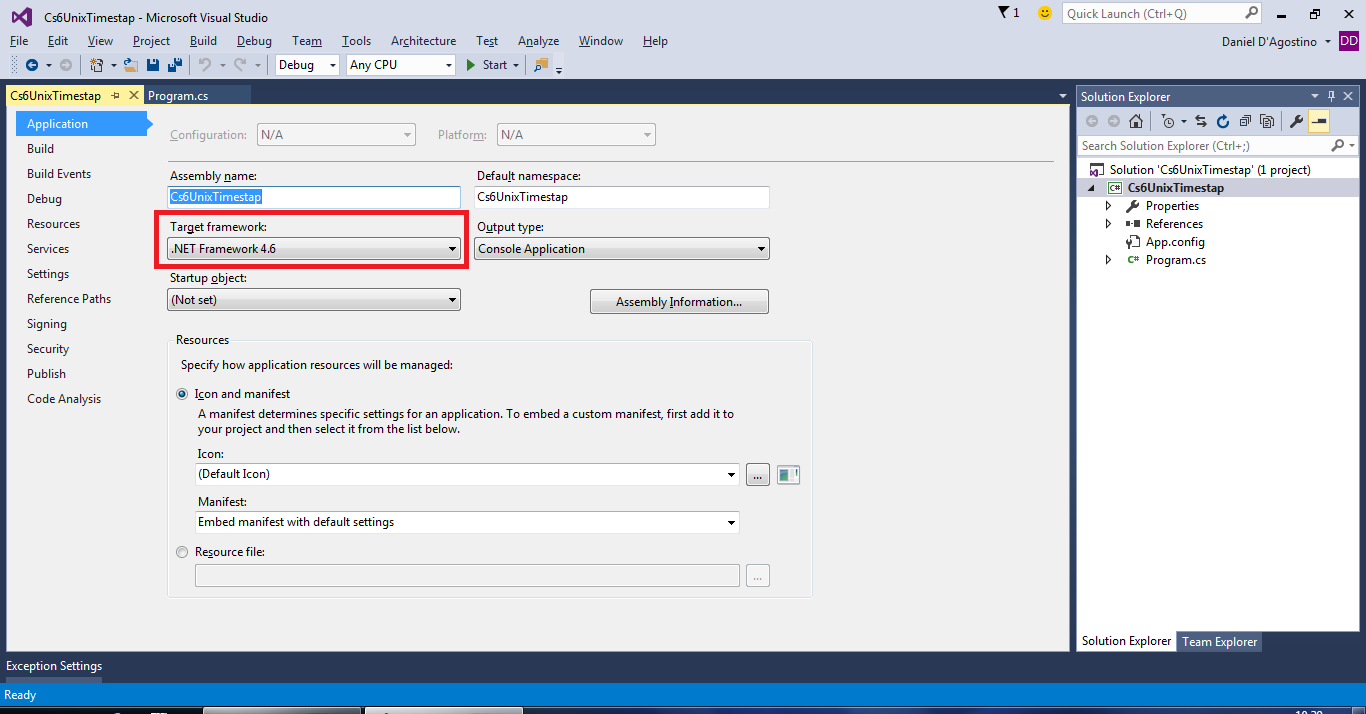
csunixtime-frameworkversion

you can then use the new methods:

var datetime = new datetime(2015, 05, 24, 10, 2, 0, datetimekind.local);
            var datetimeoffset = new datetimeoffset(datetime);
            var unixdatetime = datetimeoffset.tounixtimeseconds();

…and to change back…

var localdatetimeoffset = datetimeoffset.fromunixtimeseconds(unixdatetime)
        .datetime.tolocaltime();
Cross platform .NET Framework Convert (command) Release (computing) Redis (company)

Published at DZone with permission of Daniel D'agostino. See the original article here.

Opinions expressed by DZone contributors are their own.

Related

  • .NET Aspire: Building Cloud-Native Applications
  • A Comprehensive Guide To Migrating from .NET Framework to .NET Core
  • Exploring ML.NET Catalogs and Use Cases
  • Converting Multi-Frame TIFF to GIF in Cross-Platform .NET Environments

Partner Resources

×

Comments

Loading comments

The comments didn't load

Please try again in a moment.

Likes

Loading

The next likes didn't load. Please try again.

The likes didn't load

Please try again in a moment.

See who liked this

Log in or join DZone for free to see who liked this article.

Log in Join for free
  • RSS
  • X
  • Facebook

ABOUT US

  • About DZone
  • Support and feedback
  • Community research

ADVERTISE

  • Advertise with DZone

CONTRIBUTE ON DZONE

  • Article Submission Guidelines
  • Become a Contributor
  • Core Program
  • Visit the Writers' Zone

LEGAL

  • Terms of Service
  • Privacy Policy

CONTACT US

  • 3343 Perimeter Hill Drive
  • Suite 215
  • Nashville, TN 37211
  • [email protected]

Let's be friends:

  • RSS
  • X
  • Facebook