

Data Governance for the Agentic Era
This article explores how modern data governance and AI-ready architecture help enterprises manage data quality, risk, compliance, and AI at scale.
 CORE
·
CORE
·
 ·
·
Join the DZone community and get the full member experience.
Join For FreeThe modern enterprise generates and consumes unprecedented volumes of data across operational systems, customer interactions, partner ecosystems, cloud applications, IoT devices, and AI platforms. At the same time, AI systems are becoming major consumers of enterprise data, making decisions, generating content, recommending actions, and automating workflows.
Poor data quality is no longer just a reporting issue; it is also an AI issue. Inaccurate, incomplete, or poorly governed data can produce biased outcomes, regulatory violations, AI hallucinations, and flawed business decisions.
Traditional data governance programs were primarily designed to support business intelligence and regulatory compliance. However, the AI era introduces new requirements around model governance, explainability, lineage, ethical AI, data observability, and autonomous decision-making. Organizations must therefore evolve toward a unified data and AI governance model that ensures data can be trusted not only by humans but also by machines.
Poor data governance can result in hallucinating AI systems, biased model outcomes, regulatory violations, security breaches, increased operational costs, customer trust erosion, and incorrect business decisions.
Data governance has therefore evolved from a compliance function into a strategic business capability. Enterprises that establish trusted, governed, and accessible data foundations will be better positioned to scale AI initiatives, accelerate innovation, and create sustainable competitive advantages.
The basic objectives of data governance are:
- Enhance the agility of data-informed business decisions
- Facilitate seamless knowledge sharing across the enterprise
- Eliminate ambiguity and foster trust in data assets
- Increase data trust, better decision-making, and faster innovation cycles
- Improve compliance posture, reduce data duplication, and increase business agility
To fully comprehend these objectives, it is essential to first recognize the critical role that data governance plays within an enterprise's broader data management strategy.
This white paper explores the challenges, next-generation data capabilities, modern data architecture, and strategic considerations required to build an AI-ready data foundation.
Industry Trends of Data Governance
According to Gartner, “Any organization in any industry, especially those with very large amounts of data, can use AI for business value.”
According to Statista, by 2027 the global market for big data will be worth $103 billion.
According to Gartner, 60% of organizations will fail to realize the value of their AI initiatives due to weak data governance frameworks.
By 2028, enterprises will increasingly adopt autonomous, AI‑driven governance systems capable of automated policy enforcement, continuous data quality scoring, and real‑time anomaly detection. Gartner forecasts that AI‑driven automation will reduce manual data stewardship tasks by 40% by 2027.
Governance models will shift from centralized to federated and hybrid, ultimately evolving toward autonomous domain‑driven governance. Gartner reports that over 60% of enterprises will adopt federated governance by 2027. The rise of AI‑augmented data mesh as a dominant architecture by 2028 (Thoughtworks).
AI Trust, Risk, and Security (AI TRiSM) will become the top governance investment area as organizations confront risks related to hallucinations, bias, and regulatory compliance. Gartner predicts that enterprises implementing AI TRiSM will reduce AI‑related risk incidents by 50% by 2026.
With the rapid expansion of IoT, 5G, and edge AI, governance must operate in real time. IDC estimates that 30% of enterprise data will be processed at the edge by 2027.
AI platforms will embed governance natively, enabling governed prompt engineering, model access, and data contracts. Gartner predicts that 75% of AI platforms will include built‑in governance controls by 2027. Databricks Mosaic AI, Snowflake Cortex, and Microsoft Azure AI’s Responsible AI Dashboard exemplify this trend.
Synthetic data will become a regulated and essential component of AI training. Gartner projects that synthetic data will overshadow real data in AI training by 2030. McKinsey estimates that 50% of AI training datasets will include synthetic data by 2028.
Global regulations will mandate transparency, lineage, and automated audits. Gartner states that regulatory pressure will be the top driver of data governance investments through 2030.
Data contracts will replace traditional API documentation, enforcing schema, SLAs, lineage, and quality. Gartner predicts that data contracts will reduce integration failures by 40% by 2027.
Challenges in Data Governance
As enterprises expand into multi-cloud environments and increasingly adopt generative AI, governance challenges continue to multiply. The most common data governance challenges faced by enterprises today are,
- Data explosion: Data exists across multiple, diverse systems throughout the enterprise. Data is spread across structured data, semi-structured data, unstructured content, streaming data, IoT telemetry, computer vision assets, agent-generated content, and AI-generated outputs. Traditional governance frameworks often lack the scalability and automation required to manage such diversity.
- Data silos: Data is segmented across various platforms, channels, tools, and business units, making it challenging to access across the enterprise. Most data resides across ERP systems, CRM platforms, legacy applications, cloud-native platforms, data warehouses, data lakes, and SaaS applications. This leads to inefficiency, data duplication, and data inconsistency.
- Data accuracy, completeness, and timeliness: Ensuring data accuracy, completeness, and timeliness remains a challenge.
- Data quality: Poor oversight of the quality of data coming into an enterprise, as well as its usage throughout the organization, can lead to poor data quality. Common quality challenges include missing values, duplicate records, outdated information, inconsistent definitions, incomplete lineage, and data drift.
- Regulatory complexity: Managing regulatory compliance, data security, and data privacy presents significant challenges. Enterprises must comply with GDPR, HIPAA, CCPA, PCI-DSS, the EU AI Act, and industry-specific regulations.
- Data management: Poor data management strategies can result in an enormous amount of data in a completely unmanageable format.
- Data leakage: Sensitive business information or customer data may be exposed or leaked, leading to misuse. Unsecured data originating from different data sources can lead to data breaches.
- AI-specific risks: New AI-era governance concerns include algorithmic bias, explainability requirements, training data provenance, prompt governance, LLM hallucinations, and autonomous agent controls.
Next Generation Data Capabilities
Governance alone does not create value. Enterprises need enterprise data capabilities that make governance operational while enabling innovation and AI adoption. Modern data ecosystems require intelligent platforms capable of discovering, understanding, protecting, and serving data on a scale.
- Data processing techniques: Unstructured processing covers entity extraction, concept extraction, sentiment analysis, NLP, ontology, etc. To automate portions of the extraction process, Machine Learning techniques are leveraged.
- Data intelligent platform: It enables natural language queries, AI-powered recommendations, intelligent search, and context-aware discovery.
- Data products: Data products provide ownership, accountability, defined SLAs, reusability, and business value measurement.
- On-demand data services: Provide virtualized access to data across the enterprise through way of composable on-demand data services for both online and offline use. It should provide the ability to query in a federated fashion for both online and offline access.
- Intelligent metadata management: Digital throws data into enterprise systems at a rate that doesn’t allow SMEs to look at data structures and extract metadata. Automated metadata extraction based on ontology is critical. Modern metadata platforms provide automated discovery, classification, catalog generation, lineage tracking, and semantic enrichment.
- Data fabric: It provides unified data access, cross-platform integration, federated governance, and policy automation.
- Data mesh: It enables domain ownership, distributed accountability, product-centric thinking, and decentralized governance.
- Data observability: It focuses on data health monitoring, pipeline performance, anomaly detection, drift identification, and SLA compliance.
- Real-time analytics: Multi-channel applications and decision management systems are used to capture interactions for digital processes in real-time scenarios.
- Data archival: Compliance and performance requirements drive the need for archival of both structured and unstructured data.
Principles of Data Governance
Architecture principles provide a baseline for decision-making across the enterprise. To guide implementation, enterprise data governance principles are categorized into three strategic domains: Value and ownership, security, privacy and ethics, and architecture and quality.
Value and Ownership
- Data as an asset: Data is an enterprise asset with specific, measurable value to the enterprise and must be managed accordingly.
- Data is shared: Users have access to the data necessary to perform their duties; therefore, data is shared across enterprise functions and business units.
- Data stewardship: Governance structure must define the owner and those accountable for data-related decisions that are cross-functional. Define the personnel accountable for leadership activities and assign responsibilities to individual contributors or groups of data handlers.
- Data trustee: Each data element has an assigned trustee accountable for its quality, lifecycle, and compliance.
Security, Privacy & Ethics Principles
- Data security: Data is protected from unauthorized use and disclosure.
- Data privacy: Privacy and data protection are considered throughout the entire life cycle of the data. All data sharing will conform to relevant regulatory and business requirements
- Data integrity: Each party to data must be aware of, and abide by, their responsibilities regarding the provision of source data and the obligation to establish and maintain adequate controls over the use of personal or other sensitive data.
- Data transparency: Governance decisions, policies, and lineage must be transparently documented and clearly communicated across the enterprise. All data-related decisions must be explained clearly to all personnel how, when, and why they are introduced.
Architecture & Quality Principles
- Common vocabulary and data definitions: Data definitions are consistent across the enterprise and understandable to all users.
- Fit for purpose: Next-generation information ecosystem needs to have fit-for-purpose tools, as no one technology will satisfy all the workloads and processing techniques - E.g., Text Processing, Data Discovery, Dynamic Data Services, High-Performance Analysis, Streaming Analytics, etc.
- Data metrics: Critical Data Elements (CDEs) of the Business are managed through a lifecycle-oriented data governance process to ensure data quality, with clear metrics and dashboards. As data will reside in many repositories, integrated metadata lineage and PII protection are important.
Key Components of Data Governance
In the modern era, data management covers both technical requirements and strategic assets for businesses. Efficient data management Strategies help enterprises make informed decisions, improve customer experiences, and drive innovation.
Data governance covers the automation of policies, guidelines, principles, and standards for managing data assets. It ensures data quality, accuracy, and compliance with regulatory requirements, building trust in the data. Data governance must be aligned with EA Governance at the enterprise level to realize the business objectives.
Some of the open-source data governance tools are Amundsen, DataHub, Apache Atlas, Magda, Open Metadata, Egeria, and TrueData. These tools offer features like Metadata Management, Data Cataloging, and Collaboration to manage data assets effectively.
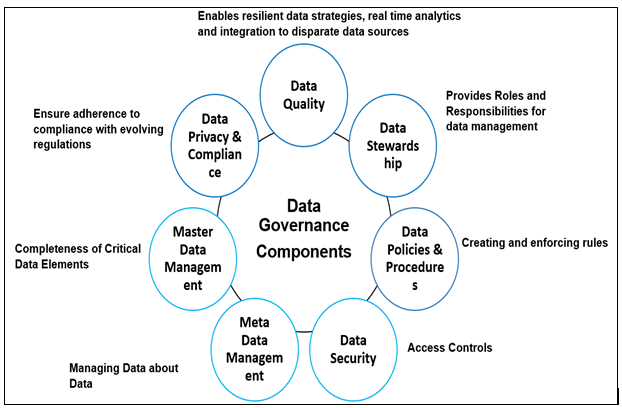
The major components of data governance are:
- Data quality
- Data stewardship
- Data policies and procedures
- Data security
- Metadata management
- Master data management
- Data storage
- Data privacy and compliance
- Data metrics
The following figure depicts the key components of data governance:
Data Quality
It helps ensure the accuracy, completeness, and consistency of data. Data quality management involves identifying and correcting errors, standardizing formats, and maintaining a high level of data integrity.
Some of the top open-source data quality tools are: Cucumber, Deequ, dbt Core, MobyDQ, Great Expectations, and Soda Core. These tools help automate data validation, data cleaning, and monitoring.
Data Stewardship
It is about assigning roles and responsibilities related to data management. Data stewards are designated individuals or teams entrusted with overseeing the appropriate use, integrity, and secure storage of enterprise data. They serve as a vital bridge between IT and business units, ensuring that data conforms to the enterprise’s established quality and consistency standards. Key responsibilities include defining and standardizing data elements, monitoring data quality, and collaborating with IT to resolve any technical challenges.
Other key data roles are:
- Chief data officers (CDOs) lead the data strategy, ensuring data is treated as a valuable business asset. Their goal is to drive executive investment in data compliance, risk reduction, and value creation as data becomes a trusted driver of business outcomes.
- Data protection officers (DPOs) ensure organizational compliance with data privacy laws like GDPR and CCPA. They oversee the protection of personal data, such as that of customers or suppliers, processed during daily operations. DPOs must have direct access to senior leadership to fulfill regulatory requirements.
- Data architects design robust yet flexible data foundations that empower users to manage and enhance their own datasets. They ensure data is meaningful, business-driven, and aligned with organizational goals. Their priorities often reflect measurable business outcomes.
- Data engineers and developers design and maintain data pipelines, ensuring data quality and flow across complex systems. They aim to empower business users while managing access, security, and data product governance.
- Data scientists extract value from data pipelines to deliver actionable insights. They solve complex problems using statistics, mathematics, and computer science. Their expertise often includes data mining and predictive analytics.
- Business analysts identify trends, assess risks, and gauge business performance using BI tools like Tableau, Power BI, and Looker. They extract trusted insights from data pipelines and present them through clear, actionable dashboards.
Data Policies and Procedures
It establishes and enforces policies for how data is collected, stored, shared, and used. As enterprise central data management,
- Prescribes permitted and prohibited practices at every stage of the data lifecycle
- Ensures compliance with internal standards and external regulations
- Assigns accountability for data stewardship and risk mitigation
- Aligns day-to-day data handling with strategic business objectives
Data Security
Establishing proper security protocols helps in reducing the risk of data breaches and threats. It also safeguards sensitive information. Implementation of Encryption, access controls, authentication, and intrusion detection systems helps in protecting data across the lifecycle.
Top open-source data security tools that are widely used include: Metasploit, OSSEC, OpenVAS, Snort, KeePass, ClamAV. These tools can be integrated into various security strategies to protect against a wide range of cyber threats.
Metadata Management
It helps in keeping track of data definitions, relationships, and structures. It’s essentially data about data. Metadata functions as the contextual glue that transforms isolated data points into coherent, actionable assets. It captures essential attributes covering:
- Creation timestamp
- Authorship and ownership
- Source provenance
- Relationships to other data elements
Metadata strategy should:
- Adopt a centralized metadata catalog (e.g., Apache Atlas, Collibra)
- Automate metadata harvesting and lineage tracking
- Integrate metadata-driven data quality checks into your pipelines
- Establish governance policies for metadata stewardship and versioning
- Monitor metadata KPIs like catalog adoption rate and lineage coverage to drive continuous improvement
Leading open-source metadata management tools are Apache Atlas, Amundsen, Metacat Data Catalog, Open Metadata, and Marquez.
Master Data Management
Master data management is a process for ensuring the accuracy, consistency, and completeness of critical data elements, such as customer data and product data, etc. master data is standardized, matched, merged, enriched, and validated according to governance rules.
Some of the open-source key players in the MDM area are Talend Open Studio for MDM, AtroCore, and Pimcore.
Data Storage
It helps determine where and how data will be stored within the enterprise data repository. It covers both structured and unstructured data sources, which include databases, data warehouses, and data lakes. The factors that determine data storage are Performance, scalability, and data retrieval requirements.
Some of the key open-source players in the data storage area are Hadoop, LakeFS, Cassandra, and Neo4j. These tools provide scalability, robustness, and performance in managing large data and analyzing large datasets in various applications.
Data Privacy and Compliance
It ensures adherence to regulations and ethical considerations. Privacy implements controls to prevent unauthorized access and provides control over individuals' personal data.
Regulatory frameworks such as the European Union’s General Data Protection Regulation (GDPR) and California’s Consumer Privacy Act (CCPA) impose stringent requirements on how businesses collect, process, and safeguard personal data.
Data Metrics Management
Defining and implementing robust business metrics and key performance indicators (KPIs) to quantify the enterprise-wide impact of data governance is critical to its success. These measures should be clearly articulated, inherently quantifiable, tracked longitudinally, and applied each year consistently to ensure comparability, accountability, and continuous improvement. Some of the metrics monitoring activities are,
- Aligning KPIs to strategic goals (e.g., data-quality gains, reduced time-to-insight, compliance rates, cost savings)
- Leveraging real-time dashboards for ongoing visibility
- Conducting annual KPI reviews to recalibrate targets and processes as the organization evolves
Modern Data Architecture for AI
A modern data architecture provides capabilities necessary for analytics, machine learning, generative AI, and autonomous systems. It enables enterprises to manage data as a strategic asset while ensuring governance, security, and scalability. The architecture is a unified, governed, AI-ready data foundation that enables trusted insights, intelligent automation, and autonomous decision-making through reusable data products, continuous observability, and embedded governance controls.
The architecture is organized into two structural categories. The first five layers form the primary pipeline, the path data travels, from the moment it is created in a source system to the moment it produces a business outcome.
The remaining three layers are cross-cutting disciplines that are applied continuously, at every stage, from ingestion through consumption. A modern AI-ready data architecture provides the infrastructure necessary for analytics, machine learning, generative AI, and autonomous systems. It enables organizations to manage data as a strategic asset while ensuring governance, security, and scalability.
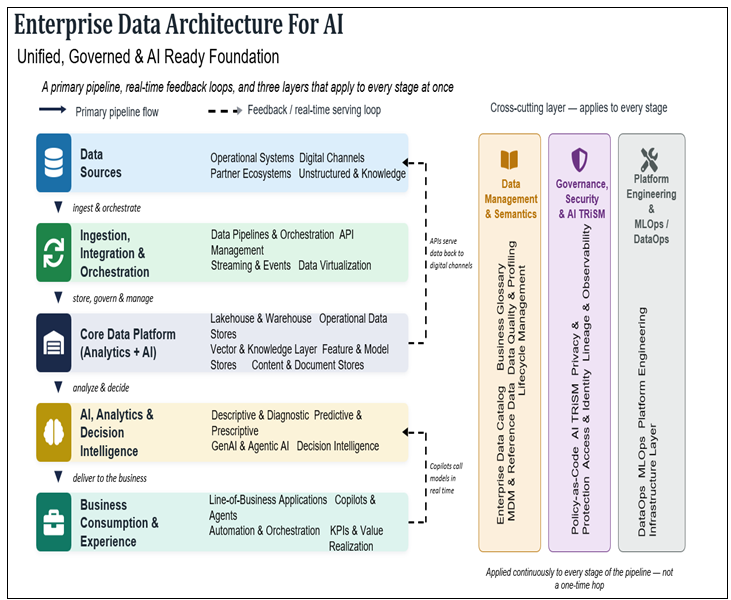
Figure 2: Enterprise Data Architecture For AI
Data Sources
This layer represents the full surface area of enterprise data — every system, channel, partner relationship, and unstructured artifact that generates information the organization can use. This layer groups the ecosystem into four major categories:
- Operational systems: The systems of record that run the business day-to-day: ERP, CRM, domain platforms, billing, and HR, etc. These remain the backbone of structured, transactional data.
- Digital channels: Web, mobile, API, and customer portal through which customers and employees interact directly with the enterprise. These channels are not purely a source; they also receive personalized or real-time data back through APIs.
- Partner ecosystems: B2B integrations, data exchanges, and marketplaces that bring external, third-party data into the enterprise's view.
- Unstructured and knowledge: Documents, email, video, knowledge bases, and ontologies. This category has grown in strategic importance because it is precisely the content that large language models and retrieval-augmented generation (RAG) pipelines depend on.
Ingestion, Integration, and Orchestration
This helps to move data from source into the platform reliably, securely, and in the right cadence, like batch, streaming, or on-demand. This layer comprises four capability areas,
- Data pipelines and orchestration: Engines that sequence and monitor data movement, paired with pipeline observability so failures and delays are visible before they become business problems.
- API management: Gateways, throttling, versioning, and security policy enforcement for every API-based integration, ensuring that data movement through APIs is controlled rather than ad hoc.
- Streaming and events: Event hubs and pub/sub infrastructure (e.g., Kafka-style platforms) that support event-driven integration for use cases where near-real-time movement is required.
- Data virtualization: Query federation that lets consumers query across multiple heterogeneous stores without first physically consolidating the data, reducing duplication and latency for enterprise usage.
Core Data Platform (Analytics + AI)
This is the heart of the architecture that acts as an AI-ready layer. It provides a unified storage and serving layer. This is the place where data lives and is made available for both traditional analytics and AI workloads from a single, governed foundation.
- Lakehouse and warehouse: It combines the flexibility of a data lake with the performance and semantic structure of a warehouse, including reusable semantic models that give consistent business meaning to raw tables.
- Operational data stores (ODS): Supports near-real-time reporting for use cases that cannot wait for a batch cycle.
- Vector and knowledge layer: Vector databases and ontologies that power agentic AI and semantic search are foundational to GenAI.
- Feature and model stores: Reusable features, a model registry, and model artifact storage, enabling machine learning models to be built, versioned, and reused consistently rather than recreated per project.
- Content and document stores: A repository that supports GenAI applications operating directly over enterprise content (contracts, policies, knowledge articles).
AI, Analytics, and Decision Intelligence
In this layer, the governed data is converted into insight, prediction, and increasingly autonomous action.
- Descriptive and diagnostic: BI, dashboards, and self-service analytics
- Predictive and prescriptive: Machine learning models, optimization, and simulation
- GenAI and agentic AI: Copilots, task-oriented agents, and RAG pipelines that generate content to take bounded actions on the enterprise's own data
- Decision intelligence: Composite decision flows that blend rules engines, analytics, and AI models into a single decision path
Data Management and Semantics Layer
Makes data trustworthy, findable, and consistently defined. This is applied continuously across every stage of the pipeline rather than as a single processing step.
- Enterprise data catalog: Technical and business metadata plus a data marketplace, such that stakeholders and systems can discover what data exists and what it means.
- Business glossary: Shared definitions, metrics, and domain vocabularies that prevent the classic problem of different business units calculating "revenue" or "active customer" differently.
- MDM and reference data: Golden records for core entities such as provider or product, eliminating duplication and conflicting versions of the truth.
- Data quality and profiling: Rules, scoring, and remediation workflows that continuously monitor and improve data fitness for use.
- Lifecycle management: Retention, archival, tiering, and deletion policies that keep the data estate compliant and cost-efficient over time.
Agentic AI Governance, Security, and AI TRiSM
Protects data and models with policy, privacy, identity, and full traceability.
- Policy-as-Code: Codified policies that are enforced programmatically rather than documented
- Least-privilege tool scope: Agents should operate with scoped function definitions rather than open-ended enterprise API access. Tools exposed to agents must enforce fine-grained parameter constraints
- AI TRiSM (Trust, Risk, and Security Management): Model risk assessment, explainability, fairness testing, and ongoing monitoring, addressing the risks introduced by AI/ML models
- Identity delegation and impersonation: Enterprise agents must pass user identity context (OAuth 2.0 Token Exchange/On-Behalf-Of flow) down to underlying APIs. The agent must never inherit broader database permissions than the initiating user.
- Privacy and protection: PII/PHI classification, masking, and tokenization to limit exposure of sensitive data.
- Access and identity: RBAC/ABAC, fine-grained entitlements, and a Zero Trust posture, ensuring access is granted on a least-privilege basis
- Lineage and observability: End-to-end lineage across data, models, and prompts
- Prompt/Context provenance and non-determinism audit: Every dynamic branch decision made by an agent must log its inputs, system prompts, retrieved context chunks, and seed parameters. This ensures that non-deterministic outputs can be audited post-hoc for compliance, debugging, and root-cause analysis during hallucinations or incorrect tool dispatches.
- Lineage granularity for vector and RAG workflows: Lineage models must extend beyond tabular source-to-target paths to map vector embedding lineage, tracing an agent’s final action back through the vector search embeddings, semantic chunking boundaries, and original unstructured document versions.
Platform Engineering and MLOps/DataOps
Dedicated engineering discipline.
- DataOps: CI/CD for data pipelines, including automated testing and deployment, bringing software-engineering rigor to pipeline changes.
- MLOps: CI/CD for models, including drift detection and automated retraining, so model performance is managed as an ongoing operational concern rather than a one-time deployment event.
- Platform engineering: Self-service portals, templates, and guardrails that let data and AI teams provision what they need quickly while staying within approved patterns.
- Infrastructure layer: Serverless compute, storage tiering, and cost management, ensuring the platform scales economically as usage grows.
Business Consumption and Experience
In this layer, the value is realized. The components and agents in this layer call back into the AI/Analytics layer in real time to inform what gets built upstream.
- Line-of-business applications: Domain applications, operations tooling, and customer service platforms through which employees and customers experience the business
- Copilots and agents: Embedded copilots and agents inside applications and communication channels
- Automation and orchestration: Business process management (BPM), robotic process automation (RPA), and event-driven automation that act on insight without requiring manual intervention
- KPIs and value realization: OKRs, business outcome tracking, and benefit tracking that close the loop, measuring whether the solution is delivering value
Benefits of Data Governance
Enterprises with mature governance capabilities experience higher AI model accuracy, increased data trust, better decision-making, faster innovation cycles, improved compliance posture, reduced data duplication, and greater business agility. It also helps in:
- Ensuring consistent, uniform data across the enterprise, empowering smarter, more comprehensive decision support
- Establishing data integrity, data accuracy, completeness, trustworthiness, and dependability to achieve higher quality business decisions
- Helping teams gain comprehensive decision support by enabling strong governance across the enterprise
- Defining clear protocols for evolving data workflows; data governance helps in establishing agility and scalability for both the business and IT
- Reducing duplication of effort and improving productivity
- Making better-informed decisions with accurate and reliable data
- Increasing efficiency by introducing the ability to reuse data and data processes
- Lowering the expenses of data management by implementing centralized control mechanisms and reducing the risk of data breaches
- Reducing the volume of data collected and retained, optimizing data storage, and improving data management practices
- Enhancing trust in the accuracy of data and the documentation of data-related procedures
- Ensuring adherence to data regulations and supporting compliance with the EU’s GDPR, California Consumer Privacy Act (CCPA), Health Insurance Portability and Accountability Act (HIPAA), and the Payment Card Industry Data Security Standard (PCI-DSS)
Conclusion
Data governance is not a one-time activity, but it’s a journey. It is not optional but mandatory. It enables insight generation and informed decision-making. Effective data governance is a collection of processes, people, policies, standards, and metrics that ensure the efficient and effective use of data, enabling an enterprise to achieve its goals. It helps streamline operations, minimize data risks, enhance decision-making, drive innovation, create data policies, maximize data usage, and improve business efficiency and competitiveness.
The modern AI data architecture is a unified, governed, and AI-ready foundation that turns enterprise data into trusted decisions and measurable business outcomes, with governance and AI risk management built in from the first byte rather than added at the end.
By implementing data governance best practices, enterprises can ensure that they are managing their data to maximize its value.
Acknowledgements
The authors would like to thank Tricon Solutions LLC and Gspann Technologies, Inc for giving the required time and support in many ways in bringing up this article.
Disclaimer
The views expressed in this article/presentation are those of the authors, and Tricon Solutions LLC and Gspann Technologies, Inc. do not subscribe to the substance, veracity, or truthfulness of the said opinion.
Opinions expressed by DZone contributors are their own.
Comments