

Data Mesh Security: How to Protect Decentralized Data Architectures
Data mesh decentralizes data ownership, creating new security gaps. This guide covers zero trust, federated governance, and observability to secure modern architectures.
Join the DZone community and get the full member experience.
Join For FreeThe rise of data mesh architectures redefines how modern organizations have approached the concept of data security. Standard best practices dictate that data should be centralized, allowing it to be collected, stored, and governed within monolithic systems, such as data warehouses. enabled centralized access control, governance, and 'auditability'. The data mesh model, however, disrupts this architecture and decentralizes data ownership.
Now, instead of a centralized team governing data access, data mesh empowers domain-oriented teams to treat data as a product, allowing them to manage it independently. While this new approach offers speed and flexibility, it also introduces serious data mesh security challenges.
In this article, we examine these architectures and their associated security implications. We also discuss practical tools and techniques that help organizations secure these architectures without sacrificing the speed and flexibility they bring.
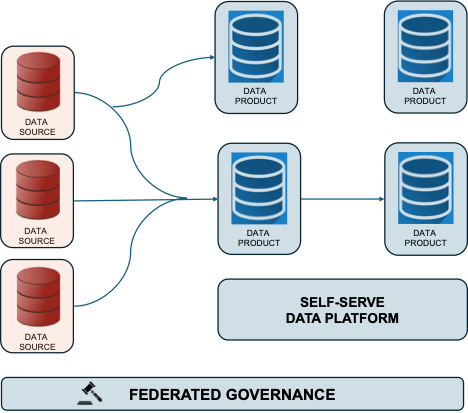
Decentralized data architecture with federated governance
How Data Mesh Changes the Security Paradigm
Data mesh is a decentralized approach to data architecture that treats data as a product and assigns ownership of data to cross-functional domain teams. Unlike centralized data platforms, data mesh distributes responsibility for data storage, governance, and security across the organization.
While traditional data architectures lend themselves towards centralized access models, making them easier to monitor and govern, data mesh completely changes this paradigm. We now have independent data teams responsible for their respective domains and access rules.
This decentralized data model leads to several new types of data security requirements, such as:
- Federated access control: Each domain must enforce its access controls while integrating with a broader enterprise identity framework.
- Data lineage and provenance: Cybersecurity teams must have visibility into how data moves and transforms across domains, as it is critical for security, auditability, and trust.
- Governance without bottlenecks: Security governance must adapt to decentralized models without becoming a roadblock to innovation and speed.
Security Challenges in Data Mesh Architectures
Now that we have a firm understanding of the data mesh, let us look at some of the key challenges:
1. Distributed Authentication and Authorization
In a data mesh, each domain is its own publisher of data products. Each product needs controls over who can discover, access, or modify data. But without a unified access model, inconsistent policies may emerge. This may lead to fragmented access policies across domains, overly permissive roles, or misconfigured permissions, and difficulties in auditing who accessed what data and why
2. Lack of End-to-End Data Lineage
As data flows between multiple teams and environments, tracking its origin and transformation becomes increasingly difficult. This can lead to limited visibility into data provenance, incomplete audit trails, and a greater risk of data corruption or tampering going unnoticed
3. Inconsistent Data Governance
When domains own their data governance models, there’s a risk of inconsistent policies for classification, retention, masking, or encryption. This may potentially lead to regulatory non-compliance, regulated data being exposed, and an overall misalignment with enterprise policies
4. Data Product Security
In a data mesh architecture, data products are the most valuable asset, but their security is often overlooked in the rush to make data discoverable and useful. Teams may rush to release data products to business teams with insecure APIs, a lack of security controls, and no visibility into their usage.
Best Practices for Securing Data Mesh Architectures
Centralized access models are no longer applicable within a data mesh environment, and cybersecurity teams must utilize architecture patterns that can operate effectively in distributed and domain-owned environments.
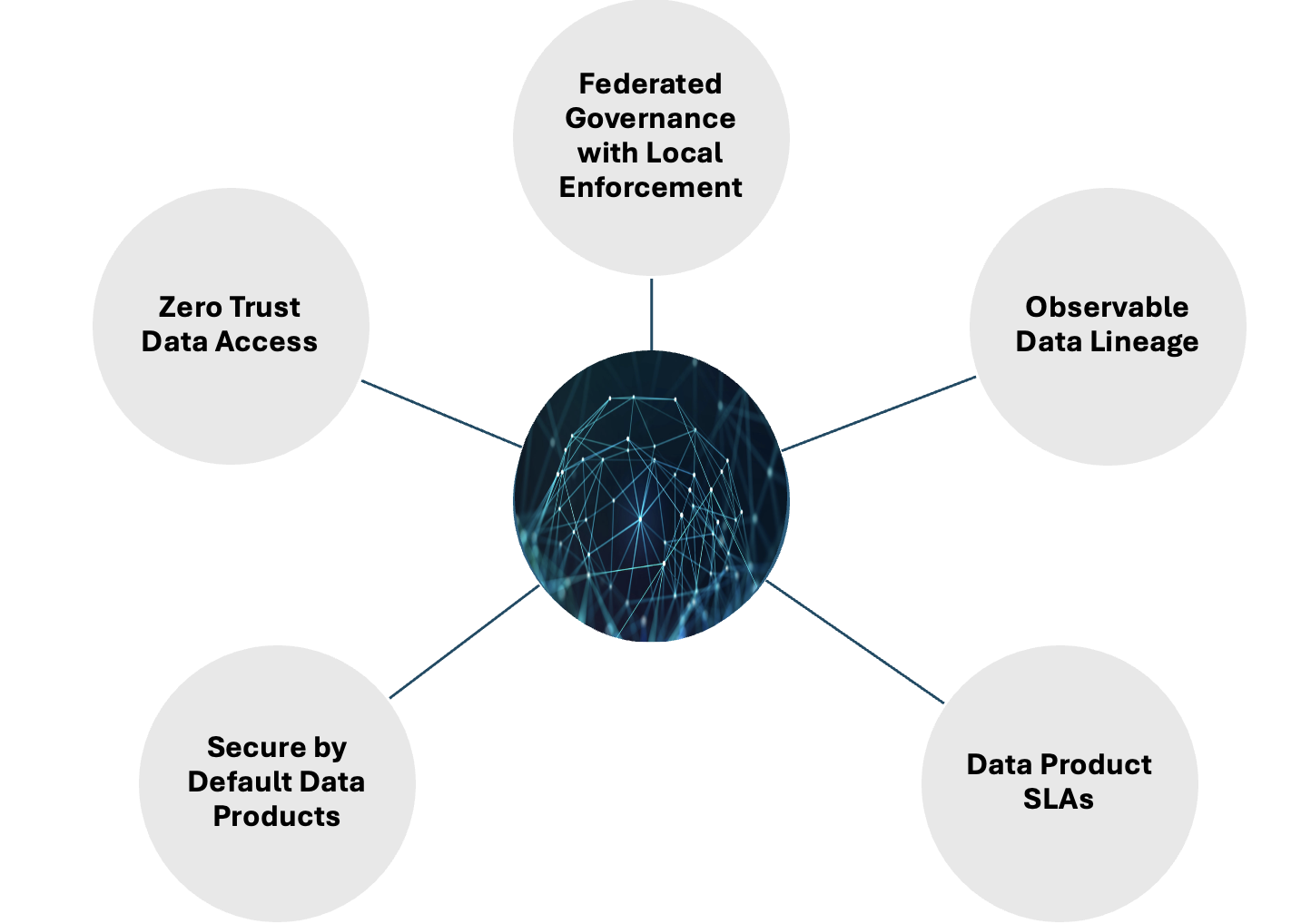
Some of the key design controls to keep in mind are:
1. Federated Governance With Local Enforcement
Global security and compliance standards should be defined centrally but enforced locally within each domain. Policy-as-code tools allow domain teams to encode these requirements directly into infrastructure, promoting compliance without blocking the speed at which data products are delivered.
2. Zero Trust Data Access
Zero Trust security models are uniquely suited for a data mesh architecture due to their principle of assuming a breach from the outset. Access to data products should be granted based on user identity, device posture, and contextual factors, not relying on network location. Integrating identity providers and dynamic authorization engines enables robust, context-aware access control.
3. Observable Data Lineage
Complete visibility into how data is produced, transformed, and consumed is essential for a secure data mesh architecture. Integrating observability at each pipeline stage enables the tracking of changes, identification of anomalies, and maintenance of compliance through immutable audit trails.
4. Secure by Default Data Products
Cybersecurity teams must ensure that every data product comes with pre-configured security controls, such as field-level encryption, access policies, and schema validation, to protect sensitive data. Infrastructure templates can enforce baseline protections automatically during creation and modification.
5. Data Product SLAs
Security must be part of each data product’s contract. This includes clearly defined Service Level Agreements (SLAs) and Service Level Objectives (SLOs) that cover encryption protocols, retention periods, availability targets, and incident escalation paths. This helps promote security as a shared obligation and responsibility between teams, rather than a blocker.
Essential Tools for Data Mesh Security and Governance
The patterns we discussed in the previous section require a set of integrated capabilities and tools to be implemented effectively.
Key tools include:
- Identity and access management (IAM): IAM enables federated login and role-based or attribute-based authorization across domains. These tools help establish least-privilege access by integrating with enterprise identity systems.
- Policy-as-code engines: These allow centralized policies to be enforced programmatically across different environments. This, in turn, supports compliance and consistency at scale.
- Metadata and lineage tracking: Provide traceability across data transformations and enable auditability. These tools help identify where the data came from, how it changed, and who accessed it
- Data catalog services: These services centralize metadata about data products, helping cybersecurity teams in the classification, tagging, and labeling of distributed data.
- Observability platforms: Monitor the performance, reliability, and security of data pipelines to ensure optimal operation and ensure optimal performance. These platforms flag anomalies, track usage, and help enforce server-level agreements (SLAs).
- Privacy and anonymization frameworks: Implement techniques such as tokenization, masking, and differential privacy to protect sensitive data and support compliance with regulations like GDPR and HIPAA.
Securing the Future of Data Mesh: What Comes Next
Data mesh offers a transformative way to scale data infrastructure, but with this agility comes a heightened need for security control and maturity. Cybersecurity teams must embed themselves into the data mesh transformation early, helping domain teams balance innovation with risk. A successful security strategy in data mesh combines centralized standards with decentralized execution, continuous observability, and a cultural shift toward "data as a secure product."
Opinions expressed by DZone contributors are their own.
Comments