

Engineering Audit-Ready Data Pipelines for Regulatory Reporting
Build traceable, audit-ready regulatory data pipelines with immutable data, reconciliation, lineage, and human approval.
 ·
Join the DZone community and get the full member experience.
Join For FreeThere's a particular kind of silence that happens on a call when a regulator asks, "Can you walk me through exactly how this number was calculated?" and the person on the other end has to say, "Let me get back to you." I've been on that call. It is not a fun place to be, and it usually isn't because anyone did anything wrong. It's because the pipeline that produced the number was never built to answer that question in the first place.
Regulatory reporting, whether it's a liquidity return, a capital calculation, or something more niche, has a strange property compared to most data engineering work. Nobody outside the team really cares how the dashboard behind it looks. What they care about is whether you can prove, months or years later, exactly where every figure came from, who touched it, and why it changed between two reporting periods. That's a fundamentally different design goal than "make the report run fast," and honestly, a lot of pipelines get built for speed and convenience first, with auditability bolted on afterward as an afterthought. It shows.
What "Audit-Ready" Actually Means in Practice
I think people sometimes hear "audit-ready" and picture some heavyweight compliance layer sitting on top of a normal pipeline. In my experience, it's less about adding a layer and more about changing a handful of default behaviors early, before the pipeline exists in production. Four things tend to matter most.
First, nothing gets overwritten. Ever. If a source record changes, you keep the old version and the new one, both timestamped. Second, every transformation step has to be reproducible from code, not from a person's memory of what they clicked in a tool three years ago. Third, there's a reconciliation point, a moment where the pipeline checks its own output against the source and either passes or stops. And fourth, a human actually looks at the number before it leaves the building. Not a dashboard glance, an actual documented sign-off with a name and a timestamp attached to it.
Here's roughly how that fits together end to end.
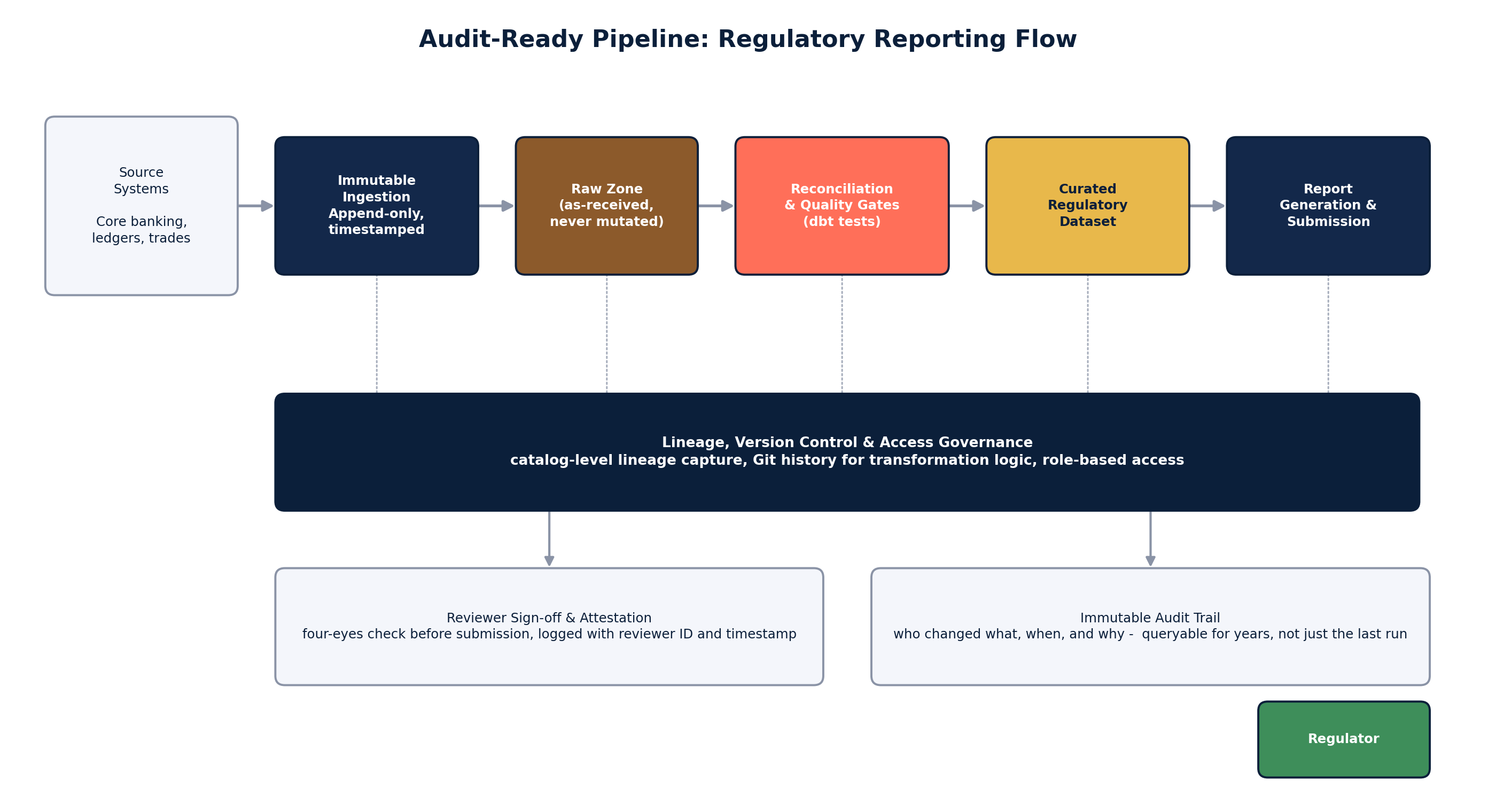
A couple of things in that picture are doing more work than they look like they are. The raw zone sitting right after ingestion, untouched and append-only, is what lets you go back eighteen months later and reconstruct exactly what the source system handed you on a given day, independent of whatever the curated tables look like now. I've genuinely had to do this, pulling raw records from a specific date to settle a dispute about whether a discrepancy came from us or from upstream. Without that raw layer, that conversation becomes a lot more uncomfortable.
The Reconciliation Step Is Where Trust Actually Gets Built
If I had to pick one part of this architecture that matters more than the rest, it's the reconciliation checkpoint. This is the moment where the pipeline stops behaving like a normal ETL job and starts behaving like a control.
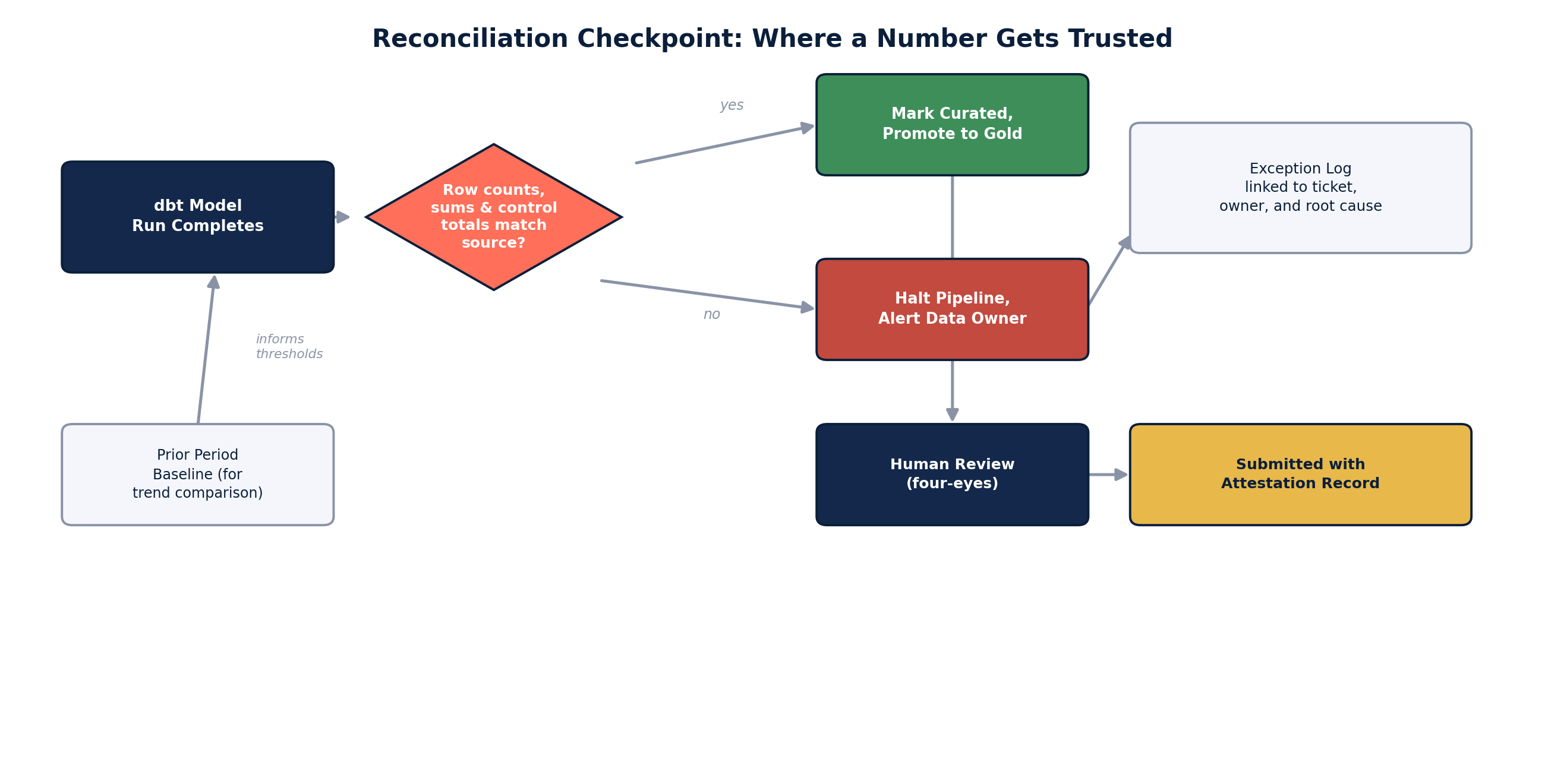
The logic itself isn't exotic. You compare row counts, sums, and control totals against the source, and you either match within tolerance or you don't. What matters is what happens on the "no" branch. A lot of pipelines I've inherited over the years treated a reconciliation break as a warning buried in a log file that nobody reads until someone complains. That's backward. A break should halt the pipeline and page someone, because a regulatory submission built on unreconciled data is worse than a late submission. I'd rather explain a delay than explain a restated figure.
I'll admit there's a tension here worth naming honestly. Hard stops on every mismatch can grind a team down if your tolerance thresholds are too tight, and you end up with alert fatigue where people start ignoring pages because most of them turn out to be rounding noise from a currency conversion. Getting the thresholds right, informed by prior period baselines rather than guessed at, takes real tuning. It's not a solved problem you configure once and forget.
Lineage and the Four-Eyes Check
The governance band running underneath the pipeline, capturing lineage and version history, is what turns "I think this is right" into "here's the exact model, the exact commit, and the exact person who approved it." On Unity Catalog or an equivalent lineage tool, this is largely automatic once you've built your transformations in something like dbt rather than scattered SQL scripts. That's honestly one of the more underrated benefits of moving regulatory pipelines onto a tool with built-in lineage tracking. You stop having to build that tracking yourself.
The human sign-off matters just as much, maybe more, even though it's the least technically interesting part of the whole design. A second person reviewing the output before submission, with their review logged, catches the kind of error that automated tests won't, like a number that's technically correct by every rule you wrote but obviously wrong to a person who understands the business context.
A Small Piece of Advice
If you're building one of these pipelines from scratch, resist the urge to treat the audit trail as something you'll add once the pipeline is "working." Retrofitting immutability and lineage onto tables that have already been overwritten a hundred times is painful, and in some cases you simply can't recover the history you needed. Build the raw, append-only layer first, even if it feels like overhead in week one. Six months later, when someone asks you to explain a number from last quarter, you'll be glad it's there.
Opinions expressed by DZone contributors are their own.
Comments