
DZone
Thanks for visiting DZone today,
Edit Profile
  • Manage Email Subscriptions
  • How to Post to DZone
  • Article Submission Guidelines
Sign Out View Profile
  • Post an Article
  • Manage My Drafts
Newsletter
Log In / Join
Refcards Trend Reports
Events Video Library
Refcards
Trend Reports

Events

View Events Video Library

Related

  • Error Handling Inside Kumologica Subflow
  • How To Use JMS ActiveMQ With Mule 4 - Part 6
  • MuleSoft Integration With RabbitMQ
  • MuleSoft APIkit Router - QueryParam and Header Strict Validation Configuration

Trending

  • Event-Driven AI Systems With Kafka and Autonomous Agents
  • Idempotency Under Concurrency: Why Your Application Check Isn't the Last Line of Defense
  • Build Software Faster With Three Simple Principles
  • Mistaking Code Production for Engineering Progress: AI Productivity Myths Part 1

Draft This article hasn't been published, so readers can't see it.

In moderation This article is waiting for review, so readers can't see it yet.

Deleted This article has been deleted, so readers can't see it.

  1. DZone
  2. Testing, Deployment, and Maintenance
  3. Testing, Tools, and Frameworks
  4. Exclude Flows and Files From MUnit Test Coverage

Exclude Flows and Files From MUnit Test Coverage

This articles explains the easiest way to exclude flows or files from MUnit Test Coverage report by adding few tags in your pom.xml.

By 
Nagaraju Kshathriya
·
Jul. 23, 20 · Tutorial
Post on X (opens in a new tab) Share on LinkedIn (opens in a new tab)
17.4K Views

Join the DZone community Save articles, join the discussion, and download Refcards and Trend Reports with a free account.

Join for free Already a member? Log in

1. Overview

In this article, we will discuss how to exclude flows and files in MUnit test. This is useful when you want to exclude unnecessary flows/files from MUnit test coverage. We also demonstrate how to run specific MUnit file or flow.

2. What Is MUnit?

MUnit is a Mule application testing framework which allows you to build automated tests for your Mule integrations and API’s. With MUnit you can mock, spy, tag processors. We will learn about these MUnit tools in next articles.
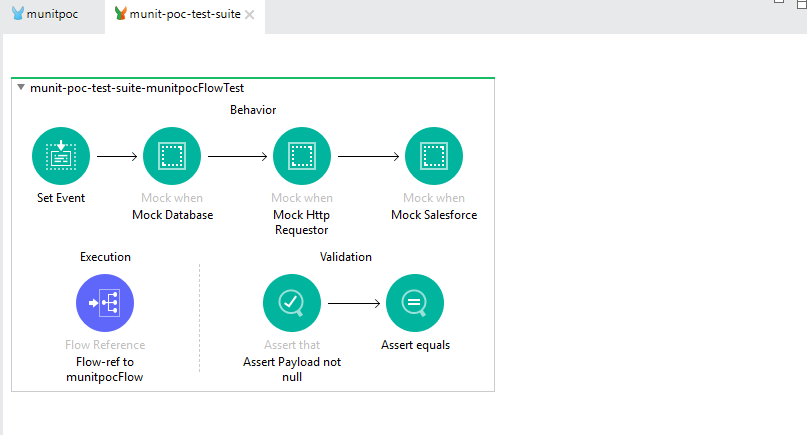
3. How to Exclude Flows and Files From MUnit Coverage?

Sometimes you may need to exclude particular files or flows from MUnit coverage. In such cases we can exclude entire file or specific flow from MUnit coverage.

Note: This will work only when you run test cases from terminal not from Anypoint Studio due to continuous integration.  

3.1 Ignore Files

Let’s see how to exclude files from MUnit coverage. To exclude files from coverage report you just need to add ignoreFiles tag in your pom file.

Plain Text


xxxxxxxxxx
1


1
<coverage>  
2
  <ignoreFiles>      <
3
     <ignoreFile>file-name.xml</ignoreFile>        
4
    <ignoreFile>file-name2.xml</ignoreFile>  
5
  </ignoreFiles> 
6
</coverage>


3.2 Ignore Flows

Let’s see how to exclude flows from MUnit coverage. To exclude files from coverage report you just need to add ignoreFlows tag in your pom file.

Plain Text


xxxxxxxxxx
1


1
<coverage>  
2
  <ignoreFlows>      <
3
     <ignoreFlow>file-name.xml</ignoreFlow>        
4
    <ignoreFlow>file-name2.xml</ignoreFlow>  
5
  </ignoreFlows> 
6
</coverage>


Make sure that the coverage tag must be included in the Mule Maven plugin configuration tag. For example: 

Plain Text


xxxxxxxxxx
1
19


1
<plugins>  
2
    <plugin>    
3
      <groupId>com.mulesoft.munit.tools</groupId>    
4
      <artifactId>munit-maven-plugin</artifactId>    
5
      <configuration>      ...      
6
         <coverage>           
7
           <ignoreFlows>      <
8
              <ignoreFlow>flow-name.xml</ignoreFlow>        
9
              <ignoreFlow>flow-name2.xml</ignoreFlow>  
10
           </ignoreFlows> 
11
           <ignoreFiles>      <
12
             <ignoreFile>file-name.xml</ignoreFile>        
13
             <ignoreFile>file-name2.xml</ignoreFile>  
14
           </ignoreFile> 
15
        </coverage>    
16
       ...    
17
    </configuration>  
18
     </plugin> 
19
</plugins>


4. Conclusion

In this short article, we have seen how to exclude files and flows from MUnit test coverage report and also demonstrated how run specific file from terminal. Stay Tuned for more MUnit articles and tips. Check out for more MuleSoft Articles.  Keep Learning!

Flow (web browser) Testing

Opinions expressed by DZone contributors are their own.

Related

  • Error Handling Inside Kumologica Subflow
  • How To Use JMS ActiveMQ With Mule 4 - Part 6
  • MuleSoft Integration With RabbitMQ
  • MuleSoft APIkit Router - QueryParam and Header Strict Validation Configuration

Partner Resources

×

Comments

Loading comments

The comments didn't load

Please try again in a moment.

Likes

Loading

The next likes didn't load. Please try again.

The likes didn't load

Please try again in a moment.

See who liked this

Log in or join DZone for free to see who liked this article.

Log in Join for free
  • RSS
  • X
  • Facebook

ABOUT US

  • About DZone
  • Support and feedback
  • Community research

ADVERTISE

  • Advertise with DZone

CONTRIBUTE ON DZONE

  • Article Submission Guidelines
  • Become a Contributor
  • Core Program
  • Visit the Writers' Zone

LEGAL

  • Terms of Service
  • Privacy Policy

CONTACT US

  • 3343 Perimeter Hill Drive
  • Suite 215
  • Nashville, TN 37211
  • [email protected]

Let's be friends:

  • RSS
  • X
  • Facebook