

Why Generative AI Needs Human Oversight to Build Trust
Generative AI is transforming industries, but Trust Calibration and human oversight are key to keeping it accurate, ethical, and reliable.
Join the DZone community and get the full member experience.
Join For FreeIn 2023, a generative AI-powered chatbot for a financial firm mistakenly gave investment advice that violated compliance regulations, triggering regulatory scrutiny. Around the same time, an AI-powered medical summary tool misrepresented patient conditions, raising serious ethical concerns.
As businesses rapidly adopt generative AI (GenAI), these incidents highlight a critical question: Can AI-generated content be trusted without human oversight?
Generative AI is reshaping industries like retail, healthcare, and finance, with 65% of organizations already using it in at least one critical function, according to a 2024 McKinsey report (McKinsey, 2024). The speed and scale of AI-driven content generation are unprecedented, but with this power comes risk. AI-generated content can be misleading, biased, or factually incorrect, leading to reputational, legal, and ethical consequences if left unchecked.
While it might be tempting to let large language models (LLMs) like GPT-4 operate autonomously, research highlights significant performance variability. A study testing GPT-4 across 27 real-world annotation tasks found that while the model performed well in structured settings, achieving precision and recall rates above 0.7, its performance dropped significantly in complex, context-dependent scenarios, sometimes falling below 0.5 (Pangakis & Wolken, 2024).
In one-third of the tasks, GPT-4’s errors were substantial enough to introduce biases and inaccuracies, an unacceptable risk in high-stakes domains like healthcare, finance, and regulatory compliance.
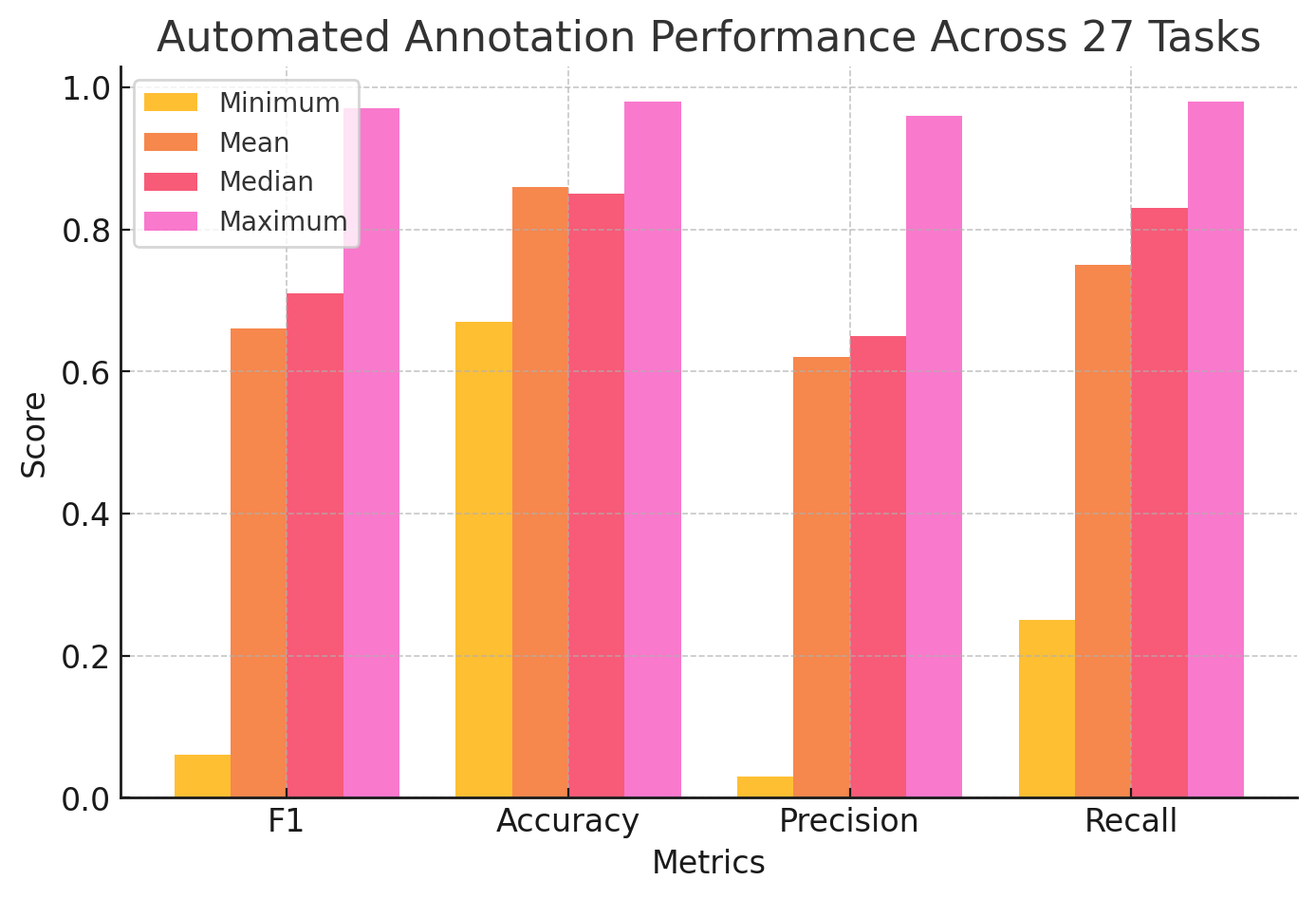 Key results from automated annotation performance using GPT-4 across 27 tasks (Pangakis & Wolken, 2024)
Think of GPT-4 as an incredibly efficient research assistant, it rapidly gathers information (high recall) but lacks the precision or contextual awareness to ensure its outputs always meet the required standard. For instance, an AI writing tool for a skincare brand might generate an enticing but misleading product description: "Erases wrinkles in just 24 hours!". Such overpromising can violate advertising laws, mislead consumers, and damage brand credibility.
Why Human Oversight Matters
AI-generated content is reshaping how businesses communicate, advertise, and engage with customers, offering unparalleled efficiency at scale. However, without human oversight, AI-driven mistakes can lead to serious consequences, eroding trust, damaging reputations, or even triggering legal issues. According to Accenture’s Life Trends 2025 report, 59.9% of consumers now doubt the authenticity of online content due to the rapid influx of AI-generated material (Accenture, 2024). This growing skepticism raises a critical question: How can businesses ensure that AI-generated content remains credible and trustworthy?
Meta has introduced AI-generated content labels across Facebook, Instagram, and Threads to help users distinguish AI-created images, signaling a growing recognition of the need for transparency in AI-generated content. But transparency alone isn’t enough — companies must go beyond AI disclaimers and actively build safeguards that ensure AI-generated content meets quality, ethical, and legal standards.
Human oversight plays a defining role in mitigating these risks. AI may generate content at scale, but it lacks real-world context, ethical reasoning, and the ability to understand regulatory nuances. Without human review, AI-generated errors can mislead customers, compromise accuracy in high-stakes areas, and introduce ethical concerns, such as AI-generated medical content suggesting treatments without considering patient history.
These risks aren’t theoretical; businesses across industries are already grappling with the challenge of balancing AI efficiency with trust. This is where Trust Calibration comes in, a structured approach to ensuring AI-generated content is reliable while maintaining the speed and scale that businesses need.
Trust Calibration: When to Trust AI and When to Step In
AI oversight shouldn’t slow down innovation; it should enable responsible progress. The key is determining when and how much human intervention is needed, based on the risk level, audience impact, and reliability of the AI model.
Organizations can implement Trust Calibration by categorizing AI-generated content based on its risk profile and defining oversight strategies accordingly:
- High-risk content (medical guidance, financial projections, legal analysis) requires detailed human review before publication.
- Moderate-risk content (marketing campaigns, AI-driven recommendations) benefits from automated checks with human validation for anomalies.
- Low-risk content (social media captions, images, alt text) can largely run on AI with periodic human audits.
Fine-tuning AI parameters, such as prompt engineering or temperature adjustments, modifying how deterministic or creative the AI's responses are by adjusting the probability distribution of generated words, can refine outputs, but research confirms these tweaks alone can’t eliminate fundamental AI limitations. AI models, especially those handling critical decision-making, must always have human oversight mechanisms in place.
However, knowing that oversight is needed isn’t enough, organizations must ensure practical implementation to prevent getting stuck in analysis paralysis, where excessive review slows down decision-making. Many organizations are therefore adopting AI monitoring dashboards to track precision, recall, and confidence scores in production, helping ensure AI reliability over time.
Use Cases: Areas Where AI Needs a Second Opinion
Understanding when and how to apply oversight is just as important as recognizing why it’s needed. The right approach depends on the specific AI application and its risk level. Here are four major areas where AI oversight is essential, along with strategies for effective implementation.
1. Content Moderation and Compliance
AI is widely used to filter inappropriate content on digital platforms, from social media to customer reviews. However, AI often misinterprets context, flagging harmless content as harmful or failing to catch actual violations.
How to build oversight:
- Use confidence scoring to classify content as low, medium, or high risk, escalating borderline cases to human moderators.
- Implement reinforcement learning feedback loops, allowing human corrections to continuously improve AI accuracy.
2. AI-Generated Product and Marketing Content
AI-powered tools generate product descriptions, ad copy, and branding materials, but they can overpromise or misrepresent features, leading to consumer trust issues and regulatory risks.
How to build oversight:
- Use fact-checking automation to flag exaggerated claims that don’t align with verified product specifications.
- Set confidence thresholds, requiring human review for AI-generated content making strong performance claims.
- Implement "guardrails" in the prompt design or model training to prevent unverifiable claims like "instant results," "guaranteed cure," or "proven to double sales."
3. AI-Powered Customer Support and Sentiment Analysis
Chatbots and sentiment analysis tools enhance customer interactions, but they can misinterpret tone, intent, or urgency, leading to poor user experiences.
How to build oversight:
- Implement escalation workflows, where the AI hands off low-confidence responses to human agents.
- Train AI models on annotated customer interactions, ensuring they learn from flagged conversations to improve future accuracy.
4. AI in Regulated Industries (Healthcare, Finance, Legal)
AI is increasingly used in medical diagnostics, financial risk assessments, and legal research, but errors in these domains can have serious real-world consequences.
How to build oversight:
- Require explainability tools so human reviewers can trace AI decision-making before acting on it.
- Maintain audit logs to track AI recommendations and human interventions.
- Set strict human-in-the-loop policies, ensuring AI assists but does not finalize high-risk decisions.
Before You Deploy AI, Check These Six Things
While Trust Calibration determines the level of oversight, organizations still need a structured AI evaluation process to ensure reliability before deployment.
| # | Step | key action | implementation strategy |
|---|---|---|---|
|
1 |
Define the objective and risks |
Identify AI’s purpose and impact |
What is the task? What happens if AI gets it wrong? |
|
2 |
Select the right model |
Match AI capabilities to the task |
Generative models for broad tasks, fine-tuned models for factual accuracy. |
|
3 |
Establish a human validation set |
Create a strong benchmark |
Use expert-labeled data to measure AI performance. |
|
4 |
Test performance |
Evaluate AI with real-world data |
Check precision, recall, and F1 score across varied scenarios. |
|
5 |
Implement oversight mechanisms |
Ensure reliability & transparency |
Use confidence scoring, explainability tools, and escalation workflows. |
|
6 |
Set deployment criteria |
Define go-live thresholds |
Establish minimum accuracy benchmarks and human oversight triggers. |
By embedding structured evaluation and oversight into AI deployment, organizations move beyond trial and error, ensuring AI is both efficient and trustworthy.
Final Thoughts
The question isn’t just “Can we trust AI?” It’s “How can we build AI that deserves our trust?”
AI should be a partner in decision-making, not an unchecked authority. Organizations that design AI oversight frameworks today will lead the industry in responsible AI adoption, ensuring innovation doesn’t come at the cost of accuracy, ethics, or consumer trust.
In the race toward AI-driven transformation, success won’t come from how fast we deploy AI; it will come from how responsibly we do it.
Published at DZone with permission of Richa Taldar. See the original article here.
Opinions expressed by DZone contributors are their own.
Comments