

The Headless Operations Engine: Solving Small-Business Friction With Enterprise Architecture Principles
An Enterprise Architect applies corporate design patterns (idempotency, temporal bounding) to a free-tier stack automating awkward small-business invoice reminders.
Join the DZone community and get the full member experience.
Join For FreeThe Micro-Enterprise Bottleneck: When Core Delivery Collides With Operations
The Business Case: The Friction of the "Comfort Gap"
I have three primary alter egos. Early in the mornings, I teach Spanish. Nothing fancy, just a simple, online session, focused on one student at a time, sharing and imparting what I learned and how I learned, to help them benefit from knowing Spanish as their second language. The rest of the day is spent in my Enterprise Architecture work — from consulting, to product development, to strategic solutions, and you know… all the standard corporate jargon. And then late at night, I imagine mysteries and write fiction.
All that is fine. But then one of the most awkward conversations I have to have occasionally is telling my student: “Hey, so… you’ve used 10 classes and only paid for 10 classes… physics dictates we cannot proceed without a renewal.” Awkward, right? One morning where I needed to have that exact conversation, I thought to myself, “Ha! Let me hire an operations manager to handle these. I just need to see the details on the Kanban board later.”
But then, I hit the budget committee. Ahem. Which was just me, looking at my own bank account. The committee quickly decided that hiring a manager for an ultra-small-scale business means I’d be working entirely to pay them, leaving me with Rs. 0 and a lot of regret.
The Solution Philosophy: Pragmatic Lifestyle Engineering
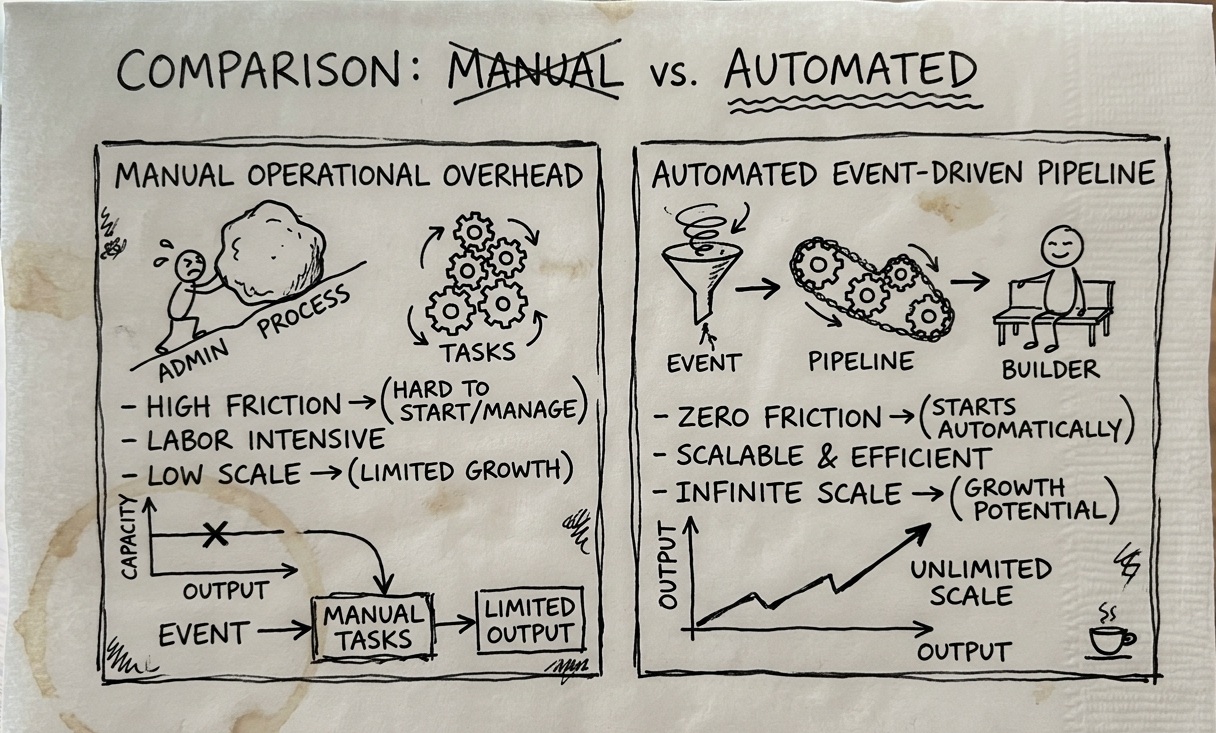
So, in real-world businesses, this is where they bring in an Enterprise Architect. I thought, “hey, that’s me!” I looked at the problem through an engineering lens and realized that manual administrative work is the technical debt of real life. If a system requires me to manually check a spreadsheet and manually make a reminder, then the system is broken! After all, why spend 10 minutes a week doing something manually, when you can spend an hour over the weekend, over-engineering a serverless cloud pipeline to do it for you — for free?
But how do you build an automated system that handles the “money talk” with the cold, polite neutrality of a machine, that ensures absolute accuracy so you don’t falsely accuse a student of not paying, and… runs with a grand total operating cost of exactly zero rupees?
Deconstructing the Solution: Three Core Architectural Pillars
First thing to consider in a multi-million-dollar platform is the core of the business problem. What pillars are going to hold up this house? It is the exact same way a structural architect might think before drawing a blueprint.
Decoupled State Management (The "Database" Illusion)
Let’s take the data storage layer first, because, well, there is data and it needs to be stored. In an enterprise, what would this be? Potentially an RDS instance or a distributed NoSQL cluster.
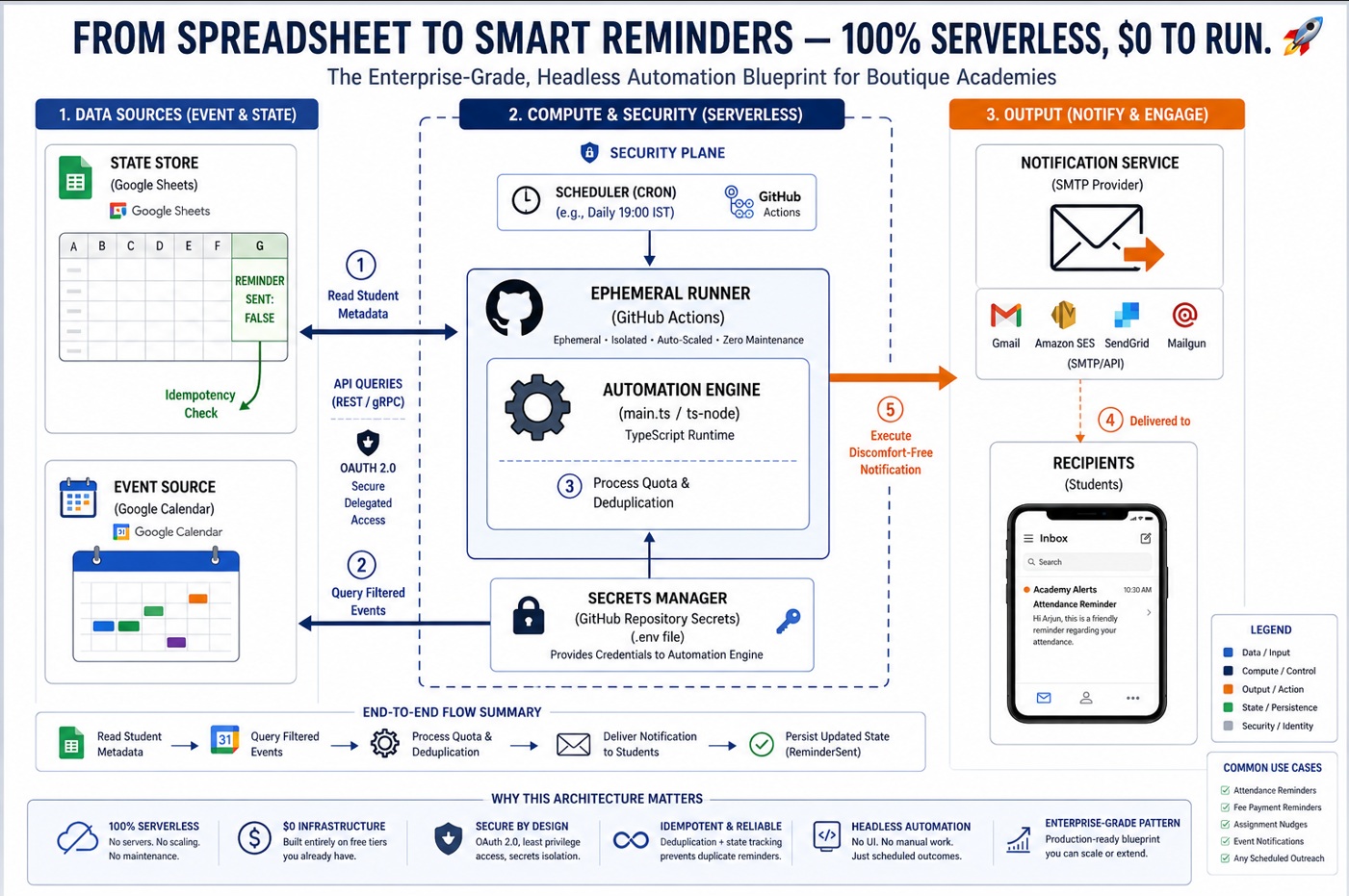
In the current use case, I found the perfect low-latency “read/write replica” for a non-technical admin interface. It is easily accessible on my phone, simple to update manually if and when required, and most importantly, it has zero hosting costs. What is it? It is an engineering sin that makes an architect shudder. It is Google Sheets. But don’t dismiss it as a glorified spreadsheet. Look at it pragmatically as a lightweight, highly available distributed state machine.
Strict Temporal Bounding (The Data Inflation Filter)
We solved the data and storage layer. Now let us look at a potential problem that could come up at this stage. Let us look at tracking this attendance event over time, correlating it to the problem statement at hand. Imagine if the code blindly counts every class a student has ever attended since day one; the data volume will burgeon, and the execution will come to a grinding halt. For all you know, the historic data can even corrupt my current cycle numbers.
To mitigate this, we introduce the pattern of setting a strict dynamic time window. The API needs to get hard boundaries based on the last transaction date. Now what if you have a recurring calendar invite? The second boundary that gets passed to the API then is the attendance data only up to the current millisecond. If this is not in place, then we are basically looking at a catastrophic data bug. If we don’t define the time array, a student who took a break three months ago might suddenly get an automated email screaming that they owe money for classes they took in some past life. We need accuracy, not a tracking crisis, remember?
Idempotency and State Gates (The "No Spam" Rule)
No one likes spam. That brings us to a crucial enterprise pattern — idempotency. What does it mean? Well, simply that no matter how many times a given operation is executed, the side effect is only applied once. I wish this were the case for medications that have side effects, but that is out of an enterprise architect’s scope.
What did I do here for this idempotency? A simple gate column in the spreadsheet with a binary value for ReminderSent. The engine strictly evaluates this Boolean flag before firing an email. Once the threshold is hit, and the email is sent, the pipeline instantly flips the state to True. Think of this as the safety valve. GitHub Actions runs this automatically every evening. Without this state gate, once a student’s package expires, my headless cron engine will politely, coldly, and relentlessly spam their inbox every single evening at 7 pm until they pay me or block my email address.
Building the Serverless, Zero-Cost Stack
Ok, enough of the talking; let us orchestrate the cloud ecosystem. Now, we are allowed to use only the free-tier resources. Ladies and gentlemen, put your hands together for the trio — Google Workspace APIs for data and logic, GitHub Actions, our ephemeral runtime environment, and Node Mailer over SMTP.
Accelerating Development via a Local AI Agent Stack
One of the biggest challenges we face as adults is context switching. I’d skip elaborating on that for all of our sanity. I built this stack without the additional burden of context switching by spinning up a local AI environment on my humble 8GB CPU on a basic home laptop running a Windows operating system. Just good old Ollama, the Continue extension in VS Code, and Gemma. The benefit of a local agent is that it allows an architect to quickly generate boilerplate code, test logic boundaries, and iterate without needing premium cloud tokens.
Engineering the Pipeline: Key Code Implementations
I chose TypeScript for the engine’s core implementation to leverage its strict typing system. When you are mapping dynamic spreadsheet cells to operational parameters, strict types are your first line of defense against runtime metadata errors, especially when handling complex student data structures.
Enforcing Temporal Boundaries in API Queries
If we look at the piece of code below, we see the strict temporal bounding pillar, which we spoke about earlier, in action. The date boundaries are dynamically calculated on the fly, with the student’s last payment date defining the lower bound and the exact current moment becoming the upper bound. This configuration payload is now handed over to the Google Calendar API query to extract only the relevant window of attendance events.
const res: any = await calendar.events.list({
  calendarId: process.env.GOOGLE_CALENDAR_ID,
  singleEvents: true,
  orderBy: "startTime",
  maxResults: 2500,
  pageToken,
  timeMin: lastPaymentDateISO, // Strictly drops anything before this timestamp
  timeMax: nowISO,             // Strictly drops anything in the future
});
By offloading this filter to the API gateway, we are protecting our serverless memory footprint and preventing legacy historical data from leaking into the current cycle calculations.
Mitigating Notification Spam via Idempotency Check Gates
After isolating the precise attendance window, the engine now evaluates the current state of the record. The logic gate is straightforward, but absolute at the same time.
- Gate A – The Quota Breach – Does the total number of attended classes meet or exceed the pair threshold?
- Gate B – The Idempotency Check – has a reminder already been dispatched for this specific cycle?
If and only if both gates evaluate to true, the communication layer fires up. The cold, polite notification goes out. And immediately, the engine executes a state synchronization back to the persistence layer.
const meetsQuotaLimit = currentLessonsCount >= s.classesPaidFor;
    const isReminderNotSentYet = !s.reminderSent;

    console.log(`↳ Quota Met (Count >= ${s.classesPaidFor}): ${meetsQuotaLimit} | Is Reminder Pending: ${isReminderNotSentYet}`);

    // Update Column H with the exact calculated count first
    await updateLessonsUsed(s.rowNumber, currentLessonsCount);

    if (meetsQuotaLimit && isReminderNotSentYet) {
      if (s.email) {
        // Step 4: Dispatch email notification message
        await sendEmail(s.email, s.student, currentLessonsCount, s.classesPaidFor);
        console.log(`↳ Outbound alert dispatched cleanly to ${s.email}`);

        // Step 5: Persist ReminderSent back to TRUE
        await updateReminderSentStatus(s.rowNumber, "TRUE");
        console.log(`↳ Spreadsheet statuses permanently updated to TRUE.`);
      } else {
        console.log(`⚠️ Email notice skipped: Student is missing an email address.`);
      }
    } else {
      console.log(`↳ Conditions not met. Sheet column counters updated, no emails dispatched.`);
    }
  }

  console.log("\nProcess finalized successfully!");
Infrastructure as a Service: The GitHub Actions Cron Engine
Great code is completely useless without an operational home. Since our core constraint when we started was an operational budget of exactly INR 0, spinning up a dedicated AWS EC2 instance or an Azure VM was entirely out of the question. That is where a knight in shining armor came to my rescue — GitHub Actions. This is not just any CI/CD tool; it serves as a highly capable serverless, headless execution environment.
Securing the Infrastructure Without an Enterprise Vault
You turn around and see the elephant in the room. Security. Let us address that then. To make this pipeline functional, the runner needs access to highly sensitive credentials. Let’s see — my Google Service Account private JSON keys, my personal SMTP email app passwords. In an enterprise, this would either be solved by pulling secrets dynamically from HashiCorp Vault or AWS Secrets Manager.
I achieved the exact same security boundary by injection-mapping these sensitive parameters directly into my execution runtime environment via GitHub Repository Secrets. This adheres strictly to one of the fundamental golden rules of software architecture: No secrets ever touch source control. So sorry, you won’t find a single credential sitting in my source repository.
Navigating Cloud Scheduler Nuances (The Asymmetric Minute Strategy)
I had this all set up and was waiting for the line to appear on the workflows tab of GitHub Actions that my job had run at exactly 7 pm that evening. But hey, what is engineering without a few infrastructure curveballs?
GitHub Actions handles both scheduled and manual workflows based on what is set up in your configuration. Now, this is a shared, multi-tenant free queue, and millions of developers configure their cron jobs to run at flat intervals like :00 or :30. This causes massive platform resource contention. The background event bus gets heavily backed up, leading to severe delays or entirely skipped jobs.
While I still haven’t learned how to bypass real-world traffic jams in Bangalore, fixing this cloud traffic jam was far easier in comparison. I deliberately shifted my cron pattern completely away from peak times to an asymmetric, off-peak minute (:33 or :37). This is one way to optimize reliability in shared cloud infrastructure. But mind you, it still won’t fire down to the exact second mentioned in your YAML file; shared platform queues will always have a slight propagation lag.
on:
  schedule:
    # Runs every day at 13:33 UTC, which corresponds to 7:03 PM IST (Indian Standard Time)
    - cron: '33 13 * * *'
  workflow_dispatch: # Allows you to also trigger it manually from the GitHub UI whenever you want
Conclusion: Reclaiming Creative Bandwidth Through System Design
Let us look at the ROI here, because isn’t that what the executives are most concerned about? I invested a weekend afternoon, working alongside a local AI agent stack, and built a production-grade automation engine. It completely eliminated a major source of personal and operational friction for me. It operates with absolute mathematical precision, and for me, the important part is that it has an ongoing operational maintenance cost of exactly INR 0.
Enterprise Architecture is not just a corporate discipline reserved for massive scaling clusters at big tech corporates. It is a systematic mindset — yes, mindset. By applying these exact design constraints — decoupling, temporal boundaries, and idempotencies - to our small personal workflows, we are protecting our most valuable non-renewable resource — our human creative bandwidth.
Let me ask you: how do you handle administrative friction or manual processes in your own side integrations or small-scale workflows? Would you prefer to see this system migrated to an edge-compute model like Cloudflare Workers, or evolved to hook directly into Meta’s WhatsApp Cloud API for notifications? Let me know in the comments below.
Opinions expressed by DZone contributors are their own.
Comments