
DZone
Thanks for visiting DZone today,
Edit Profile
  • Manage Email Subscriptions
  • How to Post to DZone
  • Article Submission Guidelines
Sign Out View Profile
  • Post an Article
  • Manage My Drafts
Newsletter
Log In / Join
Refcards Trend Reports
Events Video Library
Refcards
Trend Reports

Events

View Events Video Library

Related

  • Should Developers Switch From SQLite to DuckDB?
  • Adding Graph Retrieval to a RAG Pipeline With Python
  • PostgreSQL vs Oracle: When Higher Cost Means Better Performance
  • Catching Query Regressions Before Your Users Do

Trending

  • How to Submit a Post to DZone
  • Designing Memory Architecture for Stateful AI Agents: Short-Term Context and Long-Term Persistence
  • Part 4: Multi-Agent Orchestration — Pairing Goose With Quarkus Flow State Machines
  • Architecture Review Boards for Generative AI: A Framework for Governance, Risk Management, and Responsible Adoption

Draft This article hasn't been published, so readers can't see it.

In moderation This article is waiting for review, so readers can't see it yet.

Deleted This article has been deleted, so readers can't see it.

  1. DZone
  2. Data Engineering
  3. Databases
  4. How to Create a “Resolved By Me” Query In JIRA

How to Create a “Resolved By Me” Query In JIRA

Atlassian JIRA does not have a built-in query for all issues resolved by the current user. But it has a powerful query language that can be used to create one.

By 
Kunal Chowdhury
·
Dec. 08, 15 · Tutorial
Post on X (opens in a new tab) Share on LinkedIn (opens in a new tab)
8.5K Views

Join the DZone community Save articles, join the discussion, and download Refcards and Trend Reports with a free account.

Join for free Already a member? Log in

You might have been heard about the product JIRA. It is a bug tracking product, developed by Atlassian. It can be used as general "issue tracker", “new feature request tracker” and more, rather than solely a bug tracker. It’s more customizable than BugZilla and queries also can be modifiable.

 Today in this small blog post, we will learn how to create a query to list down all the issues “Resolved by” a particular user or you. Continue reading to know more about it.

How to create a “Resolved by me” query in #JIRA dashboard? (www.kunal-chowdhury.com)

In JIRA dashboard, you will not find any filter to find out all the issues resolved by you or a particular user. You will not find other options to change the filter too, but you can easily customize it by writing JQL (JIRA Query Language) in the filter bar. Let’s see how to write it.

Go to your JIRA dashboard and create a new filter. Click on the “Advanced” link as shown in the below screenshot:
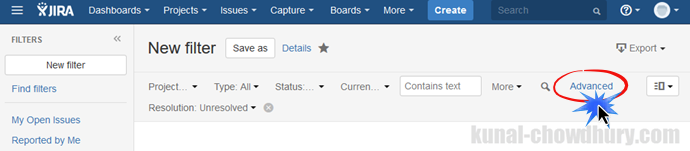
Custom filter creation in JIRA dashboard (www.kunal-chowdhury.com)

Now the default filter configuration panel will change to a free text entry box, where you can write the JIRA query (JQL) to filter out the issues or tasks. Here’s the query to list all issues resolved by the current logged-in user:

status in (Resolved, Closed, Reopened) AND status WAS "Resolved" BY currentUser()

Here is the screenshot of the same, which when run will list the issues resolved by currently logged-in user. The JIRA method “currentUser()” returns the current user details. You can also change it to specify any particular user.
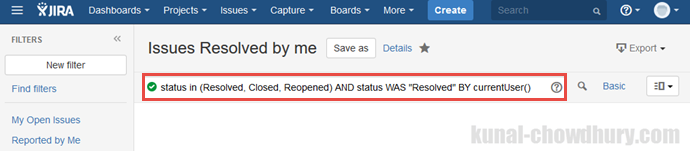
Custom filter in JIRA dashboard - Issues resolved by me (www.kunal-chowdhury.com)

 I hope that the post was clear and to the point. If you came to this site searching how to create this custom filter, don’t forget to drop a line below with your feedback about the same. Check out my other posts too. Connect with me over Twitter, Facebook, Google+ and subscribe to my feed to get all the updates that I share.

Database Jira (software)

Published at DZone with permission of Kunal Chowdhury. See the original article here.

Opinions expressed by DZone contributors are their own.

Related

  • Should Developers Switch From SQLite to DuckDB?
  • Adding Graph Retrieval to a RAG Pipeline With Python
  • PostgreSQL vs Oracle: When Higher Cost Means Better Performance
  • Catching Query Regressions Before Your Users Do

Partner Resources

×

Comments

Loading comments

The comments didn't load

Please try again in a moment.

Likes

Loading

The next likes didn't load. Please try again.

The likes didn't load

Please try again in a moment.

See who liked this

Log in or join DZone for free to see who liked this article.

Log in Join for free
  • RSS
  • X
  • Facebook

ABOUT US

  • About DZone
  • Support and feedback
  • Community research

ADVERTISE

  • Advertise with DZone

CONTRIBUTE ON DZONE

  • Article Submission Guidelines
  • Become a Contributor
  • Core Program
  • Visit the Writers' Zone

LEGAL

  • Terms of Service
  • Privacy Policy

CONTACT US

  • 3343 Perimeter Hill Drive
  • Suite 215
  • Nashville, TN 37211
  • [email protected]

Let's be friends:

  • RSS
  • X
  • Facebook