

Install oh-my-zsh on Windows
This tutorial is for Windows users who want to set up oh-my-zsh, an open source framework for managing your z shell, or ZSH, configuration.
I really like the oh-my-zsh shell setup. If you are using Linux or Mac, you can simply use these extensions, but on Windows, you should install some extra equipment.
Let's start.
I have decided to use pure mingw/msys instead of full cygwin:
choco install msys2-installerAs you can see I'm using chocolatey to maintain my windows packages.
After installing msys, you can simply open the msys terminal and upgrade all packages:
pacman -SyuuWe need some extra packages for installing oh-my-zsh:
pacman -Sy git curl zshThen you can run command for installing oh-my-zsh
sh -c "$(curl -fsSL https://raw.githubusercontent.com/robbyrussell/oh-my-zsh/master/tools/install.sh)"Once oh-my-zsh is installed we can finish setup. My mintty config file (~/.minttyrc):
BoldAsFont=no
Columns=100
Rows=35
Font=Lucida Console
FontHeight=10
ForegroundColour=208,208,208
BackgroundColour=28,28,28
CursorColour=255,175,0
IMECursorColour=128,224,160
Transparency=off
OpaqueWhenFocused=no
CursorType=line
CursorBlinks=yes
FontSmoothing=full
Locale=en_US
Charset=UTF-8
ScrollbackLines=99000
ScrollMod=shift
PgUpDnScroll=yes
CopyAsRTF=no
RightClickAction=paste
You can modify ~/.zshrc:
# If you come from bash you might have to change your $PATH.
# export PATH=$HOME/bin:/usr/local/bin:$PATH

# Path to your oh-my-zsh installation.
  export ZSH=/c/Users/michal.bocek/.oh-my-zsh

# Set name of the theme to load. Optionally, if you set this to "random"
# it'll load a random theme each time that oh-my-zsh is loaded.
# See https://github.com/robbyrussell/oh-my-zsh/wiki/Themes
ZSH_THEME="robbyrussell"

# Uncomment the following line to use case-sensitive completion.
# CASE_SENSITIVE="true"

# Uncomment the following line to use hyphen-insensitive completion. Case
# sensitive completion must be off. _ and - will be interchangeable.
# HYPHEN_INSENSITIVE="true"

# Uncomment the following line to disable bi-weekly auto-update checks.
# DISABLE_AUTO_UPDATE="true"

# Uncomment the following line to change how often to auto-update (in days).
# export UPDATE_ZSH_DAYS=13

# Uncomment the following line to disable colors in ls.
# DISABLE_LS_COLORS="true"

# Uncomment the following line to disable auto-setting terminal title.
# DISABLE_AUTO_TITLE="true"

# Uncomment the following line to enable command auto-correction.
#ENABLE_CORRECTION="true"

# Uncomment the following line to display red dots whilst waiting for completion.
COMPLETION_WAITING_DOTS="true"

# Uncomment the following line if you want to disable marking untracked files
# under VCS as dirty. This makes repository status check for large repositories
# much, much faster.
DISABLE_UNTRACKED_FILES_DIRTY="true"

# Uncomment the following line if you want to change the command execution time
# stamp shown in the history command output.
# The optional three formats: "mm/dd/yyyy"|"dd.mm.yyyy"|"yyyy-mm-dd"
# HIST_STAMPS="mm/dd/yyyy"

# Would you like to use another custom folder than $ZSH/custom?
# ZSH_CUSTOM=/path/to/new-custom-folder

# Which plugins would you like to load? (plugins can be found in ~/.oh-my-zsh/plugins/*)
# Custom plugins may be added to ~/.oh-my-zsh/custom/plugins/
# Example format: plugins=(rails git textmate ruby lighthouse)
# Add wisely, as too many plugins slow down shell startup.
plugins=(git docker docker-compose mvn svn vagrant)

source $ZSH/oh-my-zsh.sh

# User configuration

# export MANPATH="/usr/local/man:$MANPATH"

# You may need to manually set your language environment
# export LANG=en_US.UTF-8

# Preferred editor for local and remote sessions
# if [[ -n $SSH_CONNECTION ]]; then
#   export EDITOR='vim'
# else
#   export EDITOR='mvim'
# fi

# Compilation flags
# export ARCHFLAGS="-arch x86_64"

# ssh
# export SSH_KEY_PATH="~/.ssh/rsa_id"

# Set personal aliases, overriding those provided by oh-my-zsh libs,
# plugins, and themes. Aliases can be placed here, though oh-my-zsh
# users are encouraged to define aliases within the ZSH_CUSTOM folder.
# For a full list of active aliases, run `alias`.
#
# Example aliases
# alias zshconfig="mate ~/.zshrc"
# alias ohmyzsh="mate ~/.oh-my-zsh"
export PROMPT_EOL_MARK=""
And the last step is creating a conemu task:
# task parameters
/icon "C:\msys64\usr\bin\mintty.exe" /dir "%userprofile%/Documents/sources"
# command
set CHERE_INVOKING=1 & set MSYSTEM=MSYS & set MSYS2_PATH_TYPE=inherit & set SHELL=/bin/zsh & C:\msys64\usr\bin\mintty.exe - "-new_console:t:Console"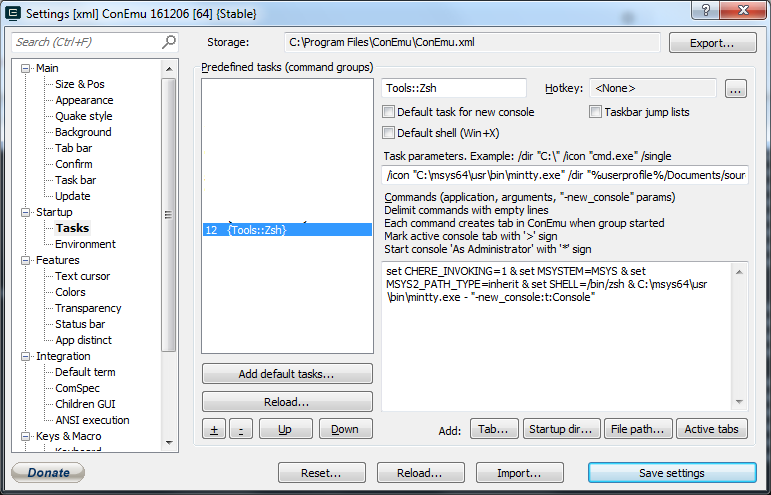
Opinions expressed by DZone contributors are their own.