

Designing a Local-First Risk Detection Pipeline for Explainable Enterprise Decisions
Combining deterministic checks, lightweight models, trusted evidence, transparent decision policy, and replayable audit records in local-first risk workflows.
 ·
·
Join the DZone community and get the full member experience.
Join For FreeEnterprise risk problems often start as data-platform issues. Challenges include fragmented signals, inconsistent definitions, missing context, weak lineage, and untimely alerts. Whether evaluating transactions, support messages, images, or metrics, the main question is: how can we turn imperfect evidence into explainable, defensible decisions?
Observations from a hackathon revealed recurring design pressures in digital safety projects. Local language and context significantly influenced outcomes. Network access was often unreliable. No single detector proved sufficient. Risk scores without clear justifications were challenging to interpret. Although not a universal solution, these insights support a practical guideline: maintain decision paths that are local, modular, and auditable.
A local-first pipeline complements cloud tools. It ensures workflows keep running when connectivity or data quality falters. Local rules, cached references, lightweight inference, and clear logs operate near the data. Cloud resources can add value for deeper analysis, large-scale training, or periodic updates as conditions allow.
The Five-Layer Architecture
The design uses five distinct layers. Start in a single process, and split into services if needed. Clear boundaries matter more than deployment details — they stop complex scores from hiding supporting evidence.
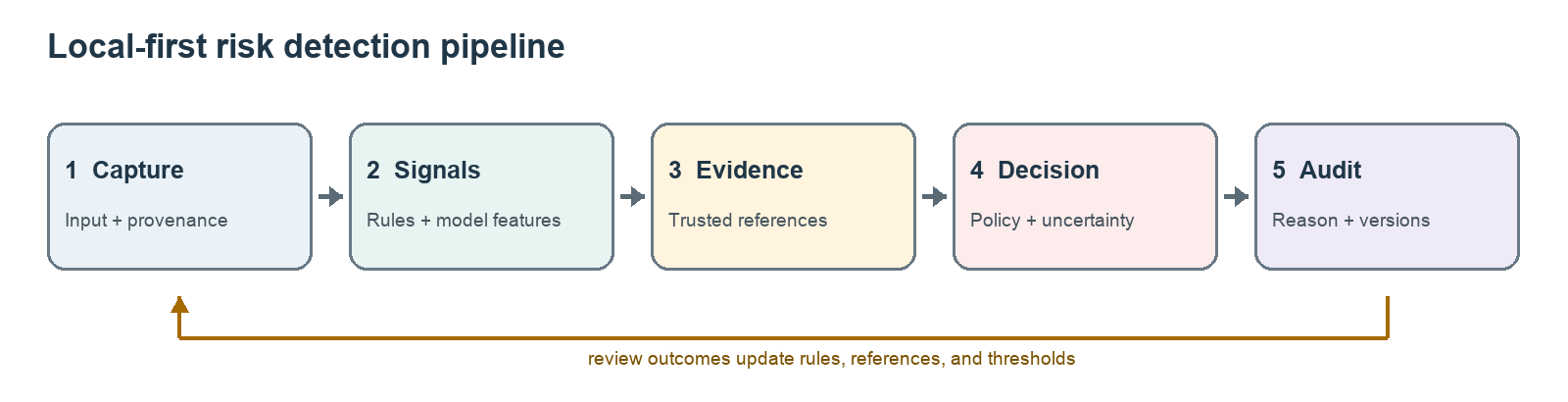
Figure 1. A local decision path with an explicit feedback loop
- Capture and provenance: Accept input with minimal assumptions. Record source, timestamp, ownership, consent or policy status, and a stable reference to the original material.
- Signal extraction: Derive typed signals using deterministic rules, metadata, statistics, feature extraction, business keys, and context windows. Each signal must have a definition and version.
- Trusted evidence: Compare signals to approved policies, verified sources, business definitions, risk patterns, and relevant incidents. Document what was retrieved and when.
- Policy decision: Apply validated thresholds, firm constraints, uncertainty checks, and escalation rules. Policy, not the model, chooses actions.
- Explanation and audit: Return the action with reason codes, supporting signals, evidence references, component versions, and decision time. Make review outcomes feedback that improves the workflow.
Do Not Average Severe Signals by Default
A scoring formula can hide risk even when every detector behaves as designed. Suppose five modules produce scores of 85, 12, 8, 5, and 0. Their simple average is 22. If the 85 came from a mandatory policy violation, averaging has transformed a severe signal into a low-looking result. That is a policy-design error, not a model error.
A max-plus-corroboration approach keeps the strongest calibrated signal as the base, adds a bounded increment when independent modules agree, and applies policy overrides. This method is a useful starting point. Scores may not be comparable, detectors can double-count, and thresholds must be validated per workflow.
base = max(calibrated_scores)

corroboration = bonus * max(0, independent_active_modules - 1)

overall = min(100, base + min(corroboration, bonus_cap))
For instance, with a base score of 85, a corroborating module, and a bonus of 3 (capped at 6), the combined score becomes 88. Retain individual scores for review; reviewers must know if 88 signals one strong flag plus corroboration or several moderate ones.
Make Failure Handling Part of the Decision
Local-first systems will encounter missing evidence, stale caches, unavailable models, and queue backlogs. These conditions should not be converted into false certainty. The decision contract needs explicit outcomes such as allow, review, request evidence, block, and abstain. The following pseudocode shows the control flow rather than prescribing a particular technology stack.
def assess(item, context):
    captured = capture_with_provenance(item, context)
    signals = run_rules_and_local_model(captured)
    evidence = retrieve_approved_evidence(signals, allow_stale=False)

    if signals.mandatory_rule_triggered:
        action = REVIEW_OR_BLOCK
    elif evidence.missing or signals.model_failed:
        action = ABSTAIN_OR_REQUEST_EVIDENCE
    else:
        action = apply_versioned_policy(signals, evidence)

    write_decision_record(captured, signals, evidence, action)
    enqueue_optional_cloud_analysis(captured.reference)
return action
The key choice is not between Python and Java, or between batch and streaming. It is that each failure state is visible and policy-controlled. An unavailable retrieval service should not quietly become an empty evidence set, and a timed-out model should not be treated as a zero-risk score.
Rules, Models, and Evidence Have Different Jobs
Rules Define Organizational Constraints
Rules are useful when the organization can name the failure mode: a forbidden export, an invalid metric join, a known scam pattern, or a compliance-sensitive combination of fields. They are fast, testable, and explainable, but they do not generalize well to new tactics or paraphrases.
Models Capture Distributed Patterns
Models help when risk is spread across many weak signals. A small logistic regression model, a gradient-boosted tree, or an embedding-similarity baseline may be easier to monitor locally than a much larger model. The right question is whether it improves the operational decision at an acceptable error rate and cost — not whether it is the newest model.
Evidence Turns Detection Into Verification
Detection says that something appears suspicious. Verification connects that suspicion to an approved source, a policy clause, a known-good example, a business definition, or a prior incident. Retrieval and relationship-aware context can help, but only if the system records the evidence identifier, version, retrieval time, and freshness status.
Keep a Replayable Decision Record
A final label is insufficient for incident review. Records must document what the pipeline processed, the components executed, and the policy invoked. Minimal representations support replay while staying small.
{

"input_ref": "sha256:...",

"event_time": "2026-06-24T14:30:00Z",

"signals": [{"id": "rule-17", "value": true, "version": "3.2"}],

"evidence": [{"id": "policy-42", "version": "2026-05-01"}],

"model": {"id": "risk-local", "version": "1.4", "score": 0.71},

"policy": {"version": "2.1", "threshold": 0.68},

"action": "review",

"reasons": ["mandatory_rule", "model_threshold"]

}
Sensitive data should be minimized, access-controlled, and retained only as long as required by policy. Replayability does not mean copying every raw input into every log. Stable references, hashes, redacted features, and protected evidence stores are often safer.
What to Measure
Offline model accuracy provides value, but it does not capture the entire workflow. The following measures should be reviewed by relevant domain, language, geography, product, or business unit, provided such segmentation is lawful and operationally meaningful:
- Precision of escalations: What proportion of reviewed high-risk flags required action?
- Recall against confirmed incidents: How many known failures did the pipeline miss?
- Safe-control pass rate: Does ordinary benign activity continue without unnecessary friction?
- Calibration and threshold stability: Do estimated likelihoods and action thresholds remain reliable on current data?
- Reviewer agreement and explanation usefulness: Can reviewers understand the reasons and reach consistent dispositions?
- Time to resolve action: How long does the workflow take from signal arrival to a completed response?
- Replayability and cost: Can a past decision be reconstructed, and what infrastructure and review effort did a resolved case consume?
Use labels from confirmed outcomes and documented reviewer actions — not previous model outputs. Review thresholds whenever data, policy, model, evidence, or review capacity changes.
Operational Checklist
- Version every rule, model, prompt, retrieval index, and decision policy.
- Store the final action together with the signals and evidence that supported it.
- Test missing-input, model-timeout, stale-evidence, and queue-backlog paths.
- Separate false positives from false negatives and connect both to business cost.
- Avoid a universal threshold when workflows have different severity and review capacity.
- Keep safe-control cases in evaluation; a system that blocks everything is not useful.
- Design the human escalation and override path before enabling automated enforcement.
Limitations and Boundaries
This architecture is a design pattern, not a validated performance claim. Rules can encode brittle or biased assumptions. Models and calibration can drift. Cached references can become incomplete or stale. Multiple detectors may share the same underlying evidence and appear more independent than they are. Human reviewers can disagree, and local storage creates obligations regarding updates, privacy, and security. A local-first pipeline should therefore be evaluated against simpler baselines — such as rules-only or model-only — and should gradually earn automation authority through documented results.
Closing
The practical lesson from constrained risk workflows is not that every team needs another large model. The decision path should remain inspectable when data, connectivity, or individual components fail. Keep rules, learned signals, evidence, policy, and audit records separate enough to test each in isolation. Preserve severe signals without pretending that one heuristic fits every domain. Most importantly, store enough context to explain and revisit the action. A model produces a prediction; an engineered pipeline turns evidence into a decision with an accountable owner.
Opinions expressed by DZone contributors are their own.
Comments