

Matter vs. Thread - A Head-to-Head Comparison!
Learn about Matter and Thread, two powerful communication protocols for IoT devices. Discover their differences and benefits for smart home ecosystems.
Join the DZone community and get the full member experience.
Join For FreeModern technology has made communication easier than ever before. From smartphones to other smart devices, we can use a single gadget to accomplish a lot. However, have you ever wondered what makes it all possible? It's the microscopic chip circuits supported by powerful protocols and standards.
Over the past two decades, the technology industry has revolutionized the way we see the world. Today, we use IoT devices that can communicate not only with us but also with other smart devices. This is all thanks to the continuous improvement of communication and networking protocols such as WiFi, Ethernet, Matter, Thread, etc.
WiFi and Ethernet are well-known technologies, but you may be wondering about Matter and Thread. This article will explain everything about Matter, Thread, and their differences.
What Is Matter?
Matter is a protocol that helps developers build powerful and easy-to-use apps and smart devices. With a plethora of smart home ecosystems like Google Home, Amazon Alexa, Apple Home Kit, etc., there are dedicated devices for each of them. This is where Matter comes in.
Matter ensures that users don't have to worry about finding exactly compatible devices with their IoT ecosystem. It establishes interoperability between devices of various brand IoT ecosystems. Therefore, if you are buying a new smart door lock for your home, you only need to check if it has the Matter-compatible logo.
Matter has various other features, such as:
- Best-in-class security features like AES encryption, SHA-256 cryptographic algorithm, Zero Trust, and Security by-design protocols
- Sits on the application layer and utilizes IPV6 and UDP protocol
- Superb privacy feature that deals with minimal data exchange
- Supported by Thread protocol, Matter is a power-efficient standard
- Matter is open-source and maintained by the Connectivity Standards Alliance, formerly ZigBee Alliance.
Working of the Matter Protocol
The working of the Matter protocol can be divided into two sections: the Matter network with WiFi and Ethernet and the network where Thread protocol is used.
The Matter network with WiFi and Ethernet communicates with the local network and the cloud. These communications happen over a high-bandwidth link and require an internet connection at all times.
On the other hand, the Matter network where Thread is used is a low-bandwidth network. The devices in this network are all inside the home and run on low power. The communication of these devices with the central hub happens through a Border Router that is directly linked to the high-bandwidth network.
What Is Thread?
Thread is a protocol that operates at a lower bandwidth. All devices communicate with each other via IP addresses and form a part of the IEEE 802.15.4-2006 wireless mesh network.
Thread excels over other 802.15 mesh networking protocols with the following features and benefits:
- Energy-efficient protocol
- Devices in the mesh network can sleep, saving a lot of power
- Internet addressable devices do not need to transmit data to the central hub first
- A self-healing network that does not fail
- Scalable device network with an easy installation process
- Thread is used to work in the 2.5 GHz global frequency band
- The range of the Thread network device is 20-30 meters
- Thread uses AES-128 and password-backed authentication with Datagram Transport Layer Security (DTLS) to ensure a secure connection between devices.
Working of Thread Protocol
In a Thread network, devices are connected to each other directly via an IP address. Whenever data transfer happens, it happens directly via the connected nodes. Instead of sending data to the central hub, it is shared with the neighboring node to reach the border router. The border router is a device node that is connected to the central hub. Every piece of data from the Thread mesh network goes through the border router.
The border router is a device node that is connected to the central hub. Every piece of data from the Thread mesh network goes through the border router. The cool thing is there is no fixed device that can be a border router. Any device can be a border router that clearly supports the self-healing feature of the network.
Matter vs. Thread
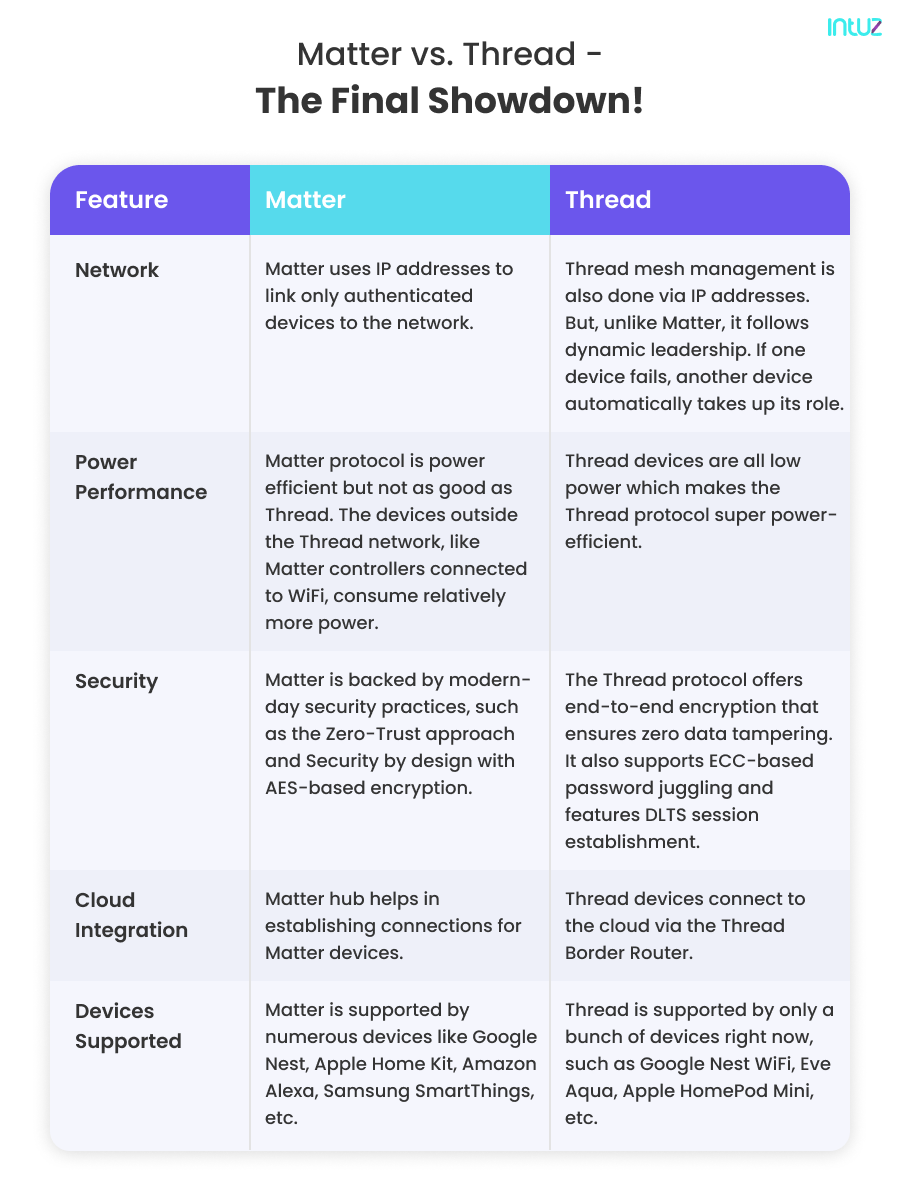
Both Matter and Thread are exceptional technologies, but Matter relies on Thread. As Thread devices eliminate the need to visit the application layer for the Matter devices, it serves as an indispensable element of the Matter network. Not to forget its relevant benefits, like power-efficiency self-healing.
Here are some chief differences between the two!
Conclusion
So, Matter and Thread are two revolutionary technologies that have the power to transform your smart home ecosystem. You don't have to worry about their compatibility or power consumption. These protocols ensure that your overall connected home experience is lovable.
Opinions expressed by DZone contributors are their own.
Comments