

Monolith vs Microservices vs Modulith
Monolithic and microservices architecture have been widely adopted, while modulithic architecture has been gaining traction. Learn about their differences and benefits.
Join the DZone community and get the full member experience.
Join For FreeIntroduction
The software industry has embraced various architectural patterns, including monolithic and microservices architecture, to address business use cases effectively. In recent years, modulith architecture adoption has gained traction, although a version of this approach has already been utilized in many enterprises.
Figure 1 illustrates the evolution of architecture patterns over time. The transition began with monolithic applications. However, as monolithic applications became increasingly resistant to change and challenging to manage, enterprises transitioned to microservices architecture. Over time, the growing number of microservices introduced complexities in management, prompting enterprises to adopt modulith architecture, which offers a balanced approach between monoliths and microservices.
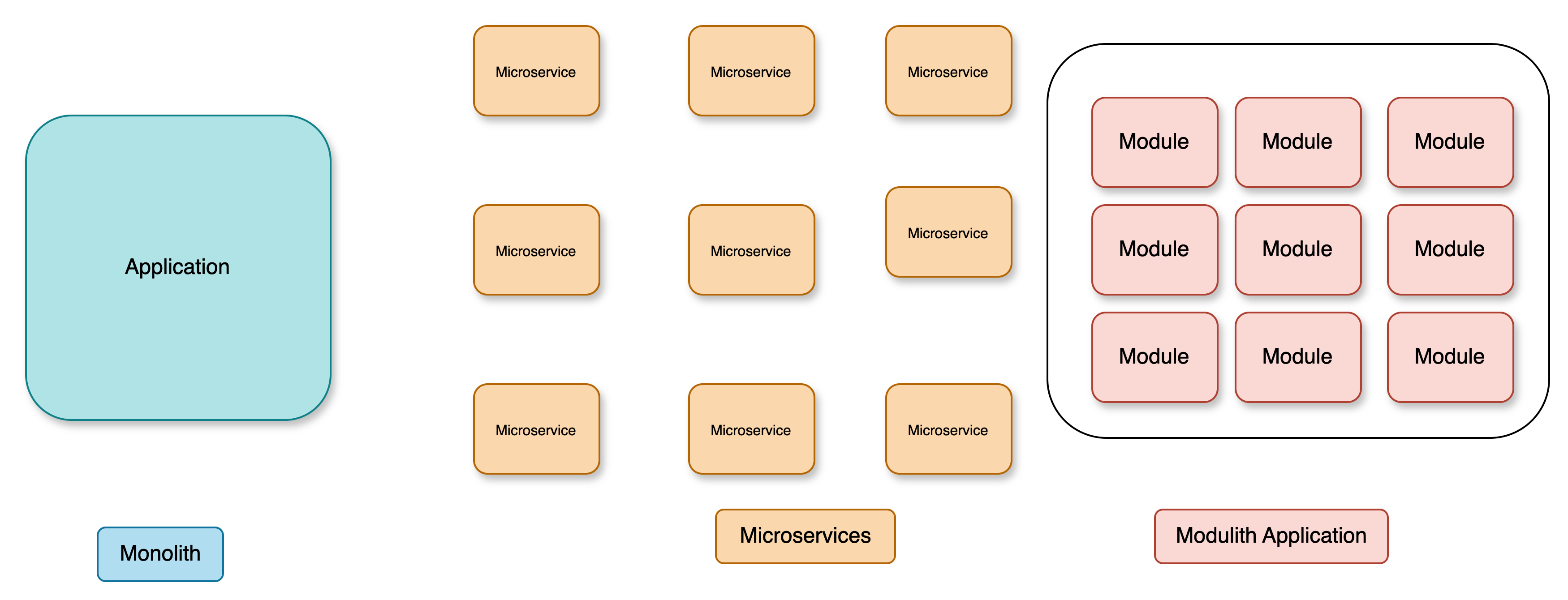
Monolith Application
Monolithic applications have been a cornerstone of software development since their early days, gaining significant traction with the rise of web applications in the 2000s. These applications were predominantly built using J2EE standards, PHP, or .NET, and many custom solutions and products were developed around this architecture. Over time, as monolithic applications grew in complexity, they accumulated vast amounts of code, eventually becoming resistant to changes and adaptations.
As businesses expanded and the criticality of their applications increased, monolithic applications also grew in size and complexity. Over time, maintaining these monolithic applications became increasingly difficult, and upgrading them posed significant challenges.
Advantages and Disadvantages of Monolith Application
| Advantages |
Disadvantages |
| Single code base makes it easy to build and deploy. |
Tight coupling of logic within the monolithic application makes it difficult to implement changes. |
| Local setup to test multiple modules or use cases can be easier. |
Testing becomes challenging as the application grows, especially unit and integration testing. |
| Communication between modules is faster, as there is no overhead of invoking modules over the network. |
Scaling a monolithic application is usually challenging; vertical scaling can be achieved, whereas horizontal scaling presents difficulties. |
| Framework is well-suited for small applications. |
Adopting new versions of programming languages or new technologies can be challenging. |
In response, enterprises began transitioning to microservices architecture (MSA).
Microservices Architecture (MSA)
Martin Flower and James Lewis define Microservice Architectural style as an approach to developing a single application as a suite of components or small services called microservices, each one running on its own process and communicating with lightweight mechanisms (e.g., HTTP APIs). The main aim of MSA is to obtain a high degree of flexibility, modularity, evolution, and adoption. The past decade has witnessed a surge in the adoption of MSA, driven by its key advantages, such as enhanced scalability and reliability, making it a preferred choice for modern software development.
Advantages and Disadvantages of Microservices Architecture
|
Advantages |
Disadvantages |
|
It is highly flexible, reliable, and scalable. |
Data consistency between services becomes an issue. |
|
It enhances developer productivity and helps to incorporate better testing practices, like unit and integration testing. |
Operational complexity increases with the number of services. |
|
It allows horizontal and vertical scaling and fosters faster time to market. |
Network overhead grows as services constantly communicate. |
|
As each service is developed as an independent unit, there is flexibility in choosing the technology for developing these services. |
DevOps & Observability complexity increases with the number of services. |
Modulith Architecture
Modulith architecture serves as a middle ground between monolithic and microservices architectures. Designing a modulith application involves identifying and clearly defining the purpose of each module. Each module should operate as an independent entity with defined functions, inputs, outputs, and standalone testing capabilities. This approach facilitates the seamless detachment of a module as an independent microservice when required.
Advantages and Disadvantages of Modulith Architecture
|
Advantages |
Disadvantages |
|
|
Maintaining modular boundaries can be challenging. |
|
simplifies testing. |
The entire application must be scaled if one module experiences high traffic. |
| It offers benefits such as simplified network infrastructure, streamlined observability processes, and minimized operational and DevOps challenges. |
Managing dependencies between modules can be complex. |
|
It is easier to transition to microservices. |
Deciding when to detach a module as a separate service can be difficult. |
Aligns with Domain-Driven Design. |
A fatal error in one module can potentially bring down the entire application. |
Conclusion
The industry has experienced both the advantages and disadvantages of various architecture patterns. When implemented and maintained correctly, these patterns can help design stable and robust applications. However, the decision to adopt a specific architecture should not be driven by trends, but rather by the application's business use case, complexity, and potential for growth. For example, a small or medium-sized application may still benefit from a monolithic framework, avoiding the complexities of a distributed microservices architecture. The design should be flexible enough to transition to a different framework when necessary, without requiring a complete rewrite of the application.
Opinions expressed by DZone contributors are their own.
Comments