

The Context Window Trap: Why More Context Doesn’t Mean Better AI
More context can create more noise, cost, and confusion. AI systems perform better when they retrieve, rank, and prioritize relevant information.
Join the DZone community and get the full member experience.
Join For FreeWhen model providers announced 1-million-token and multi-million-token context windows, the software engineering world celebrated. The immediate narrative was simple and appealing: document chunking is dead, complex RAG pipelines are obsolete, and developers can now dump entire codebases, legal libraries, or multi-year enterprise datasets into a single model call. This breakthrough led engineering teams into a new trap: assuming that a model's capacity to accept context equals its ability to reason effectively over that context.
In production, relying on massive context windows as a substitute for intelligent information retrieval leads to severe performance degradation, runaway infrastructure bills, and unpredictable hallucinations.
Operating large-scale LLM architectures taught me a hard truth: A larger context window gives a model more surface area to get confused. Before you expand your context length, you must optimize your context quality.
The Hidden Trap: "Needle in a Haystack" and Attention Degradation
In traditional database systems, doubling the size of a query payload doesn't degrade the accuracy of the returned records. Relational algebra operates on exact logic.
Large language models do not query data; they process spatial attention. As prompt lengths scale into hundreds of thousands of tokens, the self-attention mechanisms inside the transformer architecture begin to struggle. Key information buried deep in the middle of a massive prompt often suffers from "Lost in the Middle" syndrome, where the model strongly attends to tokens at the very beginning and very end of the prompt while ignoring crucial details placed in between.
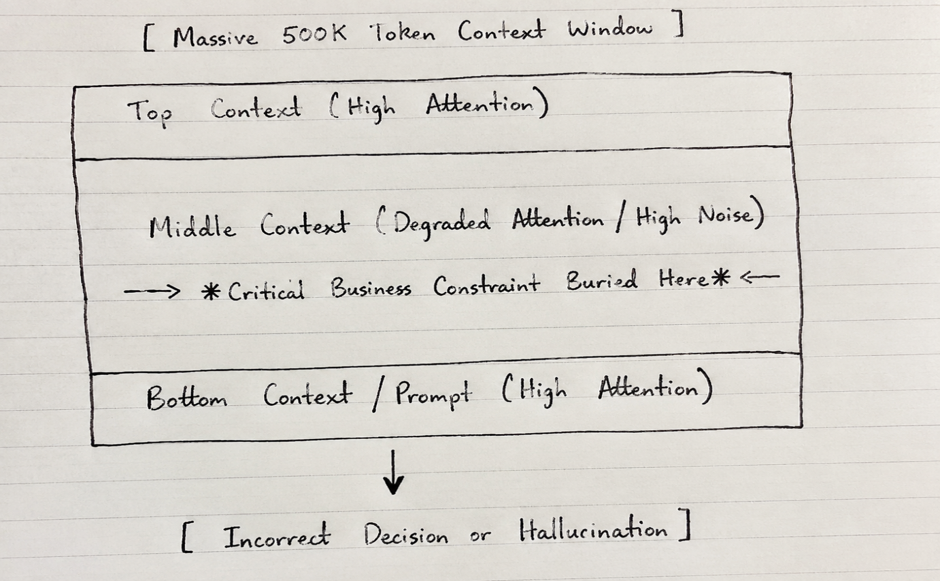
Diagram of Attention Degradation in Large Context Windows
When an application fails under a massive context window, the model rarely throws an error. Instead, it silently ignores conflicting constraints, merges unrelated concepts, or produces plausible-sounding responses derived from irrelevant sections of your input.
Step 1: Measure Prompt Noise-to-Signal Ratio
In simple LLM integrations, teams measure throughput and token count. When scaling large-context applications, you must measure context density, the proportion of tokens directly relevant to the user's intent versus the filler text passed into the prompt.
During a recent enterprise project, I built a utility to compute contextual relevance scores before submitting payloads to ultra-long context models:
import logging
from typing import List

logger = logging.getLogger("ContextOptimizer")

class ContextDensityAnalyzer:
    def __init__(self, key_terms: List[str]):
        self.key_terms = [term.lower() for term in key_terms]

    def analyze_density(self, document_text: str) -> dict:
        total_words = len(document_text.split())
        if total_words == 0:
            return {"density_score": 0.0, "total_words": 0}

        # Calculate frequency of target domain terms in payload
        matched_terms = sum(
            document_text.lower().count(term) for term in self.key_terms
        )
        density_score = round(matched_terms / total_words, 4)

        logger.info(f"Analyzed {total_words} words. Context Density: {density_score}")

        return {
            "density_score": density_score,
            "total_words": total_words,
            "status": "PASS" if density_score > 0.015 else "HIGH_NOISE"
        }

# Example Usage
analyzer = ContextDensityAnalyzer(key_terms=["quarterly revenue", "compliance", "EBITDA"])
payload = "..." # Large retrieved document payload
metrics = analyzer.analyze_density(payload)
By filtering out low-density documents prior to prompt assembly, I reduced token volume by 65% while simultaneously increasing precision on factual extraction tasks.
Step 2: The Latency Penalty of Quadratic and Pre-Fill Processing
In standard REST APIs, payload size marginally impacts network transport time. In transformer architectures, processing large context windows introduces a massive latency penalty during the pre-fill phase (time-to-first-token).
While time-to-first-token (TTFT) for a 4K token prompt might take 300 milliseconds, pre-filling a 200K token prompt can take 8 to 15 seconds before the model generates a single word.
import time

def evaluate_prefill_latency(client, model: str, context_text: str, user_query: str):
    full_prompt = f"Context:\n{context_text}\n\nQuestion: {user_query}"

    start_time = time.time()

    # Measure time to first token
    response_stream = client.chat.completions.create(
        model=model,
        messages=[{"role": "user", "content": full_prompt}],
        stream=True
    )

    ttft = None
    for chunk in response_stream:
        if chunk.choices[0].delta.content:
            ttft = time.time() - start_time
            break # Captured Time-To-First-Token

    logger.info(f"Model: {model} | TTFT: {ttft:.2f} seconds")
    return ttft
If your application requires real-time user engagement (such as customer support or interactive co-pilots), high TTFT caused by bloated context windows will ruin the user experience long before the model finishes its output.
Step 3: Compare Cost-to-Accuracy Across Context Tiers
Passing massive amounts of unstructured text into a model for every query creates an exponential cost structure. What engineering teams miss is that the relationship between context length and accuracy is non-linear: doubling the context window doubles the cost but rarely doubles accuracy.
|
Strategy |
Token Load |
Avg Latency (TTFT) |
Accuracy Rate |
Relative Cost |
|
Naive Context Dump |
128,000+ tokens |
~6.5 seconds |
72% (Lost in Middle) |
10x Baseline |
|
Hybrid RAG + Reranking |
8,000 tokens |
~0.8 seconds |
91% (High Precision) |
1x Baseline |
|
Hierarchical Summarization |
16,000 tokens |
~1.4 seconds |
86% (Broad Context) |
2x Baseline |
Table of Performance Comparison Across Context Optimization Strategies
Optimizing for cost requires evaluating whether structured pre-retrieval (like semantic search paired with cross-encoder reranking) produces a better result at a fraction of the token cost.
Step 4: Hybrid Architecture: Context Windows + Precision RAG
The most resilient enterprise AI systems don't choose between large context windows and RAG; they use large context windows inside a structured retrieval architecture.
Instead of dumping an entire database into the model, use vector retrieval and reranking to select the top relevant passages, and leverage the expanded context window exclusively to hold multi-turn conversation history and rich system instruction contracts.
def assemble_intelligent_context(user_query: str, vector_db, reranker) -> str:
    # Step 1: Broad retrieval
    raw_docs = vector_db.similarity_search(user_query, k=25)

    # Step 2: Rerank to extract dense, high-signal passages
    ranked_docs = reranker.rank(query=user_query, documents=raw_docs, top_n=5)

    # Step 3: Assemble compact, structured context
    structured_context = "\n---\n".join([doc.page_content for doc in ranked_ranked_docs])

    return f"RELEVANT CONTEXT:\n{structured_context}\n\nUSER QUERY: {user_query}"
This hybrid approach ensures that the context window is populated only with dense, actionable information, preventing attention degradation and keeping latency low.
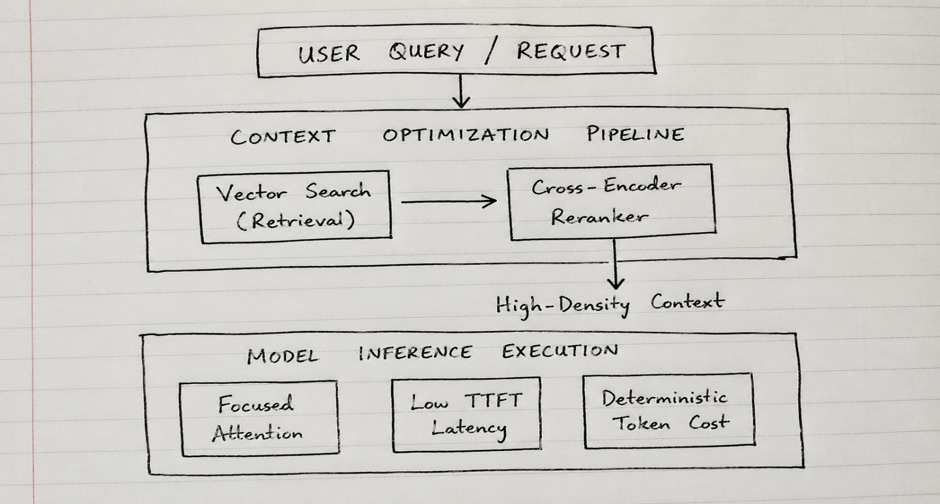
Diagram of a Context Optimization Pipeline for LLM Inference
Context Quality as the Engine for Enterprise AI Scalability
The AI industry will continue pushing context limits from millions to tens of millions of tokens. But raw capacity is an infrastructure feature, not an architecture strategy.
Relying on massive context windows as a crutch for poor data pipeline design is the modern equivalent of storing an entire relational database in server memory because you don't want to build indexes.
Before you scale up your context window size, invest in context quality, intelligent chunking, and strict relevance filtering. When you feed your models high-density, low-noise prompts, you don't just get cheaper and faster applications; you build a system that executes predictably at scale.
Conclusion
Bigger context windows are an impressive engineering feat, but they are not a silver bullet for enterprise AI systems. As context size expands, the trade-offs in attention accuracy, latency, and operational cost become impossible to ignore. Real enterprise performance isn't achieved by seeing how much data a model can swallow in a single request; it is achieved by engineering precise, high-density context pipelines that deliver the exact right information at the right time. True intelligence in production starts with discipline, not volume.
Opinions expressed by DZone contributors are their own.
Comments